Quick answer
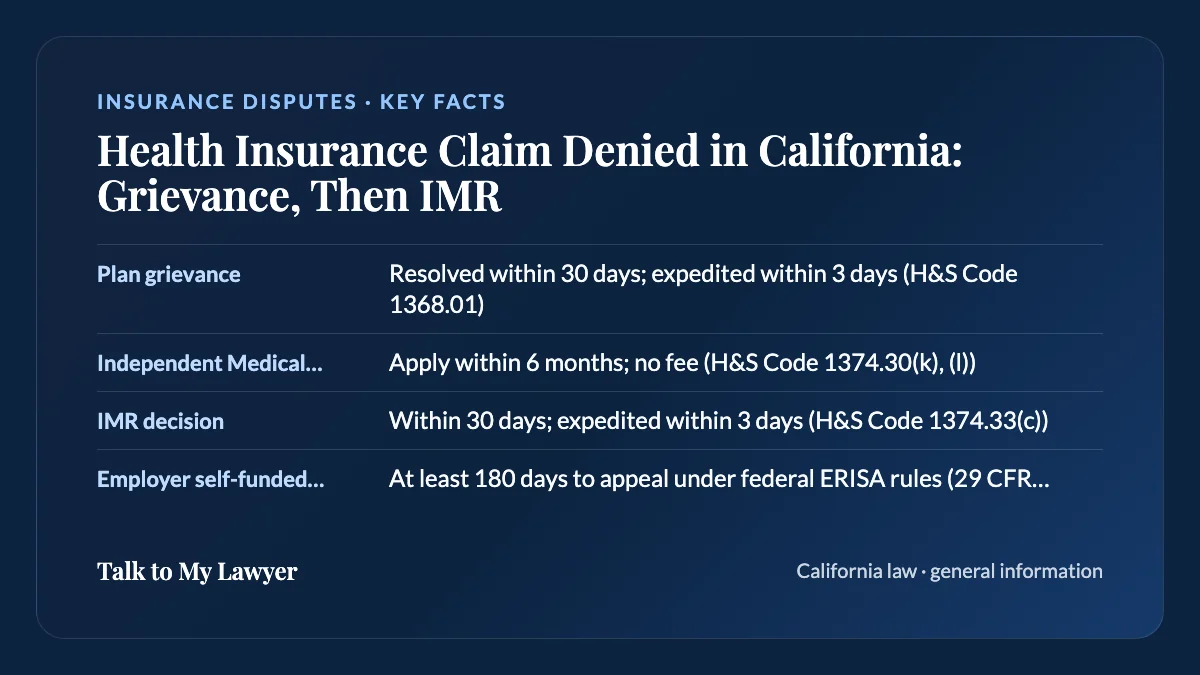
If a health insurance claim is denied in California, first file a grievance or internal appeal with your plan, which has 30 days to resolve it, or three days if your health is under serious threat. If the plan upholds a medical necessity denial or misses the 30 days, you can apply for Independent Medical Review, which charges no fee, within six months (Health and Safety Code section 1374.30).
At a glance
- Plan grievance
- Resolved within 30 days; expedited within 3 days (H&S Code 1368.01)
- Independent Medical Review
- Apply within 6 months; no fee (H&S Code 1374.30(k), (l))
- IMR decision
- Within 30 days; expedited within 3 days (H&S Code 1374.33(c))
- Employer self-funded plans
- At least 180 days to appeal under federal ERISA rules (29 CFR 2560.503-1)
- DMHC Help Center
- 1-888-466-2219; refers you if another regulator oversees your plan
Who regulates your health plan? Start here
The appeal route depends on who oversees your coverage, so find that first. Your plan card, Evidence of Coverage or denial letter may name the regulator.
| Type of coverage | Regulator | Outside review |
|---|---|---|
| Health care service plan, such as an HMO | Department of Managed Health Care (DMHC) | Independent Medical Review (H&S Code 1374.30) |
| Health insurance policy regulated by the Department of Insurance | California Department of Insurance (CDI) | Independent Medical Review (Insurance Code 10169) |
| Self-funded employer plan | Federal ERISA rules, U.S. Department of Labor | Internal appeal under federal claim rules, then federal external review for most non-grandfathered plans (29 CFR 2590.715-2719) |
If you are not sure, call the DMHC Help Center at 1-888-466-2219. The state says that if your plan is not regulated by the DMHC, the Help Center will refer you to the right regulator. The Department of Insurance Consumer Hotline is 1-800-927-4357.
Step one: the grievance or internal appeal with your plan
Before an outside review, you generally have to ask the plan itself to reconsider. For DMHC plans this is called a grievance.
- Standard grievance: the plan must resolve it within 30 days (Health and Safety Code section 1368.01(a)).
- Expedited grievance: if the case involves an imminent and serious threat to your health, such as severe pain or potential loss of life, limb or major bodily function, the plan must give you a written decision or status within three days and tell you of your right to contact the DMHC (section 1368.01(b)).
- You do not have to wait longer than 30 days (three days for expedited cases) before going to Independent Medical Review (section 1374.30(j)(3)). Insurance Code section 10169 sets the same limits for CDI-regulated insurers.
For self-funded employer plans, federal rules require at least 180 days after the denial notice to file an appeal. The plan must decide within 72 hours for urgent care, 30 days for a service you have not yet received, and 60 days for one you already received, where the plan has one level of appeal (29 CFR 2560.503-1(h)(3), (i)(2)).
Deadlines for filing a grievance with a state-regulated plan are set in your Evidence of Coverage and the denial letter. Check them the day the denial arrives.
How to write a health insurance appeal letter
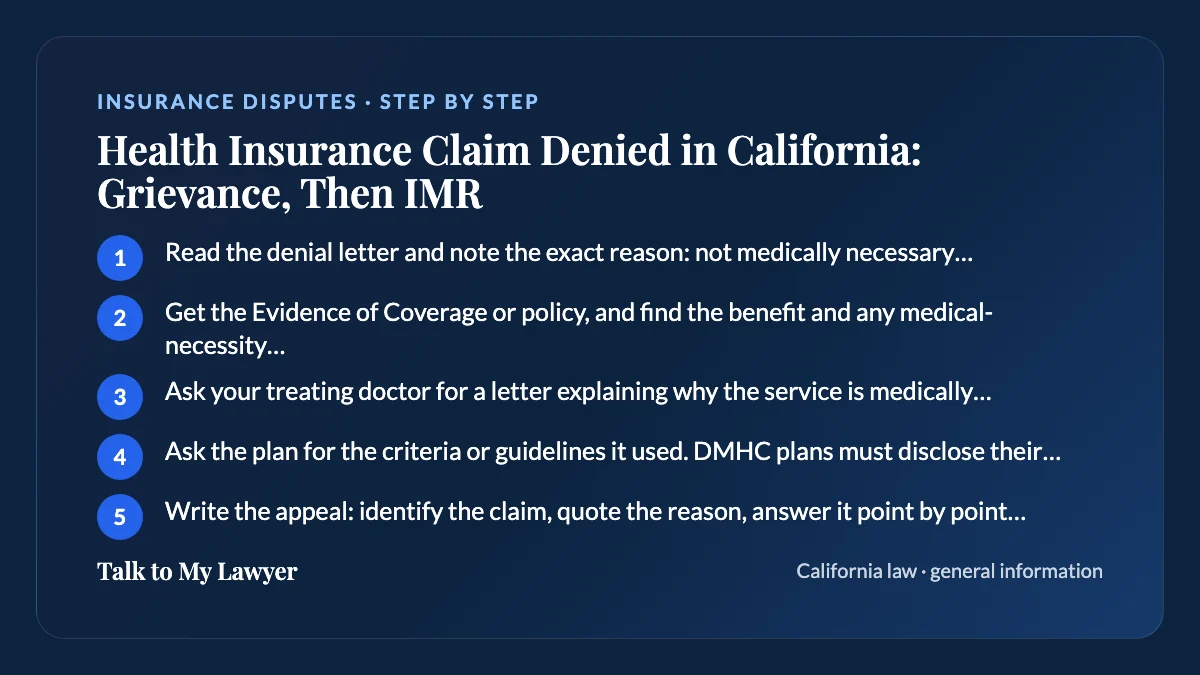
An appeal letter answers the plan's stated reason with the plan's own words and your doctor's opinion. These steps build one:
- Read the denial letter and note the exact reason: not medically necessary, experimental, out of network, or not a covered benefit. If the plan says a service is not covered, the letter must name the contract provision that excludes it (H&S Code 1374.30(b)).
- Get the Evidence of Coverage or policy, and find the benefit and any medical-necessity definition.
- Ask your treating doctor for a letter explaining why the service is medically necessary for you, citing your history and any failed alternatives.
- Ask the plan for the criteria or guidelines it used. DMHC plans must disclose their review policies and procedures to enrollees on request (H&S Code 1367.01(b)).
- Write the appeal: identify the claim, quote the reason, answer it point by point, attach the doctor's letter and records, and say whether you need an expedited review.
- Keep copies and proof of the date you filed, and calendar day 30.
I am filing a grievance about the denial dated May 2, 2026, of the lumbar MRI ordered by Dr. Patel, reference number 88-1043. The denial states the MRI is not medically necessary. Dr. Patel's enclosed letter explains that six weeks of physical therapy and medication have not relieved my symptoms and that new numbness in my left leg requires imaging. Please reverse the denial. If it is upheld, please send the Independent Medical Review application form required by Health and Safety Code section 1374.30(m).
Independent Medical Review: when the plan says no again
Independent Medical Review (IMR) sends a denial based on medical necessity to independent medical reviewers outside the plan. You can apply when all of these are true (H&S Code 1374.30(j)):
- Your provider recommended the service as medically necessary, you received urgent or emergency care a provider found necessary, or you were seen by an in-plan provider for the condition.
- The plan or one of its contracting providers denied, changed or delayed the service, in whole or in part, as not medically necessary.
- You filed a grievance and the plan upheld the decision, or did not resolve it within 30 days.
You must apply within six months of those events, though the director may extend that. There is no application or processing fee. When the plan decides your grievance against you, it must send you the application form and an addressed envelope (sections 1374.30(k) to (m)). The review is completed within 30 days of receiving the application and documents, or within three days for care not yet provided when a provider or the department certifies an imminent and serious threat to your health (section 1374.33(c)).
Who is allowed to deny care as not medically necessary?
Only a licensed physician or a licensed health care professional competent in the clinical issues involved may deny or modify a request for medical necessity reasons (H&S Code section 1367.01(e)).
As of October 2026, a law effective January 1, 2025 (SB 1120) adds rules for plans that use artificial intelligence, algorithms or other software tools in utilization review. Those tools must base decisions on your clinical history and circumstances, and they may not deny, delay or modify care based on medical necessity; that determination must be made by a licensed physician or qualified licensed health care professional (section 1367.01(k)). If your denial letter does not identify who made the decision, ask.
Example: one denial, start to finish
Example (hypothetical), for a DMHC-regulated plan:
| Date | Event | Rule |
|---|---|---|
| May 2 | Plan denies a prescribed MRI as not medically necessary | Denial letter must explain IMR rights |
| May 9 | Patient files a grievance with her doctor's letter | Plan has 30 days |
| June 8 | Day 30 passes with no decision | She may now apply for IMR |
| June 12 | She files the IMR application with the DMHC | No fee; within six months |
| By about July 12 | Independent reviewers decide | 30 days from receipt of the application and documents |
IMR can also reach urgent or emergency care you already received that a provider found medically necessary. Denials on other kinds of policies are covered in how to answer an insurance claim denial, and for life coverage, our guide to a life insurance claim denial.
When to have a lawyer write to your health plan
The grievance and IMR systems are built for patients to use on their own, and the DMHC Help Center answers questions at no cost. A lawyer's letter fits a narrower set of moments: a large bill for care already received, a coverage dispute that does not qualify for IMR, a self-funded employer plan under ERISA, or a plan that has ignored the 30-day limit.
Through Talk to My Lawyer, a licensed California attorney writes your letter from your denial letter, Evidence of Coverage, doctor's letter and bills, and sends it on your behalf to the plan or insurer. For advice about a lawsuit or ERISA rights, talk to a lawyer about your facts.
Frequently asked questions
How long do I have to appeal a health insurance denial in California?
For a self-funded employer plan under federal ERISA rules, you have at least 180 days from the denial notice to file an internal appeal. For state-regulated plans, check the grievance deadline in your Evidence of Coverage and the denial letter. After the grievance, you have six months to apply for Independent Medical Review, which the director can extend in some cases.
What is an Independent Medical Review in California?
It is a state-run review in which independent medical professionals decide whether a service your plan denied, changed or delayed as not medically necessary should be provided. The DMHC runs it for health care service plans (Health and Safety Code section 1374.30), and the Department of Insurance runs a parallel process for the insurers it regulates (Insurance Code section 10169). There is no fee.
Can I get a faster review if I need care urgently?
Yes. For an imminent and serious threat to your health, such as severe pain or potential loss of life, limb or major bodily function, a DMHC plan must address the grievance within three days, and you need not wait more than three days before seeking IMR. When a provider or the department certifies that threat, the IMR decision is due within three days.
Does Independent Medical Review cover denials for services that are not covered at all?
IMR is for medical necessity disputes. If the plan says a service is excluded from your contract, that is a coverage decision, and the DMHC reviews it as a consumer complaint. The plan's denial must cite the contract provision that excludes coverage. When it is unclear whether a dispute is about medical necessity, the DMHC makes the final call.
What if my health plan is through my employer?
Employer coverage may be insured, and then regulated by the DMHC or Department of Insurance, or self-funded, and then governed mainly by federal ERISA rules. Self-funded plans must give at least 180 days to appeal and decide urgent appeals within 72 hours. Ask your human resources office or the plan administrator which type you have, and call the DMHC Help Center if unsure.
Sources
Checked against these official sources on October 18, 2026.
- California Health and Safety Code section 1374.30 (California Legislative Information)
- California Health and Safety Code section 1368.01 (California Legislative Information)
- California Health and Safety Code section 1367.01 (California Legislative Information)
- California Insurance Code section 10169 (California Legislative Information)
- Health insurance complaints and medical review request (State of California (ca.gov))
- 29 CFR 2560.503-1 Claims procedure (Legal Information Institute (federal regulation text))
This guide explains California law in general terms as of October 2026. It is general information, not legal advice for your situation, and local rules can add to it.
Join the email list and get a lawyer letter started
With Talk to My Lawyer, a licensed California attorney writes your letter from your facts and documents and sends it on your behalf. Join the Talk to My Lawyer email list for letter checklists, document prompts, and reminders before you start your letter.