Quick answer
The Los Angeles tenant harassment ordinance (TAHO, LAMC section 45.30 and following) bans a landlord's bad faith conduct aimed at a tenant, such as cutting services, ignoring needed repairs, abusing entry rights or pressuring a move-out. A tenant who wins in court receives three times compensatory damages, a civil penalty of $2,000 to $10,000 per violation, and attorney fees. The deadline to sue is three years.
At a glance
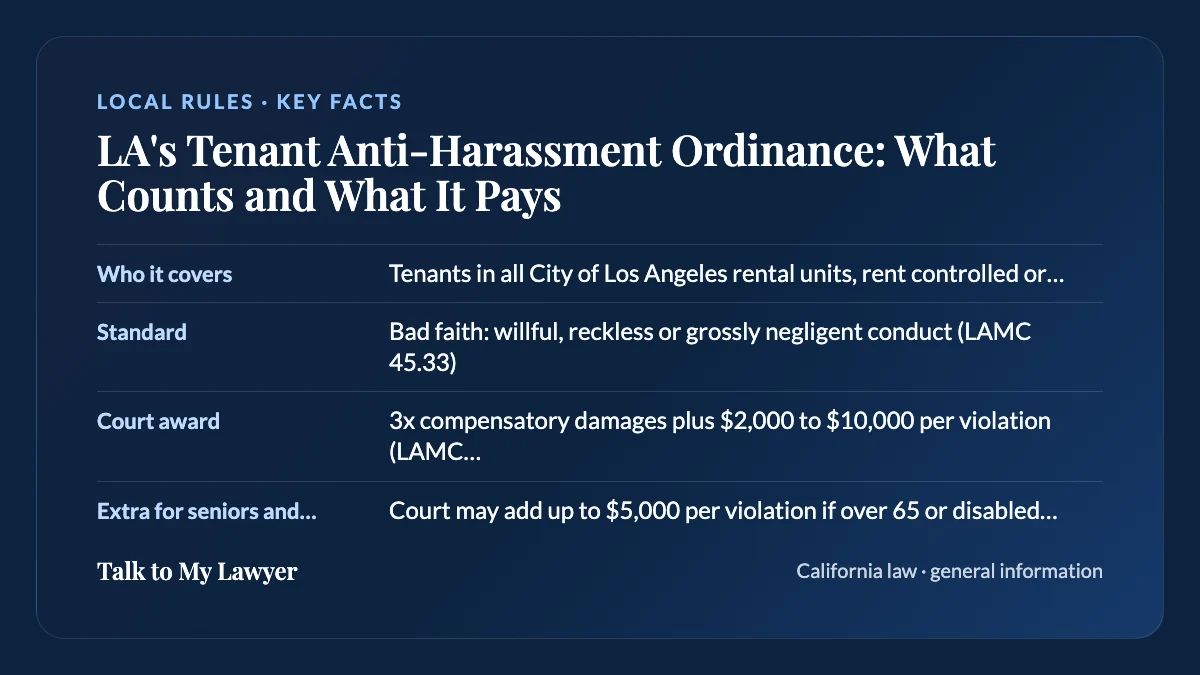
- Who it covers
- Tenants in all City of Los Angeles rental units, rent controlled or not (LAMC 45.32)
- Standard
- Bad faith: willful, reckless or grossly negligent conduct (LAMC 45.33)
- Court award
- 3x compensatory damages plus $2,000 to $10,000 per violation (LAMC 45.35 B)
- Extra for seniors and disabled
- Court may add up to $5,000 per violation if over 65 or disabled (LAMC 45.35 C)
- Time limit
- Three years (LAMC 45.35 G)
- Report it
- LAHD at 1-866-557-7368 or online
What counts as harassment under the Los Angeles tenant harassment ordinance?
Harassment is a landlord's bad faith conduct directed at a specific tenant that causes the tenant harm. Bad faith means willful, reckless or grossly negligent conduct (LAMC section 45.33). The ordinance was strengthened effective December 29, 2024, and now lists 17 examples, grouped here:
- Services and repairs: cutting or threatening to cut services the lease or law requires, including parking in the lease; failing to make and finish necessary repairs; ignoring industry standards for dust, noise, lead paint or asbestos.
- Entry abuse: entering or photographing beyond the scope of a lawful entry, notices that hide the real reason, unreasonable time windows, or excessive entry requests.
- Pressure to leave: threats of physical harm, coercive cash offers, false claims that you must move, and eviction notices based on facts the landlord has no reasonable cause to believe.
- Rent games: refusing lawful rent or rental assistance, including payments from a third party or a needed W-9.
- Privacy and immigration: asking about immigration or citizenship status, threatening to disclose it, or demanding information such as a Social Security number without legal authority.
- Retaliation and discrimination: interfering with tenant organizing or engaging in conduct barred by fair housing laws.
- Changing the deal: imposing new material lease terms on an existing tenant, with limited exceptions.
- Catch-all: other repeated acts that substantially disturb your peace and aim to make you give up your rights.
Does TAHO protect tenants outside rent control?
Yes. The ordinance defines a rental unit to include apartments, condominiums, single-family homes, guest rooms and mobile homes anywhere in the City of Los Angeles (LAMC section 45.32). LAHD describes it as covering all residential properties.
Rent-stabilized tenants get one extra protection. In an RSO unit, offering money to move out without first giving the tenant LAHD's written buyout disclosure is itself harassment (LAMC section 151.33). And if an RSO unit becomes vacant because of harassment, the landlord may re-rent it only at the last lawful rent (LAMC section 45.37), as explained in our Los Angeles rent control guide.
What can a court award for tenant harassment in Los Angeles?
LAHD says the amendment that took effect December 29, 2024 (Ordinance 188416) made damages mandatory for a tenant who wins in court. LAMC section 45.35 now provides:
| Remedy | What the ordinance says |
|---|---|
| Damages | Three times compensatory damages, including mental or emotional distress |
| Civil penalty | $2,000 to $10,000 per violation, depending on severity |
| Seniors and disabled tenants | The court may add up to $5,000 per violation if the tenant was over 65 or disabled |
| Rent refunds | For reduced housing services, if applicable |
| Fees | Reasonable attorney fees and costs |
| Other relief | Relocation if applicable, injunctions, and punitive damages in a proper case |
| Deadline | Three years to bring the action |
Violations can also be prosecuted as infractions or misdemeanors, with a fine of up to $1,000 and up to six months in jail (LAMC section 45.36). Harassment is also an affirmative defense in an eviction case, whatever the notice claims (LAMC section 45.34).
Why written notice matters for repair-based claims
If your claim is about repairs or maintenance, you generally must give the landlord written notice and a reasonable period to fix the problem before filing a lawsuit or a small claims case (LAMC section 45.35 F). No waiting period applies when the landlord's conduct is intentional and shows willful disregard for your comfort, safety or well-being.
That makes a dated letter more than a formality. It starts the clock, shows exactly what was reported, and documents the landlord's response or silence. Our guide to repair demand letters in California covers the state habitability rules that run alongside TAHO.
How TAHO works alongside California Civil Code 1940.2
State law adds its own penalty. Civil Code section 1940.2 makes it unlawful for a landlord, to influence a tenant to leave, to commit theft or extortion, use force or menacing threats, significantly and intentionally violate the entry rules in section 1954, or threaten to disclose immigration status. A tenant who prevails, including in small claims court, can receive a civil penalty of up to $2,000 per violation.
Civil Code section 1942.5 separately bars retaliation, such as a rent increase or reduced services, within 180 days after a tenant's good faith repair complaint, while the tenant is current on rent. For a statewide overview, see our guide to landlord harassment cease and desist letters.
How to document landlord harassment in Los Angeles
LAHD does not take anonymous complaints and asks for documents supporting each violation. A clean record also supports a letter or a lawsuit. Work through these steps:
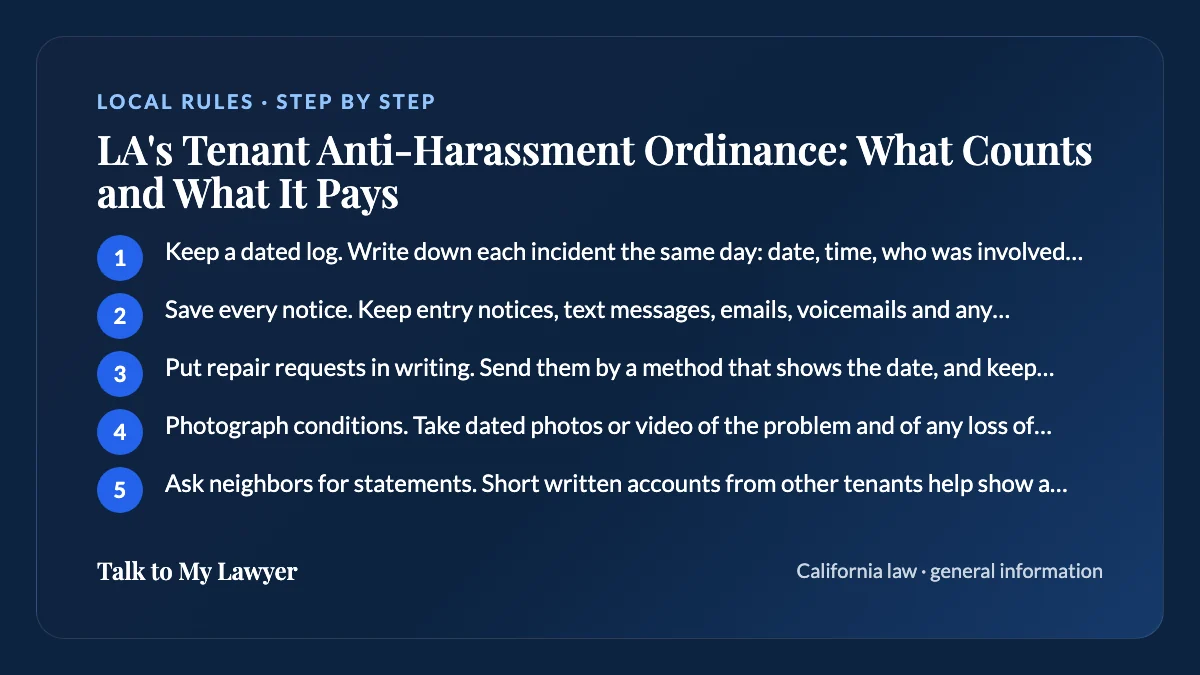
- Keep a dated log. Write down each incident the same day: date, time, who was involved, what was said or done.
- Save every notice. Keep entry notices, text messages, emails, voicemails and any buyout offer.
- Put repair requests in writing. Send them by a method that shows the date, and keep copies.
- Photograph conditions. Take dated photos or video of the problem and of any loss of services, such as a locked laundry room.
- Ask neighbors for statements. Short written accounts from other tenants help show a pattern.
- Report it. Call LAHD at 1-866-557-7368 or file online, and call the police or 911 if you feel physically unsafe.
What a TAHO cease and desist letter should say
A strong letter is specific and calm. It names the conduct, ties it to the ordinance and says what must change.
- Each incident by date, matched to the TAHO category it falls under.
- Any repair still outstanding, with the date you first reported it, which also serves as the written notice section 45.35 F requires.
- The remedies in LAMC section 45.35 and Civil Code section 1940.2.
- What you are asking for: completed repairs by a date, entries only with proper notice and stated reasons, and no further cash-for-keys contact.
- Where future communication should go, in writing.
Since August 4, 2026, your manager has entered my unit four times with notices that state no reason, and the bathroom leak I reported in writing on July 20 remains unrepaired. These acts fall within LAMC section 45.33, items 2 and 3. Please complete the repair by October 31, 2026, state the specific reason for any future entry in the written notice, and direct all further contact to me in writing.
When an attorney-written TAHO letter makes sense
Because LAMC section 45.35 sets penalties per violation, a harassment letter does its job when every incident is dated and matched to an item in section 45.33. That care matters most when the conduct has continued after your own requests, when a buyout offer or eviction threat is part of the pattern, or when the letter must also serve as the repair notice that section 45.35 F requires.
Through Talk to My Lawyer, a licensed California attorney writes your letter from your incident log, photos and messages, matches each act to the ordinance, and sends it on your behalf. If you have been served with eviction papers, speak with a lawyer about your facts without delay.
Frequently asked questions
What is considered tenant harassment in Los Angeles?
Under LAMC section 45.33, harassment is a landlord's bad faith conduct aimed at a tenant that causes harm. Examples include cutting services, failing to make needed repairs, abusing the right of entry, threats, coercive buyout offers, refusing lawful rent, asking about immigration status and imposing new lease terms. Bad faith includes willful, reckless or grossly negligent conduct, so a pattern of neglect can qualify.
Can I sue my landlord for harassment in Los Angeles?
Yes. LAMC section 45.35 gives tenants a private right of action. A tenant who prevails is awarded three times compensatory damages, including emotional distress, a civil penalty of $2,000 to $10,000 per violation, and attorney fees and costs. The court may add up to $5,000 per violation for a tenant over 65 or disabled. The deadline is three years.
Does the LA anti-harassment ordinance apply if I rent a house?
Yes. The ordinance covers single-family homes, condominiums, apartments, guest rooms and mobile homes in the City of Los Angeles, whether or not they are rent stabilized. Tenants in unincorporated areas or other cities, such as Santa Monica or Pasadena, fall under their own local rules and state law instead.
How do I report landlord harassment to LAHD?
Call the LAHD hotline at 1-866-557-7368 or use the online complaint form. Harassment is one of the listed complaint reasons, there is no charge to file, and complaints cannot be anonymous because each one needs supporting documents. Bring your incident log, photos, written repair requests and any notices or messages from the landlord.
Do I have to notify my landlord before suing over repairs?
Generally, yes. For claims based on failed repairs or maintenance, LAMC section 45.35 F requires written notice to the landlord and a reasonable period to fix the problem before you file in court or small claims. The waiting period does not apply if the landlord acted intentionally with willful disregard for your comfort, safety or well-being.
Sources
Checked against these official sources on October 18, 2026.
- LAMC Section 45.33 Tenant Harassment (City of Los Angeles (American Legal Publishing))
- LAMC Section 45.35 Private Right of Action; Civil Penalties (City of Los Angeles (American Legal Publishing))
- Tenant Anti-Harassment Ordinance (Los Angeles Housing Department)
- File an RSO or JCO Complaint (Los Angeles Housing Department)
- California Civil Code section 1940.2 (California Legislative Information)
- California Civil Code section 1942.5 (California Legislative Information)
This guide explains California law in general terms as of October 2026. It is general information, not legal advice for your situation, and local rules can add to it.
Join the email list and get a lawyer letter started
With Talk to My Lawyer, a licensed California attorney writes your letter from your facts and documents and sends it on your behalf. Join the Talk to My Lawyer email list for letter checklists, document prompts, and reminders before you start your letter.