Quick answer
Los Angeles rent control, the Rent Stabilization Ordinance (RSO), covers most rental units in buildings first approved for occupancy on or before October 1, 1978. For increases that take effect between July 1, 2026 and June 30, 2027, the allowable RSO increase is 3 percent, once every 12 months, with no extra percentage for utilities. A landlord who collects more can owe three times the overcharge (LAMC 151.10).
At a glance
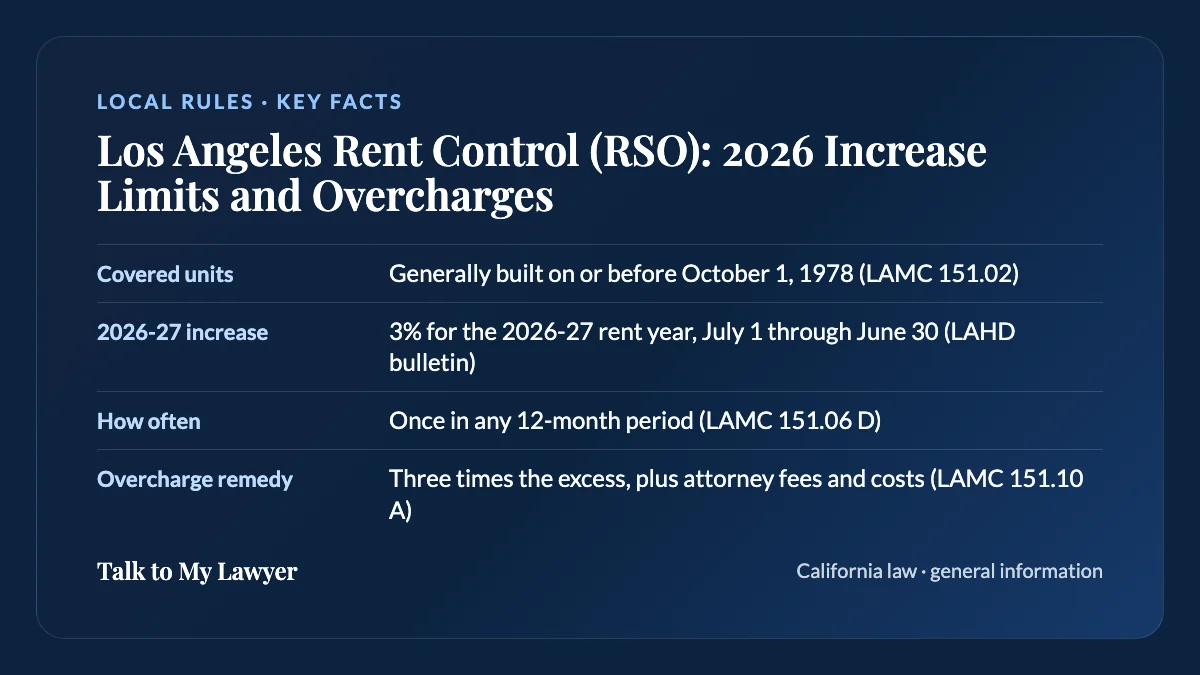
- Covered units
- Generally built on or before October 1, 1978 (LAMC 151.02)
- 2026-27 increase
- 3% for the 2026-27 rent year, July 1 through June 30 (LAHD bulletin)
- How often
- Once in any 12-month period (LAMC 151.06 D)
- Overcharge remedy
- Three times the excess, plus attorney fees and costs (LAMC 151.10 A)
- Registration
- No rent may be demanded without serving a valid registration statement (LAMC 151.05 A)
Is my apartment covered by Los Angeles rent control?
Your unit is probably covered if it sits in the City of Los Angeles and the building received its first certificate of occupancy on or before October 1, 1978. The code also covers buildings that got a residential building permit by that date even if the certificate came later (LAMC section 151.02).
The Los Angeles Housing Department (LAHD) lists these property types as covered when they meet the date test:
- Apartments and duplexes.
- Two or more single-family houses on the same parcel.
- Condominiums and townhomes, although the rent amount is not regulated for tenancies that began after December 31, 1995.
- Rooms in hotels, motels and rooming houses occupied by the same tenant for more than 30 consecutive days.
- Accessory dwelling units (ADUs and JADUs) and units attached to commercial buildings.
- Mobile homes and recreational vehicles in mobile home parks.
A single house alone on its parcel is outside the RSO, and so is a building whose first certificate of occupancy was issued after October 1, 1978. Those homes still have eviction protections under the city's Just Cause Ordinance. If you are unsure, the annual registration statement your landlord must serve is a strong clue, and the LAHD hotline at (866) 557-7368 can confirm coverage for an address.
How much can an RSO landlord raise the rent in 2026?
LAHD's Allowable Rent Increase Bulletin sets the figure at 3 percent for any annual increase that takes effect between July 1, 2026 and June 30, 2027. The increase can be applied once in any 12-month period and is not cumulative, so a landlord who skipped last year cannot stack two years together.
| Period | Allowable increase |
|---|---|
| July 2024 to June 2025 | 4% |
| July 2025 to June 2026 | 3% |
| July 2026 to June 2027 | 3% |
The formula changed with an ordinance effective February 2, 2026. The annual figure is now 90 percent of the year-over-year change in the Consumer Price Index for Los Angeles-Long Beach-Anaheim (averaged over the 12 months ending September 30), rounded to a whole number, with a floor of 1 percent and a ceiling of 4 percent (LAMC section 151.06 D). Since that date, landlords can no longer add an extra percentage for utilities, and adding a dependent to the household no longer allows any increase.
A few separate charges are allowed on top of rent, including a $2.83 monthly share of the Systematic Code Enforcement fee and a $1.61 monthly share of the registration fee, as listed in the LAHD bulletin. A 10 percent increase is allowed for each additional tenant who is not a dependent, if the landlord gives notice within 60 days of learning about that person, and the rent must come back down when that tenant leaves.
Notice rules come from state law. LAHD's bulletin summarizes them as 30 days' written notice for a smaller increase and 90 days when the increase tops 10 percent within 12 months. Our guide to rent increase notice rules in California covers service and timing.
Does the statewide rent cap apply to an RSO unit?
No. The state rent cap in Civil Code section 1947.12 does not apply to housing covered by a local rent control law that limits annual increases to less than the state formula (section 1947.12(d)(3)). For an RSO unit, the city's 3 percent figure is the limit that matters.
The RSO also controls what happens when a unit turns over. When a tenant leaves voluntarily or is evicted for nonpayment or an uncured lease breach, the RSO lets the landlord reset the rent for the next tenant. After most no-fault evictions, such as an owner move-in, the landlord must re-rent at the last lawful rent plus allowed annual adjustments (LAMC section 151.06 C).
What does registration have to do with your rent?
A landlord may not demand or accept rent for an RSO unit without first serving the tenant a valid registration or annual renewal statement from LAHD (LAMC section 151.05 A). Every RSO unit must be registered every year, and the building must post a notice that it is rent stabilized.
If the landlord has not complied, section 151.11 B lets the tenant withhold rent until the landlord does. Once the landlord complies, the withheld rent becomes due. Withholding carries eviction risk if anything is miscounted, so talk to a lawyer before relying on it. An unregistered unit can also be reported to LAHD through its complaint form.
The code also blocks the annual increase entirely for a unit in the Rent Escrow Account Program or under an uncorrected rent-reduction notice, among other cases. A landlord also cannot insist that rent be paid only online or by electronic transfer (LAMC section 151.04 C).
Example: working out an RSO overcharge
Example (hypothetical): a tenant in a 1965 fourplex in Mar Vista paid $1,800 a month. Starting August 1, 2026, the landlord raised the rent to $1,926, a 7 percent increase. The lawful maximum after a 3 percent increase was $1,854.
| Item | Amount |
|---|---|
| Rent charged from August 2026 | $1,926 |
| Lawful rent (3% increase) | $1,854 |
| Monthly overcharge | $72 |
| Overcharge through January 2027 (6 months) | $432 |
| Three times the overcharge under LAMC 151.10 A | $1,296 |
Whether a court awards the full treble amount depends on the evidence. The tenant's letter would ask for the $432 back, a corrected rent of $1,854 going forward, and a written confirmation.
How to challenge an illegal rent increase in Los Angeles
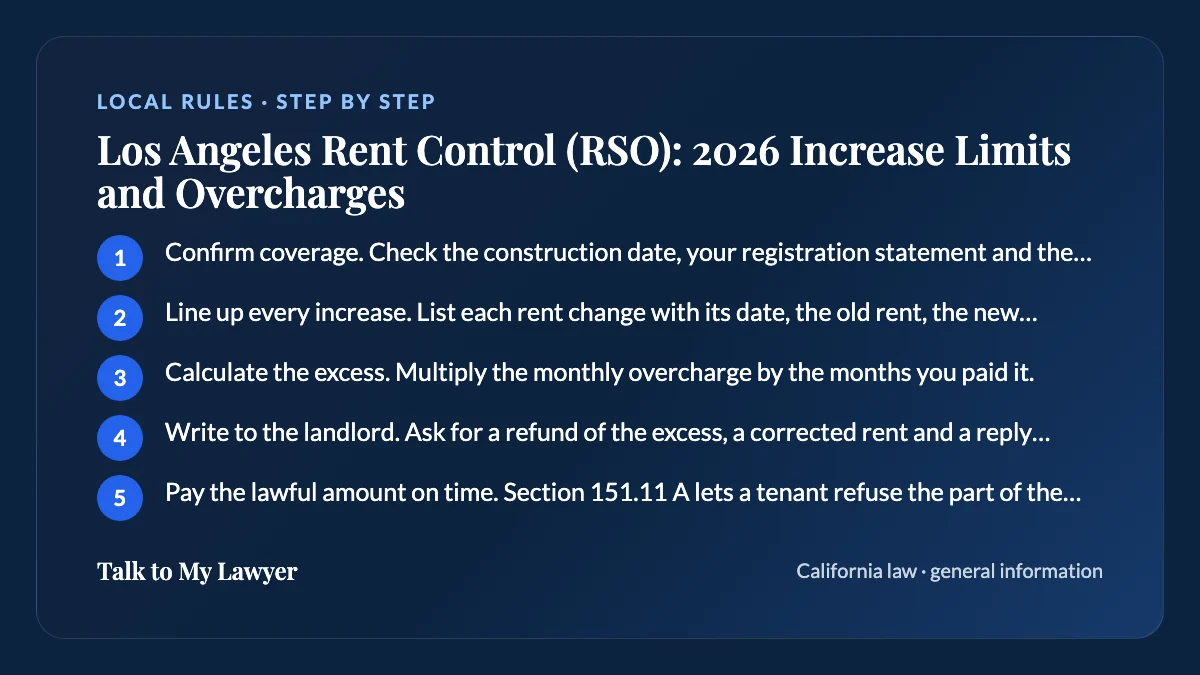
- Confirm coverage. Check the construction date, your registration statement and the posted RSO notice.
- Line up every increase. List each rent change with its date, the old rent, the new rent and the percentage LAHD allowed that year.
- Calculate the excess. Multiply the monthly overcharge by the months you paid it.
- Write to the landlord. Ask for a refund of the excess, a corrected rent and a reply date, such as 14 days out.
- Pay the lawful amount on time. Section 151.11 A lets a tenant refuse the part of the rent above the RSO maximum, so pay the lawful rent and keep proof.
- File with LAHD if needed. Illegal Rent Increase is a complaint category for RSO units, with no charge to file, though complaints cannot be anonymous and need supporting documents.
- Consider court. An individual's claim of up to $12,500 can go to small claims court (Code of Civil Procedure section 116.221).
My unit at 4410 Grand View Boulevard, Unit 2, is subject to the Los Angeles Rent Stabilization Ordinance. On August 1, 2026 you increased my rent from $1,800 to $1,926. LAHD's allowable increase for the 2026-27 rent year is 3 percent, which makes the lawful rent $1,854. Please refund the $432 I have overpaid and confirm in writing by February 15, 2027 that my rent is $1,854.
For a deeper look at the letter itself, see our rent overcharge demand letter guide.
What other protections come with an RSO unit?
- Just cause for eviction. A landlord may evict only for a reason listed in LAMC section 151.09, and must file any termination notice with LAHD within three business days of serving it.
- A threshold for nonpayment. An eviction for unpaid rent requires the amount owed to exceed one month of HUD fair market rent for a unit with the same number of bedrooms.
- Relocation money for no-fault evictions. Owner move-ins, demolitions and similar evictions require relocation payments, covered in our guide to Los Angeles relocation assistance amounts.
- Buyout disclosures. A cash-for-keys offer must come with LAHD's disclosure form.
- Harassment protections. The city's tenant anti-harassment ordinance applies to every RSO unit.
- A right-to-counsel notice. Since August 20, 2025, landlords must post the Notice of Right to Counsel and give it to tenants at the start of the tenancy.
When an attorney-written RSO overcharge letter makes sense
An RSO overcharge claim rests on a short chain of facts: the lawful base rent, each increase date and the percentage LAHD allowed for that year. If one of those links is unclear, for example after a change of owner, a long gap in registration or a buyout offer, an attorney-written letter can lay the chain out so the landlord sees exactly how the refund was calculated.
Through Talk to My Lawyer, a licensed California attorney writes your letter from your facts and documents (the increase notices, rent receipts and LAHD registration statement), cites the RSO sections that apply, and sends it on your behalf. To decide whether to withhold rent or sue, talk to a lawyer about your facts.
Frequently asked questions
How do I know if my Los Angeles apartment is rent controlled?
Look at the building's age and paperwork. Units in buildings first approved for occupancy on or before October 1, 1978 are generally covered by the Rent Stabilization Ordinance. Your landlord must serve you an annual registration statement and post an RSO notice in the building. A single house alone on its lot is usually not covered. The LAHD hotline at (866) 557-7368 can check a specific address.
What is the RSO rent increase for 2026?
LAHD set the allowable increase at 3 percent for the rent year running July 1, 2026 through June 30, 2027. It can be applied once every 12 months. Since February 2, 2026, landlords may not add an extra percentage for utilities, and the annual figure is set at 90 percent of local inflation, with a minimum of 1 percent and a maximum of 4 percent.
Can my landlord raise the rent to market rate when I move out?
Usually yes, if you leave voluntarily or are evicted for cause. The RSO then lets the landlord set a new starting rent for the next tenant. After most no-fault evictions, such as an owner move-in or a government order to vacate, the landlord must re-rent the unit at the last lawful rent plus allowed annual increases.
What happens if my landlord charged more than the RSO allows?
LAMC section 151.10 makes a landlord who collects or holds on to rent above the lawful maximum liable in a civil action for three times the overcharge, plus reasonable attorney fees and costs. You can also file an Illegal Rent Increase complaint with LAHD. A written demand that states the overcharge and asks for a refund gives the landlord a chance to correct it first.
Does AB 1482 apply to my RSO apartment?
Not for rent increases. The statewide cap in Civil Code section 1947.12 exempts housing already covered by a local rent control law that limits increases to less than the state formula, so the RSO's 3 percent figure controls. Units outside the RSO may fall under the state cap and the city's Just Cause Ordinance instead.
Sources
Checked against these official sources on October 18, 2026.
- RSO Overview (Los Angeles Housing Department)
- Rent Stabilization Bulletin: Allowable Rent Increase (Los Angeles Housing Department)
- LAMC Section 151.06 Automatic Adjustments (City of Los Angeles (American Legal Publishing))
- LAMC Section 151.10 Remedies (City of Los Angeles (American Legal Publishing))
- California Civil Code section 1947.12 (California Legislative Information)
- File an RSO or JCO Complaint (Los Angeles Housing Department)
This guide explains California law in general terms as of October 2026. It is general information, not legal advice for your situation, and local rules can add to it.
Join the email list and get a lawyer letter started
With Talk to My Lawyer, a licensed California attorney writes your letter from your facts and documents and sends it on your behalf. Join the Talk to My Lawyer email list for letter checklists, document prompts, and reminders before you start your letter.