Quick answer
A rent increase calculator for California applies Civil Code section 1947.12: over any 12 months, rent on a covered unit may rise by no more than 5 percent plus the regional change in the cost of living, or 10 percent, whichever is lower, measured from the lowest rent charged in the prior 12 months. Some rentals are exempt, and local rent control can set a lower limit.
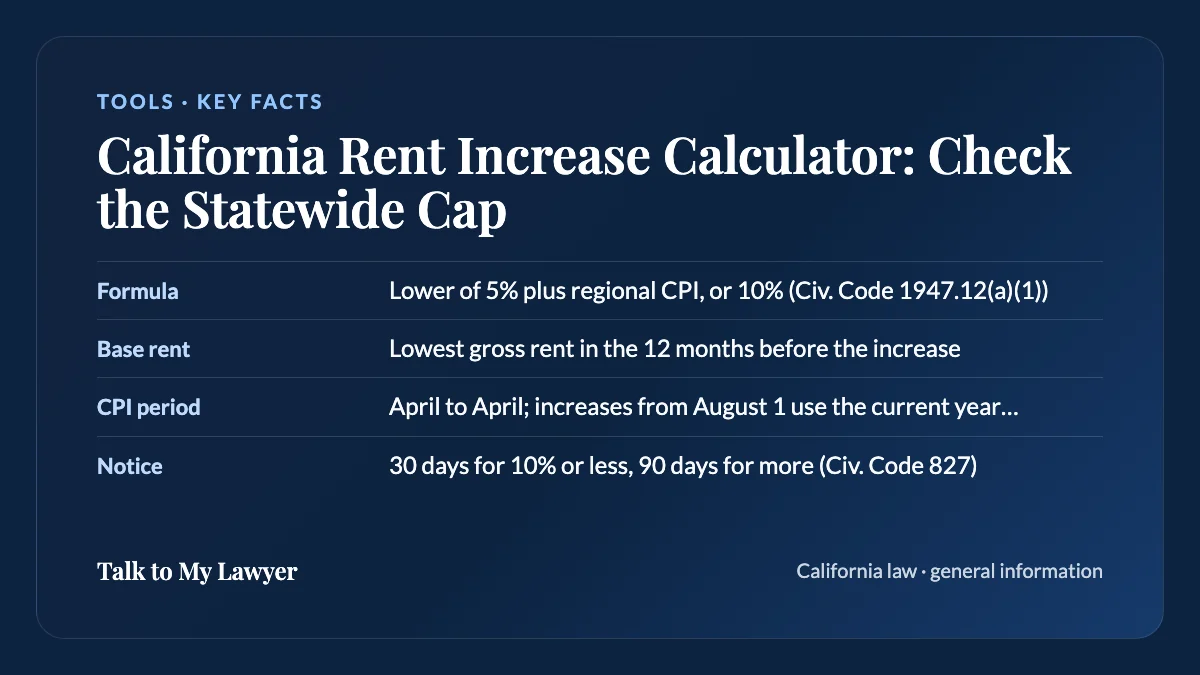
At a glance
- Formula
- Lower of 5% plus regional CPI, or 10% (Civ. Code 1947.12(a)(1))
- Base rent
- Lowest gross rent in the 12 months before the increase
- CPI period
- April to April; increases from August 1 use the current year (1947.12(g)(3))
- Notice
- 30 days for 10% or less, 90 days for more (Civ. Code 827)
- Overcharge
- Excess repaid; up to 3 times if willful (1947.12(k))
How much can a landlord raise rent in California?
For covered rentals, total increases over any 12 months cannot exceed 5 percent plus the percentage change in the cost of living, or 10 percent, whichever is lower (Civil Code section 1947.12). The percentage applies to the lowest gross rent charged in the 12 months before the increase.
- Gross, not discounted. Discounts or credits you accepted are left out when finding the lowest rent.
- New tenants reset the base. When no prior tenant remains, the landlord may set the starting rent.
- An end date. As of October 2026, the section runs until January 1, 2030.
How to use the rent increase calculator
Enter the lowest gross monthly rent charged in the past 12 months, the regional CPI change, and the proposed rent. The calculator shows the percentage limit, the highest rent it allows, and whether the proposal exceeds it.
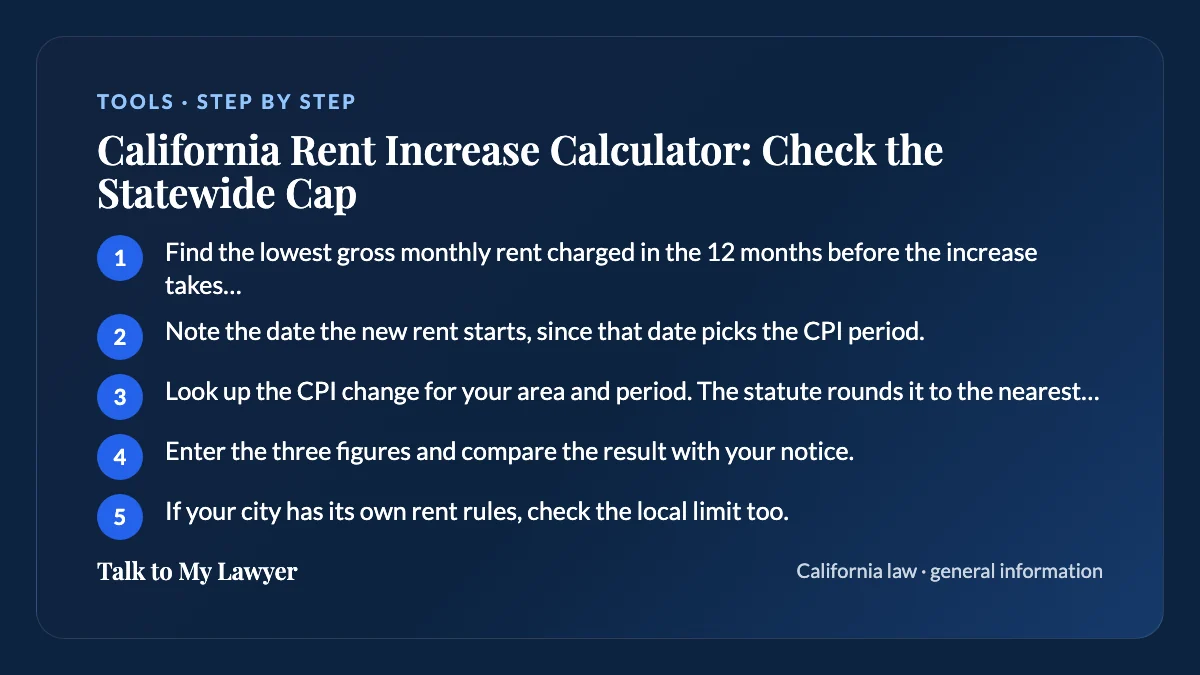
- Find the lowest gross monthly rent charged in the 12 months before the increase takes effect.
- Note the date the new rent starts, since that date picks the CPI period.
- Look up the CPI change for your area and period. The statute rounds it to the nearest tenth of a percent, and the calculator does the same (1947.12(g)(3)(B)(iii)).
- Enter the three figures and compare the result with your notice.
- If your city has its own rent rules, check the local limit too.
Which CPI figure should you use?
Use the CPI for All Urban Consumers (CPI-U), all items, that the U.S. Bureau of Labor Statistics publishes for your metro area. Elsewhere, use the California CPI from the Department of Industrial Relations (Civil Code 1947.12(g)(1)).
| Where the rental is | Index the statute names |
|---|---|
| Los Angeles or Orange County | CPI-U, Los Angeles-Long Beach-Anaheim |
| Riverside or San Bernardino County | CPI-U, Riverside-San Bernardino-Ontario |
| San Diego County | CPI-U, San Diego-Carlsbad |
| Alameda, Contra Costa, Marin, San Francisco or San Mateo County | CPI-U, San Francisco-Oakland-Hayward |
| Elsewhere in California | California CPI for All Urban Consumers, Department of Industrial Relations |
The period depends on when the increase takes effect (1947.12(g)(3)):
- On or after August 1: April of the prior year to April of the current year. An increase effective September 1, 2026 uses April 2025 to April 2026.
- Before August 1: the two previous Aprils. An increase effective June 1, 2026 uses April 2024 to April 2025.
- No April figure: some indexes skip months; then use March to March.
Since 10 percent is the ceiling, a CPI change of 5 percent or more gives a 10 percent limit.
Which rentals are exempt from the statewide rent cap?
Civil Code 1947.12(d) lists the exemptions. One is housing under a local ordinance that caps increases below the state formula; there the local limit governs, and the city's rent program publishes it.
- Housing restricted as affordable for very low, low or moderate income households.
- Dormitories run by a college or a K-12 school.
- Housing under stricter local rent control.
- Housing issued a certificate of occupancy within the previous 15 years, unless it is a mobilehome.
- A separately saleable single-family home or condo, if the owner is not a real estate investment trust, a corporation or an LLC with a corporate member, and the tenants received the written exemption notice the statute spells out. Both conditions are required.
- A two-unit building where the owner lived in one unit when the tenancy began and still does, if neither unit is an ADU or junior ADU.
How do you ask for a refund of an illegal rent increase?
Put it in writing with the numbers: the lowest rent in the prior 12 months, the CPI index and period, the maximum allowed rent, and the excess paid each month, with a date to correct the rent and repay the difference.
The statute backs that request. A landlord who demands, accepts or keeps rent above the cap can be liable for the excess, injunctive relief, attorney's fees and costs at the court's discretion, and up to three times the excess for willful conduct, oppression, fraud or malice (1947.12(k)), in an action brought within three years. The Attorney General notes that retaliation for pointing out an unlawful increase is illegal.
Your notice dated [date] raises my rent from $[lowest rent] to $[new rent]. Under Civil Code section 1947.12, the maximum for an increase effective [date] is $[maximum], using the [index name] change of [x] percent. Please confirm the corrected rent and refund the $[excess] overpaid by [date].
Check the notice period too: 30 days for an increase of 10 percent or less over 12 months, 90 days for more (Civil Code 827). See the rent increase notice guide for delivery rules and the rent overcharge demand letter guide for refunds.
When an attorney-written rent letter is worth it
If your numbers show an overcharge and the landlord disagrees, a letter that sets out the math and cites the statute gives both sides a clear record. Through Talk to My Lawyer, a licensed California attorney writes your letter from your facts and documents (the lease, the notice, your payment records) and sends it on your behalf.
If you have an eviction notice or a rent board petition in play, ask a lawyer about timing first.
Frequently asked questions
What is the maximum rent increase in California for 2026?
It depends on your area and the effective date. The cap is 5 percent plus the regional CPI change, up to 10 percent. Increases starting on or after August 1, 2026 use the April 2025 to April 2026 change; earlier 2026 increases use April 2024 to April 2025.
Does the rent cap apply to a single-family home?
Sometimes. It is exempt only if the owner is not a real estate investment trust, a corporation, or an LLC with a corporate member, and the tenant received the written exemption notice in Civil Code 1947.12(d)(5). If either condition is missing, the cap can apply.
Can my landlord raise the rent twice in one year?
Yes, but no more than twice in 12 months while you stay, and together the increases must fit within the cap. For the second, enter the lowest rent in the 12 months before it, which may predate the first increase.
Does signing a new lease give up the rent cap?
No. Civil Code 1947.12(l) makes any waiver of the rights in the section void as contrary to public policy, so a covered tenant can still claim the excess under subdivision (k) within three years.
Sources
Checked against these official sources on October 18, 2026.
- California Civil Code section 1947.12 (California Legislative Information)
- California Civil Code section 827 (California Legislative Information)
- California Consumer Price Index (California Department of Industrial Relations)
- West Information Office: Consumer Price Index releases (U.S. Bureau of Labor Statistics)
- Landlord-Tenant Issues (California Attorney General)
This guide explains California law in general terms as of October 2026. It is general information, not legal advice for your situation, and local rules can add to it.
Join the email list and get a lawyer letter started
With Talk to My Lawyer, a licensed California attorney writes your letter from your facts and documents and sends it on your behalf. Join the Talk to My Lawyer email list for letter checklists, document prompts, and reminders before you start your letter.