Quick answer
For Los Angeles no-fault evictions in the year running through June 30, 2027, LAHD's relocation assistance amount is $11,000 for an eligible household with under three years in the unit and $14,400 for three or more years or low income. Qualified households (a tenant 62 or older, disabled, or with minor children) receive $23,150 or $27,400. Payment is due within 15 days of the notice.
At a glance
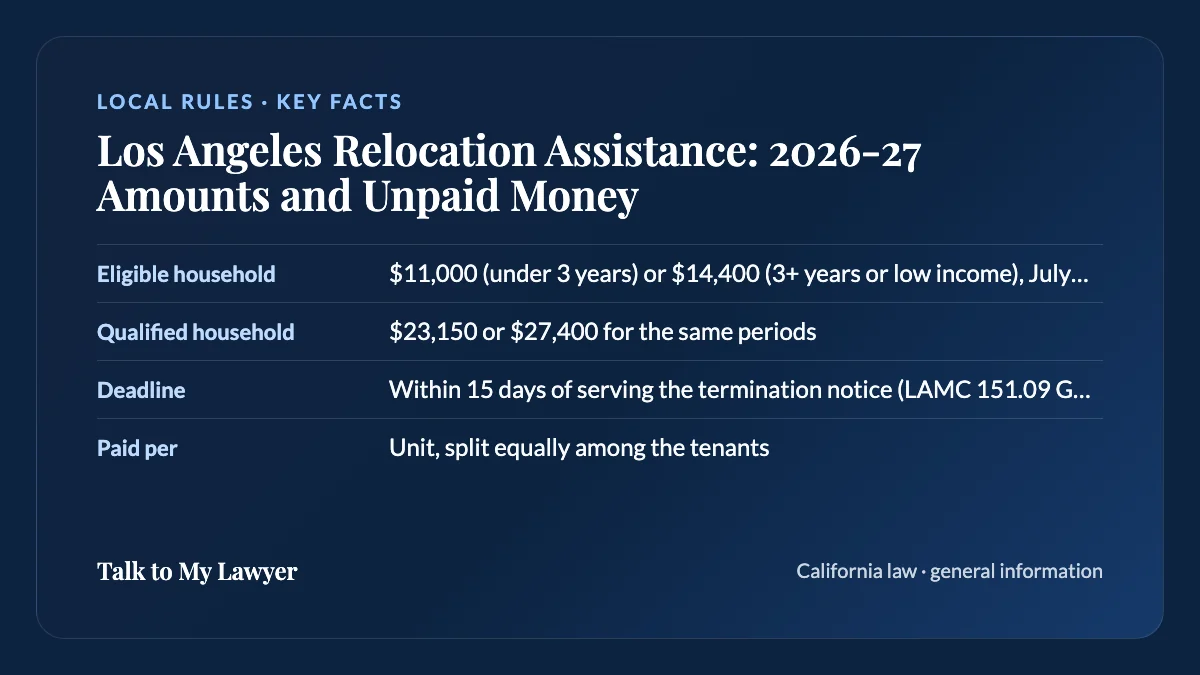
- Eligible household
- $11,000 (under 3 years) or $14,400 (3+ years or low income), July 2026 through June 2027
- Qualified household
- $23,150 or $27,400 for the same periods
- Deadline
- Within 15 days of serving the termination notice (LAMC 151.09 G, 165.06 G)
- Paid per
- Unit, split equally among the tenants
- If unpaid (RSO)
- Civil action for the unpaid amount plus attorney fees (LAMC 151.09 H)
How much relocation assistance does Los Angeles require in 2026-27?
The amount depends on two things: whether your household is eligible or qualified, and how long you have lived there or what you earn. LAHD's Relocation Assistance Bulletin sets these figures for no-fault evictions from units covered by the Rent Stabilization Ordinance (RSO) and the Just Cause Ordinance (JCO):
| Household | Less than 3 years | 3+ years, or income at or below 80% AMI | Mom-and-pop owner move-in |
|---|---|---|---|
| Eligible | $11,000 | $14,400 | $10,550 |
| Qualified | $23,150 | $27,400 | $21,250 |
LAHD's Chart A applies these amounts through June 30, 2027, and they rise every July 1. The RSO section (LAMC 151.09 G) prints the same figures. The Just Cause section (LAMC 165.06) still prints its original, lower base amounts but requires them to be adjusted each year, and LAHD's bulletin applies one chart to both RSO and JCO units, so check the bulletin in effect when the notice is served. The money is paid per unit, not per person. If several tenants share the unit, each receives an equal share, and if more than one amount could apply, the landlord pays the highest (LAMC section 151.09 G).
Eligible, qualified or low income: which tier are you in?
You are a qualified tenant if, on the date the termination notice is served, you are 62 or older, disabled as defined in state or federal law, or have one or more minor dependent children. Everyone else is an eligible tenant.
An eligible household moves to the higher column after three years in the unit, or sooner if household income is at or below 80 percent of Area Median Income. The 2026 HUD limits printed in the bulletin include:
| Household size | 80% AMI limit (2026) |
|---|---|
| 1 person | $93,300 |
| 2 people | $106,600 |
| 3 people | $119,950 |
| 4 people | $133,250 |
A tenant claiming the income-based amount files a statement with LAHD on its form. Either side can appeal LAHD's eligibility decision within 15 calendar days, and the appeal fee is $300 per unit, with a waiver for low-income applicants.
Which evictions trigger relocation money?
Only no-fault evictions. A tenant evicted for unpaid rent or a lease violation does not receive relocation assistance. LAHD lists these no-fault grounds:
- Occupancy by the owner, the owner's spouse, children, grandchildren, parents or grandparents, or a required resident manager.
- Demolition, or an Ellis Act withdrawal that takes the unit off the rental market for good.
- Compliance with a government order to vacate.
- A HUD-owned property being vacated before sale.
- Conversion or demolition of a residential hotel unit.
- Conversion of the property to affordable housing.
Two exceptions remove the payment: replacing one resident manager with another, and a unit made unsafe by fire, flood, earthquake or a similar event the owner did not cause. The landlord may also subtract rent you owe from the payment, unless the eviction is due to a government order for an unpermitted unit.
Owner move-ins: the mom-and-pop and single-family rules
A smaller payment applies to owner or family move-ins when all four conditions in the bulletin are met: the building has four or fewer units, the owner has not used this provision in the past three years, the owner holds no more than four residential units plus one single-family home in the city, and the relative moving in owns no residential property in the city.
Single-family homes covered only by the JCO have their own rule. When the owner is a natural person (including through a trust or an entity that person controls) who owns no more than four units and one house in the city, the relocation amount is one month's rent at the time of the notice, paid in cash or as a credit (LAMC section 165.06 A(6)).
The Tenant Protection Act adds a separate state layer; see our explainer on California's statewide relocation rules.
When does a Los Angeles landlord have to pay?
Relocation assistance must be made available within 15 days after the landlord serves the written notice terminating the tenancy (LAMC sections 151.09 G and 165.06 G). Before serving that notice, the landlord must file a Declaration of Intent to Evict with LAHD, and a copy of the notice itself must be filed with LAHD within three business days of service.
The landlord may choose to deposit the money in an escrow account instead of paying it directly. In that case the escrow must pay your actual moving costs, such as first and last month's rent, a security deposit, utility hookups and movers, within three working days of a request, with the balance released when you move out.
Can a large rent increase entitle you to relocation money?
Yes, for units covered by the JCO. If the landlord proposes an increase above the lesser of inflation plus 5 percent or 10 percent, and you choose to move out instead, LAMC section 165.09 requires relocation assistance of three times HUD's fair market rent for a similar unit plus $1,411 in moving costs. LAHD publishes the updated amounts each year.
The landlord may offset unpaid rent, and some individual owners of a single-family home owe one month's rent instead. RSO units are not part of this rule, because their increases are already capped.
Example: how a payment is split
Example (hypothetical): three roommates have rented an RSO two-bedroom in Highland Park for four years. The owner serves a notice for an owner move-in. One roommate is 64, so the household is qualified, and with more than three years in the unit the amount is $27,400.
Each roommate is entitled to an equal share of about $9,133. If the owner qualified for the mom-and-pop rate, the figure would be $21,250, or about $7,083 each. If one roommate owes $1,000 in back rent, the owner could deduct it from that roommate's share.
What to do if the relocation money does not arrive
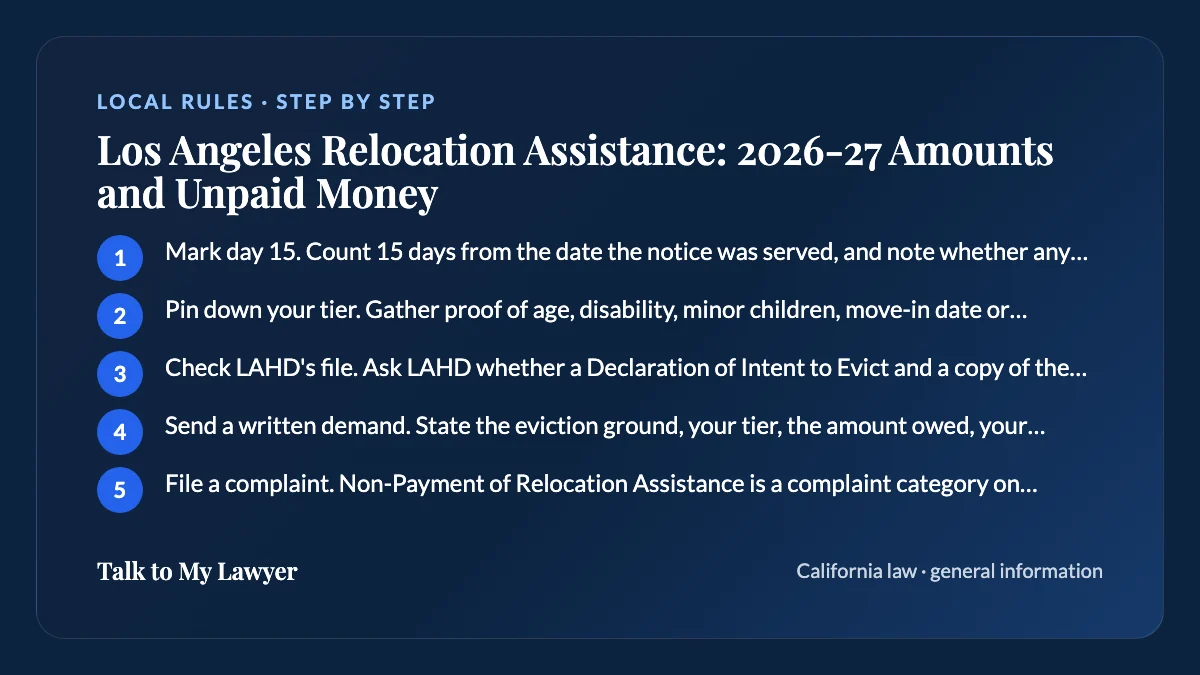
- Mark day 15. Count 15 days from the date the notice was served, and note whether any payment or escrow notice arrived.
- Pin down your tier. Gather proof of age, disability, minor children, move-in date or income for the household.
- Check LAHD's file. Ask LAHD whether a Declaration of Intent to Evict and a copy of the notice were filed.
- Send a written demand. State the eviction ground, your tier, the amount owed, your share and a payment date.
- File a complaint. Non-Payment of Relocation Assistance is a complaint category on LAHD's RSO and JCO complaint form.
- Keep the defense in mind. In an eviction case, failure to pay relocation assistance is an affirmative defense for RSO and JCO units.
On March 2, 2027 you served a 60-day notice to terminate my tenancy for owner occupancy. Our household has lived in the unit since 2022 and includes a tenant over 62, so the relocation amount under LAMC section 151.09 G is $27,400. No payment or escrow notice was provided by March 17, 2027. Please pay the full amount, shared equally among the three tenants, by March 31, 2027.
For RSO units, a landlord who does not pay is liable in a civil action for the unpaid amount plus reasonable attorney fees and costs (LAMC section 151.09 H). For JCO units, a tenant who prevails under section 165.07 is awarded three times compensatory damages (which can include the unpaid relocation money), a civil penalty between $2,000 and $10,000 for each violation, and attorney fees. Pressure to leave without the money can also count as harassment under the Los Angeles tenant anti-harassment ordinance.
When an attorney-written relocation demand makes sense
A fight over unpaid relocation money can come down to the tier: the landlord pays the eligible amount, and the household believes it is qualified or low income. An attorney-written demand can set out the eviction ground, the tier, the code section and the exact share each tenant is owed, which is useful when roommates, an escrow company and a property manager are all involved.
Through Talk to My Lawyer, a licensed California attorney writes your letter from your termination notice, lease and household documents, and sends it on your behalf. If you have already been served with an eviction lawsuit, LAHD notes that the court response is due within ten business days, so get legal advice right away.
Frequently asked questions
How much is relocation assistance in Los Angeles in 2026?
For no-fault evictions in the 2026-27 year, LAHD's chart lists $11,000 or $14,400 for eligible households and $23,150 or $27,400 for qualified households, with the higher figures for tenancies of three years or more or low-income households. Owners who meet the mom-and-pop conditions pay $10,550 or $21,250 for an owner or family move-in.
Who is a qualified tenant for LA relocation assistance?
A qualified tenant is someone who, on the date the termination notice is served, is 62 or older, is disabled under state or federal definitions, or has at least one minor dependent child. A household with a qualified tenant receives the higher qualified amounts. Every other tenant is an eligible tenant, whose amount depends on length of tenancy and income.
Do I get relocation money if I am evicted for not paying rent?
No. Los Angeles relocation assistance applies to no-fault evictions, such as owner move-ins, Ellis Act withdrawals, demolitions and government orders to vacate. At-fault evictions, including nonpayment of rent and lease violations, do not trigger it. A landlord can also subtract unpaid rent from a relocation payment in most no-fault cases.
When must my landlord pay relocation assistance in LA?
Within 15 days after serving the written notice that ends the tenancy. The landlord may pay you directly or put the money in an escrow account. An escrow must cover actual moving expenses on request within three working days, and the rest is released when you move out.
What can I do if my landlord refuses to pay relocation assistance?
You can send a written demand, file a Non-Payment of Relocation Assistance complaint with LAHD and raise the nonpayment as a defense in any eviction case. For RSO units, the code lets you sue for the unpaid amount plus attorney fees. For units under the Just Cause Ordinance, a court can award three times compensatory damages and civil penalties.
Sources
Checked against these official sources on October 18, 2026.
- Relocation Assistance Bulletin: No-Fault Evictions Under the RSO and JCO (Chart A, July 1, 2026 to June 30, 2027) (Los Angeles Housing Department)
- Relocation Assistance Information (Los Angeles Housing Department)
- LAMC Section 151.09 Evictions (City of Los Angeles (American Legal Publishing))
- LAMC Section 165.06 Relocation Assistance (City of Los Angeles (American Legal Publishing))
- LAMC Section 165.09 Relocation Assistance for Economic Displacement (City of Los Angeles (American Legal Publishing))
- LAMC Section 165.07 Remedies (City of Los Angeles (American Legal Publishing))
This guide explains California law in general terms as of October 2026. It is general information, not legal advice for your situation, and local rules can add to it.
Join the email list and get a lawyer letter started
With Talk to My Lawyer, a licensed California attorney writes your letter from your facts and documents and sends it on your behalf. Join the Talk to My Lawyer email list for letter checklists, document prompts, and reminders before you start your letter.