Quick answer
The covenant of quiet enjoyment in California comes from Civil Code section 1927, which binds a landlord to secure the tenant's quiet possession of the rental. For a tenant, it means protection from serious interference with the use of the home, including landlord harassment that Civil Code section 1940.2 ties directly to section 1927. Ordinary living noise is not a breach; repeated, substantial disturbance can be.
At a glance
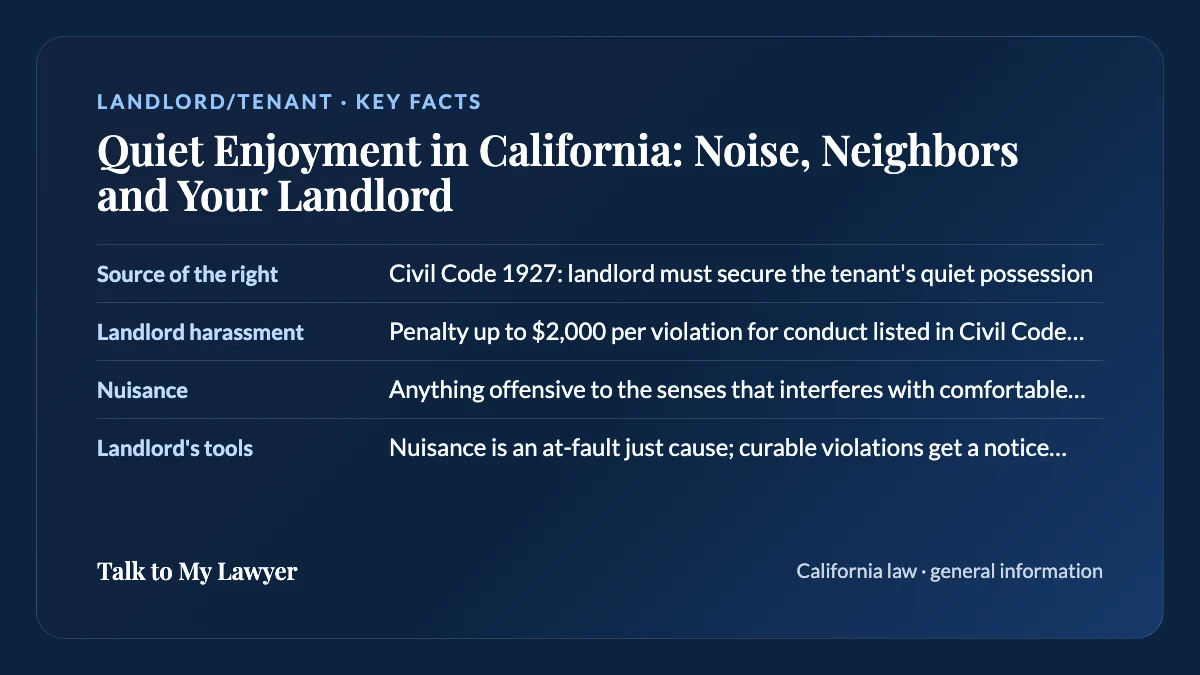
- Source of the right
- Civil Code 1927: landlord must secure the tenant's quiet possession
- Landlord harassment
- Penalty up to $2,000 per violation for conduct listed in Civil Code 1940.2
- Nuisance
- Anything offensive to the senses that interferes with comfortable enjoyment (Civil Code 3479)
- Landlord's tools
- Nuisance is an at-fault just cause; curable violations get a notice to fix first (Civil Code 1946.2)
- Small claims
- Up to $12,500 for individuals (CCP 116.221)
What is the covenant of quiet enjoyment in California?
It is a promise built into every lease. Civil Code section 1927, unchanged since 1872, says an agreement to rent property binds the landlord to secure to the tenant "the quiet possession of the thing hired during the term of the hiring." In plain terms, renting you a home includes a promise that you get to use it.
"Quiet" here means undisturbed, not silent. The covenant is about substantial interference with your possession and use of the unit. A neighbor's footsteps, a baby crying or daytime vacuuming are part of apartment life. Nightly parties that keep you awake, a landlord who keeps showing up unannounced, or construction that makes rooms unusable are different.
The Legislature has also linked the covenant to landlord harassment. Civil Code section 1940.2(a)(3) makes it unlawful for a landlord, in order to push a tenant to leave, to use or threaten force, willful threats or menacing conduct amounting to a course of conduct that interferes with the tenant's quiet enjoyment under section 1927 and would make a reasonable person fear harm.
Which kind of disturbance are you dealing with?
The right letter depends on who is causing the problem. This table matches common situations with the rules that fit them.
| Problem | Rule that fits | Who to write to |
|---|---|---|
| Another tenant's late-night noise | Lease rules, nuisance (Civil Code 3479), landlord's covenant | The landlord, and possibly the neighbor |
| Landlord threats or pressure to move | Civil Code 1940.2 and 1927 | The landlord |
| Repeated entries without notice | Civil Code 1954 | The landlord |
| Building construction or renovation | Lease terms, local noise rules, entry rules for work inside your unit | The landlord |
| Smoke or odors from another unit | Nuisance (Civil Code 3479) and lease rules | The landlord |
| A neighbor in a separate building | Nuisance law and local ordinances | The neighbor directly |
For a neighbor who is not your landlord's tenant, see our guide to neighbor harassment in California. For a landlord who keeps letting itself in, see our guide to California's landlord entry rules.
Is your landlord responsible for noisy neighbors?
It depends on your lease and the facts, but your landlord has legal tools that you do not. A lease may include quiet hours or rules against disturbing other residents. When another tenant breaks those rules, the landlord can enforce them.
- Under the Tenant Protection Act, Civil Code section 1946.2(b)(1)(C), maintaining or permitting a nuisance is an at-fault just cause for ending a tenancy.
- Breach of a material lease term, including after a written notice to correct, is also an at-fault cause (section 1946.2(b)(1)(B)).
- For a curable violation, section 1946.2(c) requires the landlord to give a notice and a chance to cure before a notice to quit.
- Code of Civil Procedure section 1161(4) lists maintaining a nuisance among the grounds for a three-day notice to quit.
Your letter does not need to ask for an eviction. A request that the landlord enforce the lease's noise rules, send a written warning and follow up is a reasonable place to start. Section 1940.2(c) confirms that a good-faith oral or written warning to a tenant about lease or rule violations does not violate that section, so a warning to your neighbor is not harassment under it.
Keep a noise log your landlord can act on
A single complaint gives a landlord little to act on. A dated log gives it specifics to put in a warning to the other tenant. Track:
- Date, start time and end time of each incident.
- What you heard or smelled and which unit it came from, if you know.
- How it affected you: woke you at 2 a.m., could not work from home, child could not sleep.
- Short audio or video clips from inside your unit, where lawful.
- Any police or security call numbers, and any building rules you referred to.
- Every report you sent the landlord and any reply.
Quiet hours, if any, come from your lease and your city or county noise ordinance, so look up both and cite them.
How to write a quiet enjoyment letter to your landlord
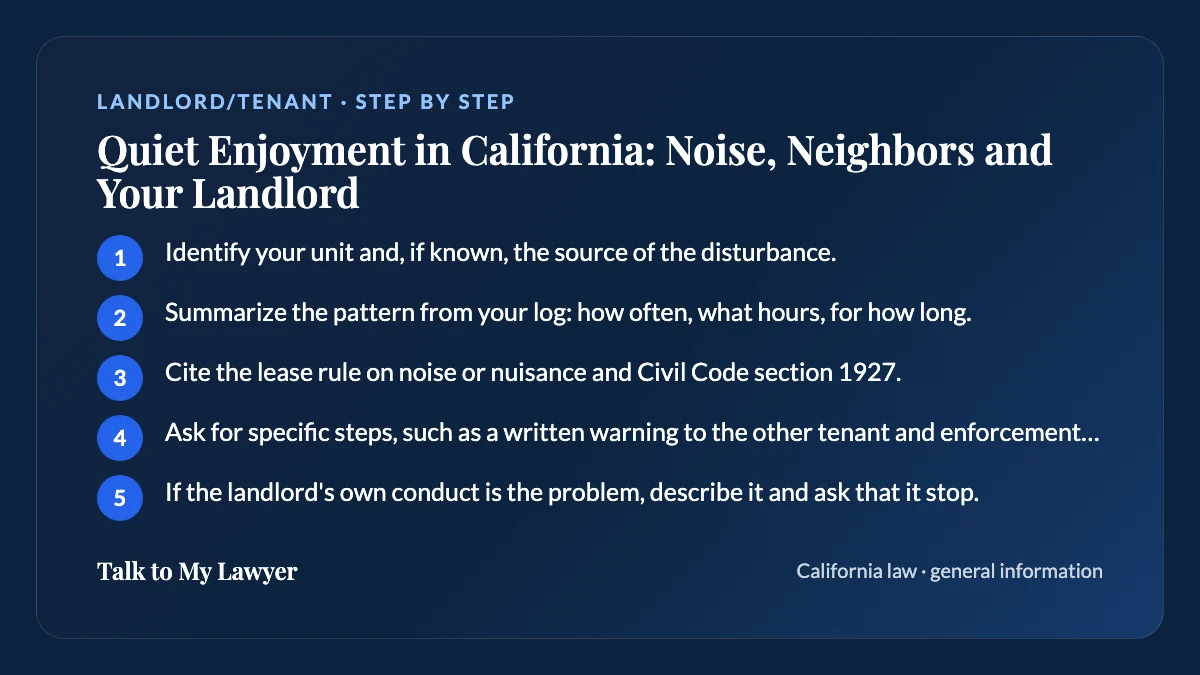
- Identify your unit and, if known, the source of the disturbance.
- Summarize the pattern from your log: how often, what hours, for how long.
- Cite the lease rule on noise or nuisance and Civil Code section 1927.
- Ask for specific steps, such as a written warning to the other tenant and enforcement of quiet hours.
- If the landlord's own conduct is the problem, describe it and ask that it stop.
- Request a written reply by a date, such as 10 days out.
- Attach the log and keep proof of delivery.
Since September 1, loud music and shouting from Unit 3B, directly above my unit, have continued past midnight on at least 14 nights, most recently on October 9 from 11:40 p.m. to 2:15 a.m. A log is attached. Section 12 of our lease sets quiet hours from 10 p.m. to 8 a.m. and prohibits disturbing other residents. Under Civil Code section 1927, my lease includes the right to quiet possession of my home. Please send a written warning to the occupants of Unit 3B, enforce the quiet hours, and let me know by October 20 what steps you have taken.
Can you get a rent reduction for a breach of quiet enjoyment?
No statute sets a rent reduction for noise. You can ask your landlord for a rent credit in writing, and a landlord may agree. If the dispute goes to court, a tenant can ask for damages for the interference, and what a court awards depends on the facts and the proof.
Some conduct carries a set penalty. Under section 1940.2(b), a tenant who wins a case, including in small claims, over the landlord conduct that section lists can recover a civil penalty of up to $2,000 for each violation. The small claims limit for an individual is $12,500 under Code of Civil Procedure section 116.221.
Civil Code section 1942.5(d) makes it unlawful for a landlord to raise rent, cut services or threaten eviction to retaliate against a tenant for lawfully exercising legal rights, which includes complaining in good faith.
When an attorney-written quiet enjoyment letter makes sense
When weeks of logged 2 a.m. noise have drawn no reply, when the disturbance comes from the landlord or its own staff, or when construction has shut you out of part of the unit, an attorney-written letter can connect your log to section 1927 and the lease terms. It can also ask for a rent credit or compensation in specific figures.
Through Talk to My Lawyer, a licensed California attorney writes your letter from your log, lease and messages, cites section 1927 and the other rules that fit, and sends it on your behalf. Talk to a lawyer about your own facts before you withhold rent or end the lease.
Frequently asked questions
Does the covenant of quiet enjoyment mean my apartment must be silent?
No. The word quiet refers to undisturbed possession, not an absence of sound. Ordinary living noise from neighbors is part of renting in a shared building. The covenant in Civil Code section 1927 is concerned with substantial interference with your use of the home, such as repeated late-night disturbances, harassment or conditions that make rooms unusable.
Can my landlord evict a noisy tenant in California?
A landlord can end a tenancy for at-fault just cause under Civil Code section 1946.2, which includes maintaining or permitting a nuisance and breaching a material lease term after a written notice to correct. For curable violations, the landlord must give a notice with a chance to cure first. Whether eviction is appropriate is the landlord's decision; your letter can ask for enforcement of the lease.
Is landlord harassment a breach of quiet enjoyment?
It can be. Civil Code section 1940.2 makes it unlawful for a landlord, to pressure a tenant to leave, to use a course of force, threats or menacing conduct that interferes with quiet enjoyment under section 1927, to significantly and intentionally violate the entry rules, or to threaten to disclose a tenant's immigration or citizenship status. A tenant who prevails can recover a penalty of up to $2,000 for each violation.
Can I break my lease because of noise?
None of the statutes discussed in this guide gives a tenant a right to end a lease early because of noise. If you leave, the landlord's ability to collect future rent is limited by Civil Code section 1951.2 to losses that could not reasonably be avoided. Before leaving, get legal advice; our guide to breaking a lease early in California explains the rules.
Will complaining about noise get me evicted?
Civil Code section 1942.5(d) makes it unlawful for a landlord to raise rent, decrease services, cause a tenant to leave or threaten those acts in retaliation for the tenant's lawful and peaceful exercise of legal rights. The tenant bears the burden of producing evidence that the conduct was retaliatory, so keep copies of your complaints and the dates of anything that follows.
Sources
Checked against these official sources on October 18, 2026.
- California Civil Code section 1927 (California Legislative Information)
- California Civil Code section 1940.2 (California Legislative Information)
- California Civil Code section 3479 (California Legislative Information)
- California Civil Code section 1946.2 (California Legislative Information)
- California Civil Code section 1942.5 (California Legislative Information)
- California Code of Civil Procedure section 116.221 (California Legislative Information)
This guide explains California law in general terms as of October 2026. It is general information, not legal advice for your situation, and local rules can add to it.
Join the email list and get a lawyer letter started
With Talk to My Lawyer, a licensed California attorney writes your letter from your facts and documents and sends it on your behalf. Join the Talk to My Lawyer email list for letter checklists, document prompts, and reminders before you start your letter.