Quick answer
Breaking a lease early in California does not automatically mean paying every remaining month. Under Civil Code section 1951.2, the landlord can recover unpaid rent and other losses, minus any rent loss you prove could reasonably have been avoided, which in practice means re-renting the unit. Tenants leaving because of domestic violence and certain other crimes (section 1946.7) or qualifying military orders have special termination rights.
At a glance
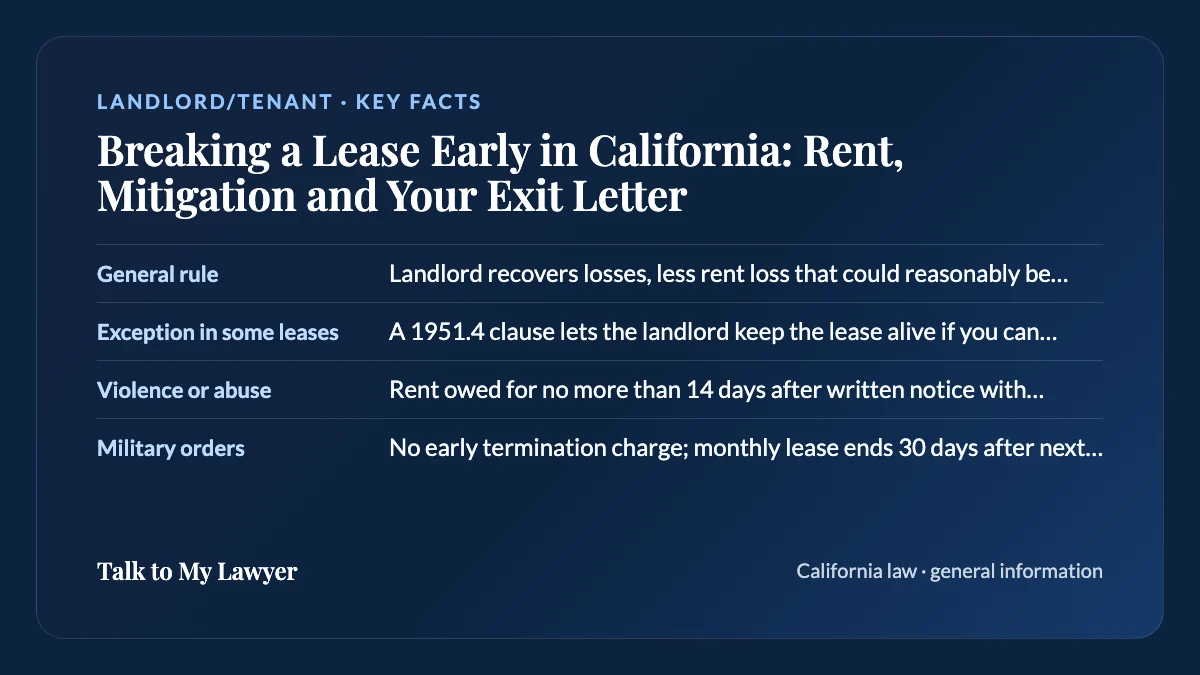
- General rule
- Landlord recovers losses, less rent loss that could reasonably be avoided (Civil Code 1951.2)
- Exception in some leases
- A 1951.4 clause lets the landlord keep the lease alive if you can sublet or assign
- Violence or abuse
- Rent owed for no more than 14 days after written notice with documents (Civil Code 1946.7)
- Military orders
- No early termination charge; monthly lease ends 30 days after next rent due (50 U.S.C. 3955)
- Untenantable unit
- Tenant may vacate after the landlord neglects repairs following notice (Civil Code 1942)
What happens if you break a lease early in California?
If you leave before the term ends and the landlord treats the lease as over, Civil Code section 1951.2 allows the landlord to recover the rent you owed up to that point, plus later rent losses minus the amount you prove could reasonably have been avoided, plus other losses caused by your early exit.
That middle phrase is what tenants mean by the landlord's duty to mitigate. Rent lost because a landlord left a rentable unit empty for months is the kind of loss a tenant can argue was avoidable. Notice that the statute puts the burden on you, the tenant, to prove what loss was avoidable, so records of the unit's re-listing matter.
Section 1951.2 also says the landlord's efforts to re-rent do not waive its right to recover damages. Re-listing the unit is not the landlord forgiving you; it is the landlord reducing what you may owe.
Read your lease before you do anything else
Three kinds of clauses change the math.
- A section 1951.4 clause. If the lease says the landlord has the remedy in Civil Code section 1951.4, and you are allowed to sublet or assign (subject to reasonable limits), the landlord can keep the lease in effect and collect rent as it comes due. Finding a qualified replacement then becomes your best tool.
- Early termination or buyout terms. Some leases set a fee or notice period for leaving early. Whether a particular fee is enforceable depends on its wording and your facts.
- Subletting and assignment terms. These tell you whether you can hand the lease to someone else and what approval you need.
If you rent month to month, there is no remaining term to break. Civil Code section 1946.1 says a tenant gives notice at least as long as the rental period, so 30 days for a monthly tenancy.
Example: what early exit can cost
Example (hypothetical): a tenant pays $2,000 a month on a 12-month lease with six months left. She gives 30 days' written notice, moves out on March 31 and returns the keys. The landlord lists the unit on April 3 and a new tenant moves in May 6 at the same rent.
| Item | Amount | Why |
|---|---|---|
| Rent through March 31 | Paid | Owed under the lease |
| April 1 to May 5 | About $2,320 | Rent lost while the unit sat empty for about five weeks |
| Reasonable re-listing costs | Varies | Section 1951.2(a)(4) covers other losses caused by the breach |
| May 6 to end of lease | $0 | The new tenant's rent covers it |
If the landlord instead kept the unit off the market for months, the tenant would argue that most of that loss was avoidable. Her deposit can be applied to unpaid rent under Civil Code section 1950.5, and the landlord still has 21 days after move-out to send an itemized statement.
When can you end a California lease early without owing the rest?
Several laws let a tenant end a lease with limited or no liability for future rent. Each has strict conditions.
| Situation | What the law provides | Key conditions |
|---|---|---|
| Domestic violence, sexual assault, stalking, human trafficking, elder abuse or certain violent crimes (Civil Code 1946.7) | Rent owed for no more than 14 calendar days after notice; no forfeit of the deposit because of the termination | Written notice within 180 days of the order, report or act, with a protective order, police report, qualified third-party statement or other documentation |
| Military service or orders (50 U.S.C. 3955) | No early termination charge; prepaid rent refunded within 30 days | Entering service after signing, or orders for a permanent change of station or deployment of at least 90 days; written notice with a copy of the orders |
| Uninhabitable unit (Civil Code 1942) | Tenant may vacate and owe no further rent after the landlord neglects the repair | Notice to the landlord, a reasonable time to repair, and conditions that make the unit untenantable |
Under the federal Servicemembers Civil Relief Act, a lease with monthly rent ends 30 days after the first date on which the next rental payment is due after notice is delivered. If mold, pests or other defects are the reason you want out, start with a written repair request; see our guides on mold in a California rental and landlord repair demand letters.
How to write an early lease termination letter
Your letter should give clear notice, show you are trying to limit the landlord's loss, and protect your deposit.
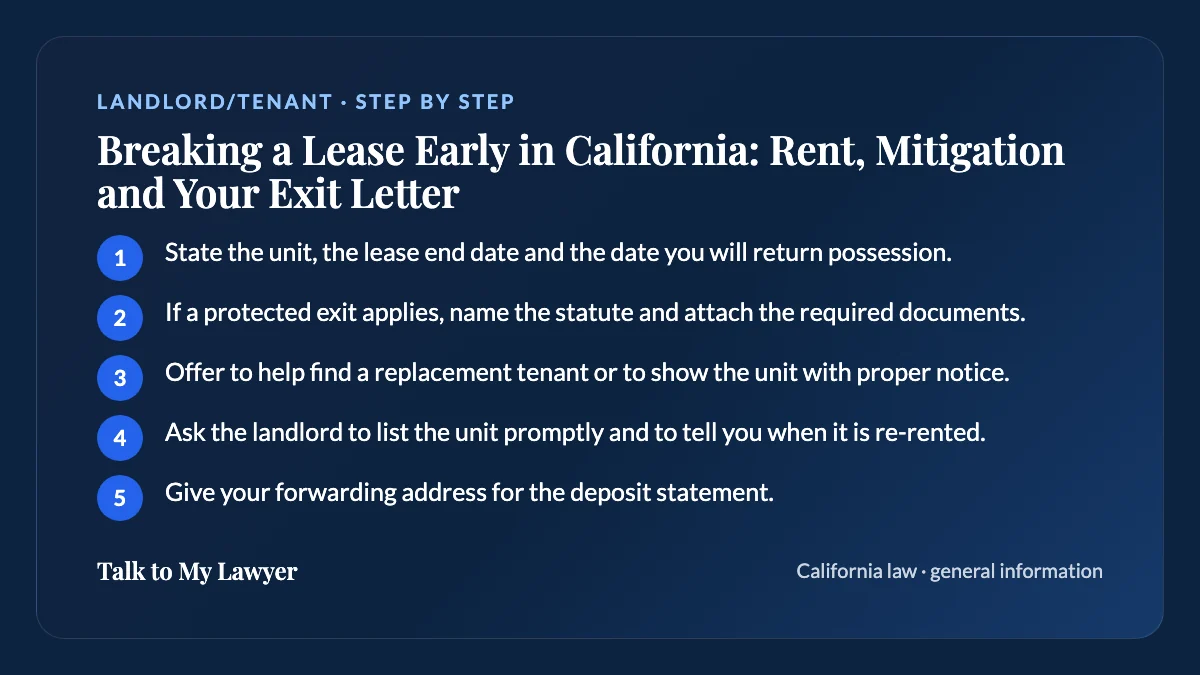
- State the unit, the lease end date and the date you will return possession.
- If a protected exit applies, name the statute and attach the required documents.
- Offer to help find a replacement tenant or to show the unit with proper notice.
- Ask the landlord to list the unit promptly and to tell you when it is re-rented.
- Give your forwarding address for the deposit statement.
- Propose a written release or buyout if you want a clean break.
- Use a delivery method that gives you proof of receipt, and keep a copy.
I am writing to give notice that I will move out of 220 Mission Lane, Unit 5, and return all keys on March 31, before my lease ends on September 30. I understand that under Civil Code section 1951.2 you may recover rent losses that cannot reasonably be avoided. I am glad to show the unit to applicants with notice and have two people interested in applying. Please let me know when the unit is listed and when it is re-rented. My forwarding address for the security deposit statement is 18 Alder Way, Fresno, CA 93701.
Negotiating a release from the lease
A landlord may prefer a predictable exit to an empty unit and a dispute. A negotiated release, sometimes called a mutual termination agreement, can trade a set payment for a written promise that you owe nothing more.
- Put the agreed move-out date, the amount and the release of future rent in one signed document.
- State how the deposit will be handled, since the deposit rules still apply.
- If roommates stay behind, spell out who remains on the lease.
- Read any release fully before signing, and consider having a lawyer look at it.
If the landlord later sends a bill for the full remaining term, our guide on how to respond to a demand letter explains how to answer in writing.
When an attorney-written lease letter makes sense
Consider an attorney-written letter when money or safety rides on the exit: a landlord's bill for every month left on the term, a move for safety that has to be documented under section 1946.7, military orders that arrived mid-lease, or a buyout that needs firm written terms.
Through Talk to My Lawyer, a licensed California attorney writes your letter from your lease, dates and documents, cites the rules that fit your exit, and sends it on your behalf. A lawyer who has read your lease can tell you how much, if anything, you may still owe.
Frequently asked questions
Can my landlord charge me rent for the rest of the lease if I move out early?
Not automatically. Under Civil Code section 1951.2, the landlord can recover lost rent only to the extent it exceeds what the tenant proves could reasonably have been avoided, plus other losses the breach caused. If the unit could have been re-rented quickly, that limits what you owe. A lease with a section 1951.4 clause works differently, so read yours.
Is there a legal way to break a lease in California?
Yes, in specific situations. Civil Code section 1946.7 lets tenants who are victims of domestic violence and certain other crimes end a lease with written notice and documentation, owing rent for no more than 14 days. Service members with qualifying orders can terminate under 50 U.S.C. section 3955. A tenant may also vacate an untenantable unit after the landlord neglects repairs, under section 1942.
How much notice do I need to end a month-to-month rental in California?
Civil Code section 1946.1 says a tenant must give notice at least as long as the rental period, so at least 30 days for a month-to-month tenancy. Landlords face longer notice periods and, for many tenancies, just-cause rules. Give the notice in writing and keep proof of when the landlord received it.
Can my landlord keep my deposit if I break my lease?
The deposit can be applied to rent you actually owe, along with damage beyond ordinary wear and tear and needed cleaning, under Civil Code section 1950.5. The landlord must still send an itemized statement within 21 days after you move out. If you ended the lease under section 1946.7, the landlord cannot require you to forfeit the deposit because of the termination.
Does the military lease termination right cover every service member?
It covers leases signed before entering service, and leases signed during service when the member later receives orders for a permanent change of station or a deployment of at least 90 days. Written notice with a copy of the orders is required. The landlord may not impose an early termination charge, and rent paid in advance must be refunded within 30 days.
Sources
Checked against these official sources on October 18, 2026.
- California Civil Code section 1951.2 (California Legislative Information)
- California Civil Code section 1951.4 (California Legislative Information)
- California Civil Code section 1946.7 (California Legislative Information)
- 50 U.S. Code section 3955 (Legal Information Institute, Cornell Law School)
- California Civil Code section 1942 (California Legislative Information)
- California Civil Code section 1950.5 (California Legislative Information)
This guide explains California law in general terms as of October 2026. It is general information, not legal advice for your situation, and local rules can add to it.
Join the email list and get a lawyer letter started
With Talk to My Lawyer, a licensed California attorney writes your letter from your facts and documents and sends it on your behalf. Join the Talk to My Lawyer email list for letter checklists, document prompts, and reminders before you start your letter.