Quick answer
Mold in an apartment is a landlord repair issue in California when it reaches the level the law calls substandard. Health and Safety Code section 17920.3 lists visible mold growth, as determined by a health officer or code enforcement officer, and dampness of habitable rooms as substandard conditions. Civil Code section 1941.1 makes such a unit untenantable, so the landlord must repair it after notice.
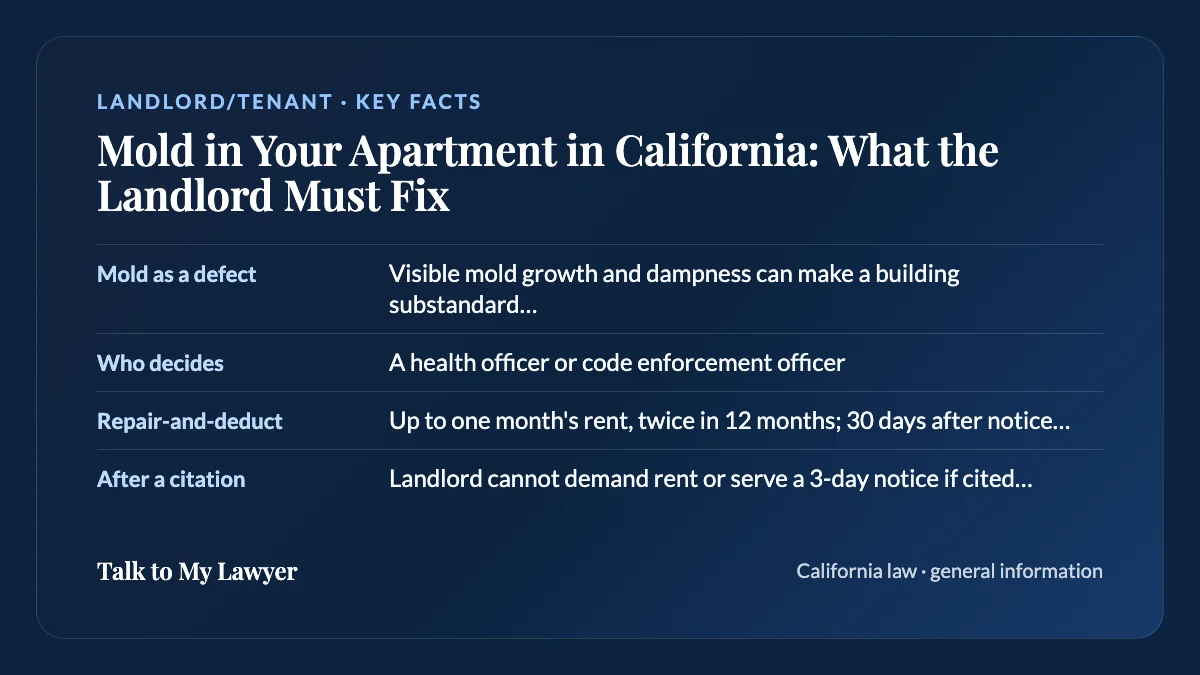
At a glance
- Mold as a defect
- Visible mold growth and dampness can make a building substandard (H&S Code 17920.3(a)(11), (a)(13))
- Who decides
- A health officer or code enforcement officer
- Repair-and-deduct
- Up to one month's rent, twice in 12 months; 30 days after notice presumed reasonable (Civil Code 1942)
- After a citation
- Landlord cannot demand rent or serve a 3-day notice if cited conditions stay unfixed 35 days (Civil Code 1942.4)
- Retaliation
- Protected for 180 days after a good-faith complaint (Civil Code 1942.5)
Is mold in an apartment the landlord's responsibility in California?
Yes, once it rises to the level state law calls substandard. Health and Safety Code section 17920.3 lists conditions that make a building substandard when they endanger the health or safety of the people living there. Two of them matter for mold: dampness of habitable rooms (subdivision (a)(11)) and visible mold growth (subdivision (a)(13)).
Civil Code section 1941.1 then treats any unit described in section 17920.3 as untenantable, which means unfit to live in. A landlord has to keep a rental tenantable, so a mold problem at that level becomes a repair the landlord owes you.
The statute carves out one thing: mold that is minor and found on surfaces that collect moisture as part of their normal use. A few dark spots on shower grout are a cleaning job. Mold spreading across a bedroom wall from a hidden leak is a different matter.
Who decides whether the mold makes your unit substandard?
Under section 17920.3(a)(13), last amended effective January 1, 2025, visible mold growth is determined by a health officer or a code enforcement officer. In practice that means your city or county building, housing or environmental health department.
The California Department of Public Health says its own Air Quality Section does not inspect homes or enforce housing codes. Its mold FAQ points tenants to local code enforcement and explains that a local inspector who cites a unit as substandard can require the landlord to fix it. CDPH also notes that finding the right agency can take some work, because code enforcement sits in different departments from city to city.
Does a California landlord have to disclose mold?
The Toxic Mold Protection Act contains two disclosure sections, but both are written to switch on only after state health officials take certain steps. Read them before you cite them in a letter.
- Health and Safety Code section 26147 requires written disclosure to current and prospective tenants when the landlord knows or has reason to believe mold is present that exceeds permissible exposure limits set by the department or poses a health threat under its guidelines. The section says it does not apply until the first January 1 or July 1 at least six months after the department adopts those standards and its remediation guidelines.
- Section 26148 requires landlords to give prospective tenants a department-approved consumer booklet on mold health risks, with the same kind of delayed start tied to the department's approval of that booklet.
- Section 26147 also says a landlord is not required to run air or surface tests.
CDPH's current guidance says there are no recommended unhealthy levels for mold, which bears on whether the exposure-limit trigger in section 26147 has been met. Whether a disclosure claim fits your facts is something to ask a lawyer about. The habitability rules above apply either way.
What to document before you write
Mold disputes turn on three questions: what is growing, where the water is coming from, and when the landlord found out. Build your file around those.
- Dated photos and short videos of each patch, with something in the frame for scale.
- Photos of the likely moisture source: a dripping supply line, a stained ceiling under an upstairs bathroom, a window that leaks in rain.
- A simple log of when you first noticed it, when it grew and any musty smell.
- Copies of every text, email, portal request or letter you sent, and any reply.
- Notes from any doctor visit if you or a household member had symptoms you connect to the mold.
- Receipts for anything you had to throw out or replace, such as a mattress or clothing.
Keep the log factual. A record that says "March 4: patch above bed now about 18 inches wide, ceiling stain darker after rain" is more useful than a description of how upsetting it is.
How to write a mold repair request letter
A mold letter has one job: put the landlord on written notice of a specific condition and ask for a repair that fixes the cause, with access arranged. Keep it short and dated.
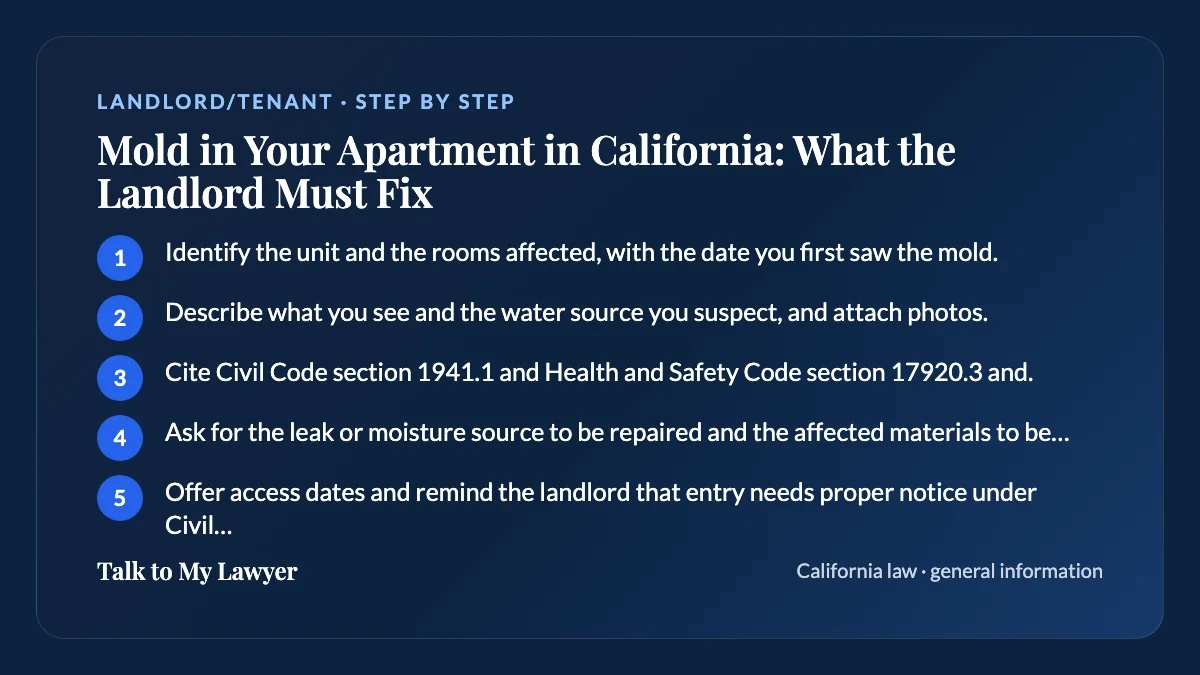
- Identify the unit and the rooms affected, with the date you first saw the mold.
- Describe what you see and the water source you suspect, and attach photos.
- Cite Civil Code section 1941.1 and Health and Safety Code section 17920.3(a)(11) and (a)(13).
- Ask for the leak or moisture source to be repaired and the affected materials to be cleaned or removed.
- Offer access dates and remind the landlord that entry needs proper notice under Civil Code section 1954.
- Ask for a written reply by a set date, such as 10 days, with a repair schedule.
- Keep a copy and proof of delivery, such as a certified mail receipt or the portal confirmation.
Mold is growing on the north wall of the back bedroom and inside the hall closet at 77 Laurel Court, Unit 4. I first reported it through the portal on February 2. The patch has grown to about two feet wide and the wall is damp after each rain, which suggests a leak from the exterior wall or window. Visible mold growth and dampness of habitable rooms are substandard conditions under Health and Safety Code section 17920.3 and make a unit untenantable under Civil Code section 1941.1. Please repair the source of the moisture and remove the affected materials. I am available for entry on March 10, 11 or 12 after written notice. Please reply with a repair date by March 6.
If other repairs are also outstanding, our broader guide to repair demand letters for California tenants covers heat, hot water, leaks and the full list of minimum standards.
What if the landlord does not fix the mold?
California law gives tenants several routes, each with its own conditions. None of them is automatic, and some carry real risk if the facts do not line up.
| Route | What the statute says | Watch for |
|---|---|---|
| Code enforcement | A local inspector can cite the unit as substandard and order repairs | Ask for a copy of the inspection report or notice |
| Rent protections after a citation | After an inspector's written notice, conditions left unabated for 35 days without good cause bar the landlord from collecting rent, raising it or serving a pay-or-quit notice (Civil Code 1942.4) | Damages of $100 to $5,000 plus actual damages; claims can go to small claims |
| Repair and deduct | Tenant may repair and deduct up to one month's rent, no more than twice in 12 months; acting after 30 days is presumed reasonable (Civil Code 1942) | Proper mold work can cost more than one month's rent |
| Move out | Section 1942 also lets a tenant vacate and stop owing rent after the landlord neglects the repair | Talk to a lawyer first, and see breaking a lease early |
One limit applies across the board. Under Civil Code sections 1941.2 and 1942(c), the landlord's repair duty and the repair-and-deduct remedy do not apply when the tenant's own substantial violation, such as misusing plumbing fixtures, contributed substantially to the problem.
Can your landlord retaliate after a mold complaint?
Civil Code section 1942.5 bars a landlord from evicting you, raising rent or cutting services within 180 days after a good-faith complaint about habitability, a complaint to a housing agency, or an inspection or citation that followed one, if you are not behind on rent. A tenant can use that 180-day protection once in any 12-month period.
A landlord who retaliates can owe actual damages and, where fraud, oppression or malice is shown, punitive damages of $100 to $2,000 for each retaliatory act. The statute still allows an eviction or increase when the landlord's notice states a lawful reason in good faith, so keep paying rent and keep your records in order.
When an attorney-written mold letter makes sense
Mold that reappears a few weeks after every wipe-down points to a moisture source nobody has fixed. When that happens, or when someone in the household has health concerns, belongings have been ruined, or the landlord answers your complaint with a rent increase or a notice, an attorney-written letter can put the habitability rules and your evidence in front of the landlord together.
Through Talk to My Lawyer, a licensed California attorney writes your letter from your photos, log and messages, sets out the habitability rules that apply to your unit, and sends it on your behalf. Repair-and-deduct, withholding and moving out each carry risk, so get advice from a lawyer on your own facts before using them.
Frequently asked questions
How long does a landlord have to fix mold in California?
No statute sets one deadline for mold. The landlord must repair within a reasonable time after notice. For repair-and-deduct, a tenant who acts after the 30th day following notice is presumed to have waited long enough under Civil Code section 1942. If a housing inspector cites the unit and the conditions stay unfixed for 35 days without good cause, section 1942.4 limits the landlord's right to collect rent.
Is black mold treated differently under California law?
No. Section 17920.3 refers to visible mold growth, not to a color or species. CDPH's guidance says any mold you can see or smell indoors is a health risk that should be fixed, and that identifying the species does not add useful information when the mold is already visible. The focus in a repair letter is the extent of the growth and the moisture causing it.
Can I withhold rent because of mold?
Withholding is risky without legal advice, because unpaid rent can lead to a 3-day notice. California does give specific protection after official action: under Civil Code section 1942.4, once a housing official has notified the landlord in writing and the conditions remain unabated for 35 days without good cause, the landlord may not demand or collect rent or serve a 3-day notice for nonpayment. Talk to a lawyer before holding back rent.
Can I sue my landlord for mold in small claims court?
Yes, for claims within the limit. Individuals can ask for up to $12,500 in California small claims court (Code of Civil Procedure section 116.221), and Civil Code section 1942.4 expressly allows its claims there. A claim might cover ruined belongings, rent paid for an untenantable unit or statutory damages. Bring your photos, your log and copies of every repair request.
What if the mold came from something I did?
The landlord's duty to repair does not arise when the tenant's substantial violation of basic obligations, such as keeping the unit clean and using fixtures properly, contributes substantially to the problem (Civil Code section 1941.2). If a hidden leak or a building defect caused the mold, that limit does not fit. Photos of the water source help show where the moisture came from.
Sources
Checked against these official sources on October 18, 2026.
- California Health and Safety Code section 17920.3 (California Legislative Information)
- California Civil Code section 1941.1 (California Legislative Information)
- California Health and Safety Code section 26147 (California Legislative Information)
- California Civil Code section 1942.4 (California Legislative Information)
- California Civil Code section 1942.5 (California Legislative Information)
- Frequently Asked Questions about Mold (California Department of Public Health)
This guide explains California law in general terms as of October 2026. It is general information, not legal advice for your situation, and local rules can add to it.
Join the email list and get a lawyer letter started
With Talk to My Lawyer, a licensed California attorney writes your letter from your facts and documents and sends it on your behalf. Join the Talk to My Lawyer email list for letter checklists, document prompts, and reminders before you start your letter.