Quick answer
In California, responsibility for bed bugs starts with the landlord's duty to keep a rental free of vermin (Civil Code section 1941.1), and a separate bed bug chapter (Civil Code sections 1954.600 to 1954.605) adds rules. A landlord cannot rent out a unit it knows is infested, must give tenants written bed bug information, and must share a pest control operator's findings in writing within two business days.
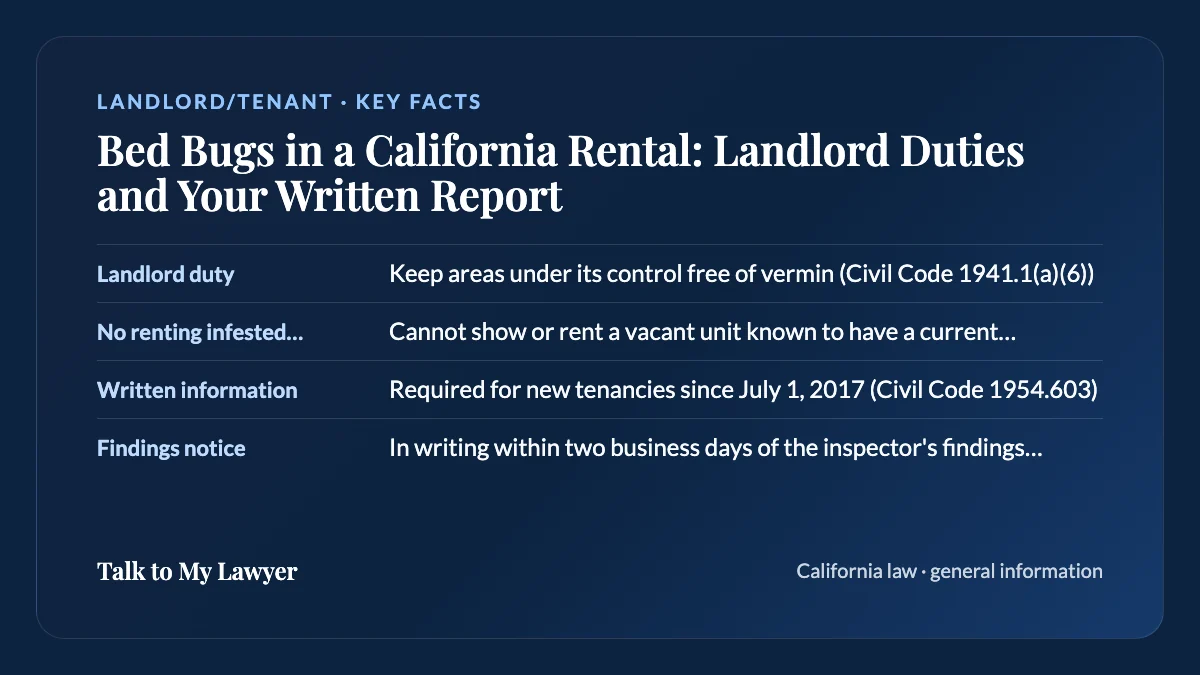
At a glance
- Landlord duty
- Keep areas under its control free of vermin (Civil Code 1941.1(a)(6))
- No renting infested units
- Cannot show or rent a vacant unit known to have a current infestation (Civil Code 1954.602)
- Written information
- Required for new tenancies since July 1, 2017 (Civil Code 1954.603)
- Findings notice
- In writing within two business days of the inspector's findings (Civil Code 1954.605)
- Retaliation
- Reporting a suspected infestation is protected (Civil Code 1942.5)
Who is responsible for bed bugs in a California rental?
The landlord carries the core duty. Civil Code section 1941.1 says a unit is untenantable if it substantially lacks clean, sanitary conditions free of rodents and vermin, both in the building and grounds at the start of the tenancy and in all areas under the landlord's control. Separately, the state housing law (Health and Safety Code section 17920.3, subdivision (a)(12)) lists an infestation of insects, vermin or rodents, as determined by a health officer or code enforcement officer, as a substandard condition.
The Legislature added a dedicated bed bug chapter in 2016, effective January 1, 2017 (Civil Code sections 1954.600 to 1954.605). Its findings say bed bugs are uniquely hard to control because their resistance to existing insecticides is significant, and that control works best when landlords, tenants and pest control operators cooperate. The chapter is built around that idea: early written reporting, licensed inspection and shared results.
Tenants have duties too. Under section 1941.2, the landlord's repair duty does not arise if a tenant's substantial failure to keep the unit clean and sanitary contributes substantially to the problem.
What California's bed bug law requires of landlords
| Rule | What it says | Section |
|---|---|---|
| No showing or renting | A landlord may not show, rent or lease a vacant unit it knows has a current bed bug infestation | 1954.602(a) |
| When the landlord has notice | No duty to inspect without notice, but an infestation evident on visual inspection counts as notice | 1954.602(b) |
| Written information | Before a new tenancy starts (since July 1, 2017), and to all other tenants by January 1, 2018: bed bug facts in at least 10-point type plus the procedure for reporting suspected infestations | 1954.603 |
| Inspection access | Entry follows section 1954; follow-up inspections of surrounding units until the bugs are gone count as a necessary service | 1954.604 |
| Sharing results | Tenants of inspected units get the findings in writing within two business days; all tenants get notice of confirmed common-area infestations | 1954.605 |
"Pest control operator" has a specific meaning here: someone holding a Branch 2 operator, field representative or applicator license from the Structural Pest Control Board (section 1954.601). The chapter does not set a fixed number of days for treatment, so the general habitability rules on a reasonable time apply.
Signs of bed bugs and what to record
The notice required by section 1954.603 lists common signs, which make a useful checklist for your own photos:
- Small red to reddish-brown fecal spots on mattresses, box springs, bed frames, linens, upholstery or walls.
- Molted skins, white sticky eggs or empty eggshells.
- A sweet odor in heavily infested areas.
- Red, itchy bite marks, though some people show no reaction at all.
Alongside those signs, keep a short record: the date you first noticed them, photos with a coin or ruler for scale, any bug you can capture in a sealed bag or clear tape, and copies of every message to the landlord. If neighbors mention bugs, note the unit numbers and dates. The statute's own notice stresses prompt written reporting, so put the first report in writing even if you also call.
How to write a bed bug report letter to your landlord
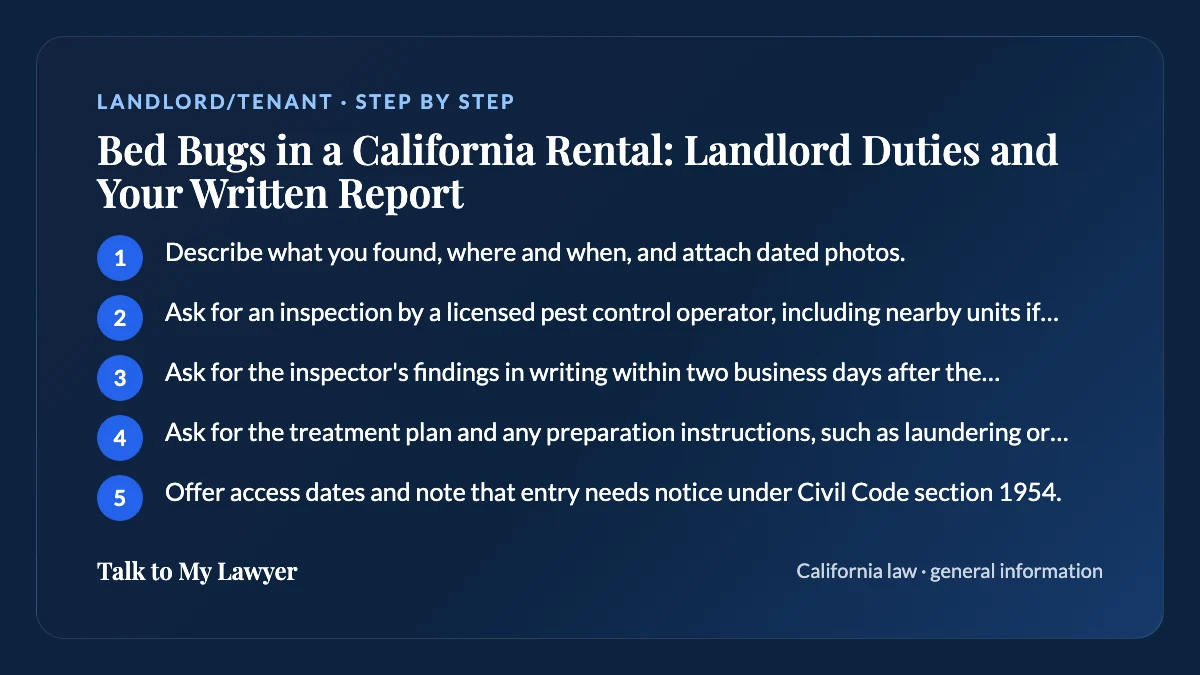
Your first written report does three things: it gives the landlord notice, it asks for a licensed inspection, and it confirms you will cooperate with treatment.
- Describe what you found, where and when, and attach dated photos.
- Ask for an inspection by a licensed pest control operator, including nearby units if the inspector recommends it.
- Ask for the inspector's findings in writing within two business days after the landlord receives them, as Civil Code section 1954.605 requires.
- Ask for the treatment plan and any preparation instructions, such as laundering or reducing clutter.
- Offer access dates and note that entry needs notice under Civil Code section 1954.
- Request a written reply by a set date.
I am writing to report a suspected bed bug infestation in Unit 12 at 900 Pine Street. On October 4 I found reddish-brown spots and two live insects along the seam of the bedroom mattress; photos are attached. Please arrange an inspection by a licensed pest control operator and provide the findings in writing within two business days of receiving them, as required by Civil Code section 1954.605. I will follow the operator's preparation instructions and am available for entry on October 9 or 10 after written notice. Please confirm the inspection date by October 8.
Do you have to let the exterminator in?
Yes, with proper notice. Section 1954.604 says tenants must cooperate with the inspection, including giving the pest control operator information needed to detect and treat the bugs. Entry must follow Civil Code section 1954:
- Written notice with the date, approximate time and purpose of entry.
- Twenty-four hours is presumed reasonable notice; notice mailed at least six days ahead is also presumed reasonable.
- Entry during normal business hours unless you agree otherwise at the time.
- You and the landlord can agree orally on a repair visit within one week, with the date and approximate time set.
Cooperation can mean prep work: washing and drying bedding and clothes, bagging items and clearing floor space. Ask for the instructions in writing so it is clear what was asked and what you did. If entries become repeated or improper, see our guide to a landlord entering without proper notice.
What if the landlord does not deal with the bed bugs?
If your written report goes unanswered, a follow-up letter can cite the bed bug chapter and section 1941.1. Beyond that, the general habitability tools apply:
- Local code enforcement or environmental health. An inspector can find an infestation under the state housing law's list of substandard conditions and notify the landlord.
- Civil Code section 1942.4. Once an inspector's written notice to the landlord has gone 35 days without the conditions being abated, and the delay lacks good cause, the landlord loses the right to collect rent, increase it or serve a pay-or-quit notice, and faces damages between $100 and $5,000.
- Civil Code section 1942. A tenant may pay for a repair and subtract it from rent, capped at one month's rent and two uses a year, once a reasonable time has passed; waiting past day 30 is presumed reasonable. Whole-building treatment can cost more than that cap, so get legal advice first.
Retaliation rules expressly cover this situation. Civil Code section 1942.5(a)(1) protects a tenant who in good faith has "provided notice of a suspected bed bug infestation," barring eviction, rent increases or reduced services within 180 days if the tenant is current on rent. If other repairs are waiting too, see how to demand repairs from a California landlord.
When an attorney-written bed bug letter makes sense
If the bugs return after every treatment because the units next door were never inspected, if the landlord has billed you for treatment you did not cause, or if a mattress and a closet of clothing have gone to the curb, an attorney-written letter can set out the facts and the bed bug chapter in one place. The same applies when a rent increase or notice follows your report.
Through Talk to My Lawyer, a licensed California attorney writes your letter from your photos, messages and inspection reports, points to the bed bug chapter and the habitability rules, and sends it on your behalf. Questions about holding back rent or leaving the unit are best taken to a lawyer before you act.
Frequently asked questions
Can a California landlord rent me an apartment that has bed bugs?
Not knowingly. Civil Code section 1954.602 says a landlord may not show, rent or lease to a prospective tenant a vacant unit the landlord knows has a current bed bug infestation. The landlord has no duty to inspect without notice, but if an infestation is evident on visual inspection, the law treats the landlord as having notice. Document what you find at move-in.
How fast does a landlord have to respond to bed bugs in California?
The bed bug chapter does not set a treatment deadline. It does require written notice of a pest control operator's findings within two business days of the landlord receiving them. The general habitability rules require repairs within a reasonable time after notice, and for repair-and-deduct, acting after 30 days is presumed reasonable under Civil Code section 1942.
Can I be evicted for reporting bed bugs?
Civil Code section 1942.5 treats a good-faith notice of a suspected bed bug infestation as protected activity. If you are not behind on rent, the landlord may not evict you, raise the rent or decrease services in retaliation within 180 days, and a retaliating landlord can owe damages. The protection does not stop a landlord who states a genuine, lawful ground in its notice.
Who pays for bed bug treatment in a California apartment?
The bed bug chapter does not assign treatment costs. The landlord must keep areas under its control free of vermin under section 1941.1, and that duty does not arise when a tenant's substantial failure to keep the unit clean contributed substantially to the problem (section 1941.2). Your lease may also address pest control. If you receive a bill, ask in writing what it is based on.
What written bed bug notice should I have received?
Since July 1, 2017, Civil Code section 1954.603 has required landlords to give prospective tenants a written notice, in at least 10-point type, with general information about bed bug identification, behavior and prevention, and the procedure for reporting suspected infestations. Existing tenants were to receive it by January 1, 2018. Check your lease packet for it.
Sources
Checked against these official sources on October 18, 2026.
- California Civil Code section 1954.602 (California Legislative Information)
- California Civil Code section 1954.603 (California Legislative Information)
- California Civil Code section 1954.604 (California Legislative Information)
- California Civil Code section 1954.605 (California Legislative Information)
- California Civil Code section 1954 (California Legislative Information)
- California Civil Code section 1942.5 (California Legislative Information)
This guide explains California law in general terms as of October 2026. It is general information, not legal advice for your situation, and local rules can add to it.
Join the email list and get a lawyer letter started
With Talk to My Lawyer, a licensed California attorney writes your letter from your facts and documents and sends it on your behalf. Join the Talk to My Lawyer email list for letter checklists, document prompts, and reminders before you start your letter.