Quick answer
In California, a reasonable accommodation request asks a landlord to change a rule, policy, practice or service because of a disability. Refusing a reasonable accommodation that may be necessary for equal use and enjoyment of a home is discrimination under the Fair Employment and Housing Act (Government Code section 12927) and the federal Fair Housing Act. The request can be oral or written, and landlords must consider it promptly.
At a glance
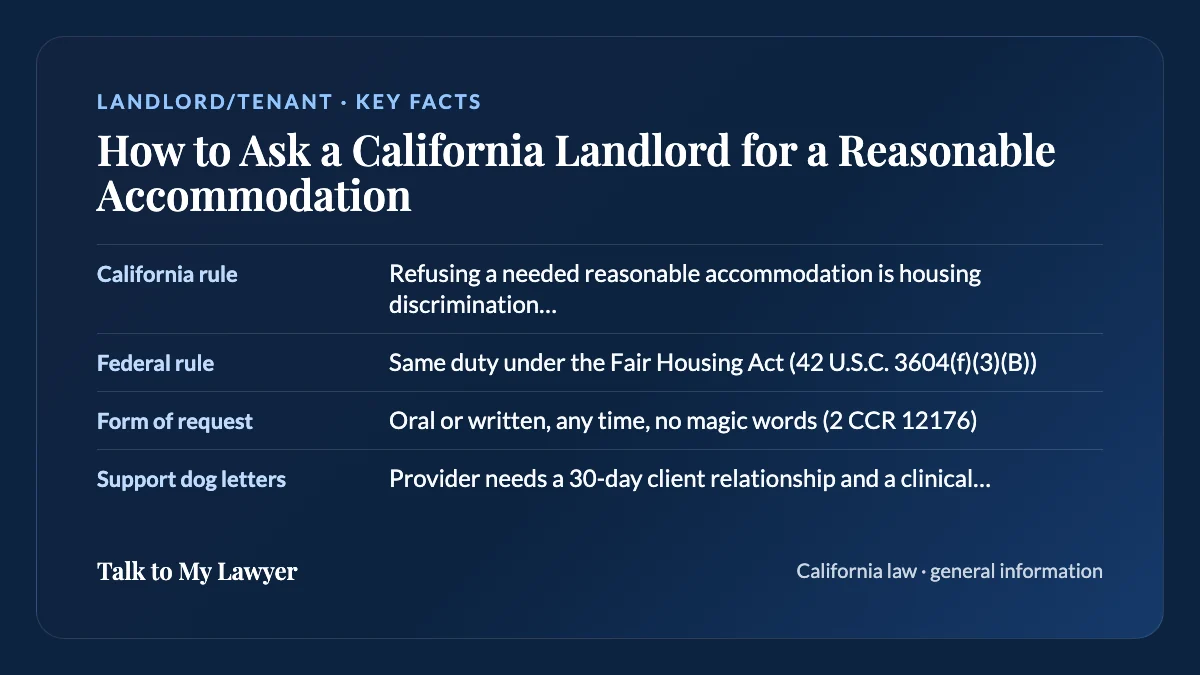
- California rule
- Refusing a needed reasonable accommodation is housing discrimination (Gov. Code 12927(c)(1))
- Federal rule
- Same duty under the Fair Housing Act (42 U.S.C. 3604(f)(3)(B))
- Form of request
- Oral or written, any time, no magic words (2 CCR 12176)
- Support dog letters
- Provider needs a 30-day client relationship and a clinical evaluation (H&S Code 122318)
- Complaint deadline
- Generally one year to file with the California Civil Rights Department
What counts as a reasonable accommodation from a California landlord?
A reasonable accommodation is an exception or change to a landlord's rules, policies, practices or services that a person with a disability may need for an equal opportunity to use and enjoy a home. California's Fair Employment and Housing Act lists the refusal to make one as a form of discrimination (Government Code section 12927(c)(1)), and the federal Fair Housing Act says the same (42 U.S.C. section 3604(f)(3)(B)).
A separate category, a reasonable modification, covers physical changes to the unit, such as grab bars or a wider doorway. Those are generally at the tenant's expense, and in a rental the landlord may, where reasonable, ask you to restore the interior when you leave.
Requests that commonly come up include:
- An assigned accessible parking space near your entrance, even where parking is otherwise unassigned.
- A rent due date moved to match the day disability benefits arrive.
- Permission to keep a service animal or support animal despite a no-pets rule.
- A move to a ground-floor or more accessible unit when one is available.
- Help completing application forms, or communication by a method you can use.
- Waiver of a guest fee for a live-in aide or caregiver.
- Using a co-signer when disability-related limited income falls short of an income rule.
The parking example comes straight from federal guidance: a joint statement by the U.S. Department of Housing and Urban Development and the Department of Justice describes a resident with a mobility impairment asking for an assigned accessible space and concludes the provider must make an exception to its unassigned parking policy.
Does a reasonable accommodation request to a landlord have to be in writing?
No. California's fair housing regulations say a request can be oral or written and need not be made in a particular manner or at a particular time (California Code of Regulations, title 2, section 12176). You do not have to use the words "reasonable accommodation."
Writing still helps. The HUD and Justice Department guidance notes that a written request prevents misunderstandings about what was asked and when. A dated email or letter gives you a clean record if the request stalls.
- Who can ask: you, a family member, or someone you authorize to act for you.
- When: at any point, including during the application, the tenancy, or even an eviction case.
- Landlord forms: a landlord may offer a form, but cannot refuse a request or skip the interactive process because you did not use it.
- Privacy: information about your disability and your request must be kept confidential, with limited exceptions.
What information can a landlord ask for?
It depends on whether the disability and the need are obvious. If both are readily apparent, such as a tenant who uses a walker asking for a closer parking space, federal guidance says the landlord may not require more information.
If the disability or the link to the request is not obvious, the landlord may ask for information needed to evaluate it. Under California's rules, forms may not ask for more than is needed, and a landlord who lacks enough information must ask for clarification before denying a request for that reason (2 CCR sections 12176 and 12177). The focus is the disability-related need. If a landlord asks for full medical records or details that seem unrelated to the request, you can ask in writing what the information is needed for.
Emotional support and service animals: California's documentation rules
California regulations treat service animals and support animals as two kinds of assistance animals, with different rules about what a landlord may ask (2 CCR section 12185).
| Question | Service animal | Support animal |
|---|---|---|
| What it does | Trained to perform disability-related tasks | Provides support; not specifically trained for a task |
| What a landlord may ask | Only whether you have a disability and what task the animal is trained to do | Evaluated as a reasonable accommodation request, which may include reliable supporting information |
| Online certificates | Not needed; the landlord is limited to the two questions above | Without an individualized assessment, presumed not reliable; you get a chance to submit more |
| Pet deposit, pet rent, insurance | Not allowed | Not allowed |
| Breed, size, weight limits | Not allowed | Not allowed |
For emotional support dogs, Health and Safety Code section 122318 (added by AB 468, effective January 1, 2022) limits who can write the supporting letter. The health care practitioner must hold an active license and list its number, type, jurisdiction and effective date; be licensed where the documentation is provided; have a client relationship with you for at least 30 days (with an exception for people verified as homeless); complete a clinical evaluation; and tell you that knowingly and fraudulently representing yourself as the owner or trainer of a guide, signal or service dog is a misdemeanor under Penal Code section 365.7.
You remain responsible for damage the animal causes beyond ordinary wear and tear.
What if the landlord ignores or denies the request?
Silence can count as a denial. The Civil Rights Department states that failing to respond to a reasonable accommodation request is unlawful housing discrimination, and California's regulations say an undue delay or no response in a reasonable time may amount to a denial (2 CCR section 12177).
A landlord may refuse only on limited grounds: an undue financial and administrative burden, a fundamental alteration of its operations, a direct threat to others' health or safety, or substantial physical damage to others' property. Even then, the landlord is expected to discuss an equally effective alternative in good faith. You do not have to accept an alternative that does not meet your needs, and your preferences get significant weight.
If talks break down, you can file a complaint with the California Civil Rights Department, generally within one year of the discriminatory act. A federal complaint with HUD is another route. If the issue has become repeated pressure or retaliation, see our guide to a landlord harassment cease and desist letter.
Step by step: making the request and following up
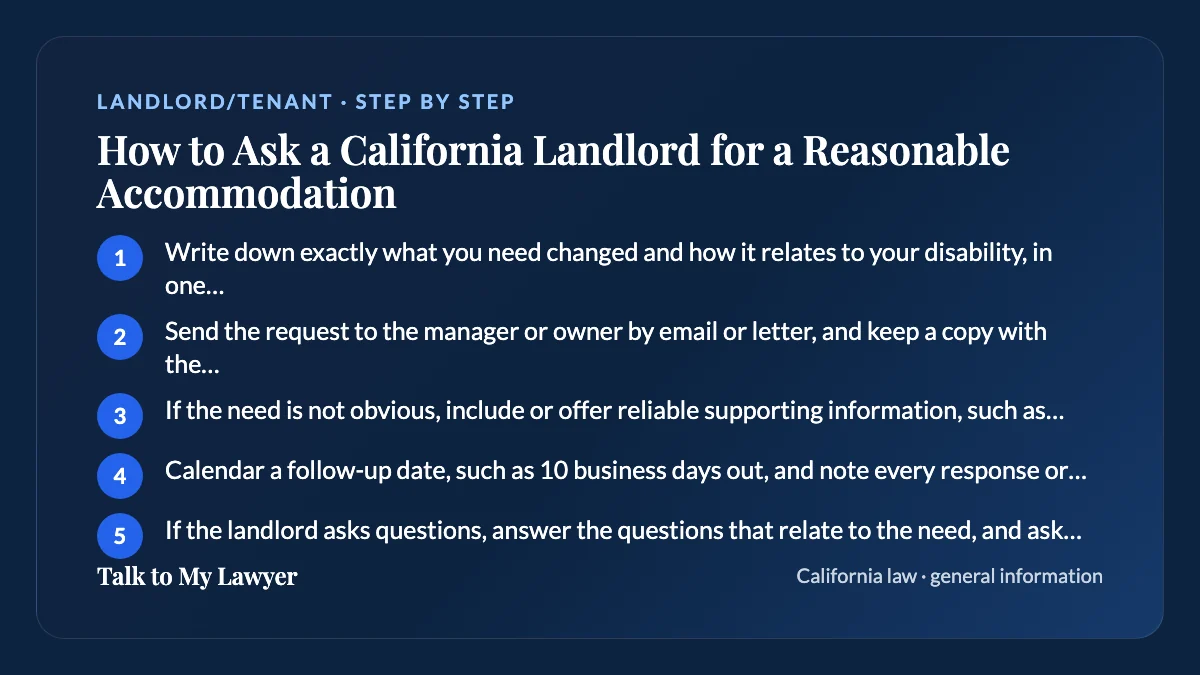
- Write down exactly what you need changed and how it relates to your disability, in one or two sentences.
- Send the request to the manager or owner by email or letter, and keep a copy with the date.
- If the need is not obvious, include or offer reliable supporting information, such as a letter from a licensed provider who knows your situation.
- Calendar a follow-up date, such as 10 business days out, and note every response or call.
- If the landlord asks questions, answer the questions that relate to the need, and ask in writing why any extra information is required.
- If an alternative is offered, say in writing whether it meets your need and why.
- If there is no answer or a denial without a real discussion, send a follow-up letter that restates the request and the dates.
On September 3, I asked in writing for an assigned accessible parking space near Building C because a mobility disability limits how far I can walk. I have not received a response. Under Government Code section 12927 and California Code of Regulations, title 2, section 12176, a housing provider must consider reasonable accommodation requests promptly. Please confirm by October 1 whether you will assign the space or propose an alternative you believe would be equally effective.
If repairs connected to your disability are also stalled, our guide to a landlord repair demand letter covers that separate duty.
When an attorney-written accommodation letter makes sense
A landlord who has gone quiet for weeks, asks for your full medical records, or bills pet rent for a support animal is no longer dealing with a simple request. A letter from an attorney can help in those situations, and when a denial is being used to set up a lease violation or an accommodation is tied to an eviction notice and timing matters.
Talk to My Lawyer offers that kind of letter: a licensed California attorney writes your letter from your dated requests, the landlord's replies and your supporting documents, cites the fair housing rules behind the request, and sends it on your behalf. Filing with the Civil Rights Department or HUD, or going to court, is a choice best made with a lawyer who has seen your file.
Frequently asked questions
Can a California landlord charge a pet deposit for an emotional support animal?
No. California fair housing regulations say a person with an assistance animal, including a support animal, cannot be charged a pet fee, pet rent, an extra deposit or required liability insurance for the animal. Breed, size and weight limits also do not apply. The tenant can still be held responsible for the cost of repairing damage the animal causes beyond ordinary wear and tear.
Is an online emotional support animal certificate enough for a landlord?
Often not. California regulations presume that a certificate from an online service without an individualized assessment by a medical professional is not reliable third-party information, though the landlord must give you a chance to provide more before denying. For a support dog, the letter writer must also meet Health and Safety Code section 122318, including a 30-day client relationship and a clinical evaluation.
How long does a landlord have to answer a reasonable accommodation request?
No fixed number of days applies to every request. California regulations say requests must be considered promptly, judged case by case based on factors such as urgency and whether more information is needed. An undue delay, or no response within a reasonable time, may be treated as a denial. Keeping dated records of your request and follow-ups shows how long you waited.
Can I ask my landlord to move me to a different unit because of a disability?
You can ask. A transfer request, such as moving to a ground-floor unit, is evaluated like other accommodation requests: the landlord considers whether it may be necessary because of your disability and whether a recognized ground for refusal applies, such as undue burden. Availability of a suitable unit matters. If the exact request cannot be granted, the landlord should discuss alternatives.
What is the deadline to file a housing discrimination complaint in California?
The California Civil Rights Department says a housing discrimination complaint generally must be filed within one year from the date the alleged discriminatory act occurred, and lists two years for filing in court. A complaint can also be filed with HUD under the federal Fair Housing Act. Because deadlines can depend on the facts, such as when a denial happened, talk to a lawyer or the agency if timing is close.
Sources
Checked against these official sources on October 18, 2026.
- California Government Code section 12927 (California Legislative Information)
- California Health and Safety Code section 122318 (California Legislative Information)
- Cal. Code Regs. tit. 2, section 12176 (Legal Information Institute (Cornell Law School))
- Cal. Code Regs. tit. 2, section 12185 (Legal Information Institute (Cornell Law School))
- Housing (California Civil Rights Department)
- Joint Statement on Reasonable Accommodations under the Fair Housing Act (U.S. Department of Housing and Urban Development and U.S. Department of Justice)
This guide explains California law in general terms as of October 2026. It is general information, not legal advice for your situation, and local rules can add to it.
Join the email list and get a lawyer letter started
With Talk to My Lawyer, a licensed California attorney writes your letter from your facts and documents and sends it on your behalf. Join the Talk to My Lawyer email list for letter checklists, document prompts, and reminders before you start your letter.