Quick answer
If a rental car company is charging you for damage in California, the bill is limited by Civil Code sections 1939.03 to 1939.09. Repair charges must track actual or estimated repair costs after discounts, administrative fees are capped at $50, $100 or $150 depending on the repair cost, and the company cannot charge your card for damage without your express permission after the damage.
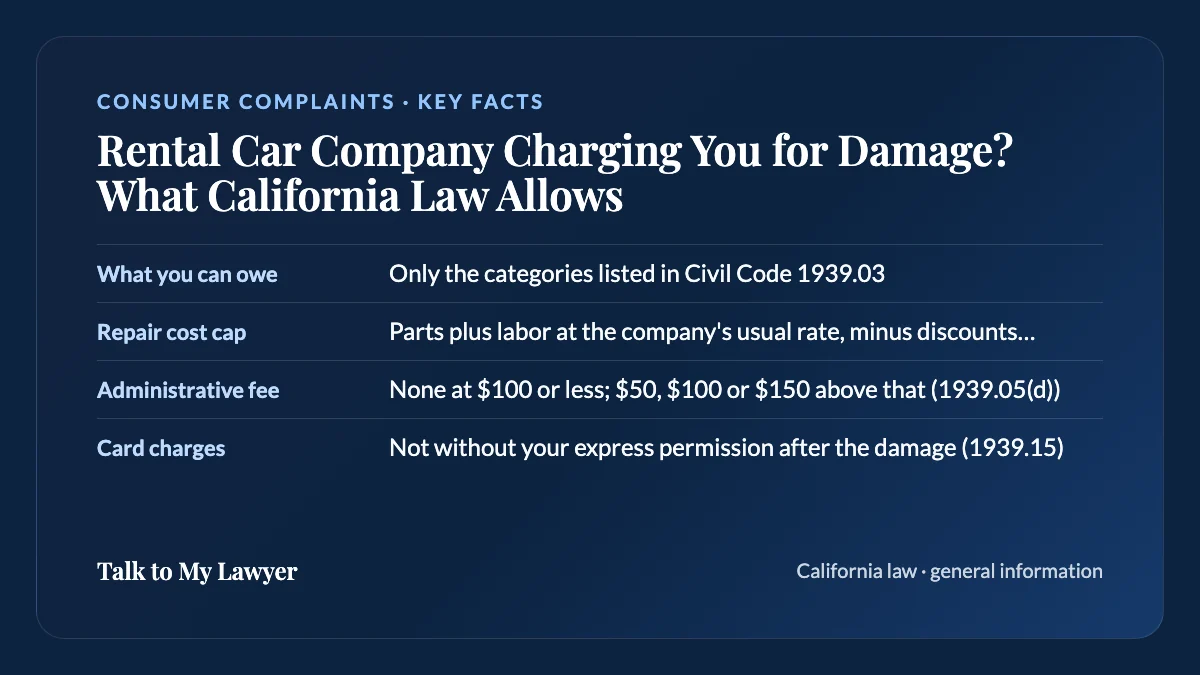
At a glance
- What you can owe
- Only the categories listed in Civil Code 1939.03
- Repair cost cap
- Parts plus labor at the company's usual rate, minus discounts (1939.05, 1939.07)
- Administrative fee
- None at $100 or less; $50, $100 or $150 above that (1939.05(d))
- Card charges
- Not without your express permission after the damage (1939.15)
- Damage waiver
- Covers damage, loss and loss of use, with only listed exceptions (1939.09)
- Your remedy
- Lawsuit for damages, with attorney's fees to the prevailing party (1939.25)
What can a California rental car company charge you for damage?
A rental company can hold you responsible only for the items in Civil Code section 1939.03, and only up to the limits in section 1939.05. These rules apply to passenger vehicle rentals of less than 30 days (section 1939.01).
- Collision damage, physical or mechanical, up to the car's fair market value, whatever caused it.
- Theft, up to fair market value, but only if the company proves by clear and convincing evidence that you or an authorized driver failed to use ordinary care.
- Vandalism unrelated to a theft, capped at $500 in total.
- Towing, storage and impound fees the company actually paid, if you are liable for the damage.
- An administrative charge, which must cover appraisal and every other cost connected with the damage or repair, and is capped as shown below.
Recent change: as of January 1, 2026, AB 1197 revised the theft presumption, which used to turn on the driver having the key or showing it was not in the car. You are now presumed to have no liability for a theft if an authorized driver returns the ignition key, reports the theft to police within 24 hours of learning of it, and reasonably cooperates. The company can rebut that presumption by showing an authorized driver committed or helped commit the theft.
How California caps the repair bill and the admin fee
Your total liability for damage cannot exceed the estimated parts cost, plus labor at the rate the company usually pays for that type of work, plus towing, storage and impound fees it actually paid (section 1939.05(a)). Every discount or price reduction the company receives must be subtracted (section 1939.05(b)).
Section 1939.07 adds that a damage claim must be reasonably and rationally related to the actual loss. The company must mitigate where possible and cannot collect more than the actual cost of repairs performed, or the estimated cost if it chooses not to repair. For a total loss, the claim is capped at the total-loss value determined the way insurers usually do it, less any salvage the company keeps.
| Estimated parts and labor | Maximum administrative charge | Rule |
|---|---|---|
| $100 or less | None allowed | 1939.05(d) |
| More than $100, up to $500 | $50 | 1939.05(d)(1) |
| More than $500, up to $1,500 | $100 | 1939.05(d)(2) |
| More than $1,500 | $150 | 1939.05(d)(3) |
Can a rental company charge for loss of use?
Loss of use, the rental income a company says it lost while the car was in the shop, does not appear among the items section 1939.03 lets a renter agree to pay. Nor do diminished value or fleet fees. If your bill includes those lines, ask the company in writing which part of section 1939.03 it relies on.
Some rental agreements include such terms, and a dispute over them can turn on the contract language and how a court reads the statute. That makes this a good point to get advice on your facts before you pay a disputed line.
If you bought the damage waiver
A damage waiver means you have no liability for damage, loss, loss of use or related costs, unless an exception in the statute applies (section 1939.09(a)). Any limitation or exclusion beyond those listed is void.
The allowed exceptions include damage from intentional, willful, wanton or reckless driving; driving under the influence; towing or pushing anything; damage caused by unpaved road conditions; use for commercial hire, in conduct that could be charged as a felony, or in a speed contest; driving by someone who is not an authorized driver; driving outside the United States; and fraudulent or false information that affected the rental.
The company cannot require you to buy the waiver or use coercive tactics to sell it (section 1939.13), and the daily price for smaller car classes is capped by section 1939.09(d), with yearly adjustments for inflation.
Your credit card, your insurer and how the company collects
A rental company may not process a credit card charge, debit or hold for damage unless you give express permission after the damage happened (section 1939.15). A clause in the contract you signed at pickup is not that permission. The statute also bars unfair, deceptive or coercive tactics in collecting a damage claim.
If your personal or business auto policy covers the damage and the coverage is confirmed during business hours, you can require the company to submit the claim to your insurer (section 1939.07(b)). The company may not say it will refuse to deal with your carrier. You stay responsible for anything your policy does not cover, such as a deductible.
If a charge has already hit your card, chargebacks compared with demand letters covers when a card dispute fits. If your own insurer denies coverage, see insurance claim denial letters.
Example: auditing a $1,240 damage bill
Example (hypothetical): a renter without the damage waiver returns a car with a dented rear bumper. The company emails a bill for $1,240: a $780 repair estimate, $250 for loss of use and a $210 administrative fee. It says it will charge the card on file in seven days.
| Line | Billed | Issue | Amount questioned |
|---|---|---|---|
| Repair estimate | $780 | Request the itemized estimate, labor rate and any fleet discount | To be confirmed |
| Loss of use | $250 | Not among the items listed in 1939.03 | $250 |
| Administrative fee | $210 | Cap is $100 when parts and labor are between $500 and $1,500 | $110 |
| Card charge | $1,240 | Needs express permission after the damage (1939.15) | Do not authorize yet |
On these facts, $360 is disputed before the repair estimate is even examined. A court decides any amount actually owed.
How to dispute a rental car damage claim in writing
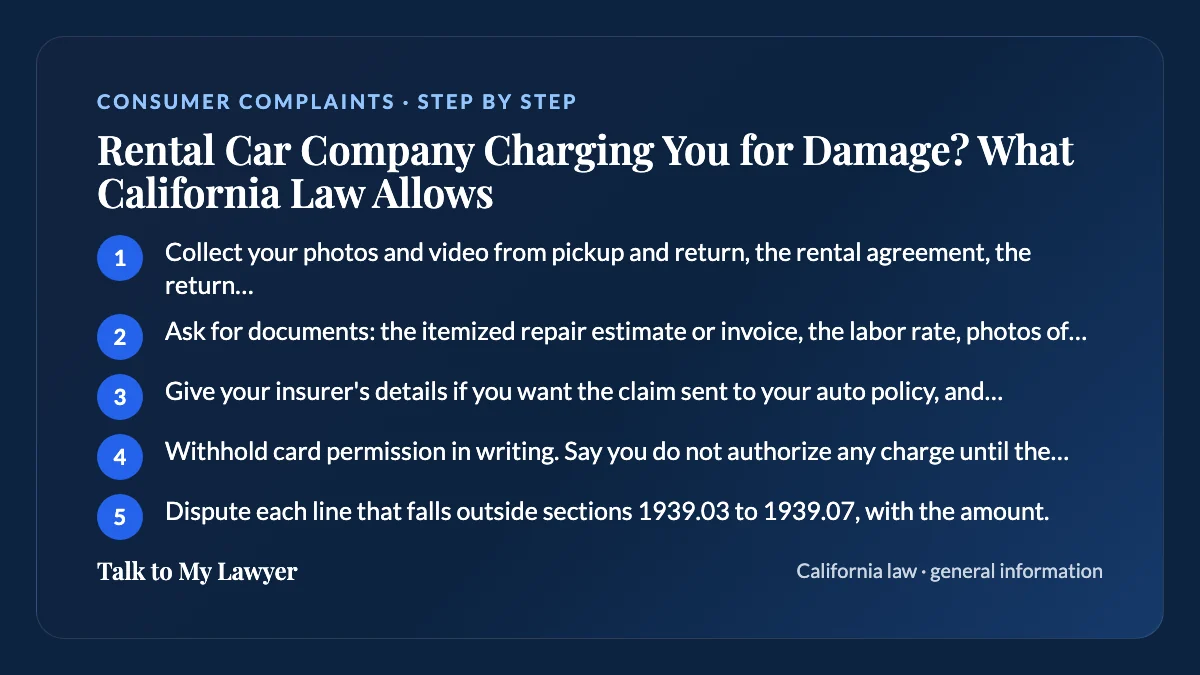
- Collect your photos and video from pickup and return, the rental agreement, the return receipt and any damage report you signed.
- Ask for documents: the itemized repair estimate or invoice, the labor rate, photos of the damage, and any discounts the company receives.
- Give your insurer's details if you want the claim sent to your auto policy, and confirm coverage by phone during business hours.
- Withhold card permission in writing. Say you do not authorize any charge until the claim is resolved.
- Dispute each line that falls outside sections 1939.03 to 1939.07, with the amount.
- Set a response date and keep copies of everything you send.
I rented a 2025 sedan under agreement 77104 from June 2 to June 6. Your June 27 letter seeks $1,240. California Civil Code section 1939.03 does not list loss of use among the charges a renter may be responsible for, and section 1939.05(d) caps the administrative charge at $100 for estimated repairs between $500 and $1,500. Please remove the $250 loss of use charge, reduce the administrative charge to no more than $100, and send me the itemized estimate and any discounts applied. I do not authorize any charge to my credit card under Civil Code section 1939.15.
If the company sues or keeps billing, section 1939.25 lets a renter sue for damages and equitable relief for violations of the rental car statutes, and the prevailing party recovers reasonable attorney's fees and costs. For amounts within the limit, small claims is another route, as our small claims demand letter guide explains.
When an attorney-written rental car letter makes sense
If the only problem is an administrative fee above the section 1939.05(d) cap, a short letter of your own can cite the table above. An attorney's letter fits better when the bill is large, when the company has charged your card or sent the claim to collections, when it says your damage waiver does not apply, or when the claim involves a total loss.
When you use Talk to My Lawyer, a licensed California attorney writes your letter from your rental agreement, photos and the company's bill and sends it on your behalf, directed at the company's claims department. Questions about your contract terms or a lawsuit deserve individual legal advice.
Frequently asked questions
Can a rental car company charge my credit card for damage without asking?
Not in California. Civil Code section 1939.15 bars a rental company from processing a credit card charge, debit or hold to recover a damage claim unless the renter gives express permission after the damage or loss occurred. The company also may not use unfair, deceptive or coercive tactics to collect. A general authorization signed at pickup does not meet that standard.
How much can a rental company charge as an administrative fee in California?
It depends on the estimated parts and labor. Section 1939.05(d) allows no administrative charge when the estimate is $100 or less, $50 for estimates over $100 up to $500, $100 for estimates over $500 up to $1,500, and $150 above $1,500. The fee has to include appraisal and all other costs tied to the damage or repair.
Does my car insurance have to deal with the rental company directly?
You can require it. If your personal or business auto policy covers the damage and coverage is confirmed during regular business hours, including by phone, section 1939.07(b) lets you require the rental company to submit its claim to your insurer. The company and insurer then resolve the amount, and you stay responsible for anything the policy does not cover.
Am I liable if the rental car was stolen?
Only if the company proves by clear and convincing evidence that you or an authorized driver failed to use ordinary care. As of January 1, 2026, you are presumed to have no liability for the theft if an authorized driver returns the ignition key, reports the theft to police within 24 hours of learning of it and reasonably cooperates.
Sources
Checked against these official sources on October 18, 2026.
- California Civil Code section 1939.03 (California Legislative Information)
- AB 1197 Rental passenger vehicles (Chapter 449, Statutes of 2025) (California Legislative Information)
- California Civil Code section 1939.05 (California Legislative Information)
- California Civil Code section 1939.07 (California Legislative Information)
- California Civil Code section 1939.09 (California Legislative Information)
- California Civil Code section 1939.15 (California Legislative Information)
This guide explains California law in general terms as of October 2026. It is general information, not legal advice for your situation, and local rules can add to it.
Join the email list and get a lawyer letter started
With Talk to My Lawyer, a licensed California attorney writes your letter from your facts and documents and sends it on your behalf. Join the Talk to My Lawyer email list for letter checklists, document prompts, and reminders before you start your letter.