Quick answer
Your car was towed illegally in California if a private tow broke Vehicle Code section 22658: for example, no compliant sign at every entrance, no written authorization from someone at the property, or fees above the local police or CHP-approved rate. Property owners who skip the sign or notice rules can owe double the charges. Towers who overcharge or refuse a card can owe four times.
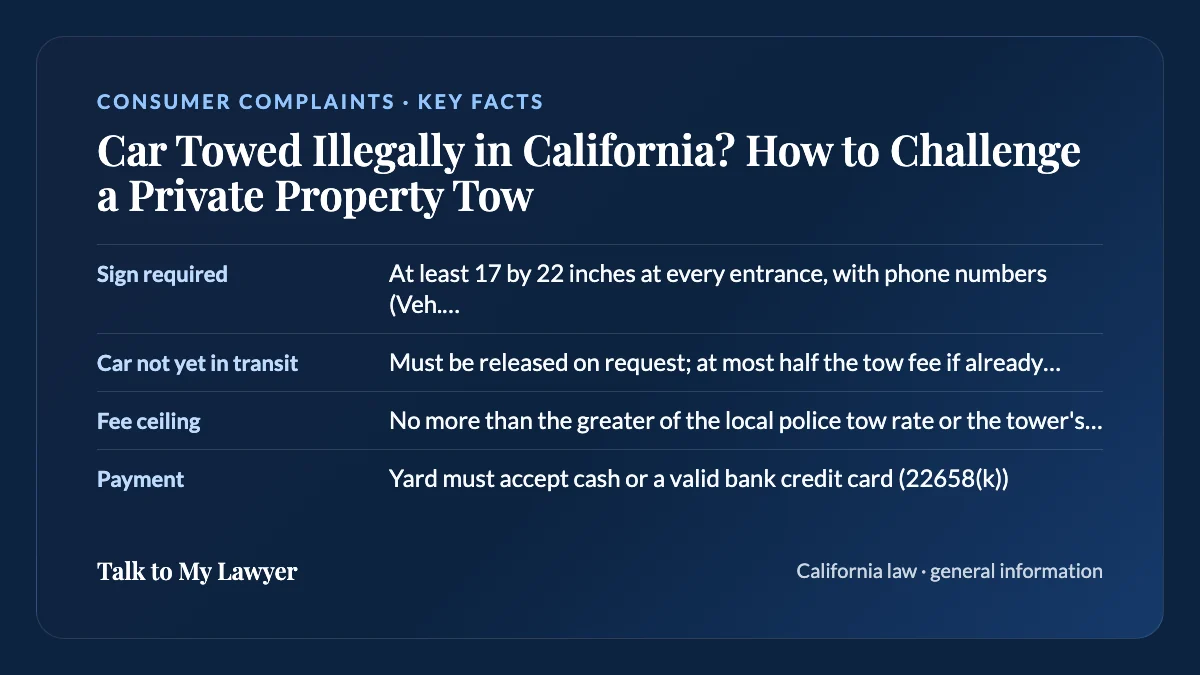
At a glance
- Sign required
- At least 17 by 22 inches at every entrance, with phone numbers (Veh. Code 22658(a)(1))
- Car not yet in transit
- Must be released on request; at most half the tow fee if already hooked up (22658(g), (h))
- Fee ceiling
- No more than the greater of the local police tow rate or the tower's CHP-approved rate (22658(i))
- Payment
- Yard must accept cash or a valid bank credit card (22658(k))
- Penalties
- Double charges for property owners; four times for overcharges and card refusals (22658(e), (j), (k))
When is a private property tow legal in California?
A private property owner may have your car towed only under one of the conditions in Vehicle Code section 22658(a). The one drivers see is the sign, and the statute is specific about it.
- The sign route. A sign at least 17 by 22 inches, with letters at least one inch high, displayed in plain view at all entrances. It must prohibit public parking, say vehicles will be removed at the owner's expense, and list the phone number of the local traffic law enforcement agency plus the name and number of each towing company under contract.
- The ticket route. Your car got a notice of parking violation and 96 hours have passed since it was issued.
- The disabled-vehicle route. The car lacks an engine, wheels, doors or another major part, the owner notified local police, and 24 hours have passed.
- Single-family homes. The lot holds a single-family dwelling, so no sign is needed.
Even with a proper sign, the towing company needs written authorization from the property owner or lessee (or an employee or agent) who is present at the time of the tow and verifies the violation (section 22658(l)). That paper must list your car's make, model, VIN and plate, the name, signature, job title and phone number of the person authorizing the tow, the grounds, when the car was first seen and when the tow was authorized.
Two exceptions matter. At a residential rental of 15 or fewer units with no on-site owner, agent or employee, the person authorizing the tow need not be present if a tenant verified the violation and gave a signed request or email to tow a car from the tenant's assigned space. And a towing company with a written general authorization may tow cars parked within 15 feet of a hydrant, in a fire lane, or blocking an entrance or exit, but it must photograph the violation first.
Can you stop a tow before your car leaves the lot?
Yes. If you or your agent asks before the car has left the property and is in transit, the tow company or its driver must release it immediately and unconditionally (section 22658(g)). Refusing is a misdemeanor.
If the car is already hooked up or lifted off the ground, the company may charge no more than half its regular towing charge. The full towing charge applies only after the car has left the property and is in transit (section 22658(h)).
What the tow yard must give you before you pay
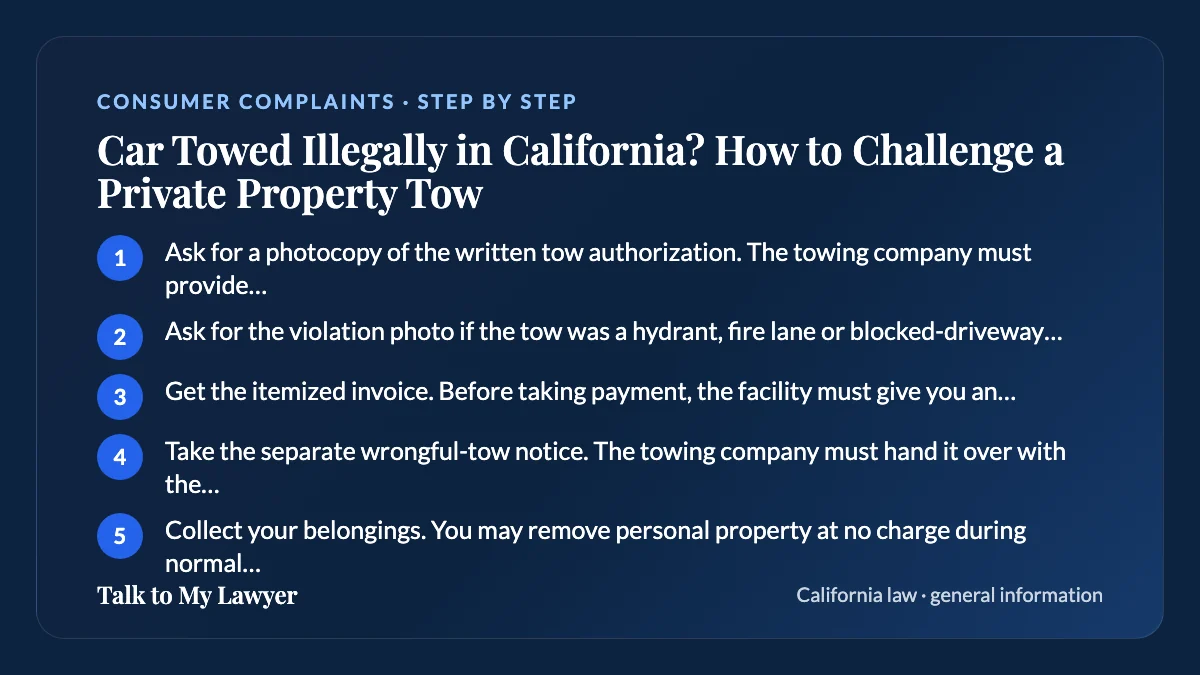
California gives you several rights at the storage facility, before any money changes hands. Use them in this order:
- Ask for a photocopy of the written tow authorization. The towing company must provide it before you pay (section 22658(l)(1)(C)). For tows from residential property, the authorizer's personal details are redacted.
- Ask for the violation photo if the tow was a hydrant, fire lane or blocked-driveway tow under a general authorization. You get a free copy (section 22658(l)(2)).
- Get the itemized invoice. Before taking payment, the facility must give you an itemized invoice showing the tow location, dispatch and completion times, the hourly or per-item rate, daily storage rate and days stored, and any gate fee as separate lines (section 22651.07(b), (g)).
- Take the separate wrongful-tow notice. The towing company must hand it over with the authorization copy, and it must give the phone number of the local law enforcement or prosecuting agency to call if you believe the tow was wrongful (section 22658(l)(1)(C)).
- Collect your belongings. You may remove personal property at no charge during normal business hours, Monday to Friday, 8 a.m. to 5 p.m. (section 22651.07(c)(1)).
- Pay by card if you want a record. The yard must accept cash or a valid bank credit card in your name and must post a notice saying so (section 22658(k)).
- Photograph the car and the odometer before you drive off.
Timing affects storage. If you retrieve the car within 24 hours of its arrival at the yard, the storage charge is for only one day (section 22658(i)(2)). Retrieval in the first 72 hours also means no lien fee (section 22651.07(c)(2)). After-hours release fees are capped at half the hourly tow rate, and the yard must normally be within 10 miles of where your car was parked (section 22658(n)).
What does a tow company owe if it breaks the rules?
Section 22658 sets fixed multipliers, and each one falls on a particular party.
| Problem | Who is liable | Civil amount | Rule |
|---|---|---|---|
| No compliant sign, ticket or notice (subdivision (a)(1) to (3)), or refusing to state the grounds for the tow | Property owner, person in lawful possession, or HOA | Double the towing or storage charges | 22658(e)(1) |
| Charging more than the greater of the police or CHP rate, or more than half the tow fee for a car released before it left the lot | Anyone who charged the excessive rate | Four times the amount charged | 22658(j)(1) |
| Refusing a valid credit card or not posting the payment notice | Storage facility operator | Four times the towing and storage charges | 22658(k)(4) |
| Towing without proper written authorization or photo | Towing company | Four times the towing and storage charges | 22658(l)(5) |
| Not notifying police within 30 minutes after the car is in transit | Towing company | Three times the towing and storage charges | 22658(m)(3) |
| Missing itemized invoice or fee notice | Facility that charged | Up to twice the amount charged, capped at $500 per vehicle | 22651.07(k) |
Damage is separate. You may recover for damage caused by an intentional or negligent act of the person who ordered or performed the tow (section 22658(d)), and the towing company is responsible for damage in transit and storage.
Example: adding up a wrongful tow
Example (hypothetical): a driver parks in a shopping center lot at 9 p.m. The only sign is at the rear entrance, so the main driveway has none. The car is towed and the driver retrieves it the next afternoon, 19 hours after it reached the yard. The bill shows a $295 tow and two days of storage at $75, for $445. The yard refuses a credit card and insists on cash.
| Issue | Rule | What the letter asks for |
|---|---|---|
| Sign missing at one entrance | 22658(a)(1), (e)(1) | Property owner refunds $445 and notes exposure of up to double, $890 |
| Two days of storage for a 19-hour stay | 22658(i)(2) | Refund of the extra $75 storage day |
| Credit card refused | 22658(k)(1), (k)(4) | Notes the four-times liability on the towing and storage charges |
Whether any multiplier applies is for a judge to decide on the evidence. Photos of every entrance, taken soon after the tow, show what the sign situation was that night.
What to put in a demand letter after an illegal tow
Send the letter to the towing company and, when the problem is the sign or the authorization, to the property owner or management company as well. If you are unsure who legally owns a lot or runs a tow business, see how to look up a California business's legal name.
- Date, time and address of the tow, with your plate number.
- What you paid, line by line, from the itemized invoice.
- Each rule that was missed, with the subdivision of section 22658 or 22651.07.
- The exact refund you request and any statutory amount you believe applies.
- A response date and the payment method you want.
- Copies of your receipt, the authorization photocopy and your photos.
On March 4, my vehicle (plate 8ABC123) was removed from 2100 Grand Avenue and stored at your facility. The property's main entrance on Grand Avenue had no sign of the kind required by California Vehicle Code section 22658(a)(1), as shown in the enclosed photos taken that night. I paid $445 in towing and storage charges. Please refund $445 by March 25. Section 22658(e)(1) makes a property owner liable for double the towing or storage charges when the sign requirement is not met.
If you paid by credit card and the tow was wrongful, a card dispute may also be an option. Our comparison of a chargeback and a demand letter explains how they differ.
Where to complain and when small claims makes sense
Call the number on the wrongful-tow notice. Several towing violations are misdemeanors, and towers must give their records to law enforcement, the Attorney General, a district attorney or a city attorney within 24 hours of a request. Some cities also have their own towing ordinances, so check local rules.
For your money, small claims court handles cases up to $12,500 for individuals, with filing fees between $30 and $100 and no lawyers representing parties at the hearing. Bring a copy of your demand letter, your receipt and your photos. Our pre-filing demand letter guide covers that step.
When an attorney-written towing letter makes sense
Section 22658 spells out the sign, release and fee rules in enough detail that you can write a towing demand yourself. A lawyer's letter fits better when the car was damaged, when several drivers were towed from the same lot, when the property manager and the tow company each blame the other, or when you want the statutory multipliers set out precisely.
With Talk to My Lawyer, a licensed California attorney writes your letter from your receipts, photos and tow paperwork and sends it on your behalf, addressed to both the tow company and the property owner. Deciding whether to sue, and whom, is a conversation to have with a lawyer about your facts.
Frequently asked questions
Do I have to pay to get my belongings out of a towed car in California?
No. Before paying any towing or storage fees, you have the right to retrieve your personal property at no charge during normal business hours, which the statute defines as Monday through Friday, 8 a.m. to 5 p.m., excluding state holidays. You may also inspect the car without paying a fee. These rights come from Vehicle Code section 22651.07.
Can a tow yard refuse my credit card?
Not for a private property tow. Vehicle Code section 22658(k) requires the storage facility to accept a valid bank credit card or cash from the registered owner, legal owner or their agent, and to post a notice saying so. The card must be in the name of the person presenting it. A facility that refuses can be civilly liable for four times the towing and storage charges.
How much can a tow company charge for a private property tow?
The charge is excessive if it is more than the greater of two benchmarks: what the local law enforcement agency's contract tower would charge for the same tow and storage, or the rate the California Highway Patrol approved for that operator. A person who charges an excessive rate can be liable for four times the amount charged under section 22658(j).
Can my apartment complex tow my car without warning?
It depends on how the tow was authorized. In general, a private lot needs the required sign at every entrance or a parking violation notice that is at least 96 hours old. At rentals of 15 or fewer units with no on-site owner or staff, the person authorizing a tow from a tenant's assigned space need not be present if that tenant verified the violation and signed a request. Your lease and any city ordinance may add rules.
What if the tow truck damaged my car?
Photograph the damage at the yard before you leave and note it on any paperwork. Section 22658(d) lets you recover for damage caused by an intentional or negligent act of the person who ordered or performed the tow, and towing companies are responsible for damage during transit and storage. Your own insurer may also be able to inspect the car at the yard during business hours.
Sources
Checked against these official sources on October 18, 2026.
- California Vehicle Code section 22658 (California Legislative Information)
- California Vehicle Code section 22651.07 (California Legislative Information)
- Small claims in California (California Courts Self-Help Guide)
This guide explains California law in general terms as of October 2026. It is general information, not legal advice for your situation, and local rules can add to it.
Join the email list and get a lawyer letter started
With Talk to My Lawyer, a licensed California attorney writes your letter from your facts and documents and sends it on your behalf. Join the Talk to My Lawyer email list for letter checklists, document prompts, and reminders before you start your letter.