Quick answer
If your ex won't return your stuff in California, the law generally requires someone who holds your property without your consent to give it back (Civil Code section 1712). Items you gave as completed gifts usually stay with your ex, because a gift cannot be revoked (section 1148). For the rest, send a written demand, then consider small claims court (up to $12,500) or a claim and delivery action.
At a glance
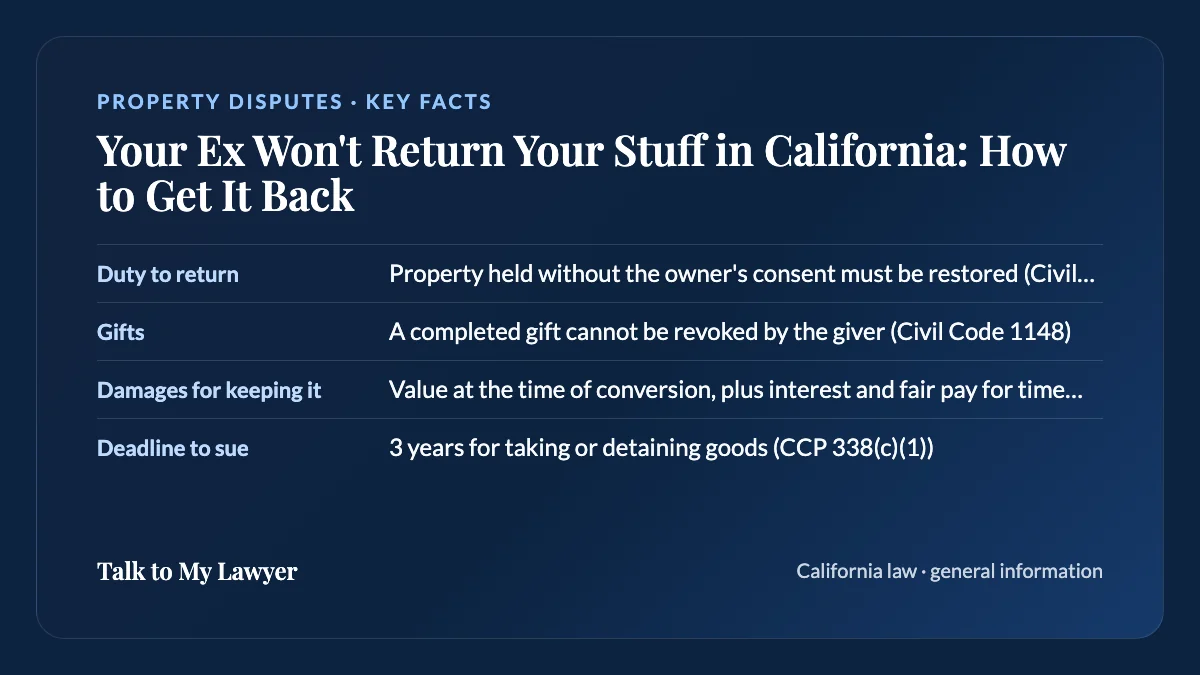
- Duty to return
- Property held without the owner's consent must be restored (Civil Code 1712)
- Gifts
- A completed gift cannot be revoked by the giver (Civil Code 1148)
- Damages for keeping it
- Value at the time of conversion, plus interest and fair pay for time and money spent pursuing it (Civil Code 3336)
- Deadline to sue
- 3 years for taking or detaining goods (CCP 338(c)(1))
- Small claims
- Up to $12,500 for individuals; the court can also order restitution (CCP 116.221, 116.220(b))
Who owns the things you left at your ex's place?
Ownership usually comes down to one question: was the item given, or just kept there? California defines a gift as a transfer of personal property made voluntarily and without anything in return (Civil Code section 1146). A spoken gift is valid only if the item was actually or symbolically delivered, or the means of taking possession of it, such as keys, were handed over (section 1147). Once a gift is complete, the giver cannot take it back (section 1148).
- Things you owned before the relationship and brought over are still yours.
- Things you bought for yourself during the relationship are yours, even if they lived at your ex's place.
- Things you gave your ex as birthday or holiday presents generally belong to your ex now.
- Things bought together need proof of who paid: receipts, bank records or messages about splitting the cost.
- Things you loaned, like a car or laptop 'to use for a while', remain yours if you can show it was a loan.
Is it illegal for your ex to keep your belongings?
Keeping property that belongs to you, after you ask for it back, can be a civil wrong called conversion. Civil Code section 1712 says a person who obtains a thing without the owner's consent, or by a consent later withdrawn, must restore it. Your request for its return is how you withdraw that consent, which is one reason to put it in writing.
If a court finds conversion, Civil Code section 3336 presumes the damages are the property's value at the time of the conversion, with interest, plus fair compensation for the time and money you spent trying to get it back. You have three years to sue for taking or detaining goods, including suits to recover the item itself (Code of Civil Procedure section 338(c)(1)).
Police may treat an ownership dispute between former partners as a civil matter for the courts. Some departments will stand by to keep the peace while you collect belongings, sometimes called a civil standby. Call your local department's non-emergency line to ask whether it offers one.
What if contact with your ex is not safe?
Your safety comes before your stuff. If you have been abused or threatened, a domestic violence restraining order can include orders about property: a court may decide the temporary use, possession and control of the parties' personal property (Family Code section 6324).
The court system's self-help guide also says you do not have to ask the other side for money before filing a small claims case if there is a restraining order between you or you think asking would be dangerous.
Checklist: proof that the items are yours
- Receipts, order confirmations or bank and card statements.
- Photos of the items in your earlier home, or dated photos at your ex's place.
- Texts or emails where your ex calls something 'yours' or agrees to return it.
- Serial numbers, warranty registrations or app accounts tied to your name.
- Appraisals or resale listings showing current value, for anything costly.
- A list of each item with a short description and estimated value.
Sentimental items with little resale value still count. Describe them precisely, because a court can order things returned, and 'the blue quilt my grandmother made' is easier to identify than 'bedding'.
How do you get your belongings back from an ex in California?
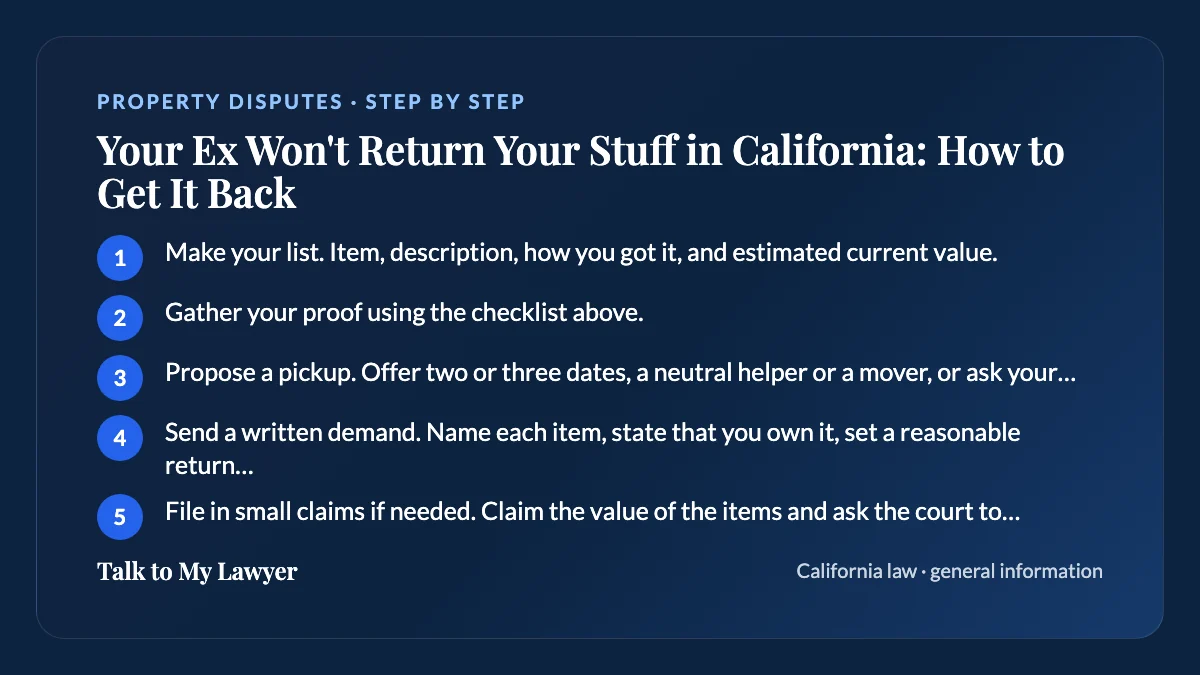
- Make your list. Item, description, how you got it, and estimated current value.
- Gather your proof using the checklist above.
- Propose a pickup. Offer two or three dates, a neutral helper or a mover, or ask your ex to box items for collection.
- Send a written demand. Name each item, state that you own it, set a reasonable return date, and say what you will do if it does not happen.
- File in small claims if needed. Claim the value of the items and ask the court to order their return as an alternative.
- For valuable items, consider claim and delivery. This is a superior court procedure for getting a writ of possession before trial.
Since we separated on May 2, the following items of mine remain at your apartment: my Trek road bike (serial number ending 4471), my grandmother's blue quilt, and a KitchenAid stand mixer I bought in 2023 (receipt enclosed). I withdraw any permission for you to keep them. Please make them available for pickup on one of these dates: June 7, 8 or 14. My cousin will collect them so we do not need to meet. If the items are not returned by June 14, I will file a claim in small claims court for their value and their return.
Small claims expects that request to come first; see asking before you file in small claims.
Can small claims court make your ex give your stuff back?
Small claims cases are for money, but the judge has more tools than a check. In a case for money, the court may grant equitable relief in the form of rescission, restitution, reformation or specific performance, in place of or in addition to money damages, and may issue a conditional judgment (Code of Civil Procedure section 116.220(b)). That can include an order to return items by a date or pay their value.
| Option | Where | What it does |
|---|---|---|
| Small claims | Small claims court; individuals can claim up to $12,500 (CCP 116.221) | Money for the items, with possible orders to return them. No lawyers at the hearing. |
| Claim and delivery | Superior court, after filing a lawsuit | A writ of possession before trial. The application is under oath and must describe the property, its value, its location and why it is wrongfully held (CCP 512.010). |
| Restraining order with property orders | Family court, for domestic violence cases | Temporary use and control of personal property (Family Code 6324). |
Example (hypothetical): the bike is worth $1,400, the mixer $350 and the quilt has no market price but deep family value. A small claims filing could claim $1,750 and ask, in the alternative, for an order to return all three items, including the quilt, by a set date.
When a lawyer's letter can help after a breakup
Breakups make every message feel personal, and a demand that reads like the next round of an argument can bury the facts that matter. A neutral attorney letter is useful when the items are valuable, when your ex claims everything was a gift, when friends or family are holding things, or when you would rather not write to your ex at all.
Through Talk to My Lawyer, a licensed California attorney writes your demand letter from your item list, receipts and the messages you saved, and sends it on your behalf. If safety is a concern or you need a restraining order, talk to a lawyer or your local family court self-help center about your facts.
Frequently asked questions
Can my ex keep gifts I gave during the relationship?
Generally, yes. California treats a gift as a voluntary transfer without anything in return, and once it is delivered the giver cannot revoke it (Civil Code sections 1146 to 1148). Gifts given on the assumption that a marriage would happen are treated differently under Civil Code section 1590. Items you only loaned, or that were never handed over as gifts, remain yours.
Will the police help me get my things back from my ex?
Who owns household items after a breakup is a civil question for a court, and officers may decline to decide it on the spot. Some departments will keep the peace during a pickup, often called a civil standby, so you can collect belongings with an officer present. Policies vary, so call the non-emergency line of the department where the items are located before you go.
How long do I have to sue my ex for my property?
California generally allows three years to sue for taking, detaining or damaging personal property, including a suit to get the specific item back (Code of Civil Procedure section 338(c)(1)). Waiting has practical costs even inside that window, because items get sold, damaged or harder to trace.
What if my ex sold or threw away my things?
You can ask for money instead. Civil Code section 3336 sets the starting measure: what the items were worth at the moment they were wrongly kept, interest from that point, and fair pay for the time and money spent chasing them. An individual can bring that claim in small claims court if it totals $12,500 or less. Bring proof of what the items were worth, such as receipts or comparable listings.
Do I have to send a demand letter before small claims court?
California's small claims process expects you to ask the other side to pay or fix the problem before you file, and a letter is one way to do that. The court's self-help guide says you can skip asking if there is a restraining order between you or asking would be dangerous. A dated letter also shows when you withdrew consent for your ex to keep the items.
Sources
Checked against these official sources on October 18, 2026.
- California Civil Code section 1712 (California Legislative Information)
- California Civil Code section 1147 (California Legislative Information)
- California Civil Code section 3336 (California Legislative Information)
- California Code of Civil Procedure section 116.220 (California Legislative Information)
- California Code of Civil Procedure section 512.010 (California Legislative Information)
- Ask for the money (California Courts Self-Help Guide)
This guide explains California law in general terms as of October 2026. It is general information, not legal advice for your situation, and local rules can add to it.
Join the email list and get a lawyer letter started
With Talk to My Lawyer, a licensed California attorney writes your letter from your facts and documents and sends it on your behalf. Join the Talk to My Lawyer email list for letter checklists, document prompts, and reminders before you start your letter.