Quick answer
Who keeps the engagement ring in California depends on who ended the engagement. Under Civil Code section 1590, the person who gave a gift on the assumption the marriage would happen can recover it, or a just part of its value, if the recipient refuses to marry or the couple calls it off by mutual consent. The statute does not give that right when the giver ends it.
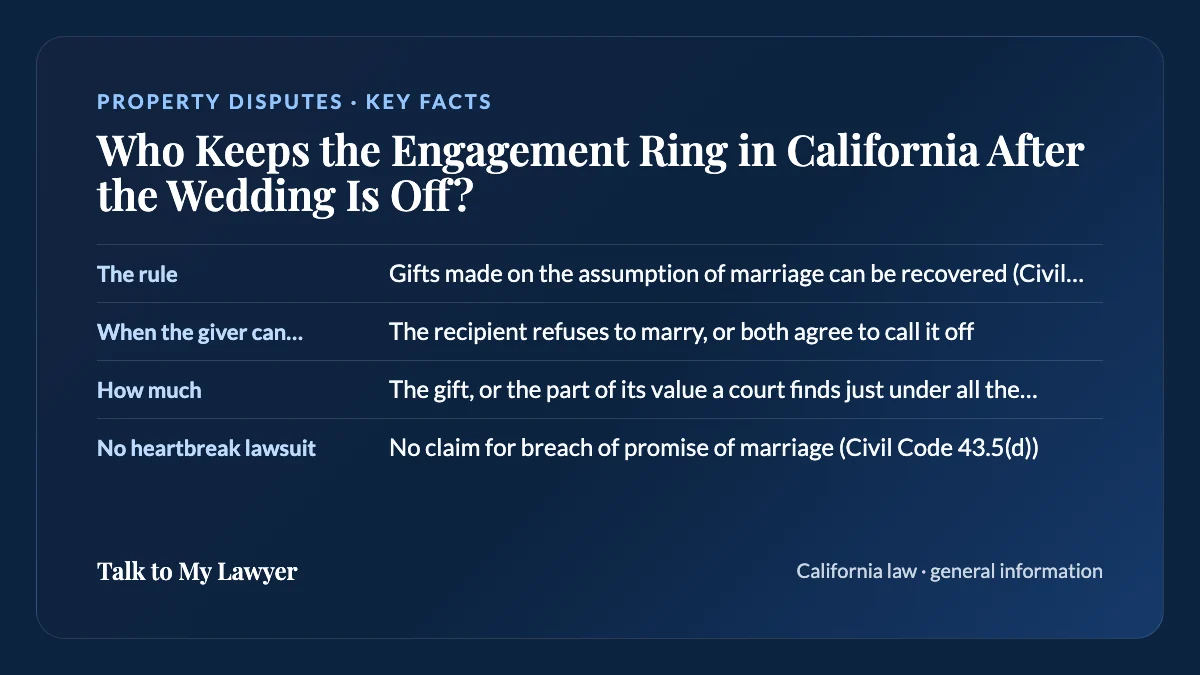
At a glance
- The rule
- Gifts made on the assumption of marriage can be recovered (Civil Code 1590)
- When the giver can recover
- The recipient refuses to marry, or both agree to call it off
- How much
- The gift, or the part of its value a court finds just under all the circumstances
- No heartbreak lawsuit
- No claim for breach of promise of marriage (Civil Code 43.5(d))
- Small claims
- Individuals can claim up to $12,500 (CCP 116.221)
Who keeps the engagement ring in California?
California does not treat an engagement ring as an ordinary present. Civil Code section 1590 covers any gift of money or property that one partner gives the other 'on the basis or assumption that the marriage will take place.' If the recipient refuses to go through with the marriage, or the engagement ends by mutual consent, the giver may recover the gift or the part of its value that a court or jury finds just under all the circumstances.
Two features of that sentence shape every ring dispute. First, the statute ties recovery to how the engagement ended: the recipient's refusal, or a mutual decision. Second, a court is not limited to all-or-nothing: it can award the value, or a share of it, based on the full picture.
Does it matter who called off the engagement?
Yes. Section 1590 lists the situations in which the giver can recover, and the giver ending things is not one of them.
| What happened | Section 1590 recovery right? | Notes |
|---|---|---|
| The person who received the ring ended it | Yes | The recipient 'refuses to enter into the marriage as contemplated'. |
| Both partners agreed to call it off | Yes | The marriage is 'given up by mutual consent'. |
| The person who gave the ring ended it | Not under the statute's terms | Ordinary gift rules apply, and a completed gift cannot be revoked (Civil Code 1148). |
| The ring was a birthday or holiday gift before any engagement | Probably not | A gift not given on the assumption of marriage is an ordinary gift. |
Who ended it is a factual question, and it is not always obvious. Texts, emails and the timing of events often tell the story better than memories do. Gather them before the conversation turns into a dispute.
Can you sue for the cancelled wedding itself?
Not for the broken promise. Civil Code section 43.5 abolished several old lawsuits, including any cause of action for breach of promise of marriage. You cannot sue a former fiancé for heartbreak or for backing out.
Section 1590 is narrower. It lets a giver recover property and money gifts made in reliance on the marriage. Wedding costs paid to third parties, such as a venue deposit, are a separate question that turns on the contract with that vendor and on any agreement between the two of you about sharing costs. For the vendor side, see our guide to asking for a refund after poor service.
Does section 1590 cover gifts other than the ring?
It can. The statute covers 'a gift of money or property' between the two people who planned to marry, made on the assumption that the marriage would happen. Depending on the facts, that could include money toward a home you planned to share or a car given as a wedding present ahead of the date.
- Gifts from the couple's parents or relatives are not gifts between the two partners, so section 1590 does not address them on its terms.
- Family heirloom rings follow the same statute. The family history may matter when a court decides what is just.
- Ordinary presents with no link to the marriage plans, such as a birthday watch, are ordinary gifts.
How to ask for an engagement ring back in California
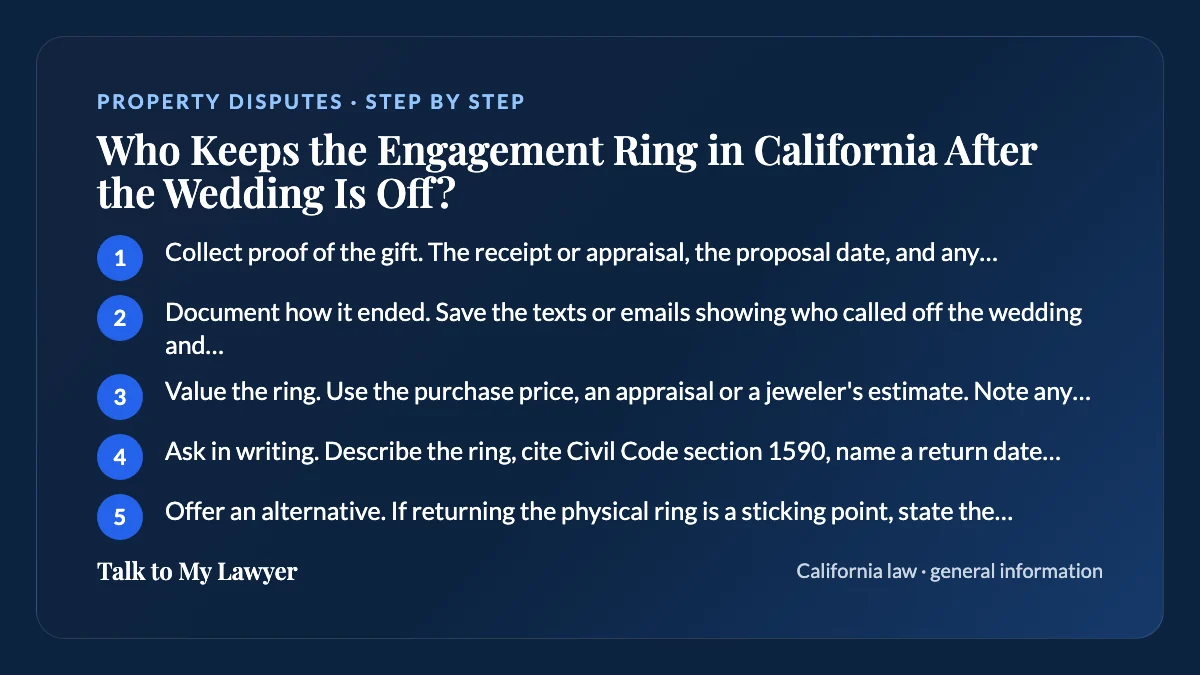
- Collect proof of the gift. The receipt or appraisal, the proposal date, and any messages describing the ring as an engagement ring.
- Document how it ended. Save the texts or emails showing who called off the wedding and when.
- Value the ring. Use the purchase price, an appraisal or a jeweler's estimate. Note any insurance rider in either name.
- Ask in writing. Describe the ring, cite Civil Code section 1590, name a return date, and offer a safe way to hand it over, such as a jeweler or a third party.
- Offer an alternative. If returning the physical ring is a sticking point, state the value you would accept instead.
- File if needed. Rings valued at $12,500 or under fit within the small claims limit for individuals; larger claims go to regular civil court.
On February 14, 2025, I gave you a platinum engagement ring with a one-carat diamond, purchased for $9,800 (receipt enclosed), on the understanding that we would marry. On August 3, 2026, you told me by text that you would not go through with the wedding. California Civil Code section 1590 allows me to recover the ring. Please return it by September 15, either in person at Main Street Jewelers or by insured mail. If you prefer, I will accept $9,800 instead.
For other belongings caught up in a breakup, see our guide on getting your things back from an ex, and for what to do before filing, the written request small claims expects.
What happens if your former partner refuses to return the ring?
If a written request does not work, the remaining route is court. Small claims takes cases up to $12,500 when the person suing is an individual (Code of Civil Procedure section 116.221), and neither side may bring a lawyer to the hearing. Although the case asks for money, the judge has authority to award restitution or specific performance alongside a money award or instead of one (section 116.220(b)), so an order to hand back the ring itself is possible.
Example (hypothetical): a ring bought for $9,800 is appraised at $8,500 after the breakup. The giver claims $9,800, the recipient argues it was a Valentine's Day gift unrelated to the proposal, and the proposal photos from that night are the giver's main evidence. Because section 1590 lets the court award the part of the value it finds just, the outcome can fall anywhere from nothing to the full amount.
Timing matters too. A suit for taking or detaining personal property, including one to recover the item itself, generally must be filed within three years (Code of Civil Procedure section 338(c)(1)). A lawyer can confirm which deadline fits your claim.
Asking for the ring through an attorney instead of a text message
After a broken engagement, a request from either partner can sound like an accusation. A letter from an attorney keeps the focus on section 1590 and the facts. It can help when the ring is valuable, when the two of you disagree about who ended things, or when family members are involved.
Through Talk to My Lawyer, a licensed California attorney writes your letter from the receipt, the appraisal and the texts about how things ended, and sends it on your behalf. If the ring is worth more than the small claims limit, or a case has already been filed, ask a lawyer how section 1590 fits what happened.
Frequently asked questions
Is an engagement ring a gift in California?
It is a gift, but a conditional one. Civil Code section 1590 treats gifts made on the assumption that the marriage will take place differently from ordinary presents. If the person who received the ring refuses to marry, or the couple calls off the wedding by mutual consent, the giver may recover the ring or a just part of its value. Ordinary gifts cannot be taken back once delivered.
If I broke off the engagement, do I have to give the ring back?
Section 1590 gives the giver a right to recover only when the recipient refuses to marry or both agree to end it. If you received the ring and your partner, the giver, ended things, the statute does not list that situation, and ordinary gift rules generally apply. If you received the ring and you ended it, the giver can ask for its return under section 1590.
Can I sue my ex-fiancé for the money I spent on the wedding?
Not on a theory of breach of promise to marry, because Civil Code section 43.5 abolished that lawsuit. Gifts of money or property to your partner made on the assumption of marriage may be recoverable under section 1590. Money paid to vendors depends on the vendor contract and on any agreement between the two of you about splitting costs, which can be a separate claim.
Can small claims court order my ex to return the engagement ring?
A small claims case asks for a dollar amount, capped at $12,500 for an individual. Section 116.220(b) of the Code of Civil Procedure still lets the judge award restitution or specific performance and make the judgment conditional, for example: return the ring by a set date or pay its value. Bring the receipt or appraisal and the messages showing who ended the engagement.
Sources
Checked against these official sources on October 18, 2026.
- California Civil Code section 1590 (California Legislative Information)
- California Civil Code section 43.5 (California Legislative Information)
- California Civil Code section 1148 (California Legislative Information)
- California Code of Civil Procedure section 116.221 (California Legislative Information)
- California Code of Civil Procedure section 116.220 (California Legislative Information)
- Small claims in California (California Courts Self-Help Guide)
This guide explains California law in general terms as of October 2026. It is general information, not legal advice for your situation, and local rules can add to it.
Join the email list and get a lawyer letter started
With Talk to My Lawyer, a licensed California attorney writes your letter from your facts and documents and sends it on your behalf. Join the Talk to My Lawyer email list for letter checklists, document prompts, and reminders before you start your letter.