Quick answer
If your ex took your dog in California, the main question is who owns it. Outside divorce, pets are personal property (Civil Code section 655; Penal Code section 491), so adoption papers, receipts, vet records and licenses matter. In a divorce or legal separation, Family Code section 2605 lets a judge assign ownership based on the pet's care. A demand letter asks for return by a set date.
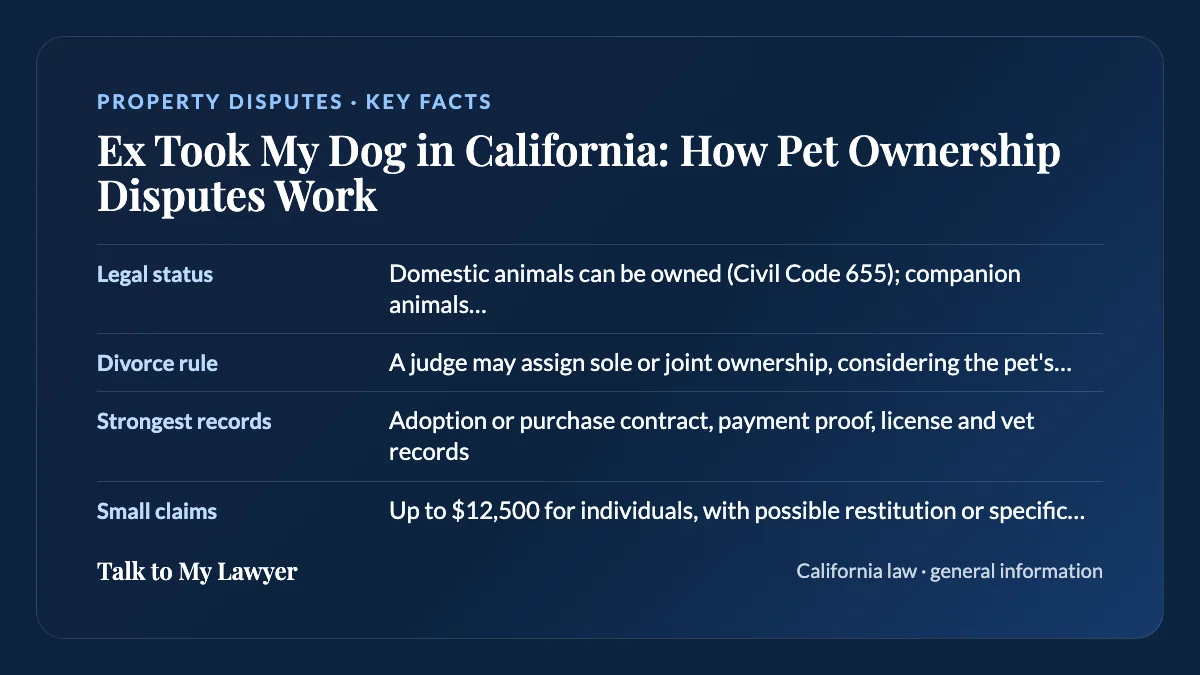
At a glance
- Legal status
- Domestic animals can be owned (Civil Code 655); companion animals are personal property (Penal Code 491)
- Divorce rule
- A judge may assign sole or joint ownership, considering the pet's care (Family Code 2605)
- Strongest records
- Adoption or purchase contract, payment proof, license and vet records
- Small claims
- Up to $12,500 for individuals, with possible restitution or specific performance (CCP 116.220, 116.221)
- Deadline
- 3 years to sue for taking or detaining personal property (CCP 338(c))
Who keeps the dog after a breakup in California?
Outside a divorce, the person who owns the dog keeps it. California law treats animals as property: Civil Code section 655 says there may be ownership "of all domestic animals," and Penal Code section 491 states that companion animals, such as a dog or cat kept as a household pet, are personal property whose value is measured the same way as other property.
That framing can feel cold when the animal sleeps on your bed. It also gives you one clear question to answer: who acquired the pet, and did ownership ever change hands? In a dispute between unmarried partners, roommates or friends, a judge looks at evidence of ownership rather than at who loves the dog more.
Ownership can change. If you bought a puppy and later gave it to your partner as a birthday present, the gift may have transferred it. A text saying "she's your dog now" can matter as much as the original receipt, so reread your own messages before you write anything.
What proof of pet ownership counts?
Proof of pet ownership is any record that shows who acquired the animal and who has been treated as its owner since. No single document settles it. A microchip registration, for example, shows whose contact details the registry holds, which may not match who paid for the dog.
| Record | What it tends to show | Watch for |
|---|---|---|
| Adoption contract or bill of sale | Who acquired the pet, and when | Two names on the contract points toward shared ownership |
| Payment for the adoption fee or purchase | Whose money bought the pet | A joint account makes this less clear |
| Microchip registration | Whose contact details the registry lists | Details can be changed; it shows contact, not purchase |
| City or county dog license | Who registered the dog with local government | Check the name on each renewal, not only the first |
| Vet records and invoices | Who brought the pet in and who paid | Clinics list one client, which may be either partner |
| Texts, emails and social posts | Statements about whose pet it is, or a gift | Messages can cut both ways |
Keep originals where your ex cannot reach them, and screenshot anything stored online. Our demand letter evidence checklist covers how to organize records so the other side can check them quickly.
Does California pet custody law apply to unmarried couples?
No. California's pet custody statute, Family Code section 2605, applies only in proceedings for dissolution of marriage or legal separation. In effect since January 1, 2019, it lets the court, at a party's request, assign sole or joint ownership of a pet animal "taking into consideration the care of the pet animal."
- Interim orders. Before the case is final, the judge may order one spouse to care for the pet. That order has no effect on the final decision about ownership.
- What care means. The statute includes preventing harm or cruelty and providing food, water, veterinary care and safe, protected shelter.
- Which pets. A "pet animal" under section 2605 is one that is community property and kept as a household pet. A dog one spouse owned before the marriage may be separate property and fall outside it.
Unmarried partners fall back on ordinary property rules. Their dispute is about ownership and possession, and the care-based test in section 2605 is not the governing standard.
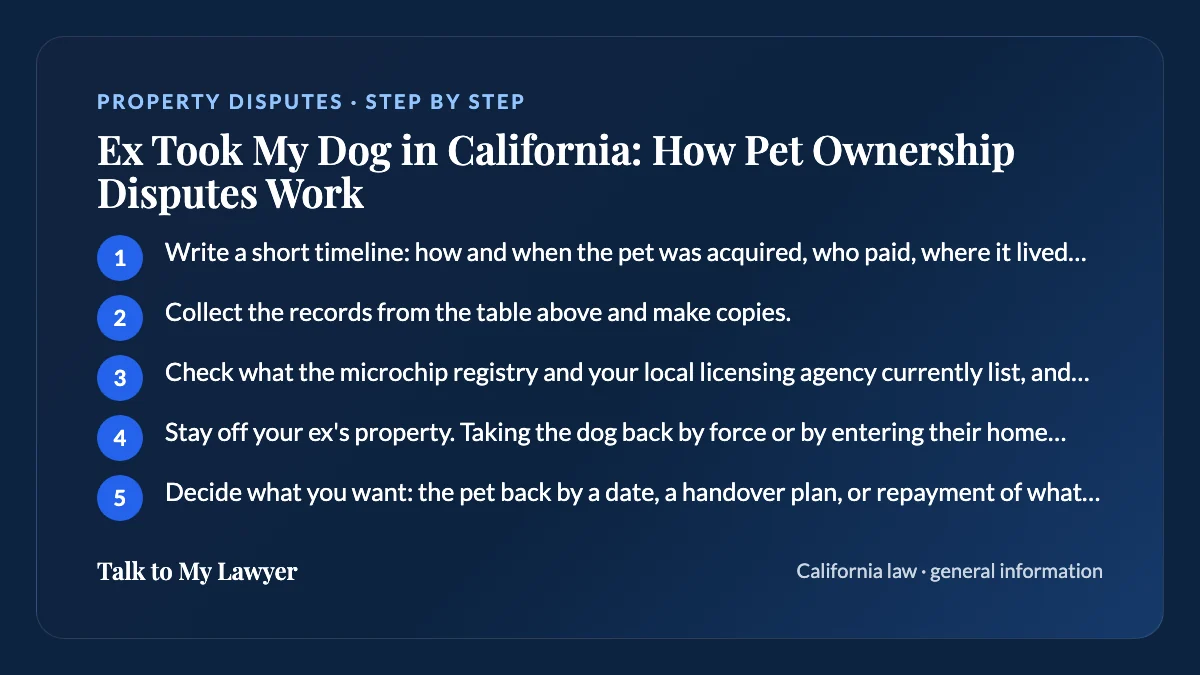
Steps to take before you ask for the dog back
- Write a short timeline: how and when the pet was acquired, who paid, where it lived, and the date your ex took it.
- Collect the records from the table above and make copies.
- Check what the microchip registry and your local licensing agency currently list, and screenshot both.
- Stay off your ex's property. Taking the dog back by force or by entering their home can create trespass or other problems that distract from the ownership question.
- Decide what you want: the pet back by a date, a handover plan, or repayment of what you spent if you would accept money instead.
- Send the demand in a way that leaves a record, for example certified mail and a matching email or text.
What to put in a demand letter for the return of a pet
A demand letter for a pet is short and specific. It identifies the animal, explains why you are its owner, asks for return by a date, and proposes how the handover will happen.
- The pet's name, breed, color, age and microchip number.
- How you acquired it, with the date and the document that proves it.
- The date your ex took the pet, and any messages about it.
- A clear request: return by a specific date and time, at a neutral place.
- What you will do if the pet is not returned, stated plainly, such as filing in small claims court.
I adopted Biscuit, a four-year-old tan terrier mix, microchip number ending 4471, from the county shelter on March 2, 2023, as shown on the enclosed adoption contract in my name. I have paid for her license and veterinary care since then. On September 14, you took Biscuit from my apartment without my consent. Please return her, with her medical records, by 6 p.m. on October 3 in the parking lot of the Elm Street Library. If she is not returned, I intend to file a claim in small claims court.
Keep the tone level. A letter that insults your ex or replays the relationship gives them something to argue about besides the paperwork.
What happens if your ex refuses to return the pet?
If your ex refuses, your main options are small claims court or a civil case in superior court. Small claims hears claims of up to $12,500 brought by individuals (Code of Civil Procedure section 116.221). Under section 116.220(b), a small claims judge may also grant equitable relief, such as restitution or specific performance, in place of or in addition to money damages, and may issue a conditional judgment.
Whether a small claims judge will order an animal handed over depends on the court and the facts, so a claim can ask for the pet's return and, in the alternative, its value.
- Value of a taken pet. Damages for a wrongful taking, called conversion, start from what the property was worth at the time it was taken, plus interest, and add fair compensation for the time and money spent getting it back (Civil Code section 3336). Evidence of value may include the adoption fee or purchase price.
- An injured pet. For willful or grossly negligent injury to an animal, Civil Code section 3340 allows exemplary damages.
- A court order for the animal itself. A superior court case can include a sworn application for a writ of possession under the claim and delivery statutes, beginning at Code of Civil Procedure section 512.010. The application must describe the property, its value and where it is believed to be.
Mind the deadline. A lawsuit for taking or detaining personal property, including one for its specific recovery, has a general limit of three years under section 338(c) of the Code of Civil Procedure. Our guide on what to send before filing in small claims walks through the filing.
Having a California attorney write your pet return letter
Pet disputes pair strong feelings with thin paperwork, and the letter has to keep its focus on the paperwork. A lawyer's letter is worth weighing when both names are on the adoption contract, when the pet was arguably a gift, when a divorce is pending and section 2605 may apply, or when your ex has stopped answering you.
Through Talk to My Lawyer, a licensed California attorney writes your letter from your adoption records, vet bills and messages, and sends it on your behalf. If you are in a divorce or need a restraining order, talk to a family lawyer about your facts.
Frequently asked questions
Is a dog considered property in California?
Yes. Civil Code section 655 allows ownership of all domestic animals, and Penal Code section 491 says companion animals are personal property valued like other property. The main departure from a pure property analysis comes in divorce and legal separation, where Family Code section 2605 lets a judge assign ownership of a community property pet by considering who has cared for it.
Does a microchip prove I own my dog?
A microchip registration is evidence, not a title document. It shows whose contact details the registry has on file, and those details can be changed. A court may weigh it alongside adoption contracts, purchase receipts, license records and vet invoices. If your ex changed the registration after taking the dog, keep a record of what it said before and after.
Can I call the police if my ex took my dog?
You can make a report. Police may decide the matter is a civil property dispute, particularly when both partners have some claim to the pet or it lived in a shared home. Bring your ownership records if you report it. Whatever the police decide, a written demand and, if needed, a court claim remain available ways to resolve who owns the animal.
Who gets the dog in a California divorce?
Under Family Code section 2605, a judge in a divorce or legal separation can assign sole or joint ownership of a pet that is community property, taking the pet's care into account. Care includes food, water, veterinary care, safe shelter and protection from harm. The judge can also order one spouse to look after the pet while the case is pending.
Can I sue my ex in small claims court for my dog?
Yes. Small claims court in California hears claims by individuals of up to $12,500. The court expects you to ask for the pet or payment before filing, and the claim is made on form SC-100. Along with money, the judge may grant equitable relief such as restitution or specific performance, so you can ask for the pet's return and, in the alternative, its value.
Sources
Checked against these official sources on October 18, 2026.
- California Civil Code section 655 (California Legislative Information)
- California Penal Code section 491 (California Legislative Information)
- California Family Code section 2605 (California Legislative Information)
- California Code of Civil Procedure section 116.220 (California Legislative Information)
- California Code of Civil Procedure section 338 (California Legislative Information)
- Small claims in California (California Courts Self-Help Guide)
This guide explains California law in general terms as of October 2026. It is general information, not legal advice for your situation, and local rules can add to it.
Join the email list and get a lawyer letter started
With Talk to My Lawyer, a licensed California attorney writes your letter from your facts and documents and sends it on your behalf. Join the Talk to My Lawyer email list for letter checklists, document prompts, and reminders before you start your letter.