Quick answer
The San Francisco minimum wage is $19.61 an hour from July 1, 2026, for employees who work within the city, including part-time and temporary workers. A small group of government-supported employees has a $17.35 rate. The rate adjusts each July 1 with inflation under Article 1 of the San Francisco Labor and Employment Code, and the Office of Labor Standards Enforcement (OLSE) takes complaints.
At a glance
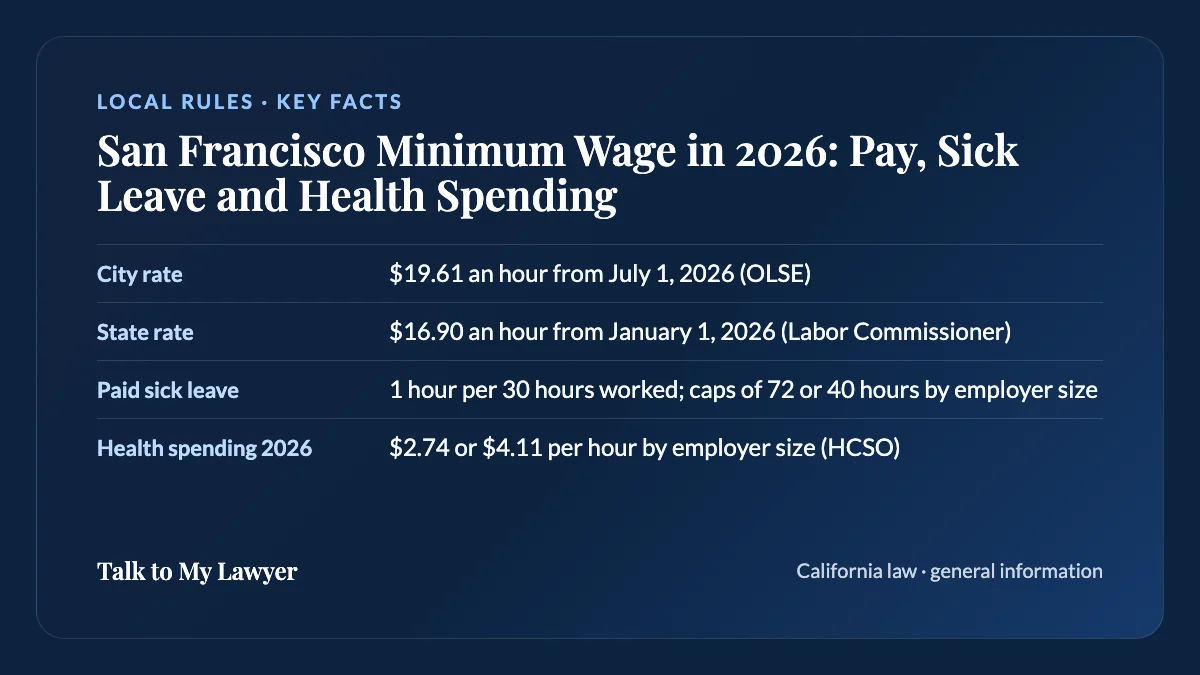
- City rate
- $19.61 an hour from July 1, 2026 (OLSE)
- State rate
- $16.90 an hour from January 1, 2026 (Labor Commissioner)
- Paid sick leave
- 1 hour per 30 hours worked; caps of 72 or 40 hours by employer size
- Health spending 2026
- $2.74 or $4.11 per hour by employer size (HCSO)
- Retaliation
- Adverse action within 90 days of a complaint is presumed retaliatory (L.E.C. 1.6)
What is the San Francisco minimum wage in 2026?
Employers must pay at least $19.61 an hour for work performed in San Francisco from July 1, 2026, according to the Office of Labor Standards Enforcement (OLSE). Because the rate changes every July 1, a claim covering more than a year can involve two different hourly figures.
| Rate | Amount | Applies to |
|---|---|---|
| San Francisco minimum wage | $19.61 per hour | Employees working in San Francisco, from July 1, 2026 |
| Government Supported Employees | $17.35 per hour | A small group of workers in government-funded programs, from July 1, 2026 |
| California minimum wage | $16.90 per hour | Statewide floor from January 1, 2026 |
The city rate rises each July 1 by the prior year's increase in the Consumer Price Index for urban wage earners in the San Francisco-Oakland-San Jose area (L.E.C. section 1.4). The state's Labor Commissioner says that when local, state and federal rates differ, the employer must pay the one most favorable to the worker.
Who has to be paid the city rate?
Any employee who performs work within San Francisco's boundaries is owed the city rate for each hour worked there, including part-time and temporary employees. Where the employer is based does not decide it; where the work happens does.
- For example, a driver dispatched from a Daly City warehouse is owed the city rate for the hours spent working inside San Francisco.
- A worker cannot agree to accept less; the Labor Commissioner notes that the minimum wage cannot be waived by agreement.
- Employers must give each employee their name, address and phone number in writing at hire, and post the city's notice where workers can read it (L.E.C. section 1.5).
If your employer kept no reliable payroll records, the ordinance presumes you were paid no more than the state or federal minimum, unless the employer proves otherwise by clear and convincing evidence. Employers must keep payroll records for four years.
Example: working out what you are owed
Example (hypothetical): a barista at a Mission District cafe is paid $18.50 an hour from July 1, 2026 and works 30 hours a week. The shortfall is $1.11 for every hour.
| Item | Calculation | Amount |
|---|---|---|
| Hourly shortfall | $19.61 minus $18.50 | $1.11 |
| Weekly shortfall | $1.11 x 30 hours | $33.30 |
| Over 16 weeks | $33.30 x 16 | $532.80 |
That $532.80 is back pay only. Under section 1.7, a court or OLSE can add interest from the date each paycheck was due, at the rate in Civil Code section 3289(b), and the penalties described below. Keep your own log of hours if your pay stubs are incomplete; our guide to California pay stub violations covers what a stub must show.
How does San Francisco paid sick leave work?
Under the Paid Sick Leave Ordinance (L.E.C. Article 11), employees who work in San Francisco earn 1 hour of paid sick leave for every 30 hours worked, including temporary and part-time employees.
- Employers with 10 or more employees may cap a worker's balance at 72 hours.
- Employers with fewer than 10 employees may cap the balance at 40 hours.
- OLSE notes that neither SFO nor the Presidio is covered by this law.
- Questions go to OLSE at 415-554-6271 or psl@sfgov.org.
San Francisco voters approved the first city paid sick leave law in the country in 2006, and 2016 amendments added worker protections that largely parallel California's statewide Healthy Workplaces, Healthy Families Act. Leave balances and caps can still differ between the two, so check both.
What does the Health Care Security Ordinance require?
Employers with 20 or more workers worldwide (or nonprofits with 50 or more) must spend a minimum amount per hour on health care for covered employees (L.E.C. Article 21). You are covered if you have worked for the employer for more than 90 days and regularly work at least 8 hours a week in San Francisco.
| Employer size | 2026 rate | From January 1, 2027 |
|---|---|---|
| 20 to 99 workers (nonprofits 50 to 99) | $2.74 per hour | $2.99 per hour |
| 100 or more workers | $4.11 per hour | $4.49 per hour |
The employer chooses how to spend it, for example on insurance premiums or payments to the SF City Option program, and since 2017 only irrevocable expenditures count. Managerial, supervisory and confidential employees earning more than $128,861 a year in 2026 are exempt. HCSO questions go to 415-554-7892 or hcso@sfgov.org.
What can OLSE or a court award for unpaid San Francisco wages?
After a hearing, OLSE can order back wages, reinstatement and an administrative penalty that the ordinance sets at $50 per affected worker for each day the violation continued, adjusted annually for inflation (L.E.C. section 1.7(c)).
A worker can also sue in court. Section 1.7(d) lets a person who wins recover back wages, the same daily penalty, reinstatement or injunctive relief, and reasonable attorneys' fees and costs. Interest on unpaid wages is added in either forum.
Can you be fired for raising a minimum wage complaint?
No. Section 1.6 makes it unlawful for an employer to take adverse action against anyone for asserting rights under the ordinance, including filing a complaint, telling coworkers about their rights, or helping someone else assert them. The protection covers a good-faith complaint even if it turns out to be mistaken.
If the employer acts against you within 90 days of the protected activity, the law presumes the action was retaliation, and the employer must rebut it. Our guide to a workplace retaliation letter in California explains the parallel state protections.
Steps to recover unpaid San Francisco wages
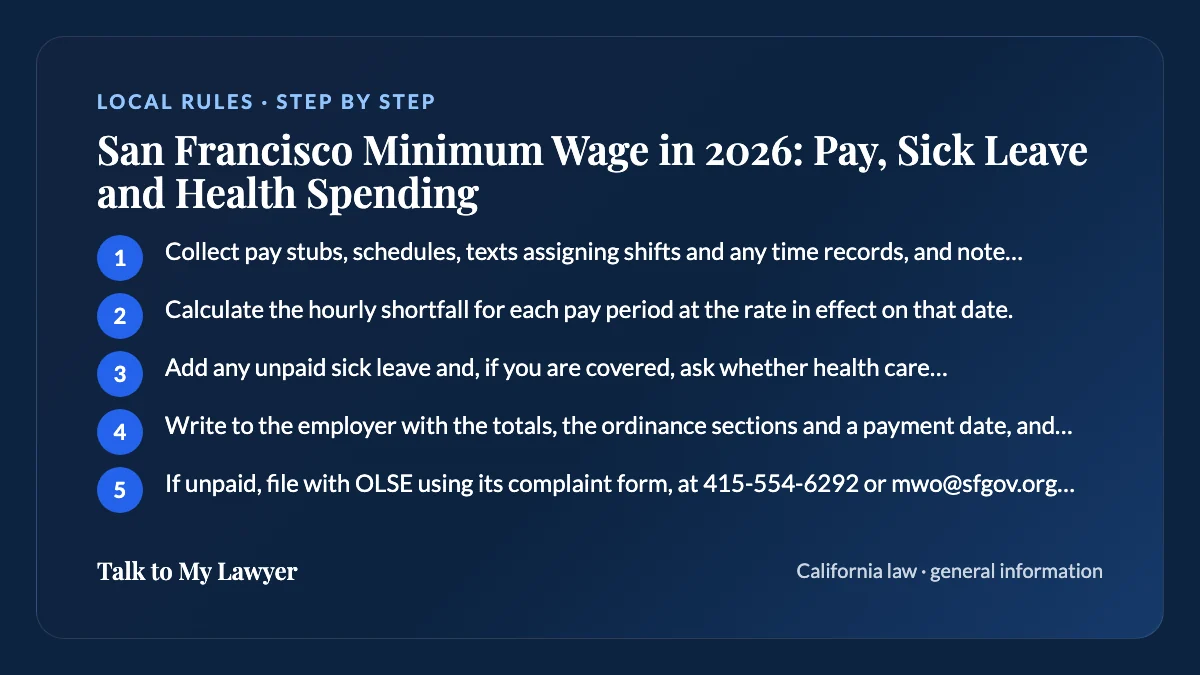
- Collect pay stubs, schedules, texts assigning shifts and any time records, and note which hours were worked inside the city.
- Calculate the hourly shortfall for each pay period at the rate in effect on that date.
- Add any unpaid sick leave and, if you are covered, ask whether health care expenditures were made for you.
- Write to the employer with the totals, the ordinance sections and a payment date, and keep proof of delivery.
- If unpaid, file with OLSE using its complaint form, at 415-554-6292 or mwo@sfgov.org, or take the claim to court. OLSE keeps a reporter's identity confidential to the extent the law allows.
From July 1 through October 18, 2026, I worked 30 hours a week at your Valencia Street location and was paid $18.50 an hour. The San Francisco minimum wage for that period is $19.61 (Labor and Employment Code section 1.4). The unpaid difference is $532.80. Please pay this amount, with interest, by November 1, 2026, and correct my rate going forward.
Wages owed at the end of a job carry separate state deadlines, covered in our guide to a final paycheck demand letter.
When a San Francisco wage claim calls for an attorney letter
Underpayment that spans two or three July 1 rate changes, hours split between city and suburban job sites, missing sick leave and health spending, or a firing within weeks of a pay complaint each add rules and dollar figures to track. A written demand that ties each dollar to a section of the Labor and Employment Code puts the employer on notice before OLSE or a court is involved.
Through Talk to My Lawyer, a licensed California attorney writes your letter (from your facts, pay stubs, schedules and other records) and sends it on your behalf to your employer. Choosing between OLSE, the state Labor Commissioner and court is a decision to make with a lawyer who knows your facts.
Frequently asked questions
What is the minimum wage in San Francisco right now?
As of October 2026, it is $19.61 an hour, effective July 1, 2026, for employees performing work in San Francisco, including part-time and temporary workers. Some government-supported employees have a $17.35 rate. The rate changes every July 1 based on regional inflation, so check OLSE's minimum wage page before each new fiscal year.
Do I get the San Francisco minimum wage if my employer is based outside the city?
Yes, for the hours you actually work inside San Francisco. The ordinance applies to each hour worked within the city's geographic boundaries, regardless of where the employer is located. Hours you work outside the city are governed by the minimum wage of that location or the state rate, whichever is higher.
How much paid sick leave do San Francisco workers get?
You earn 1 hour of paid sick leave for every 30 hours worked in San Francisco. Employers with 10 or more employees may cap your balance at 72 hours, and smaller employers at 40 hours. Temporary and part-time workers are included. Work at SFO and in the Presidio is not covered by the city's sick leave law, though state law may still apply.
How do I file a minimum wage complaint in San Francisco?
Use the Office of Labor Standards Enforcement's Minimum Wage Ordinance complaint form, available in English, Chinese, Spanish and Filipino, or contact OLSE at 415-554-6292 or mwo@sfgov.org. OLSE can investigate, hold a hearing and order back wages and penalties. You can also file a civil lawsuit under section 1.7(d) of the ordinance.
Can my employer cut my hours after I complain about pay?
Cutting hours in response to a complaint is adverse action, which section 1.6 of the ordinance prohibits. If it happens within 90 days of your complaint, the law presumes it was retaliation, and the employer has to show a legitimate reason. Write down dates, who said what and any change in schedule, since timing is central to the presumption.
Sources
Checked against these official sources on October 18, 2026.
- Minimum Wage Ordinance (San Francisco Office of Labor Standards Enforcement)
- San Francisco Labor and Employment Code, Article 1: Minimum Wage (City and County of San Francisco (American Legal Publishing))
- Paid Sick Leave Ordinance (San Francisco Office of Labor Standards Enforcement)
- Health Care Security Ordinance (San Francisco Office of Labor Standards Enforcement)
- Health Care Security Ordinance Official Notice 2026 (San Francisco Office of Labor Standards Enforcement)
- Minimum Wage Frequently Asked Questions (California Labor Commissioner's Office)
This guide explains California law in general terms as of October 2026. It is general information, not legal advice for your situation, and local rules can add to it.
Join the email list and get a lawyer letter started
With Talk to My Lawyer, a licensed California attorney writes your letter from your facts and documents and sends it on your behalf. Join the Talk to My Lawyer email list for letter checklists, document prompts, and reminders before you start your letter.