Quick answer
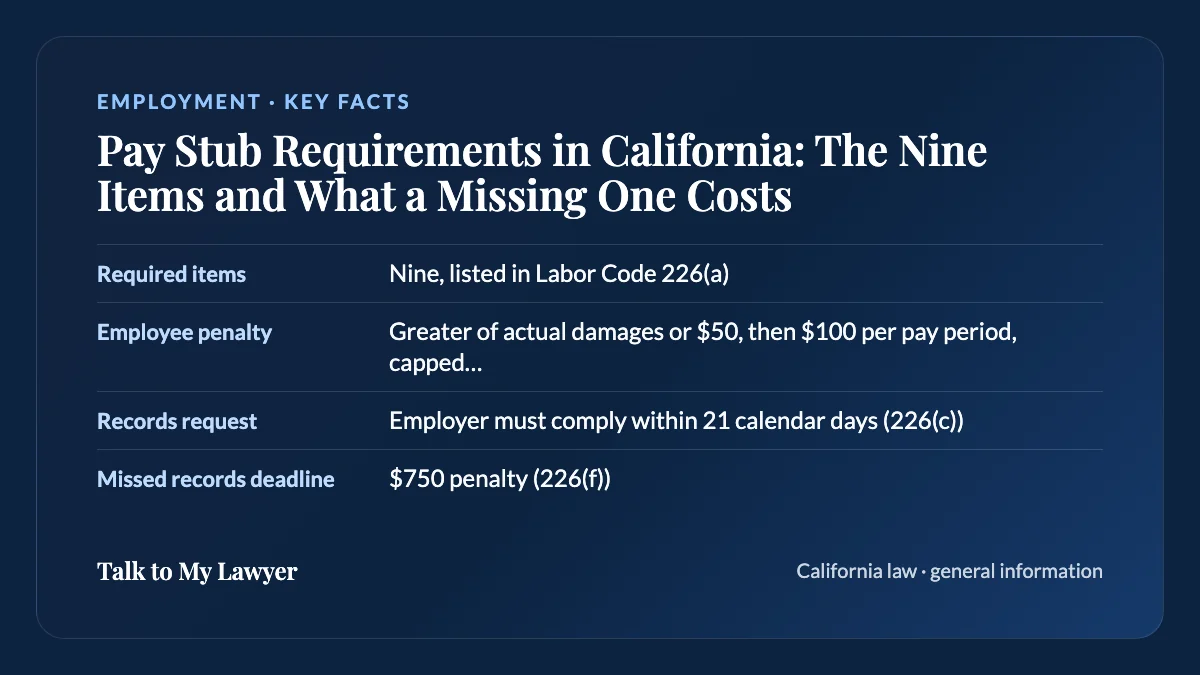
Pay stub requirements in California come from Labor Code section 226(a), which lists nine items every wage statement must show, including gross and net wages, total hours, all deductions, pay period dates, the employer's legal name and address, and each hourly rate with hours at that rate. Knowing and intentional violations bring $50 for the first pay period and $100 for each later one, up to $4,000 per employee.
At a glance
- Required items
- Nine, listed in Labor Code 226(a)
- Employee penalty
- Greater of actual damages or $50, then $100 per pay period, capped at $4,000 (226(e))
- Records request
- Employer must comply within 21 calendar days (226(c))
- Missed records deadline
- $750 penalty (226(f))
- Record keeping
- Employer keeps copies for at least 3 years (226(a))
What must be on a pay stub in California?
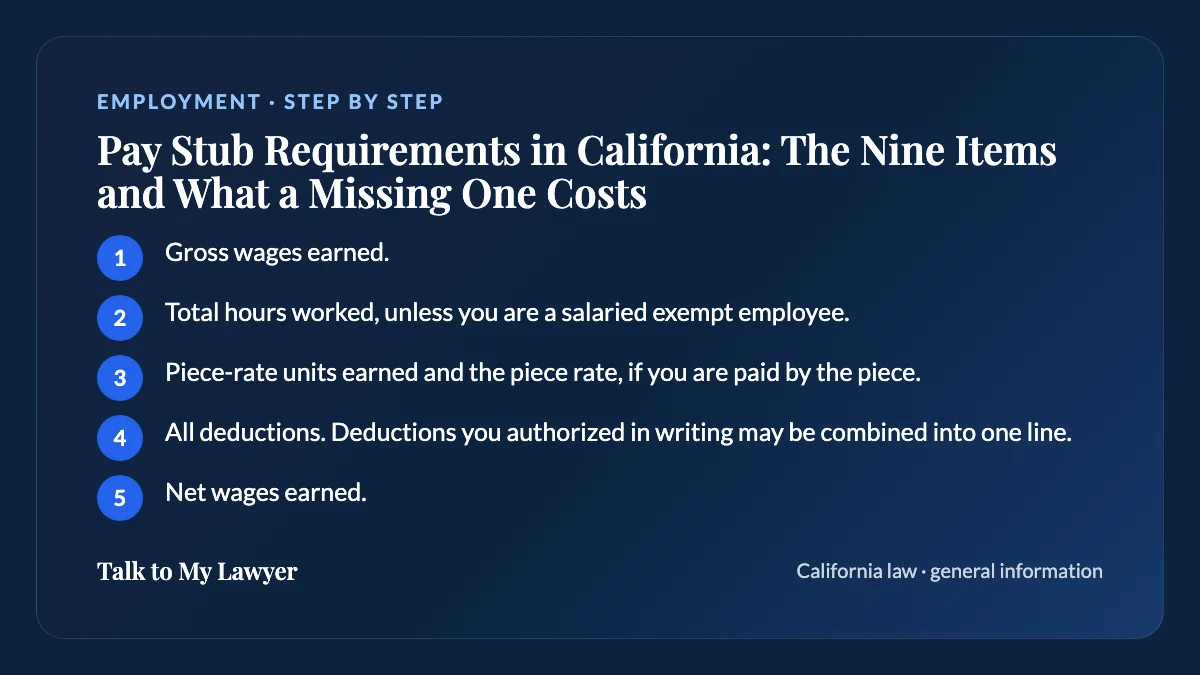
Every time you are paid, or twice a month, your employer must give you an accurate itemized statement in writing showing these nine items (Labor Code section 226(a)):
- Gross wages earned.
- Total hours worked, unless you are a salaried exempt employee.
- Piece-rate units earned and the piece rate, if you are paid by the piece.
- All deductions. Deductions you authorized in writing may be combined into one line.
- Net wages earned.
- The inclusive dates of the pay period.
- Your name and only the last four digits of your Social Security number, or an employee ID number.
- The name and address of the legal entity that is your employer.
- Every hourly rate in effect during the pay period and the hours worked at each rate.
Temporary services employers must also show the rate and hours for each assignment, and farm labor contractors must name the entity that secured their services. Separately, Labor Code section 246(i) requires your available paid sick leave or PTO balance on the stub or in a writing given on payday.
Item 8 deserves a close look. A trade name or a brand on the stub is not the same as the legal entity, and without it you may not know whom to send a demand to. The guide on how to find a business's legal name in California shows how to look it up.
What are the penalties for pay stub violations in California?
An employee injured by a knowing and intentional violation can recover the greater of actual damages or a statutory penalty, plus costs and reasonable attorney's fees (Labor Code section 226(e)).
| Penalty | Amount | Who recovers it |
|---|---|---|
| First pay period with a violation | $50 | Employee (226(e)) |
| Each later pay period with a violation | $100 | Employee (226(e)) |
| Cap on 226(e) penalties | $4,000 per employee | Employee |
| Missing the 21-day records deadline | $750 | Employee or Labor Commissioner (226(f)) |
| Labor Commissioner citation, first | $250 per employee per violation | State (226.3) |
| Labor Commissioner citation, later | $1,000 per employee per violation | State (226.3) |
Two limits matter. A knowing and intentional failure does not include an isolated, unintentional payroll error from a clerical or inadvertent mistake (section 226(e)(3)). And the injury requirement is defined in the statute: you are deemed injured if you got no stub at all, or if key information was missing or wrong and you could not promptly and easily determine it from the stub alone.
Example: how the $4,000 cap works
Example (hypothetical): a restaurant pays its line cooks every two weeks. Its stubs list gross and net pay but no hours, no hourly rates and no employer address. A cook worked there for 18 months, about 39 pay periods, and every stub had the same problems.
| Pay periods | Penalty | Running total |
|---|---|---|
| Period 1 | $50 | $50 |
| Periods 2 to 39 (38 periods x $100) | $3,800 | $3,850 |
| Statutory cap | $3,850 (under $4,000) |
Had he worked two more pay periods, the total would have reached the $4,000 cap. Whether the restaurant's failure was knowing and intentional is a question for a court or the Labor Commissioner, and a stub that leaves out hours can also hide unpaid overtime. That second problem is explained in unpaid overtime in California.
How do you get copies of your payroll records?
Current and former employees have the right to inspect or receive a copy of their payroll records on reasonable request (Labor Code section 226(b)). The employer must comply as soon as practicable, and no later than 21 calendar days from the date of the request (section 226(c)).
- The request can be written or oral, but writing gives you a dated record.
- The employer may verify your identity and may designate who receives requests.
- If you ask for copies, the employer may charge the actual cost of reproduction.
- Missing the deadline exposes the employer to a $750 penalty (section 226(f)). An employer can defend by showing compliance was impossible for reasons that did not stem from a violation of law (section 226(c)).
Payroll records and your personnel file are separate rights with separate deadlines. The guide to a personnel file request letter explains how to ask for both in one letter.
How long do you have to raise a pay stub claim?
Penalty claims can carry shorter deadlines than wage claims. On its wage claim page, the Labor Commissioner gives one year for penalty claims tied to records an employer failed to produce, against three years for claims such as unpaid minimum wage and overtime.
The deadline for 226(e) penalties in court is a separate question worth confirming with a lawyer, because the answer affects how many pay periods you can count. If the stubs also hide unpaid wages, those wage claims keep their own, longer deadlines.
How to write a letter about pay stub violations
- Lay out a few stubs and mark which of the nine items are missing or wrong on each.
- Count the pay periods with the problem and note the dates.
- Request your payroll records under section 226(b), with the 21-day deadline stated.
- Ask the employer to issue compliant stubs going forward.
- If you are seeking penalties, state the amount under section 226(e) and how you counted it.
- Date the letter, keep a copy, and deliver it by a method that leaves a receipt, such as certified mail.
My wage statements from January 2025 through June 2026 show only gross and net pay. They do not show my total hours, my hourly rate or the employer's legal name and address, as Labor Code section 226(a) requires. Please provide copies of my payroll records within 21 calendar days, as section 226(c) requires, and issue compliant wage statements from my next payday forward. I am also requesting the penalties provided by section 226(e) for the 39 affected pay periods.
When an attorney-written pay stub letter makes sense
A request for corrected stubs going forward can be a short note from you. A demand for section 226(e) penalties is a different document: it has to count pay periods correctly, deal with the knowing-and-intentional standard, and flag any unpaid overtime or missed premiums the stubs may be hiding. The same goes when an employer has ignored a records request or hands identical stubs to a whole crew.
Talk to My Lawyer works from what you already hold: a licensed California attorney writes your letter from your wage statements, payroll records and the facts you provide, and sends it on your behalf. Which penalties and deadlines apply to your stubs is a question for a lawyer looking at the stubs themselves.
Frequently asked questions
Can my employer give me electronic pay stubs in California?
Section 226(a) requires an accurate itemized statement in writing, delivered with your pay or separately if you are paid by personal check or cash. The statute does not spell out an electronic format. If your employer uses an online portal, make sure you can view, save and print each statement, including after you leave, and ask for paper copies if you cannot.
Does a salaried employee's pay stub have to show hours?
Not always. Section 226(j) lets the stub leave out total hours worked for employees paid solely by salary who are exempt from overtime, and for certain other exempt workers such as outside salespeople. The other required items still apply. If you are paid a salary but are not actually exempt, your stub must show hours, and you may also be owed overtime.
Is a small mistake on my pay stub a violation?
An isolated clerical error does not support penalties. Section 226(e) requires a knowing and intentional failure, and it excludes isolated and unintentional payroll errors caused by a clerical or inadvertent mistake. A repeated error, or one that hides unpaid wages, is a different situation. A quick written request to fix the stub is a reasonable first step.
How long must my employer keep my pay stubs?
At least three years. Section 226(a) requires employers to keep a copy of each itemized statement and the record of deductions for at least three years, at the place of employment or a central location in California. Labor Code section 1174 separately requires payroll records of daily hours and wages to be kept for at least three years.
Sources
Checked against these official sources on October 18, 2026.
- California Labor Code section 226 (California Legislative Information)
- California Labor Code section 226.3 (California Legislative Information)
- California Labor Code section 246 (California Legislative Information)
- California Labor Code section 1174 (California Legislative Information)
- How to file a wage claim (California Labor Commissioner's Office)
This guide explains California law in general terms as of October 2026. It is general information, not legal advice for your situation, and local rules can add to it.
Join the email list and get a lawyer letter started
With Talk to My Lawyer, a licensed California attorney writes your letter from your facts and documents and sends it on your behalf. Join the Talk to My Lawyer email list for letter checklists, document prompts, and reminders before you start your letter.