Quick answer
To request your personnel file in California, send your employer a written request under Labor Code section 1198.5. The employer must let you inspect the file, or give you a copy, within 30 calendar days. You can also ask for payroll records under section 226(b), due within 21 days, and copies of documents you signed under section 432. Missed deadlines on the first two carry $750 penalties.
At a glance
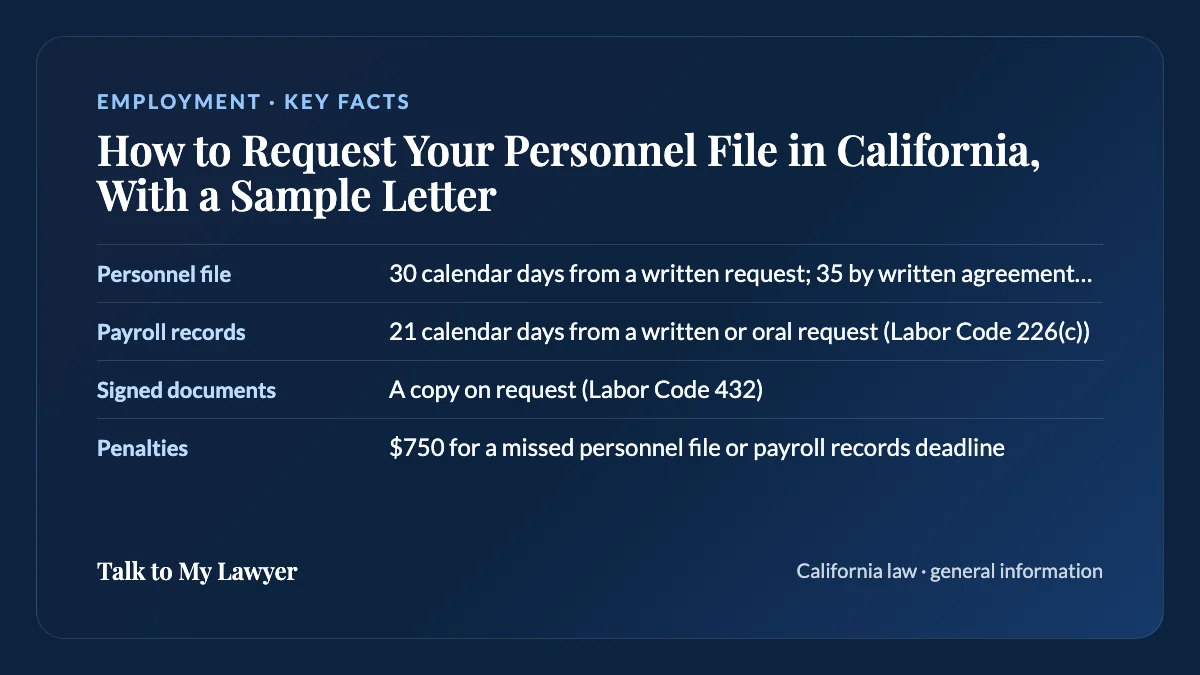
- Personnel file
- 30 calendar days from a written request; 35 by written agreement (Labor Code 1198.5)
- Payroll records
- 21 calendar days from a written or oral request (Labor Code 226(c))
- Signed documents
- A copy on request (Labor Code 432)
- Penalties
- $750 for a missed personnel file or payroll records deadline
- Former employees
- One personnel file request per year; employer keeps files 3 years after you leave
What records can you request from a California employer?
California gives employees three separate records rights. Each covers different documents and runs on its own clock, so one letter can invoke all three.
| Right | What it covers | Deadline | If the employer misses it |
|---|---|---|---|
| Personnel file (Labor Code 1198.5) | Records about your performance, including education or training records, and grievances concerning you | 30 calendar days from a written request | $750 penalty, plus injunctive relief and fees (1198.5(k), (l)) |
| Payroll records (Labor Code 226(b), (c)) | Records of the information on your pay stubs: hours, rates, deductions, pay dates | 21 calendar days from the request | $750 penalty (226(f)) |
| Signed documents (Labor Code 432) | Papers you signed to get or keep the job: offer letter, arbitration agreement, commission plan and similar | Copy on request; no day count in the statute | No stated penalty in section 432 |
These rights apply to current and former employees. Public employees and workers covered by some union contracts can have different procedures, so check whether an exception applies to you.
Who can request a personnel file, and how?
Any current or former employee, or a representative they authorize in writing, can make the request (Labor Code section 1198.5(a) and (e)). The request must be in writing, either a letter you write or a form the employer provides. If the employer uses a form, you can ask your supervisor for it verbally.
- Identity. The employer may take reasonable steps to verify who you are.
- The right person. The employer may designate who receives requests. If you know who that is, address the letter to them; otherwise, human resources is a sensible default.
- Former employees. The employer only has to honor one request per year from a former employee (section 1198.5(d)).
- Lawsuits. If you file a lawsuit that relates to a personnel matter against the employer, the right to inspect under section 1198.5 pauses while that case is pending (section 1198.5(n)).
What is in a California personnel file, and what can be left out?
The file covers records relating to your performance and to any grievance concerning you. That can include reviews, write-ups, commendations and complaints. As of January 1, 2026, the statute also lists education and training records, which must include your name, the training provider, the training's date and duration, the core competencies covered, and any resulting certification (section 1198.5(a)(2), as amended by SB 513).
The employer may withhold or alter certain items:
- Records relating to the investigation of a possible criminal offense.
- Letters of reference.
- Ratings, reports or records obtained before you were hired, prepared by identifiable examination committee members, or obtained for a promotional exam.
- Names of nonsupervisory coworkers, which may be redacted.
How long does a California employer have to provide your file?
The employer has 30 calendar days from receiving your written request to let you inspect the file, and the same 30 days to provide a copy if you ask for one. You and the employer can agree in writing to a later date, but no more than 35 days from receipt (section 1198.5(b)).
- Current employees inspect at the place they report to work, or another place both sides agree on. If you must go elsewhere, you cannot lose pay for it.
- Former employees inspect where the records are stored, unless both sides agree otherwise, and can get a copy by mail by paying actual postage.
- Copies can cost no more than the actual cost of reproduction.
- Retention. The employer must keep each employee's personnel records for at least three years after employment ends (section 1198.5(c)(1)).
Payroll records run on a shorter clock: the employer has 21 calendar days at most, and that request may be made orally or in writing (section 226(c)). The guide to California pay stub requirements explains what those records should show.
Sample personnel file request letter for California
Keep the request short and specific. You do not have to explain why you want the records.
I am a former employee of Harbor Light Logistics, Inc., employed as a dispatcher from March 2022 to August 2026. Under California Labor Code section 1198.5, I request a copy of my personnel records, including education and training records and any records of grievances concerning me. Under section 226(b), I request a copy of my payroll records for my entire employment. Under section 432, I request copies of every document I signed relating to obtaining or holding employment, including any arbitration agreement. Please send the copies by mail to the address below; I will reimburse actual postage and reproduction costs. Section 226(c) requires the payroll records within 21 calendar days of this request, and section 1198.5 requires the personnel records within 30 calendar days of your receipt of it.
The company name is invented for this example. Replace it with your employer's legal name, add your dates and contact details, sign and date the letter.
Steps to send your request and track the deadlines
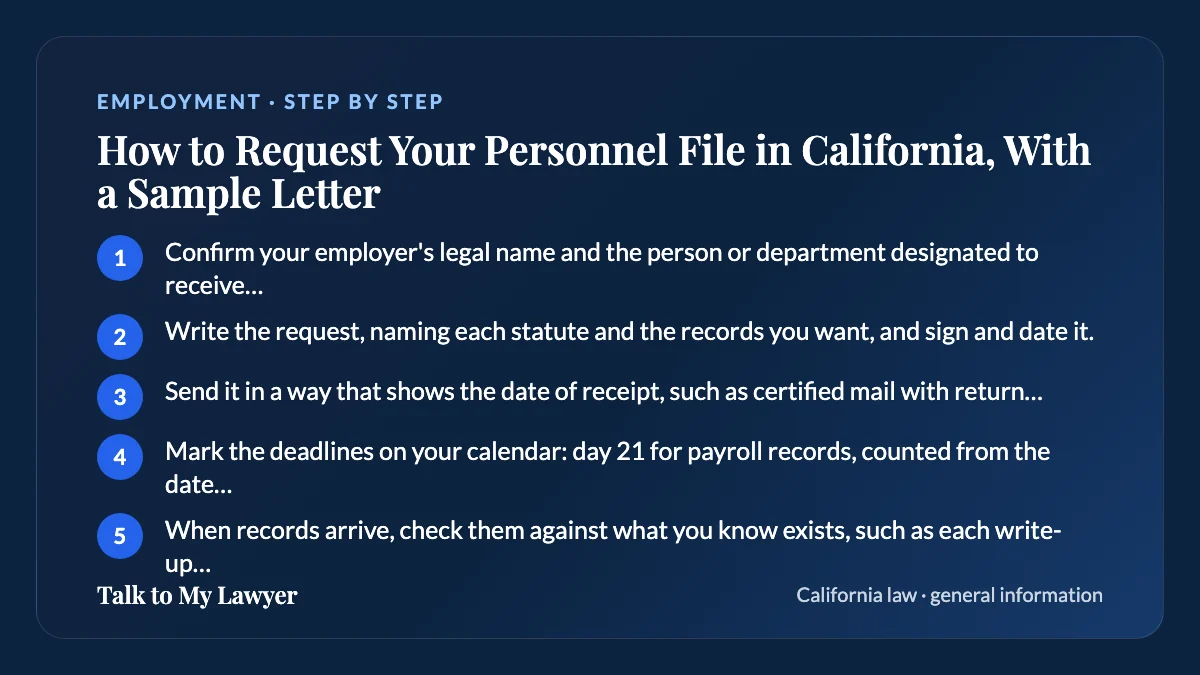
- Confirm your employer's legal name and the person or department designated to receive records requests.
- Write the request, naming each statute and the records you want, and sign and date it.
- Send it in a way that shows the date of receipt, such as certified mail with return receipt or email with a reply confirming receipt.
- Mark the deadlines on your calendar: day 21 for payroll records, counted from the date of your request, and day 30 for the personnel file, counted from the employer's receipt.
- When records arrive, check them against what you know exists, such as each write-up and review.
- If the deadline passes, send a short follow-up noting the date of your request and the statute.
If you are gathering records for a wage dispute, the guide to unpaid wages demand letters and the demand letter evidence checklist show how the documents fit into a claim.
What happens if the employer ignores your request?
If the employer misses the personnel file deadline, you or the Labor Commissioner can recover a $750 penalty (section 1198.5(k)), and you can sue for an order requiring compliance, with costs and reasonable attorney's fees (section 1198.5(l)). Missing the payroll records deadline brings a separate $750 penalty (section 226(f)). Both violations are also infractions.
Penalty claims have a short shelf life. The Labor Commissioner allows one year to file a claim for penalties when an employer fails to provide payroll or personnel records. An employer can raise impossibility of performance as a defense if the delay was not caused by its own violation of law.
If you are worried that asking for records will change how you are treated at work, the guide to workplace retaliation letters in California explains the protections.
When an attorney-written records request makes sense
A records request is a letter you can write yourself, and the sample above tracks the statutes. It becomes part of something bigger when the file is the first step in a dispute, an earlier request went unanswered, you need a specific document such as an arbitration agreement before a deadline, or penalties are already owed.
Talk to My Lawyer handles records requests too: a licensed California attorney writes your letter from your employment dates, the facts you share and the list of records you need, and sends it on your behalf. Once the records arrive, a lawyer can tell you what they mean for your situation.
Frequently asked questions
Can a former employee request their personnel file in California?
Yes. Labor Code section 1198.5 covers current and former employees and their authorized representatives. A former employee can inspect the records where they are stored or receive copies by mail after paying actual postage. Employers only have to honor one request per year from a former employee, and must keep personnel records for at least three years after employment ends.
Does my employer have to give me a copy or just let me look?
Both, if you ask. Section 1198.5 requires the employer to make the file available for inspection and, on written request, to provide a copy within 30 calendar days. The employer can charge no more than the actual cost of reproduction. Ask for a copy in your letter if you want one, so the request is clear and the deadline applies to it.
Can I see my personnel file without leaving my job?
Yes. Section 1198.5 applies while you are employed, and the employer must make it available at the place you report to work or another location you both agree on. If you have to inspect it somewhere else, you cannot lose pay for the time. The employer is not required to make the file available while you are actually scheduled to be working.
What is the difference between a personnel file and payroll records?
A personnel file holds records about performance, training and grievances, and is covered by section 1198.5 with a 30-day deadline. Payroll records hold the information on your wage statements, such as hours, rates and deductions, and are covered by section 226(b) with a 21-day deadline. Each has its own $750 penalty, so a single letter can request both and cite each statute.
Can I get a copy of an arbitration agreement I signed?
Labor Code section 432 says that if an employee or applicant signs any instrument relating to obtaining or holding employment, they must be given a copy on request. That can include an arbitration agreement, a confidentiality agreement or a commission plan. The statute does not set a day count, so ask for a specific response date in your letter.
Sources
Checked against these official sources on October 18, 2026.
- California Labor Code section 1198.5 (California Legislative Information)
- California Labor Code section 226 (California Legislative Information)
- California Labor Code section 432 (California Legislative Information)
- How to file a wage claim (California Labor Commissioner's Office)
This guide explains California law in general terms as of October 2026. It is general information, not legal advice for your situation, and local rules can add to it.
Join the email list and get a lawyer letter started
With Talk to My Lawyer, a licensed California attorney writes your letter from your facts and documents and sends it on your behalf. Join the Talk to My Lawyer email list for letter checklists, document prompts, and reminders before you start your letter.