Quick answer
Unpaid overtime in California is owed when a nonexempt employee works more than 8 hours in a day, more than 40 in a week, or on a seventh straight workday without premium pay (Labor Code section 510). Time and a half applies first; double time starts after 12 hours in a day. Claims generally reach back 3 years, and up to 4 years in some court cases.
At a glance
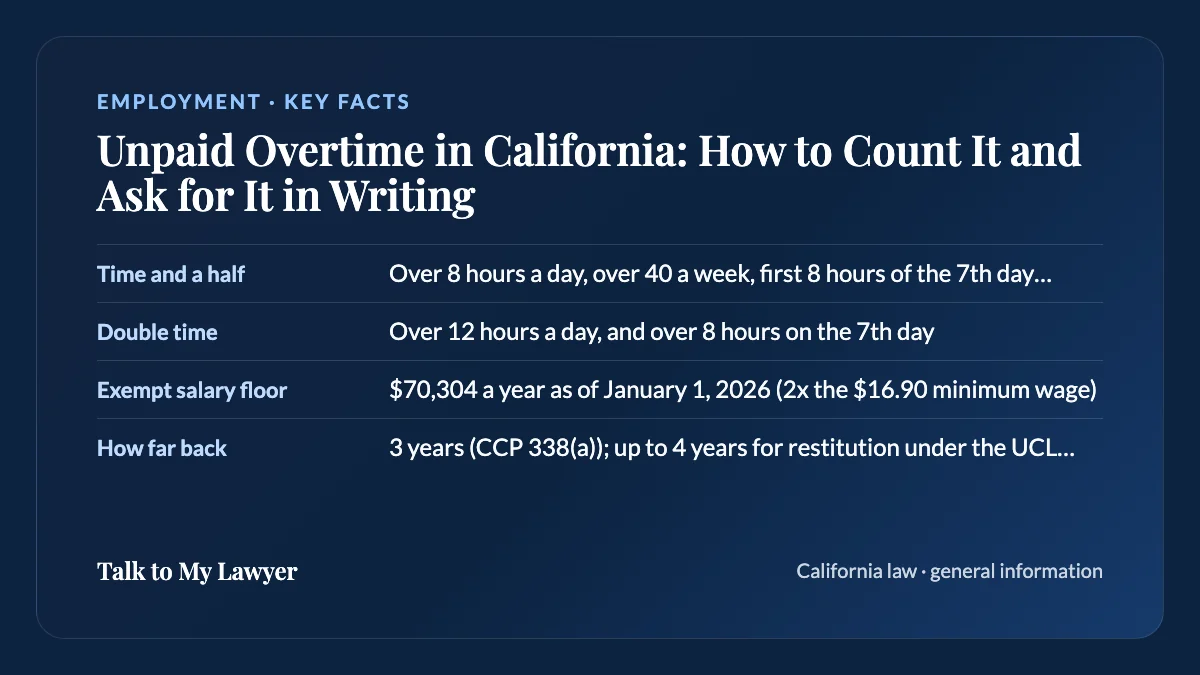
- Time and a half
- Over 8 hours a day, over 40 a week, first 8 hours of the 7th day (Labor Code 510)
- Double time
- Over 12 hours a day, and over 8 hours on the 7th day
- Exempt salary floor
- $70,304 a year as of January 1, 2026 (2x the $16.90 minimum wage)
- How far back
- 3 years (CCP 338(a)); up to 4 years for restitution under the UCL (B&P 17208)
- Extras a court can add
- Interest, attorney's fees and costs (Labor Code 1194, 218.6)
When does California require overtime pay?
California requires overtime for a nonexempt employee whenever work goes past 8 hours in a workday, past 40 hours in a workweek, or into a seventh consecutive day of work in the same workweek (Labor Code section 510). The daily rule is what sets California apart from federal law, which looks only at the 40-hour week.
| Hours worked | Minimum rate |
|---|---|
| Hours 1 to 8 in a workday | Regular rate |
| Hours 9 to 12 in a workday | 1.5 times the regular rate |
| Any hour past 12 in a workday | 2 times the regular rate |
| Hours past 40 in a workweek (not already paid as daily overtime) | 1.5 times the regular rate |
| First 8 hours on the 7th consecutive workday | 1.5 times the regular rate |
| Hours past 8 on the 7th consecutive workday | 2 times the regular rate |
The statute does not require an employer to stack two overtime rates on the same hour, so an hour counted as daily overtime is not paid again as weekly overtime. Alternative workweek schedules adopted under Labor Code section 511, and some union contracts, change these thresholds.
Overtime is owed even when nobody approved it. The Labor Commissioner's overtime guidance says an employer must pay for hours it suffered or permitted you to work, although it may discipline you for breaking an approval policy. You also cannot sign away overtime: an agreement to work for less does not bar recovery (Labor Code section 1194).
Are you really exempt from overtime in California?
You are exempt only if your job meets both a duties test and a salary test. A title such as manager or coordinator, or simply being paid a salary, does not make you exempt.
- Salary test. Executive, administrative and professional employees must earn a monthly salary of at least twice the state minimum wage for full-time work (Labor Code section 515(a)). With the minimum wage at $16.90 an hour, that comes to $70,304 a year as of January 1, 2026, according to the Department of Industrial Relations. Local minimum wages do not change this state figure.
- Duties test. The employee must be primarily engaged in exempt duties, which the statute defines as more than half of worktime (section 515(e)), and must customarily and regularly exercise discretion and independent judgment.
- Salaried but nonexempt. If you are paid a salary but fail either test, you are owed overtime. Your regular hourly rate is 1/40th of your weekly salary (section 515(d)), and the salary is treated as covering only your regular hours.
Exemption disputes are fact-heavy. If you suspect you were misclassified as exempt, a description of what you actually did each day, hour by hour, matters more than your job description. If the issue is being treated as a contractor rather than an employee, see the guide to independent contractor misclassification letters.
What counts in the regular rate of pay?
Overtime is a multiple of your regular rate, which can be higher than your base hourly wage. The Labor Commissioner explains that the regular rate includes several kinds of pay, and leaving any of them out shrinks every overtime hour.
| Counts toward the regular rate | Left out of the regular rate |
|---|---|
| Hourly wage or salary | Discretionary bonuses |
| Commissions and piece rates | Holiday or special-occasion gifts |
| Nondiscretionary bonuses tied to hours, production or staying on | Expense reimbursements |
| Shift differentials | Pay for time not worked, such as vacation or sick days |
Bonuses follow their own arithmetic. Under the Labor Commissioner's method, a production bonus is divided by all hours worked in the bonus period, and each overtime hour earns an extra half of that figure. A flat-sum bonus is divided by the regular (non-overtime) hours in the period instead, and overtime hours are paid at 1.5 or 2 times that figure. Gather the pay records that show bonuses and differentials before you calculate anything.
Example: calculating overtime back pay
Example (hypothetical): a warehouse lead earns $28 an hour. For 26 weeks she worked four 10-hour days and one 6-hour day each week, 46 hours in all, and was paid straight time for every hour.
| Step | Figure |
|---|---|
| Daily overtime hours each week (2 hours x 4 days) | 8 hours |
| Weekly overtime left after daily overtime (46 - 8 = 38 regular hours) | 0 hours |
| Unpaid half-time premium per overtime hour ($28 x 0.5) | $14 |
| Shortfall per week (8 x $14) | $112 |
| Shortfall over 26 weeks | $2,912 |
Because she was already paid straight time for those hours, only the half-time premium is missing. If she had also earned a weekly production bonus, the regular rate would rise and so would the premium. A court can add interest at 10 percent a year from the date each paycheck was due (Labor Code section 218.6 and Civil Code section 3289(b)). If she has left the job, waiting time penalties under Labor Code section 203 may also apply.
How far back can you claim unpaid overtime in California?
The general deadline is 3 years from each underpaid payday, because overtime is a liability created by statute (Code of Civil Procedure section 338(a)). Each paycheck starts its own clock, so older weeks drop off as time passes.
In a court case, unpaid overtime can also be pursued as restitution under California's Unfair Competition Law, which has a 4-year limit (Business and Professions Code section 17208). That route has its own rules and is a question for a lawyer. The Labor Commissioner's wage claim page lists 3 years for overtime claims filed with that office.
One common misconception: the doubled liquidated damages under Labor Code section 1194.2 apply to minimum wage shortfalls, and the statute expressly says they do not cover overtime. A letter that asks for double overtime damages overstates the claim.
Demand letter, wage claim or lawsuit: how they compare
A demand letter involves no filing and keeps the conversation with your employer open. It does not pause the deadline, though, so it is no substitute for a filing when time is short.
| Option | What it involves | Worth knowing |
|---|---|---|
| Demand letter | A written request to the employer with your hours, rate and the amount owed | No filing; sets out your numbers so the employer can check them |
| Labor Commissioner wage claim | File online, by email, mail or in person with the Labor Commissioner's Office | Usually a settlement conference, then a hearing if unresolved |
| Court lawsuit | A civil case, with or without an attorney | Fees and costs can be recovered for overtime (Labor Code 1194) |
| Small claims | For claims up to $12,500 when you sue as an individual | No lawyers at the hearing |
For a broader look at wage disputes, including minimum wage and missing reimbursements, see the guide to unpaid wages demand letters in California.
How to write an unpaid overtime demand letter
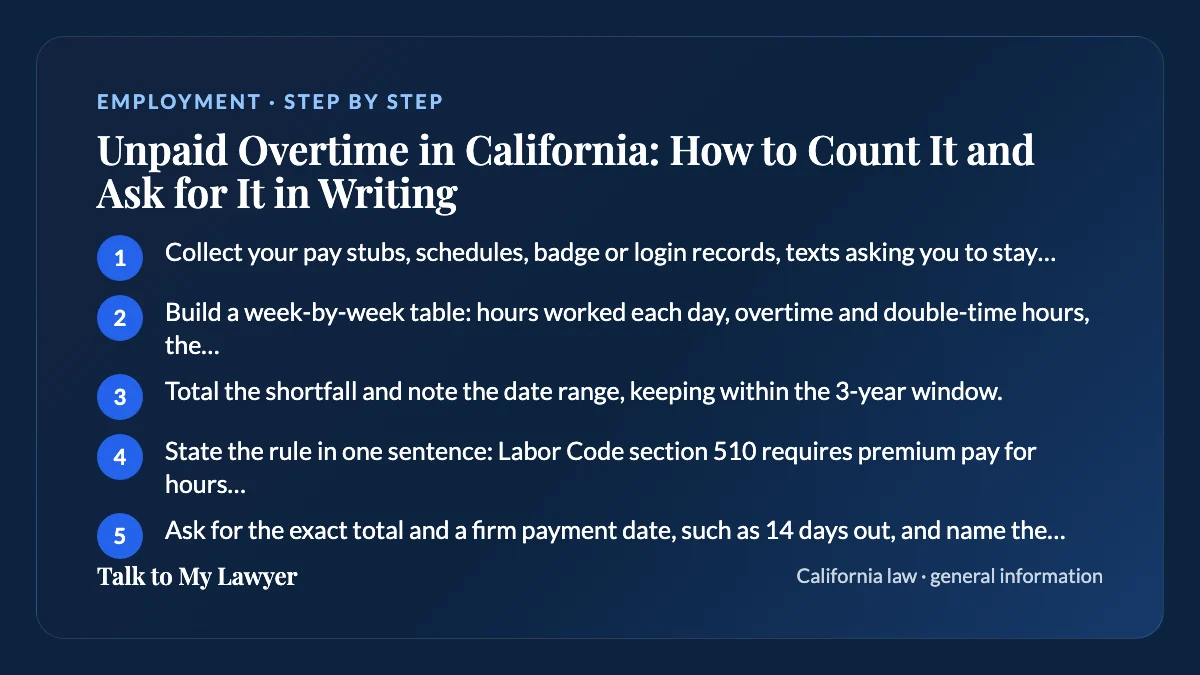
- Collect your pay stubs, schedules, badge or login records, texts asking you to stay late, and your own notes of start and stop times.
- Build a week-by-week table: hours worked each day, overtime and double-time hours, the regular rate used, and what you were paid.
- Total the shortfall and note the date range, keeping within the 3-year window.
- State the rule in one sentence: Labor Code section 510 requires premium pay for hours past 8 in a day and 40 in a week.
- Ask for the exact total and a firm payment date, such as 14 days out, and name the payment method you prefer.
- Attach the table, keep a copy, and send the letter so you can show when it arrived, for example by certified mail or by email to human resources.
From March 2 to August 28, I regularly worked 10-hour shifts four days a week and was paid straight time for every hour. Labor Code section 510 requires one and one-half times my regular rate for hours over 8 in a workday. Based on the attached schedule and pay records, the unpaid overtime premium is $2,912. Please pay this amount, with interest, by September 15, or send me the records you believe show a different figure.
Leave out adjectives and let the hours, rates and totals speak. If you worry about how your employer will react, California law protects employees who complain about unpaid wages; the guide to workplace retaliation letters explains how.
When an attorney-written overtime letter makes sense
An overtime letter gets harder to write when the employer insists you are exempt, bonuses or commissions change the regular rate, the shortfall reaches back years, or a whole crew was paid the same way. In those cases, legal reasoning has to travel with the arithmetic. A small, clean gap backed by good time records may need nothing more than a letter in your own words.
With Talk to My Lawyer, you share your schedules, pay stubs and overtime figures, and a licensed California attorney writes your letter from those facts and documents and sends it on your behalf. Whether a wage claim or a court case fits better is a question for a lawyer with your time records in hand.
Frequently asked questions
Does my employer have to pay overtime I did not get approved?
Yes. California requires pay for all hours an employer suffers or permits you to work, approved or not. The Labor Commissioner's guidance says an employer can discipline an employee for breaking a rule that requires approval for overtime, but it still has to pay for the time worked. Employers are also required to keep accurate time records, so hidden off-the-clock work is a problem for both sides.
Is overtime in California based on the day or the week?
Both. Labor Code section 510 requires time and a half for hours over 8 in a workday and over 40 in a workweek, plus special rules for a seventh consecutive workday. Hours past 12 in a day are paid at double time. An hour already paid as daily overtime is not counted again toward weekly overtime, since the statute does not require combining rates.
What is the minimum salary to be exempt in California in 2026?
As of January 1, 2026, exempt executive, administrative and professional employees must earn at least $70,304 a year, which is twice the $16.90 state minimum wage for full-time work. Meeting the salary floor is not enough on its own. The employee must also spend more than half of worktime on exempt duties and regularly exercise discretion and independent judgment.
Can I get double damages for unpaid overtime in California?
Not under the liquidated damages statute. Labor Code section 1194.2 allows an extra amount equal to unpaid minimum wages, and it states that it does not cover overtime. Overtime claims can include interest, attorney's fees and costs, and, for former employees, waiting time penalties of up to 30 days of wages under section 203 when the failure to pay was willful.
Do I have to quit before claiming unpaid overtime?
No. Someone still on the payroll has the same right to a Labor Commissioner wage claim or a court case as a former employee, and California law prohibits retaliation against workers who raise wage complaints. A written demand is one way to raise the issue while keeping the working relationship intact. Keep copies of everything you send and receive, and watch the 3-year deadline, since a letter does not stop it.
Sources
Checked against these official sources on October 18, 2026.
- California Labor Code section 510 (California Legislative Information)
- California Labor Code section 515 (California Legislative Information)
- Minimum wage and exempt salary increases for 2026 (Release 2025-118) (California Department of Industrial Relations)
- Overtime frequently asked questions (California Labor Commissioner's Office)
- California Code of Civil Procedure section 338 (California Legislative Information)
- California Labor Code section 1194.2 (California Legislative Information)
This guide explains California law in general terms as of October 2026. It is general information, not legal advice for your situation, and local rules can add to it.
Join the email list and get a lawyer letter started
With Talk to My Lawyer, a licensed California attorney writes your letter from your facts and documents and sends it on your behalf. Join the Talk to My Lawyer email list for letter checklists, document prompts, and reminders before you start your letter.