Quick answer
For missed meal breaks in California, the employer owes one extra hour of pay at your regular rate for each workday a required meal period was not provided (Labor Code section 226.7). A 30-minute, duty-free meal break must start before the end of your fifth hour of work (section 512). A separate one-hour premium applies on days rest breaks are missed.
At a glance
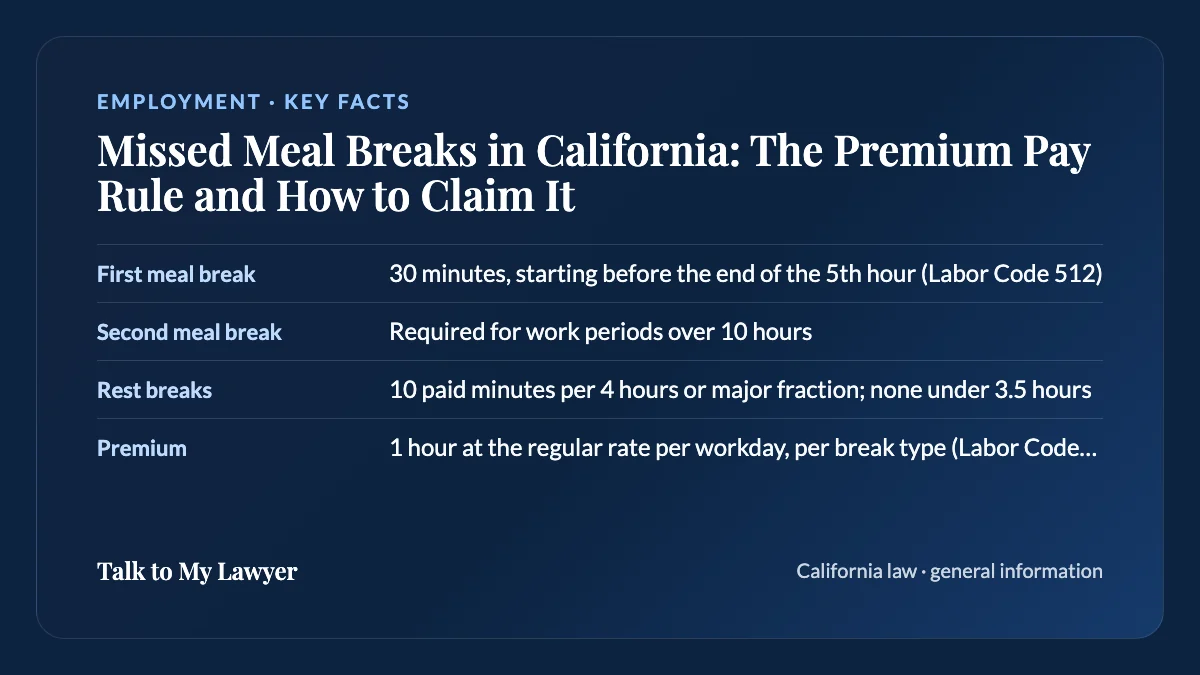
- First meal break
- 30 minutes, starting before the end of the 5th hour (Labor Code 512)
- Second meal break
- Required for work periods over 10 hours
- Rest breaks
- 10 paid minutes per 4 hours or major fraction; none under 3.5 hours
- Premium
- 1 hour at the regular rate per workday, per break type (Labor Code 226.7)
- Deadline
- 3 years from the missed break, per the Labor Commissioner
When must a California employer give you a meal break?
An employer may not have you work more than five hours in a day without a meal period of at least 30 minutes (Labor Code section 512(a)). The Labor Commissioner reads this to mean the break must begin no later than the end of your fifth hour. If your day runs past 10 hours, a second 30-minute meal period is due, no later than the end of the tenth hour.
- Waiving the first break. Allowed by mutual consent only if your total workday is six hours or less.
- Waiving the second break. Allowed by mutual consent only if your total day is 12 hours or less and you did not waive the first one.
- On-duty meal periods. Permitted only when the nature of the work prevents relief from all duty and you agree in writing (wage orders, section 11). The agreement must say you can revoke it in writing at any time, and the on-duty meal is paid time.
- Special rules. Some workers covered by qualifying union contracts, including certain construction, commercial driving, security and utility employees, follow the contract instead. Health care workers have their own waiver rule in the wage orders.
A meal break where you stay on call, keep answering the phone or cannot leave your post is not a duty-free break. If you are not fully relieved of duty, the time counts as hours worked and must be paid.
How many rest breaks do you get in California?
You earn a net 10-minute paid rest period for every four hours worked or major fraction of four hours, and none is required if your total daily work time is under three and a half hours (Industrial Welfare Commission wage orders, section 12). The Labor Commissioner treats anything over two hours as a major fraction, which produces this schedule:
| Hours worked in the day | Rest breaks owed |
|---|---|
| Under 3.5 hours | 0 |
| 3.5 hours up to 6 hours | 1 |
| More than 6 up to 10 hours | 2 |
| More than 10 up to 14 hours | 3 |
Rest breaks should fall near the middle of each work period when practicable. They are paid, so no deduction is allowed (Labor Code section 226.7(d)). The employer must relieve you of all duty and may not require you to stay on call during the break. Restroom trips do not count as a rest period.
Does the employer have to make you take your break?
No, but it must do more than make the break available. According to the Labor Commissioner, an employer must relieve you of all duty, give up control over your time, and must not impede or discourage you from taking the break.
Pressure can be quiet: a schedule that leaves one person covering the floor, or a manager who praises people for working through lunch. Quoting the California Supreme Court's 2012 Brinker decision, the Labor Commissioner says employers may not create incentives to skip breaks or undercut a break policy with scheduling that makes breaks extremely difficult. If the employer knows or has reason to know you are working through a meal period, it must also pay you for that time.
Which records prove missed meal and rest breaks?
Employers must keep time records showing when each work period begins and ends, and must record meal periods too, unless operations cease during the meal (wage orders, section 7). Rest breaks generally do not have to be recorded, so your own notes carry more weight there.
- Time punches showing meal periods that started after the fifth hour, ran short, or are missing.
- Schedules and staffing sheets showing coverage that made breaks impossible.
- Messages calling you back from lunch or asking you to stay on the floor.
- Your own calendar or notes of missed breaks, kept as you go.
- Pay stubs showing whether any premium was paid; if one was, it may appear as its own line.
You can ask for your payroll records, which the employer must produce within 21 calendar days (Labor Code section 226(c)), and your personnel file within 30 days. The guide to requesting your personnel file has sample request wording.
Where does PAGA fit after the 2024 reform?
The Private Attorneys General Act (PAGA) lets an aggrieved employee sue for civil penalties on behalf of the state after giving written notice to the Labor and Workforce Development Agency and the employer (Labor Code sections 2699 and 2699.3). It is separate from the premium pay you are owed and has its own procedures.
Amendments that apply to PAGA cases brought on or after June 19, 2024 (except cases whose notice was filed before that date) changed the picture. As of October 2026, the statute says:
- An aggrieved employee must have personally suffered each violation alleged.
- Penalties can be capped at 15 percent if the employer took all reasonable steps to comply before receiving the notice or a records request, or at 30 percent if it took them within 60 days after the notice.
- Employees receive 35 percent of recovered penalties; the agency keeps 65 percent.
PAGA cases are technical, and a demand letter for unpaid premiums is not a PAGA notice. Talk to a lawyer before relying on PAGA.
How to write a demand letter for missed breaks
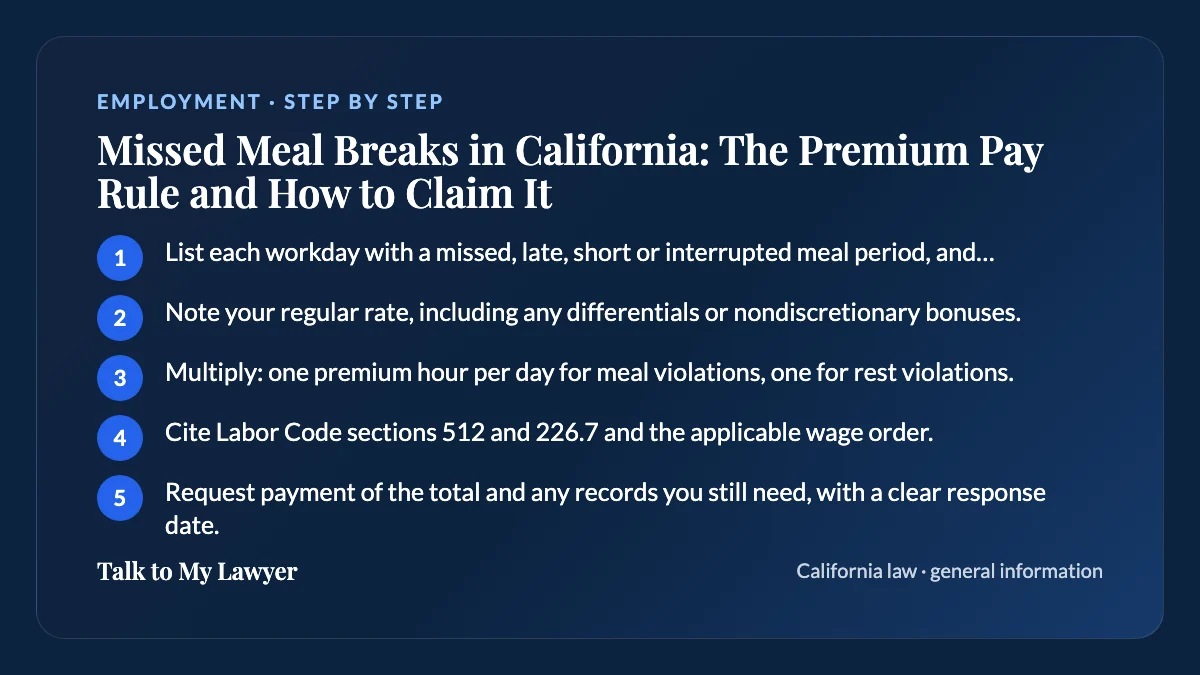
- List each workday with a missed, late, short or interrupted meal period, and separately each day with a missed rest break.
- Note your regular rate, including any differentials or nondiscretionary bonuses.
- Multiply: one premium hour per day for meal violations, one for rest violations.
- Cite Labor Code sections 512 and 226.7 and the applicable wage order.
- Request payment of the total and any records you still need, with a clear response date.
- Keep the letter factual and send it to the person who handles payroll or human resources.
Between June 1 and August 22, my meal period was not provided before the end of my fifth hour on 30 workdays, and I could not take a rest break on 18 of those days because I was the only technician on duty. Under Labor Code section 226.7, I am owed one additional hour of pay at my regular rate of $25.50 for each workday of each type of violation, a total of $1,224. A log of dates is attached. Please pay this amount by September 12.
Claims with the Labor Commissioner for meal premiums must be filed within three years of the missed break, according to that office. If the employer also shorted you on overtime for long shifts, the guide to unpaid overtime in California covers the math.
When an attorney-written letter about missed breaks makes sense
A log of dates and one short letter can be enough when the missed breaks are recent and few. Break claims get harder when the violations run across months, the employer points to a waiver or an on-duty agreement, coworkers lost the same breaks, or PAGA might come into play. Then the letter has to deal with defenses as well as dates.
For break claims like these, Talk to My Lawyer offers a direct route. A licensed California attorney writes your letter from your time records, schedules, break log and account of what happened, and sends it on your behalf. Weighing a wage claim, a lawsuit and PAGA against one another is work for a lawyer who has gone through those records with you.
Frequently asked questions
Can I get more than one premium per day for missed breaks?
Yes, but only one of each kind. Labor Code section 226.7 provides one extra hour of pay for each workday a meal period is not provided and one for each workday a rest period is not provided. Missing two rest breaks in a day still earns one rest premium, as the Labor Commissioner explains, so the most you can earn for breaks on a single day is two premium hours.
Is a late lunch a meal break violation in California?
It can be. The first meal period must start no later than the end of the fifth hour of work, according to the Labor Commissioner. A break that starts in the sixth hour, without a valid waiver for a short shift, is not timely. A 20-minute break or one interrupted by work can also fall short of the 30-minute, duty-free requirement in section 512.
Can my employer make me stay on call during my rest break?
Generally no. The Labor Commissioner's guidance, relying on the California Supreme Court's Augustus decision, says employers must relieve employees of all duty during rest periods and cannot require them to stay on call. As of October 2026, the Labor Code has a narrow exception for registered security officers covered by qualifying union contracts. An on-call rest break may support a premium claim.
Do salaried workers get meal and rest break premiums?
It depends on whether you are exempt. Properly classified exempt employees are not covered by the meal and rest period rules in the wage orders, and section 226.7 does not apply to employees exempt from those requirements. A salaried worker who is misclassified as exempt is covered, so misclassification can bring both overtime and break claims.
How long do I have to claim missed meal break pay?
The Labor Commissioner says a meal period claim must be filed within three years of the violation, citing the California Supreme Court's decision treating the premium as a wage. Each missed break has its own date, so older violations fall outside the window over time. A demand letter does not stop the clock, which is a reason to note the dates you are claiming.
Sources
Checked against these official sources on October 18, 2026.
- California Labor Code section 512 (California Legislative Information)
- California Labor Code section 226.7 (California Legislative Information)
- Meal periods frequently asked questions (California Labor Commissioner's Office)
- Rest periods frequently asked questions (California Labor Commissioner's Office)
- IWC Wage Order 4 (professional, technical, clerical, mechanical and similar occupations) (California Department of Industrial Relations)
- California Labor Code section 2699 (California Legislative Information)
This guide explains California law in general terms as of October 2026. It is general information, not legal advice for your situation, and local rules can add to it.
Join the email list and get a lawyer letter started
With Talk to My Lawyer, a licensed California attorney writes your letter from your facts and documents and sends it on your behalf. Join the Talk to My Lawyer email list for letter checklists, document prompts, and reminders before you start your letter.