Quick answer
For an Airbnb guest damage claim, document the damage immediately with dated photos, keep all messages on the platform, and get repair or replacement quotes. Booking platforms run their own damage processes with deadlines and conditions, so read the current terms. You can also send the guest a direct demand letter. California small claims generally requires serving the guest in California, which limits claims against out-of-state guests.
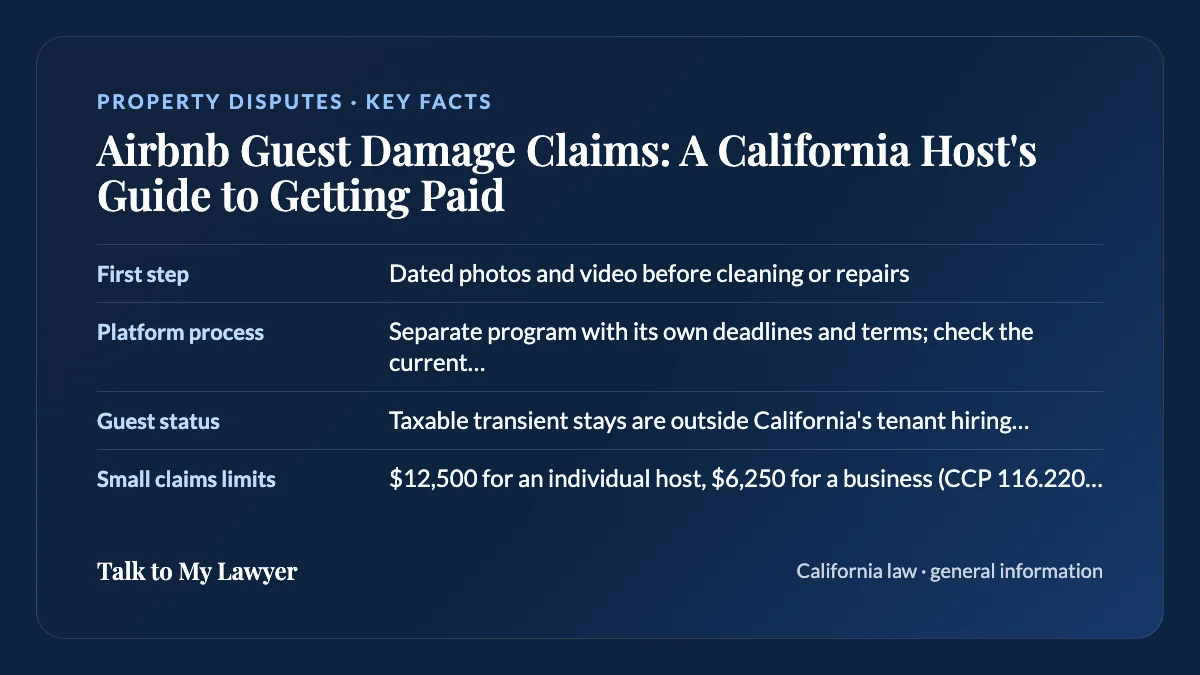
At a glance
- First step
- Dated photos and video before cleaning or repairs
- Platform process
- Separate program with its own deadlines and terms; check the current rules
- Guest status
- Taxable transient stays are outside California's tenant hiring chapter (Civ. Code 1940(b))
- Small claims limits
- $12,500 for an individual host, $6,250 for a business (CCP 116.220, 116.221)
- Out-of-state guests
- Defendants generally must be served in California for small claims
What should a host do first after finding guest damage?
Photograph and film everything before anything is cleaned, moved or repaired. Platform programs and courts both look for evidence tied to the stay, and once the cleaner has scrubbed the sofa, the proof is gone.
- Take wide shots of each room and close-ups of each item, with the date and time visible in the file data.
- Compare against your pre-arrival photos or the listing photos to show the prior condition.
- Save the cleaner's report and any statement they are willing to sign.
- Keep the booking confirmation, house rules and check-in and check-out times.
- Keep every guest message inside the platform's message system, and screenshot them.
- Get written repair or replacement quotes, with the model and age of damaged items.
- Record any bookings you had to cancel because the unit was not usable, with the lost amounts.
Message the guest calmly through the platform, describe what you found and attach photos. If the guest offers to pay, keep that message; it is evidence.
Should you file a platform claim or send a demand to the guest?
You can use both, one after the other. Booking platforms run their own damage reimbursement or host protection programs. These are contractual programs governed by the platform's terms, which change over time, and they may not work like insurance. Each sets its own filing deadline, documentation rules, limits and exclusions.
| Route | What it involves | Points to check |
|---|---|---|
| Platform request to the guest | Ask the guest to pay through the platform's resolution tool | Short deadlines after checkout; evidence uploads |
| Platform host protection program | Reimbursement under the platform's own terms if the guest does not pay | Coverage limits, exclusions, whether you must try the guest first |
| Your own insurance | A homeowner, landlord or short-term rental policy | Some policies exclude business or rental use; read the policy and notice conditions |
| Direct demand letter | A written demand to the guest for the documented amount | Guest's name and address; whether a platform payment already covered part |
| Court | Small claims or civil court | Where the guest can be served, and the dollar limit |
Track what each route pays so you never seek the same dollar twice. A demand letter should credit any amount already reimbursed by the platform or an insurer.
Is a short-term rental guest a tenant under California law?
Not for a typical vacation stay that is subject to local occupancy tax. California's chapter on hiring real property, which contains the residential security deposit statute and the entry notice rules, excludes people in transient occupancy of a hotel, motel, residence club or other facility when the stay is subject to a local transient occupancy tax under Revenue and Taxation Code section 7280 (Civil Code section 1940(b)).
Two consequences follow. First, your claim against a guest is generally a property damage or contract claim based on your house rules and the booking terms, not a tenant deposit claim. Second, longer stays can blur the line, so a guest staying for months may have tenant rights. Talk to a lawyer if a stay was long or the guest has not left.
Fair housing law can still apply. California defines housing accommodations to include stays arranged through a hosting platform (Government Code section 12927(d)), so a damage dispute should never turn on a guest's protected characteristics.
What can a host claim from a guest?
The reasonable cost to repair or replace what the guest damaged, plus documented losses that flow directly from it. The table below shows the kinds of items that are easier and harder to support:
| Usually supportable with evidence | Harder to support |
|---|---|
| Repair invoice for a broken fixture | Full price of a new item to replace an old one |
| Extra cleaning beyond normal turnover, with the cleaner's invoice | Routine cleaning already covered by the cleaning fee |
| Cancelled bookings while the unit was unusable, with records | Estimated lost bookings with no cancellation proof |
| Fees stated in the house rules the guest accepted | Penalties that appear nowhere in the listing or rules |
The evidence standards are similar to other property claims. Our demand letter evidence checklist is a useful cross-check before you send anything.
Can you sue an out-of-state guest in California small claims court?
Generally not. The California Courts self-help guide says a person you sue in small claims has to be served in California, and that if the person lives outside the state, you may not be able to sue in small claims unless they return. The listed exceptions, such as suing an out-of-state landlord or a California car accident, do not cover a host's claim against a visiting guest.
- California guest: small claims is available, up to $12,500 for an individual host (Code of Civil Procedure section 116.221) or $6,250 for a business host (section 116.220). The California Courts self-help guide says you must ask the guest for the money before you file.
- Out-of-state guest: consider the platform process, a direct demand, or a claim in the guest's home state, whose small claims rules and limits will differ.
- Larger claims: civil court in California may be possible, but jurisdiction over a nonresident raises legal questions for a lawyer.
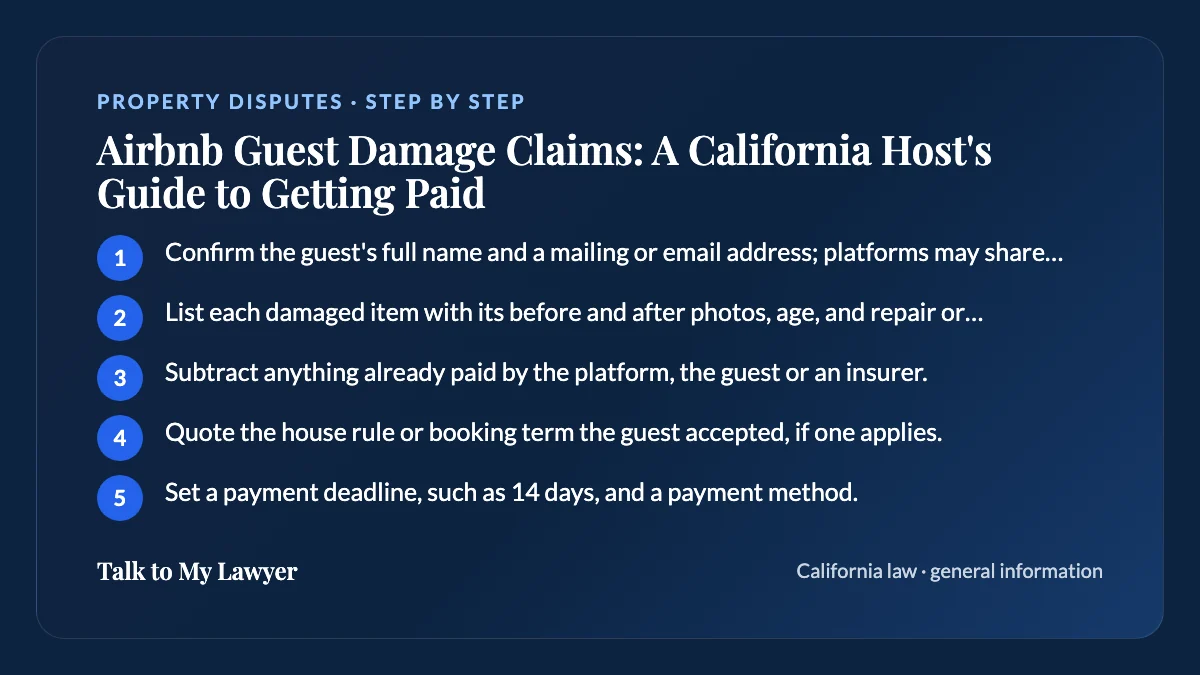
Steps for a host's demand letter to a guest
- Confirm the guest's full name and a mailing or email address; platforms may share limited contact details.
- List each damaged item with its before and after photos, age, and repair or replacement cost.
- Subtract anything already paid by the platform, the guest or an insurer.
- Quote the house rule or booking term the guest accepted, if one applies.
- Set a payment deadline, such as 14 days, and a payment method.
- Send the letter and also message the guest through the platform that you have done so.
- Keep proof of delivery and a log of every reply.
You stayed at 72 Harbor View Road from June 6 to June 9. At checkout, the living room sofa was stained and the wall-mounted television was cracked, as shown in the enclosed photos taken at 11:35 a.m. on June 9 and compared with photos taken before your arrival. Repair and replacement costs total $1,640, per the enclosed invoices. After the $400 already paid through the platform, $1,240 remains. Please pay this amount by July 1.
Some California cities and counties require short-term rental permits, registration or transient occupancy tax collection, and rules vary by location. Having your local compliance in order makes your own records cleaner if the dispute reaches a judge. For a broader template, see our guide to a small claims demand letter.
Guest damage disputes: when an attorney's letter helps
When the platform has denied or capped reimbursement, the guest denies responsibility, the damage is substantial, or a long stay raises questions about tenant status, a letter written by an attorney can put the host's claim on a clearer footing.
Talk to My Lawyer can help here: a licensed California attorney writes your letter from the booking record, the checkout photos and the repair invoices, and sends it on your behalf to the guest. Suing a guest who lives in another state involves court rules that differ by state, so get legal advice before filing anywhere.
Frequently asked questions
How long do I have to report guest damage to a booking platform?
It depends on the platform and its current terms, and windows vary. Check the platform's help pages and your host agreement as soon as you find damage. Your right to sue the guest directly is separate and runs on California's statutes of limitations, which the courts' self-help guide lists as three years for property damage.
Can I take money from a guest's security deposit for damage?
If your listing collected a security deposit or hold, the platform's terms govern how it can be claimed. California's residential deposit statute, Civil Code section 1950.5, is in a chapter that excludes taxable transient stays, so its 21-day timeline is not the usual framework for a short vacation booking. Long stays may be different.
Can I sue an Airbnb guest in small claims court?
Yes, if the guest can be served in California and the claim fits the limit: $12,500 for an individual host, $6,250 for a business. You must ask the guest to pay first. If the guest lives in another state, the California Courts self-help guide says you may not be able to use California small claims unless the guest returns.
What evidence do I need for a guest damage claim?
Before and after photos tied to the stay, the booking record, house rules the guest accepted, platform messages, the cleaner's report, and repair invoices or replacement quotes showing the item's age and cost. Records of cancelled bookings support any lost income. The more each charge connects to a specific photo and receipt, the easier it is to evaluate.
Does my homeowners insurance cover damage from short-term rental guests?
It depends on the policy. Some homeowner policies exclude or limit coverage for business or rental use, while landlord or short-term rental policies may cover it. Read the policy, check its notice requirements, and ask the insurer in writing. If a claim is denied, our guide to an insurance claim denial demand letter covers next steps.
Sources
Checked against these official sources on October 18, 2026.
- California Civil Code section 1940 (California Legislative Information)
- California Government Code section 12927 (California Legislative Information)
- Serve your small claims forms (California Courts Self-Help Guide)
- Before you start a small claims case (California Courts Self-Help Guide)
- California Code of Civil Procedure section 116.221 (California Legislative Information)
- Ask for the money (California Courts Self-Help Guide)
This guide explains California law in general terms as of October 2026. It is general information, not legal advice for your situation, and local rules can add to it.
Join the email list and get a lawyer letter started
With Talk to My Lawyer, a licensed California attorney writes your letter from your facts and documents and sends it on your behalf. Join the Talk to My Lawyer email list for letter checklists, document prompts, and reminders before you start your letter.