Quick answer
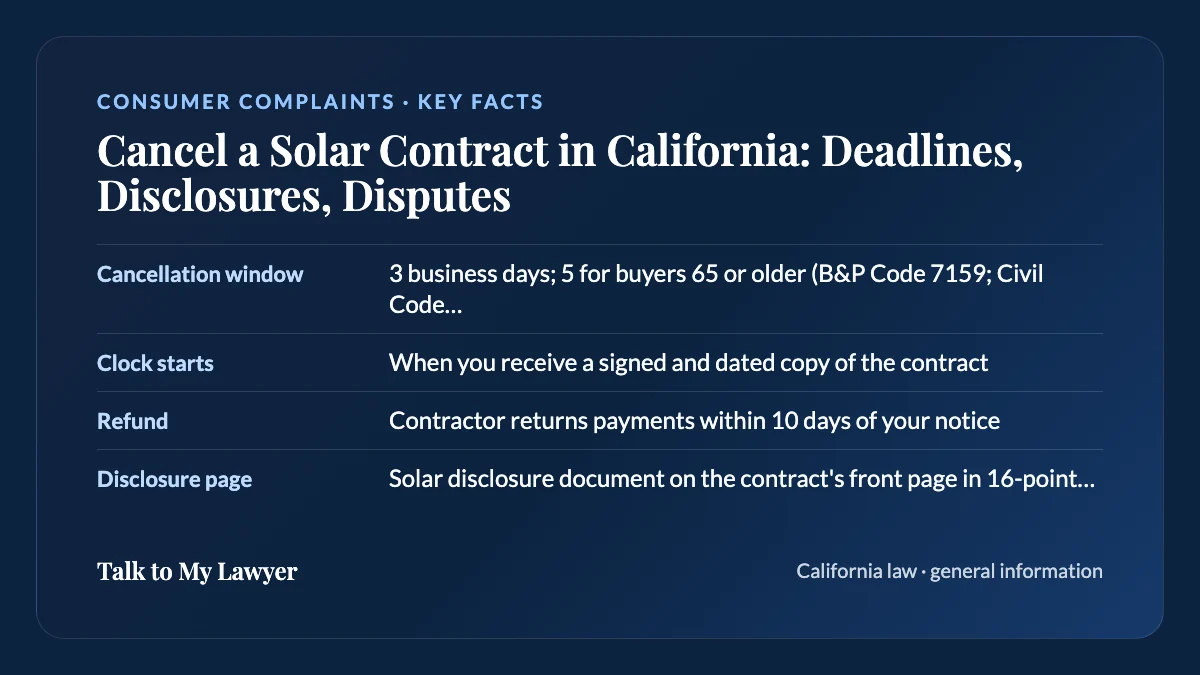
To cancel a solar contract in California, send written notice to the contractor before midnight of the third business day after you received a signed, dated copy of the contract, or the fifth business day if you are 65 or older (Business and Professions Code section 7159). Email, mail, fax or hand delivery works. The contractor must return your payments within 10 days.
At a glance
- Cancellation window
- 3 business days; 5 for buyers 65 or older (B&P Code 7159; Civil Code 1689.6)
- Clock starts
- When you receive a signed and dated copy of the contract
- Refund
- Contractor returns payments within 10 days of your notice
- Disclosure page
- Solar disclosure document on the contract's front page in 16-point bold (B&P Code 7169)
- Down payment
- No more than $1,000 or 10% of the contract, whichever is less (7159.5)
- Federal credit
- IRS: residential clean energy credit unavailable for property placed in service after December 31, 2025
Can you cancel a solar contract in California?
Yes, within a short window. Home improvement contracts must include a notice titled Three-Day Right to Cancel, or Five-Day Right to Cancel when the buyer is a senior citizen (Business and Professions Code section 7159). California's definition of home improvement expressly includes installing solar energy systems (section 7151). A senior citizen means someone 65 or older (Civil Code section 1689.5(f)).
The window runs until midnight of the third business day, or fifth for seniors, after you received a signed and dated copy of the contract. Business days exclude Sundays and listed holidays (Civil Code section 1689.5(e)), so Saturday counts. Contracts signed at your home also fall under California's home solicitation rules, which cover sales, leases and rentals of goods or services made away from the seller's business premises (Civil Code sections 1689.5 and 1689.6).
If you cancel in time, the contractor must return anything you paid within 10 days of receiving your notice. You make any delivered equipment available for pickup in substantially the same condition, and if the contractor does not collect it within 20 days, you may keep it without further obligation.
How to cancel a solar contract inside the window
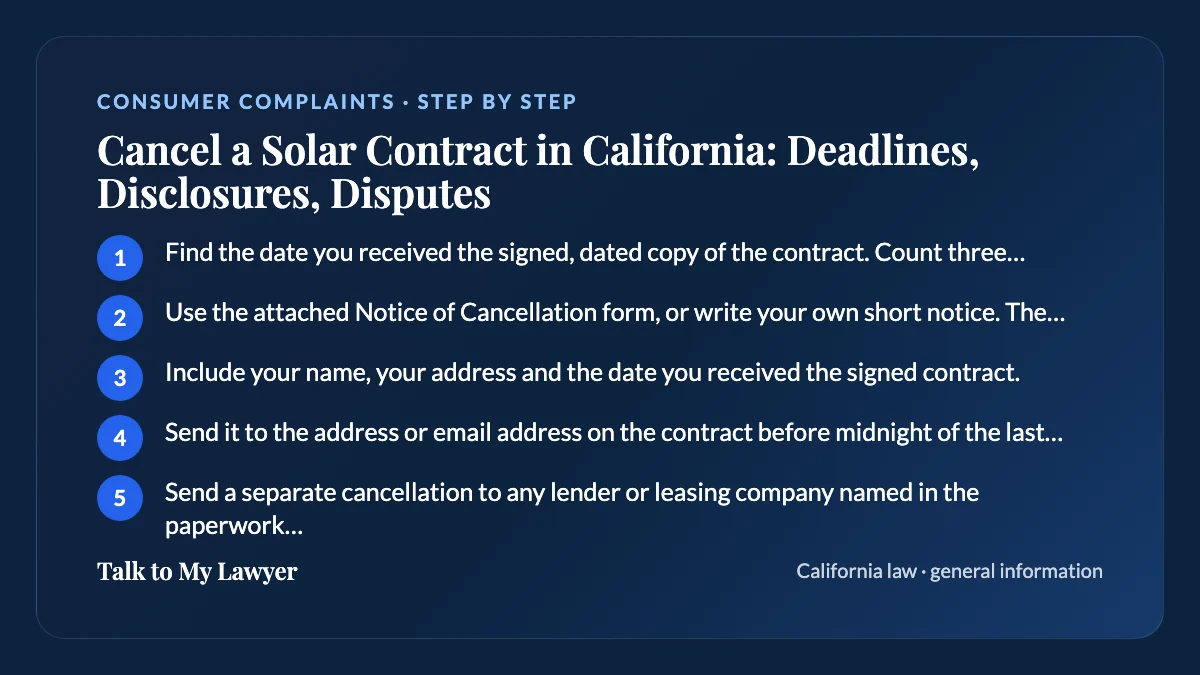
- Find the date you received the signed, dated copy of the contract. Count three business days, or five if you are 65 or older.
- Use the attached Notice of Cancellation form, or write your own short notice. The notice does not have to take a particular form if it shows you do not want to be bound (Civil Code section 1689.6(f)).
- Include your name, your address and the date you received the signed contract.
- Send it to the address or email address on the contract before midnight of the last day. A mailed notice counts when it is deposited in the mail, properly addressed and postage prepaid (section 1689.6(e)).
- Send a separate cancellation to any lender or leasing company named in the paperwork, and keep proof of every notice.
- Ask the contractor in writing to confirm the cancellation and the refund date.
What if the cancellation period has passed?
Whether the window has closed can depend on the paperwork. Under Civil Code section 1689.6, the home solicitation period runs from the signing of an agreement that complies with section 1689.7, and section 7159 says a buyer whose contract lacks the required Notice of Cancellation may complain to the Contractors State License Board (CSLB).
Check the front page. Every solar energy contract must carry the solar energy system disclosure document, developed by the CSLB with the Public Utilities Commission, printed in 16-point bold type (section 7169). It must show the total cost and payments including financing costs, how and to whom to complain, and your cancellation right. The contract and disclosure must be in the same language the salesperson mainly used in the presentation.
Outside those rules, a dispute over a signed contract turns on what you were promised and whether it was true. Misrepresented savings, a system that underperforms the written estimate, or work that is unfinished can support a written demand even after the cancellation window.
Does it matter whether you bought, financed, leased or signed a PPA?
Yes. The CSLB describes three common arrangements, and each puts different documents and parties into the dispute.
| Arrangement | Who owns the panels | What to pull for a dispute |
|---|---|---|
| Cash or loan purchase | You | Installation contract, loan agreement, payment schedule and lien releases |
| Lease | The solar company | Lease, escalator terms, buyout and home-sale provisions |
| Power purchase agreement (PPA) | The solar company; you buy its power | Price per kilowatt-hour, escalator, production estimate, transfer terms |
For residential leases and power sales by an independent solar energy producer, Public Utilities Code section 2869 requires a disclosure with a good-faith estimate of the kilowatt-hours the system will deliver, how pricing works over the contract's life with an estimated price per kilowatt-hour, who handles maintenance, what happens if you sell the house, and what happens to the system when the contract ends. Compare those estimates with your actual production and bills.
What if the savings or tax credit promises were not true?
Start with what was written down. The CSLB advises getting every sales claim about savings and power production in writing, because verbal claims are hard to prove. Gather the proposal, the disclosure page, texts and any savings calculator printout.
The federal tax credit is a common sticking point. The IRS says the residential clean energy credit covered qualified property installed from 2022 through December 31, 2025, and is not available for property placed in service after that date. A 2026 pitch for a purchased system that relied on a 30% federal credit is worth checking against the IRS guidance.
On March 9, your representative presented a proposal estimating first-year production of 9,800 kilowatt-hours and monthly savings of $180, and stated that I would receive a 30% federal tax credit. The system was placed in service on May 14. Its monitoring shows 5,900 kilowatt-hours in the first 12 months, and the IRS states that the residential clean energy credit is not available for property placed in service after December 31, 2025. I ask that you respond in writing within 30 days with a proposal to correct the system's performance or adjust the contract price.
Payment rules a solar contractor must follow
California's home improvement contract rules limit how far payments can run ahead of the work (Business and Professions Code section 7159.5):
- A down payment may not exceed $1,000 or 10% of the contract amount, whichever is less.
- Other progress payments must follow a schedule tied to the work or materials delivered.
- Apart from the down payment, the contractor may not request or accept payment beyond the value of the work performed or materials delivered, including advance payments from a lender.
- After each payment you may ask for a full, unconditional lien release covering the paid work, and you may withhold further payments until you receive it.
- These limits do not apply to a contractor that furnishes certain approved performance and payment bonds or joint control (section 7159.5(a)(8)).
If a contractor took money and left the job unfinished, the steps in our guide to contractor refund demand letters apply alongside the solar-specific rules here.
Sending a demand letter and filing a CSLB solar complaint
A demand letter identifies the contract, quotes the promise or rule at issue, and asks for a specific fix: cancellation and refund, repair, a price adjustment, or release from a lease. The CSLB solar complaint form asks what attempts you made to contact the contractor and requests copies of any letters, so keep a copy of what you send.
The CSLB has a dedicated solar complaint form, available online and on paper in English and Spanish. A complaint about visible (patent) problems generally must reach the board within four years after the act or omission, and one about hidden structural defects within 10 years (section 7091). A complaint can lead to discipline against the contractor; getting money back is a separate question. Our guides to breach of contract letters and final demand letters before a lawsuit cover that path.
When to have an attorney write your solar dispute letter
A solar dispute can pull in three companies at once: the installer, a lender or leasing company, and sometimes a separate sales firm. Having an attorney write the letter can help when a cancellation was ignored, when the contract lacked the required disclosures, when an older family member signed after a long in-home presentation, or when the amount financed is large.
Through Talk to My Lawyer, a licensed California attorney writes your letter from your facts and documents (the contract, disclosure pages, proposal and bills) and sends it on your behalf to each company involved. Whether to pursue rescission or a lawsuit is a question to take to a lawyer with your paperwork in hand.
Frequently asked questions
Do seniors get more time to cancel a solar contract in California?
Yes. Buyers 65 or older get a Five-Day Right to Cancel instead of three days for home improvement and home solicitation contracts signed from January 1, 2021 onward. The five business days run from receipt of the signed, dated contract. Business days exclude Sundays and listed holidays, so Saturdays count toward the deadline.
Can I cancel a solar lease in California?
California's home solicitation rules cover leases and rentals of goods and services sold away from the seller's business premises, so a solar lease signed at your home generally comes with the same short cancellation right. After that window, getting out depends on the lease terms, the required disclosures, and whether the company's representations were accurate. A lawyer can review the specific agreement.
What must be on the front page of a California solar contract?
The solar energy system disclosure document, in boldface 16-point type. It shows the total cost and payments for the system including financing, information on how and to whom to complain, and your cancellation right under Business and Professions Code section 7159. The CSLB posts versions for contracts with a three-day and a five-day right to cancel.
How do I file a complaint about a solar company in California?
The Contractors State License Board accepts complaints about solar contractors through a dedicated solar complaint form, online or on paper in English and Spanish. The form asks what attempts you made to contact the contractor and asks for copies of any letters. A complaint can lead to disciplinary action against the contractor, which is separate from recovering money.
Can a solar company ask for a big deposit before installing?
Not under California's home improvement rules. A down payment may not exceed $1,000 or 10% of the contract amount, whichever is less, and after that the contractor may not accept payment that exceeds the value of the work performed or materials delivered. That limit extends to advance payments from a lender. A contractor that furnishes certain approved bonds or joint control is exempt from these payment limits, so ask whether one applies.
Sources
Checked against these official sources on October 18, 2026.
- California Business and Professions Code section 7159 (California Legislative Information)
- California Business and Professions Code section 7169 (California Legislative Information)
- California Civil Code sections 1689.5 and 1689.6 (California Legislative Information)
- California Business and Professions Code section 7159.5 (California Legislative Information)
- Solar Smart (Contractors State License Board)
- Residential Clean Energy Credit (Internal Revenue Service)
This guide explains California law in general terms as of October 2026. It is general information, not legal advice for your situation, and local rules can add to it.
Join the email list and get a lawyer letter started
With Talk to My Lawyer, a licensed California attorney writes your letter from your facts and documents and sends it on your behalf. Join the Talk to My Lawyer email list for letter checklists, document prompts, and reminders before you start your letter.