Quick answer
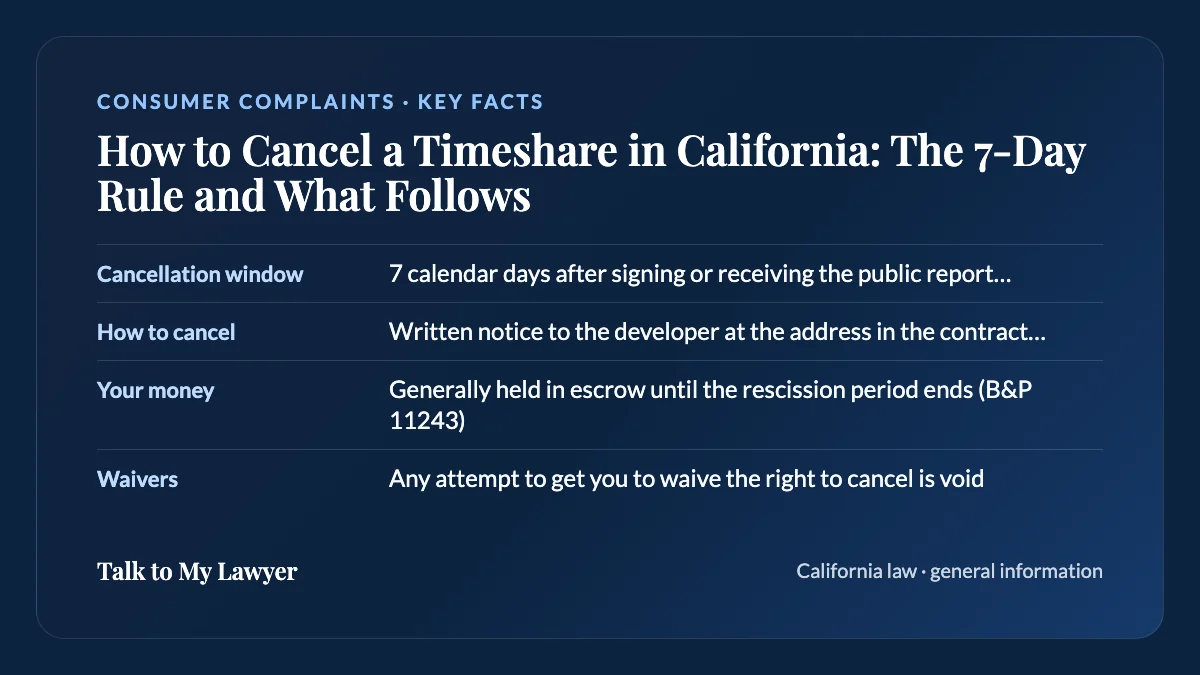
To cancel a timeshare in California, send the developer a written notice of cancellation within seven calendar days after you signed the contract or received the public report, whichever is later (Business and Professions Code section 11238). Use the address in the contract. A notice mailed by midnight of the seventh day is presumed given on its postmark date, and any waiver of this right is void.
At a glance
- Cancellation window
- 7 calendar days after signing or receiving the public report, whichever is later (B&P 11238)
- How to cancel
- Written notice to the developer at the address in the contract; mail, fax or hand delivery
- Your money
- Generally held in escrow until the rescission period ends (B&P 11243)
- Waivers
- Any attempt to get you to waive the right to cancel is void
- Regulator
- California Department of Real Estate, which handles timeshare complaints
How long do you have to cancel a timeshare in California?
You have seven calendar days. Under the Vacation Ownership and Time-share Act of 2004, a timeshare purchase contract is voidable by the buyer, without penalty, within seven calendar days after you receive the public report or sign the contract, whichever happens later (Business and Professions Code section 11238). The contract can give you longer, never less.
Three details shape the deadline:
- The later date controls. If you signed on Saturday but the public report arrived by email on Monday, the seven days run from Monday.
- Midnight counts. Notice is timely if given no later than midnight of the seventh calendar day.
- Add-ons fall with it. Cancelling the timeshare also cancels an exchange program enrollment or incidental benefit you bought with it.
The contract must print a cancellation notice in conspicuous type right above your signature (section 11238(d)). The public report must carry a cancellation form with the developer's name, address, fax number and DRE registration file number already filled in (section 11239). That form is the simplest way to cancel, but the statute says only that you may use it, so a letter of your own also works.
How to send a timeshare cancellation notice that counts
Cancellation happens in writing, delivered to the developer at the place of business named in your purchase contract. A phone call to your salesperson does not cancel anything.
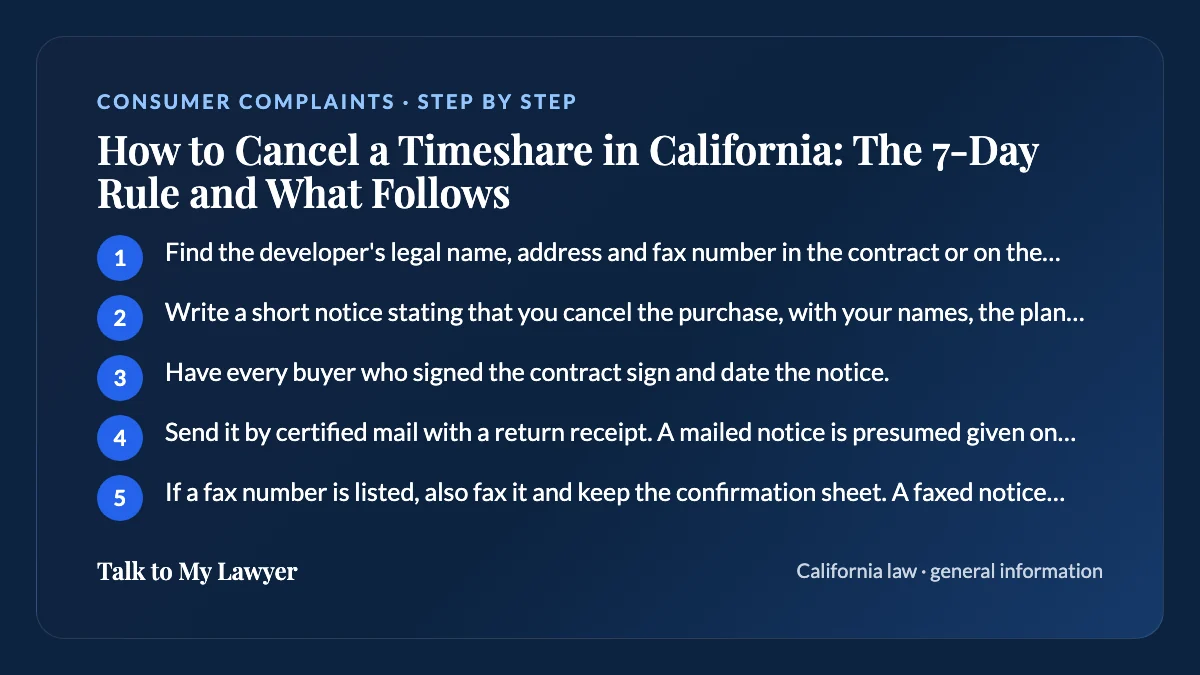
- Find the developer's legal name, address and fax number in the contract or on the cancellation form attached to the public report.
- Write a short notice stating that you cancel the purchase, with your names, the plan name, the contract date and any contract number.
- Have every buyer who signed the contract sign and date the notice.
- Send it by certified mail with a return receipt. A mailed notice is presumed given on its postmark date.
- If a fax number is listed, also fax it and keep the confirmation sheet. A faxed notice counts on the date of a confirmed transmission.
- Keep copies of the notice, the receipt, the fax confirmation and the contract in one folder.
We cancel our purchase of the time-share interest in the Harbor Point Vacation Club, contract number 55120, signed on May 3. We received the public report on May 3. This notice is given under California Business and Professions Code section 11238, within seven calendar days. Please confirm the cancellation in writing and return all money we paid, including the $3,900 down payment charged to our card.
During the rescission period, the developer must deposit 100 percent of the money you pay into an escrow account, unless the Real Estate Commissioner has accepted a bond or similar financial assurance instead. If you properly cancel, the funds go back to you (section 11243). Failing to cancel a purchase after a valid, timely notice, or failing to refund within the required timeframe, is a prohibited practice under section 11245.
Can you get out of a timeshare after the 7-day period?
Once the seven days pass, there is no automatic right to cancel. Your options then depend on what you were told, what the contract says, and whether the developer runs its own exit or deed-back program.
Section 11245 lists sales practices that the Act prohibits. If one of them happened in your presentation, it can support a claim or a complaint even after the rescission window.
| What happened in the sales room | What section 11245 says |
|---|---|
| The salesperson said the timeshare is a good investment | Developers may not state that a timeshare purchase is a financial investment |
| You were told it would be worth more when you resell | No predictions of increases in resale price or resale value |
| Annual maintenance fees came up only after you signed | Maintenance and association dues must be clearly disclosed before the contract is signed |
| The exchange program does not work as described | No material misrepresentation of exchange conditions |
| You were pressed to sign before reading the documents | Buyers must be told they can take as long as they need to read the documents, and may come back the next calendar day if they ask |
| The contract was negotiated mainly in Spanish, Chinese, Tagalog, Vietnamese or Korean | An unsigned translation of the contract must be provided before the rescission period starts |
Some developers run their own exit programs, according to the FTC. Asking the developer in writing costs nothing, and it gives you a dated record of the request.
Should you pay a timeshare exit company?
Be careful. The Federal Trade Commission warns that some exit companies are scams, and that some simply take your money and contact the timeshare company on your behalf, something you could do yourself for free.
- The FTC's warning signs include unsolicited calls offering to get you out, guarantees or promises to cancel your contract, and demands for large fees before any work is done.
- Another warning sign is an instruction to stop paying your mortgage or maintenance fees. Those payments are still owed under your contract and loan.
- For resale help, the FTC's advice is to pay fees after a sale, not in advance.
- Contact your timeshare company first. Some offer exit programs.
- Exit scams can be reported at ReportFraud.ftc.gov and to the attorney general of the state where the timeshare is located.
A letter from a California-licensed attorney to the developer is a different thing from an exit company. It goes to the party that sold you the interest, and it rests on the statute and your own documents.
What to put in a demand letter to a timeshare developer
A demand letter makes sense when the developer ignored a timely cancellation, kept your deposit, or sold the interest using practices section 11245 prohibits. Keep it factual and specific.
- The plan name, DRE registration file number, contract number and signing date.
- The date you received the public report, and the date and method of your cancellation notice, with proof.
- Each misstatement, in the words used if you remember them, with who said it and when.
- The amount paid, the amount financed and the fees charged since.
- The remedy you want: confirmation of cancellation, a refund, release of the loan, or return of the interest.
- A reasonable response date, such as 14 or 30 days out.
Example (hypothetical): a couple signs on Friday, receives the public report the same day, and mails a certified cancellation on the following Wednesday. The developer says the window closed. The postmark is day five, within the seven calendar days, so the letter cites section 11238(c) and the postmark presumption and asks for the $3,900 deposit back from escrow.
If a court finds that a developer denied a proper rescission in violation of section 11238, it may award reasonable attorney's fees and costs to the buyer (section 11238(e)). The Department of Real Estate's Complaint Resolution Program also lists difficulties with timeshare sellers or operators among the problems its facilitators try to resolve. For general structure, see what a demand letter is and how it works.
When an attorney-written timeshare letter makes sense
If you are still inside the seven days, your own written notice is all the statute requires. Hiring a lawyer to write to the developer fits a narrower set of cases: a cancellation you sent on time that the developer refuses, misrepresentations you discovered after the window closed, financing and card charges tangled together, or a record you want in order before filing a complaint or a claim. A related guide covers disputing a card charge instead of, or alongside, a letter.
Talk to My Lawyer offers that kind of letter: a licensed California attorney writes your letter from your contract, public report and dates, cites the parts of the Time-share Act that fit your facts, and sends it on your behalf. Questions about a lawsuit or your timeshare loan call for advice from a California lawyer who has seen your documents.
Frequently asked questions
Does the timeshare cancellation period include weekends?
Yes. Business and Professions Code section 11238 counts seven calendar days, so Saturdays, Sundays and holidays all count. The period starts from the later of two dates: the day you signed the purchase contract or the day you received the public report. Notice given by midnight of the seventh calendar day is timely, and a mailed notice is presumed given on its postmark date.
Can I cancel a timeshare by phone or email in California?
The statute requires written notice to the developer at the place of business named in the contract. It recognizes mail, fax with a confirmed transmission, and other writings delivered to that address. A phone call alone does not meet the rule. If you use email in addition, keep it, but send a mailed or faxed notice too so the date is easy to prove.
Can the salesperson make me waive my right to cancel?
No. The required cancellation notice states that any attempt to obtain a waiver of your cancellation right is void and of no effect, and section 11245 bars obtaining a waiver or cancellation of the rescission. A clause or side agreement saying you give up the seven days does not remove the right.
What if I bought my timeshare years ago?
The seven-day right will have expired, so the options are different. You can ask the developer about any exit or deed-back program, review whether the sale involved practices section 11245 prohibits, and get advice about your loan and fees. Be cautious with any company that wants a large fee up front to get you out; the FTC lists that as a warning sign.
Where can I complain about a timeshare developer in California?
The California Department of Real Estate regulates timeshare offerings registered in the state. Its Complaint Resolution Program lists difficulties with timeshare sellers or operators among the issues its facilitators try to resolve, and the program page gives a statewide enforcement phone number. The DRE has no jurisdiction over plans located entirely outside the United States. Problems with exit or resale companies can be reported to the FTC at ReportFraud.ftc.gov.
Sources
Checked against these official sources on October 18, 2026.
- Business and Professions Code section 11238 (California Legislative Information)
- Business and Professions Code section 11245 (California Legislative Information)
- Business and Professions Code section 11243 (California Legislative Information)
- Frequently asked questions: Time-shares (California Department of Real Estate)
- Timeshares, Vacation Clubs, and Related Scams (Federal Trade Commission)
- Complaint Resolution Program (California Department of Real Estate)
This guide explains California law in general terms as of October 2026. It is general information, not legal advice for your situation, and local rules can add to it.
Join the email list and get a lawyer letter started
With Talk to My Lawyer, a licensed California attorney writes your letter from your facts and documents and sends it on your behalf. Join the Talk to My Lawyer email list for letter checklists, document prompts, and reminders before you start your letter.