Quick answer
Wrongful termination in California means being fired for a reason the law forbids. Employment is at-will under Labor Code section 2922, but an employer cannot fire you because of a protected trait, for opposing discrimination, for reporting a legal violation, or in breach of a promise to fire only for cause. Discrimination and retaliation complaints under FEHA go to the Civil Rights Department within three years.
At a glance
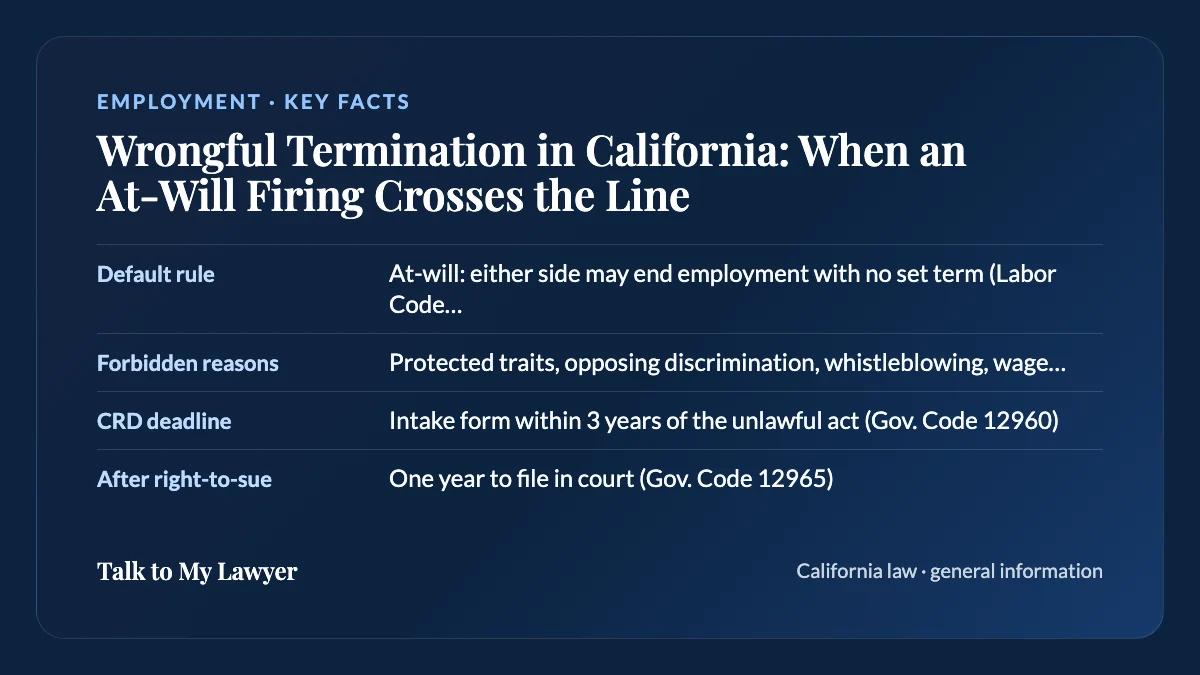
- Default rule
- At-will: either side may end employment with no set term (Labor Code 2922)
- Forbidden reasons
- Protected traits, opposing discrimination, whistleblowing, wage complaints
- CRD deadline
- Intake form within 3 years of the unlawful act (Gov. Code 12960)
- After right-to-sue
- One year to file in court (Gov. Code 12965)
- Labor Commissioner
- Retaliation complaint within one year (Labor Code 98.7)
Is California an at-will state, and what does that leave out?
Yes. Labor Code section 2922 says employment with no specified term may be ended at the will of either party on notice to the other. An employer does not need a good reason, or any stated reason, to let you go.
What at-will does not cover is an illegal reason. A firing that would be lawful on a random Monday becomes unlawful when the real motive is your race, your pregnancy, your complaint about harassment or your refusal to break the law. That makes motive the center of a wrongful termination claim, and motive is proved through dates and documents.
What makes a firing wrongful termination in California?
A firing is wrongful when it rests on a reason the law protects against. The main theories, and where each one is enforced, look like this:
| Theory | Source of the rule | Hypothetical example |
|---|---|---|
| Discrimination | Gov. Code 12940(a): no discharge because of race, sex, disability, age, religion and other listed traits | Fired a week after telling HR about a cancer diagnosis |
| Retaliation for opposing discrimination | Gov. Code 12940(h) | Fired after backing up a coworker's harassment complaint |
| Whistleblower retaliation | Labor Code 1102.5: reporting a suspected violation to an agency or to someone with authority to fix it | Fired after telling a supervisor that safety logs were being falsified |
| Retaliation for wage complaints | Labor Code 98.6: includes oral or written complaints about unpaid wages | Fired two days after asking about missing overtime |
| Violation of public policy | Court-made rule, often called a Tameny claim, for firings that undermine a policy found in a statute or constitution | Fired for refusing an instruction to break a state law |
| Breach of contract | A written or implied promise to fire only for good cause | Offer letter and handbook promised termination only for cause after probation |
Two details help some workers. Labor Code section 98.6 creates a rebuttable presumption in the employee's favor when the employer takes action within 90 days of protected activity covered by that section. And FEHA coverage generally reaches employers with five or more employees (Gov. Code section 12926(d)). For a broader look at discrimination claims, see our guide to the employment discrimination demand letter.
How long do you have to act after being fired?
For discrimination and retaliation under FEHA, you must file an intake form with the Civil Rights Department (CRD) within three years of the unlawful practice (Gov. Code section 12960(e)(5)). You must get a right-to-sue notice before suing on a FEHA employment claim, and you then have one year from the date of that notice to file in court (Gov. Code section 12965(c)(1)(D)).
- As of January 1, 2026, section 12960(f) (added by SB 477) pauses the time to file a civil action under the statutes it covers from the date you file with the CRD until the CRD files its own lawsuit or until one year after it gives written notice that it closed its investigation.
- A retaliation complaint with the Labor Commissioner is due within one year of the violation, and that period can be extended for good cause (Labor Code section 98.7).
- Public policy and contract claims carry their own limitation periods. A lawyer can tell you which date controls your case.
Build the record in the first two weeks
Memory fades fast after a firing, and access to work email ends the same day. These steps keep the timeline intact:
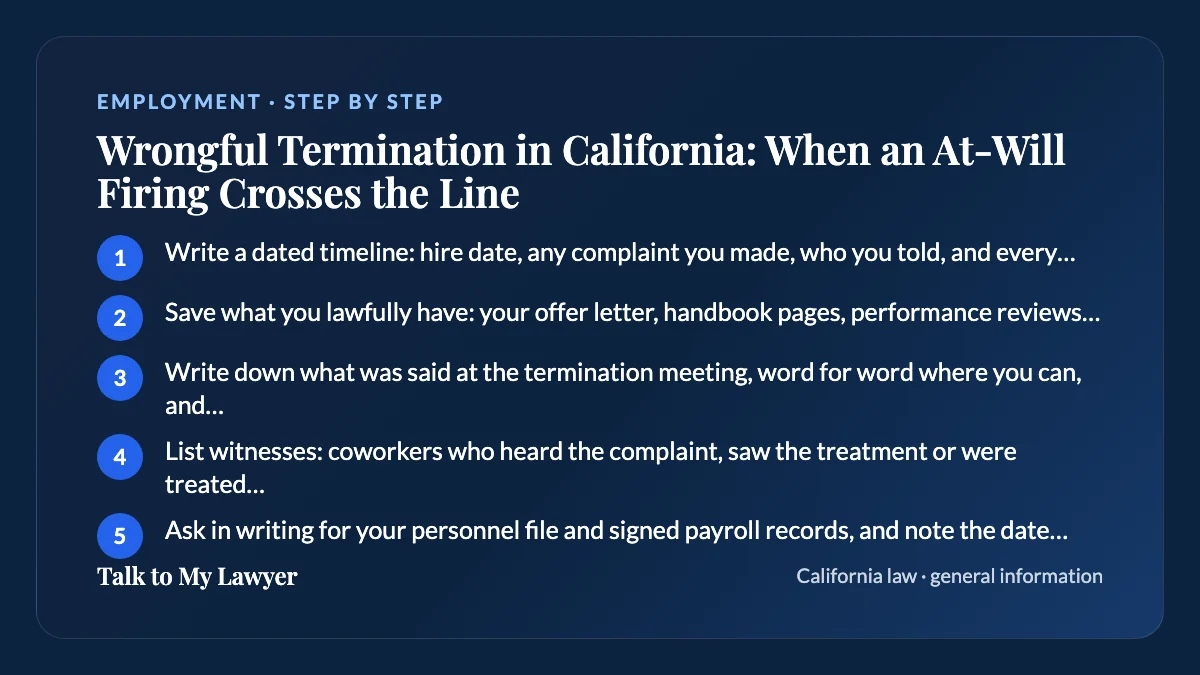
- Write a dated timeline: hire date, any complaint you made, who you told, and every warning or review before the termination.
- Save what you lawfully have: your offer letter, handbook pages, performance reviews, pay stubs and the termination notice. Do not copy confidential company files.
- Write down what was said at the termination meeting, word for word where you can, and who was present.
- List witnesses: coworkers who heard the complaint, saw the treatment or were treated differently.
- Ask in writing for your personnel file and signed payroll records, and note the date of the request.
- Check your final paycheck: under Labor Code section 201, wages are due immediately on discharge. Our guide to the final paycheck demand covers the penalties for late payment.
What can a wrongful termination demand letter do?
A demand letter puts your account on the record, names the law that applies, and asks for a specific remedy before anyone files anything. It can also ask the employer to keep emails, video and other records related to your firing.
Typical requests include lost pay through a set date, a severance payment, a neutral reference, correction of the personnel file, or reinstatement. The letter should describe events in order, cite the statute you rely on, and avoid guessing at motives you cannot support.
On March 3, I told my supervisor, Dana Ruiz, in writing that overtime hours were being removed from timecards. On March 6, I was terminated without a prior warning. Labor Code sections 98.6 and 1102.5 prohibit retaliation for this kind of report. I am asking the company to discuss a resolution that includes lost wages and a neutral reference, and to preserve all communications about my employment and termination. Please respond by March 31.
Example (hypothetical): a warehouse lead earning $1,400 a week is fired, finds a new job 10 weeks later at the same pay, and asks for $14,000 in lost wages plus a neutral reference. A documented number tied to dates gives the employer a specific figure to answer.
What should you check in a severance agreement?
A severance offer usually asks you to release legal claims in exchange for money. California limits what that agreement can take from you.
- A separation agreement cannot bar you from disclosing information about unlawful acts in the workplace, and a nondisparagement clause must say so in substantially the words set out in Gov. Code section 12964.5(b).
- The employer must tell you that you have the right to consult an attorney and give you at least five business days to do so (Gov. Code section 12964.5(b)(4)).
- If you are 40 or older, a federal age-claim waiver generally requires at least 21 days to consider it (45 for a group program), written advice to consult an attorney, and 7 days to revoke after signing (29 U.S.C. section 626(f)).
- The agreement may keep the settlement amount confidential.
Money you are already owed, such as final wages and accrued vacation, is not severance and should not be traded for a release. Our guide to severance pay in California explains that difference in more detail.
What happens if the employer does not respond?
Silence does not stop the clocks. Depending on the theory, the next step is a CRD intake, a Labor Commissioner retaliation complaint, or a lawsuit filed by a lawyer.
With the CRD, you can ask for an investigation or request an immediate right-to-sue notice if you plan to go to court. The CRD may also require the parties to mediate before a lawsuit it files itself. Your letter and any reply become part of the record either way. If the firing followed a complaint you made, our guide to workplace retaliation walks through the agency options.
When an attorney-written termination letter makes sense
A firing that came days after a complaint, a medical disclosure or a leave request is the kind of timeline where a letter has to match each legal theory to the evidence and leave out speculation. That is hard to do while you are job hunting and upset. Having an attorney write it can also help when a severance offer has a short deadline or the employer has its own legal department. Whether to go to the CRD or straight to court depends on details a lawyer should see first.
With Talk to My Lawyer, a licensed California attorney writes your letter from your facts and documents (your timeline, termination notice and pay records) and sends it on your behalf.
Frequently asked questions
Can I be fired for no reason in California?
Usually, yes. Labor Code section 2922 makes employment with no specified term terminable at will. The employer does not need to give a reason. The exceptions are firings for a reason the law forbids, such as discrimination, retaliation for protected complaints, whistleblowing, or breaking a promise that you would be fired only for good cause. A firing with no stated reason can still be unlawful if the real reason is one of these.
How long do I have to file a wrongful termination claim in California?
It depends on the theory. Discrimination and retaliation complaints under FEHA must be filed with the Civil Rights Department within three years, and after a right-to-sue notice you generally have one year to sue. Retaliation complaints to the Labor Commissioner are due within one year. Contract and public policy claims have their own periods, so check with a lawyer early.
Do I need a right-to-sue notice before suing my employer?
For claims under California's Fair Employment and Housing Act, yes. The Civil Rights Department says that in employment cases you must get a right-to-sue notice before filing your own lawsuit. You can request one immediately if you do not want the department to investigate. Other claims, such as Labor Code retaliation or breach of contract, do not run through the CRD.
Should I sign a severance agreement right away?
California requires the employer to tell you that you can consult a lawyer about a separation agreement and to give you at least five business days to do so. For workers 40 and older, federal law generally requires 21 days to consider an age-claim waiver. Signing usually releases your claims, so read the release, the confidentiality terms and the payment amount before you decide.
Can a demand letter get my job back?
A letter can ask for reinstatement, but nothing requires an employer to accept that request. A letter can instead ask for lost pay, severance, a neutral reference or a corrected personnel file. The value of the letter is that it states your position clearly and starts a written exchange before any formal filing.
Sources
Checked against these official sources on October 18, 2026.
- California Labor Code section 2922 (California Legislative Information)
- California Government Code section 12940 (California Legislative Information)
- California Government Code section 12960 (California Legislative Information)
- California Government Code section 12964.5 (California Legislative Information)
- California Labor Code section 98.6 (California Legislative Information)
- Complaint Process (California Civil Rights Department)
This guide explains California law in general terms as of October 2026. It is general information, not legal advice for your situation, and local rules can add to it.
Join the email list and get a lawyer letter started
With Talk to My Lawyer, a licensed California attorney writes your letter from your facts and documents and sends it on your behalf. Join the Talk to My Lawyer email list for letter checklists, document prompts, and reminders before you start your letter.