Quick answer
In California, an ADA demand letter to a business can carry state-law weight: the Unruh Civil Rights Act treats any federal ADA violation as a state violation and sets minimum statutory damages of $4,000 per offense (Civil Code sections 51(f) and 52). An attorney's prelitigation letter about a physical barrier must describe the barrier and dates, include a state advisory notice, and may not demand money (Civil Code 55.31).
At a glance
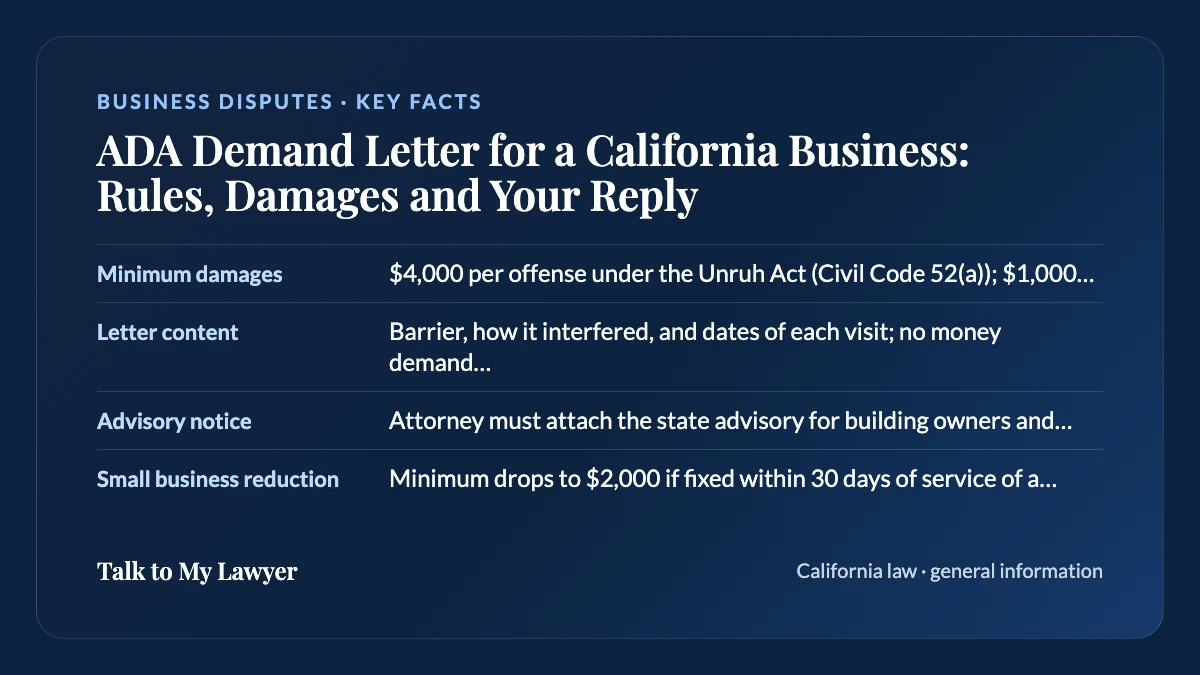
- Minimum damages
- $4,000 per offense under the Unruh Act (Civil Code 52(a)); $1,000 under the Disabled Persons Act (54.3)
- Letter content
- Barrier, how it interfered, and dates of each visit; no money demand (Civil Code 55.31)
- Advisory notice
- Attorney must attach the state advisory for building owners and tenants (Civil Code 55.3)
- Small business reduction
- Minimum drops to $2,000 if fixed within 30 days of service of a complaint (55.56(g)(2))
- CASp reduction
- Minimum drops to $1,000 for CASp-inspected sites fixed within 60 days of service (55.56(g)(1))
What must an ADA demand letter to a California business include?
When an attorney sends a prelitigation letter about a physical access barrier, California law sets the contents. Civil Code section 55.31 requires facts that let a reasonable person identify the problem:
- A plain-language explanation of each specific barrier, with enough detail about its location to find it.
- How the barrier interfered with the person's full and equal access, or deterred them, on each occasion.
- The date or dates of each occasion.
The attorney must also attach a written advisory titled for building owners and tenants (Civil Code section 55.3), include the attorney's State Bar license number, and send a copy of the letter to the California Commission on Disability Access within five business days (Civil Code section 55.32).
The letter may offer to discuss settlement, but it may not ask for money or name a dollar figure. About damages, it may say only that the owner or tenant 'may be civilly liable for actual and statutory damages' for a violation. An attorney may give a settlement figure if you ask for one, and the money-demand ban does not apply to claims involving physical injury.
How can you tell if a demand letter breaks California's rules?
Compare the letter you received with the statute. Gaps do not erase a real barrier, but they matter for how you respond.
| What you see | What the law says |
|---|---|
| A demand for a specific payment | An attorney may not issue a demand for money in a construction-related accessibility letter (55.31(c)), except in limited cases such as physical injury claims. |
| A list of code sections with no dates or visits | The letter must give the dates and describe how each barrier affected the person (55.31(a)). |
| No advisory page attached | An attorney must include the state advisory with the first demand letter or complaint (55.3(b)). |
| No State Bar number | The attorney's license number must appear in the letter (55.32(a)(1)). |
The state advisory itself explains that a recipient who believes an attorney's letter violates these rules may send a copy to the State Bar of California. Violations of the money-demand rules are cause for attorney discipline; they do not create a new lawsuit for you.
How much could a business owe for an accessibility violation?
Under the Unruh Civil Rights Act, a business that denies equal access is liable for actual damages, up to three times actual damages, but no less than $4,000 for each offense, plus attorney's fees (Civil Code section 52(a)). The Disabled Persons Act sets a $1,000 minimum instead (section 54.3).
Section 55.56 limits how those minimums are counted. Statutory damages are tied to each particular occasion the person was denied access, not to the number of separate code violations at the site. The person must have personally encountered the barrier, or known about it and been deterred from a visit they intended to make.
| Situation | Minimum per offense | Condition (Civil Code 55.56(g)) |
|---|---|---|
| Standard Unruh claim | $4,000 | None |
| Small business that fixes everything | $2,000 | All violations corrected within 30 days of being served with the complaint; 25 or fewer employees on average and gross receipts under the statutory cap |
| CASp-inspected site that fixes everything | $1,000 | All violations corrected within 60 days of being served with the complaint, plus one of the CASp-related showings the statute lists, such as a 'CASp-inspected' determination for that area |
Example (hypothetical): a deli with 12 employees gets a complaint alleging two visits blocked by a steep entry ramp. The standard minimum would be $8,000 (two occasions at $4,000). If the deli qualifies as a small business and corrects the ramp within 30 days of service, the minimum becomes $4,000 (two at $2,000). Attorney's fees are a separate question.
Federal ADA lawsuits by private individuals are different. They seek injunctive relief, such as an order to alter facilities, rather than damages (42 U.S.C. sections 12188 and 2000a-3).
What is a CASp inspection and how does it help?
A Certified Access Specialist (CASp) is a state-certified inspector who evaluates a site against construction-related accessibility standards. A CASp report can matter in three ways.
- It can support the $1,000 reduced minimum in section 55.56(g)(1) if the violations are corrected within 60 days of service.
- It lets a defendant whose site has a CASp inspection report apply for a court stay and an early evaluation conference under Civil Code section 55.54 (some other defendants qualify too). The court schedules that conference within 70 days after the application is filed.
- For a business with 50 or fewer employees, an inspection done before any demand letter or claim can block minimum statutory damages for violations noted in the report for 120 days after the inspection, if they are corrected within that time (section 55.56(g)(3)).
If you lease your space, check the lease. The state advisory notes that a commercial landlord may be responsible for some areas, such as a shared parking lot.
How should a business respond to an ADA demand letter?
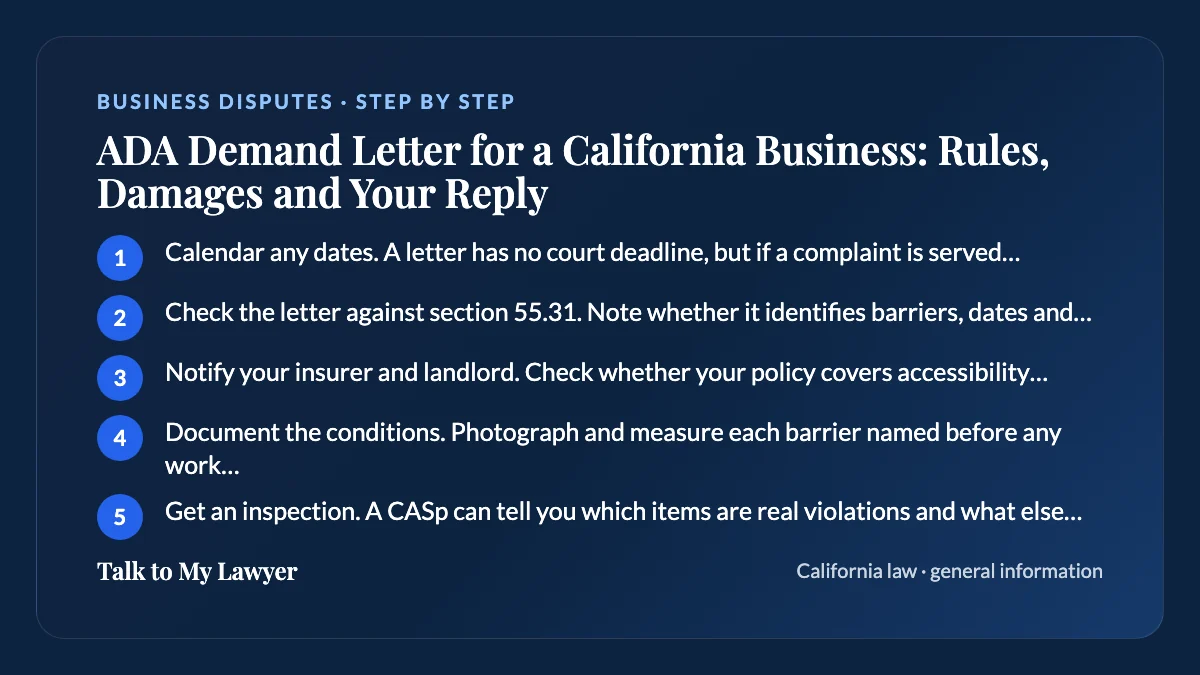
- Calendar any dates. A letter has no court deadline, but if a complaint is served later, the 30-day and 60-day repair windows run from service.
- Check the letter against section 55.31. Note whether it identifies barriers, dates and visits, and whether it improperly demands money.
- Notify your insurer and landlord. Check whether your policy covers accessibility claims and what notice it requires, and whether your lease assigns responsibility for parts of the site.
- Document the conditions. Photograph and measure each barrier named before any work begins.
- Get an inspection. A CASp can tell you which items are real violations and what else needs attention.
- Fix what is real. Corrections protect future customers and are the basis for the reduced-damage rules.
- Respond in writing. Address each barrier: corrected, being corrected with a date, or disputed with reasons.
We received your letter dated June 9 regarding our location at 1820 Main Street. We take access seriously. The entry threshold you describe was measured and photographed on June 12, and a contractor corrected it on June 20; photographs are enclosed. The restroom signage you mention complied before your client's visit, as shown in the enclosed photos. We are willing to discuss any remaining concerns about the condition of the property.
Two related reads: replying to a demand without weakening your position, and what a sender's response deadline does and does not mean.
Do these rules apply to website accessibility claims?
Partly. The demand-letter rules in sections 55.3 and 55.31 cover construction-related accessibility claims, meaning physical conditions of a place of public accommodation. A website claim against a California business may be framed under the Unruh Act on the theory that an ADA violation is also an Unruh violation (Civil Code section 51(f)). Whether and when a website alone is covered has been argued in the courts, so treat a website letter as its own legal question.
One rule does reach website suits: an attorney who files a complaint alleging an inaccessible website must send a copy to the California Commission on Disability Access within five business days (Civil Code section 55.32(b)). As of October 2026, a 2026 bill on website accessibility claims (AB 2190) was moved to the Assembly inactive file in May 2026 and has not become law.
Putting your accessibility response on attorney letterhead
An accessibility claim mixes construction facts with civil-rights statutes, and a reply that misstates either can complicate the defense later. A formal response is worth weighing when the letter skipped required content, when your landlord shares responsibility, when you have already completed repairs and want them documented, or when the letter covers several locations.
Through Talk to My Lawyer, a licensed California attorney writes your response from the demand letter, your photos, measurements and CASp findings, and sends it on your behalf. Where a complaint has already been served, talk to a lawyer about your facts and the court deadlines that apply.
Frequently asked questions
Can an attorney demand money in an ADA letter in California?
Not in a prelitigation letter about a construction-related barrier. Civil Code section 55.31 bars attorneys from requesting money or offering to accept money in that letter, and limits any damages statement to a single sentence the statute supplies. Exceptions include claims involving physical injury, a settlement figure given in response to your own request, and talks after the parties agree on repairs.
How much is the Unruh Act penalty for an ADA violation?
The Unruh Act sets damages of actual damages up to three times actual damages, with a minimum of $4,000 for each offense, plus attorney's fees (Civil Code section 52(a)). For construction-related claims, offenses are counted by each occasion the person was denied access, not by the number of violations at the site, and the minimum can be reduced to $2,000 or $1,000 when qualifying businesses correct the barriers quickly.
What counts as a small business for reduced ADA damages in California?
Under Civil Code section 55.56(g)(2), a business that has employed 25 or fewer employees on average over the past three years, or its time in existence if shorter, with average annual gross receipts under a statutory cap that started at $3,500,000 and is adjusted for inflation. It must also correct all the violations within 30 days of being served with the complaint to qualify for the $2,000 minimum.
Does fixing the barrier end the claim?
Not by itself. A federal ADA claim seeks an order to remove barriers, so a completed fix can affect that part. State claims for statutory damages and attorney's fees can continue for visits that already happened, although a timely fix by a qualifying business can lower the minimum damages per offense. Documenting the condition before and after the work helps in either case.
Is a commercial tenant responsible for parking lot accessibility?
It depends on the lease. The state advisory that must accompany an attorney's accessibility letter tells commercial tenants they may not be responsible for some portions of the premises, including common areas such as parking lots, because those areas may be the landlord's responsibility. Read the maintenance and compliance clauses and notify the landlord in writing when a letter names a shared area.
Sources
Checked against these official sources on October 18, 2026.
- California Civil Code section 55.31 (California Legislative Information)
- California Civil Code section 55.3 (California Legislative Information)
- California Civil Code section 55.32 (California Legislative Information)
- California Civil Code section 55.56 (California Legislative Information)
- California Civil Code section 52 (California Legislative Information)
- California Civil Code section 55.54 (California Legislative Information)
This guide explains California law in general terms as of October 2026. It is general information, not legal advice for your situation, and local rules can add to it.
Join the email list and get a lawyer letter started
With Talk to My Lawyer, a licensed California attorney writes your letter from your facts and documents and sends it on your behalf. Join the Talk to My Lawyer email list for letter checklists, document prompts, and reminders before you start your letter.