Quick answer
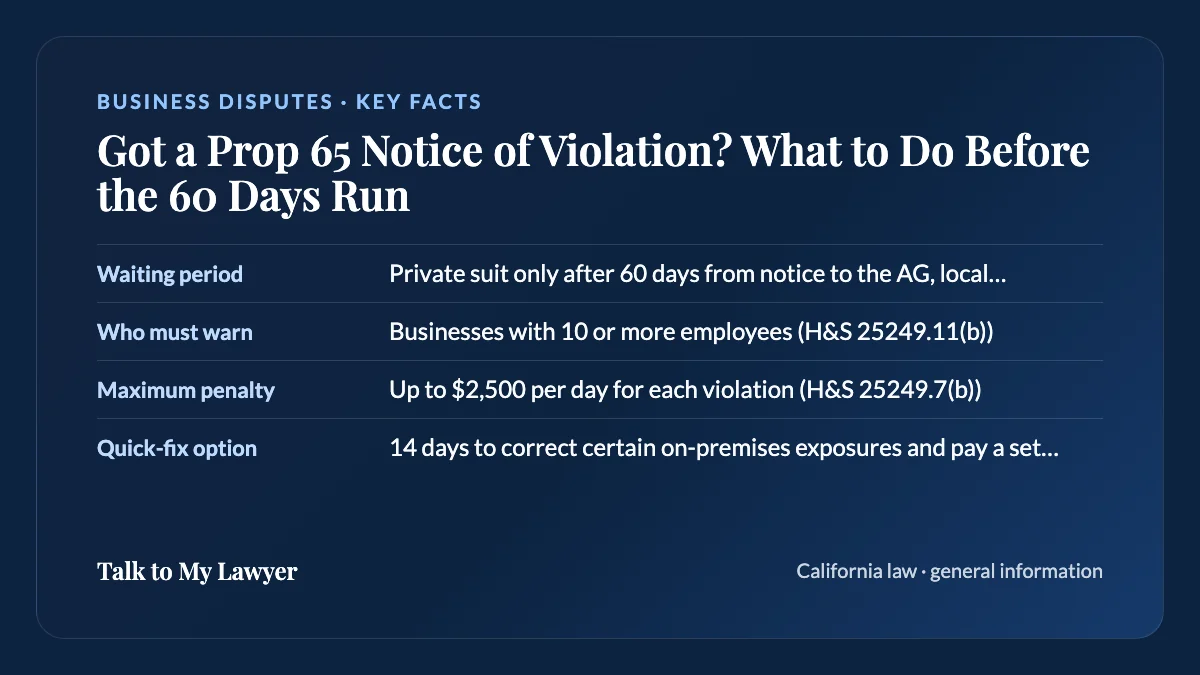
If you receive a Prop 65 notice of violation, you have 60 days before a private enforcer can sue (Health and Safety Code section 25249.7(d)). Use that time to confirm what product and chemical are named, whether your business has 10 or more employees, whether an exemption applies, and what your supplier knows. Civil penalties can reach $2,500 per day for each violation (section 25249.7(b)).
At a glance
- Waiting period
- Private suit only after 60 days from notice to the AG, local prosecutor and you (H&S 25249.7(d))
- Who must warn
- Businesses with 10 or more employees (H&S 25249.11(b))
- Maximum penalty
- Up to $2,500 per day for each violation (H&S 25249.7(b))
- Quick-fix option
- 14 days to correct certain on-premises exposures and pay a set penalty (H&S 25249.7(k))
- Newly listed chemicals
- No warning duty for exposures within 12 months after listing (H&S 25249.10(b))
What is a Prop 65 60-day notice of violation?
It is the step a private enforcer must take before suing under Proposition 65, the Safe Drinking Water and Toxic Enforcement Act of 1986. Section 25249.6 bars a business from knowingly and intentionally exposing anyone to a chemical the state lists as causing cancer or reproductive toxicity without first giving a clear and reasonable warning.
Under Health and Safety Code section 25249.7(d), a person suing 'in the public interest' must first send notice to the Attorney General, to the district attorney or city attorney where the violation allegedly happened, and to the business. The suit can begin only after 60 days pass and only if no public prosecutor has started and is diligently prosecuting an action over the same violation.
For a failure-to-warn claim, the notice must include a certificate of merit. The person signing it states that they consulted someone with relevant expertise who reviewed data about the exposure, and that they believe the case is reasonable and meritorious. The supporting facts go to the Attorney General confidentially. You do not get to see them at this stage.
Does Prop 65 apply to your business at all?
Start with the threshold questions. Any one of them can end the matter.
| Question | Rule |
|---|---|
| Do you have 10 or more employees? | A business employing fewer than 10 is not a 'person in the course of doing business' and has no warning duty (25249.11(b)). |
| Was the chemical listed recently? | The warning duty does not apply to an exposure that takes place less than 12 months after the chemical was added to the state list (25249.10(b)). |
| Does federal law control the warning? | Exposures where federal law governs warnings in a way that preempts state authority are exempt (25249.10(a)). |
| Is the exposure too small to matter? | An exemption applies if the business can prove the exposure poses no significant risk, or for reproductive toxins no observable effect at 1,000 times the level. The business carries that burden (25249.10(c)). |
| Are you the retailer, not the maker? | The law directs warning regulations, where practicable, to place labeling duties on the producer or packager rather than the retail seller (25249.11(f)). |
Each answer needs evidence: payroll records for headcount, the listing date from the state's chemical list, and testing or supplier data for exposure levels.
Is there a quick fix for restaurants, bars and parking garages?
Yes, for four kinds of exposure. Section 25249.7(k) creates a special compliance procedure when the notice alleges a missing warning for:
- Alcoholic beverages consumed on your premises, where on-site drinking is legal.
- Chemicals formed by cooking food or drinks prepared and sold on your premises for immediate consumption, if not intentionally added.
- Secondhand tobacco smoke on premises where smoking is permitted anywhere.
- Engine exhaust inside a facility you own or operate mainly for parking noncommercial vehicles.
If, within 14 days after service, you correct the violation, agree to pay a civil penalty set at $500 per facility (adjusted for inflation every five years by the Judicial Council), and notify the sender in writing using the proof of compliance form that must come with the notice, the sender may not sue you for that exposure. The penalty is due within 30 days of service. You can use this procedure only once for the same exposure at the same facility.
What penalties can a Prop 65 violation bring?
A court can order an injunction and civil penalties of up to $2,500 per day for each violation (section 25249.7(b)). That is a maximum. In setting the amount, the court must weigh the nature and extent of the violation, the number and severity of violations, the penalty's economic effect on the business, good faith efforts to comply and when they began, willfulness, deterrence, and any other factor justice requires.
- Settlements need court approval. If a private enforcer settles a filed case, the court must find the warning complies with the law, the attorney's fees are reasonable, and the penalty is reasonable under those factors (25249.7(f)(4)).
- The Attorney General can weigh in. If, after reviewing the facts behind the certificate of merit and conferring with the sender, the Attorney General believes the case has no merit, it must send both sides a letter saying so. The absence of a letter is not an endorsement (25249.7(e)).
- Baseless notices carry risk. If a court later finds no actual or threatened exposure and no credible factual basis for the certificate, the action is deemed frivolous under Code of Civil Procedure section 128.5 (25249.7(h)).
The Attorney General's Proposition 65 page links to a search tool for filed 60-day notices, which lets you see what else has been filed about the same product or chemical.
What to do after receiving a Prop 65 notice: a 60-day plan
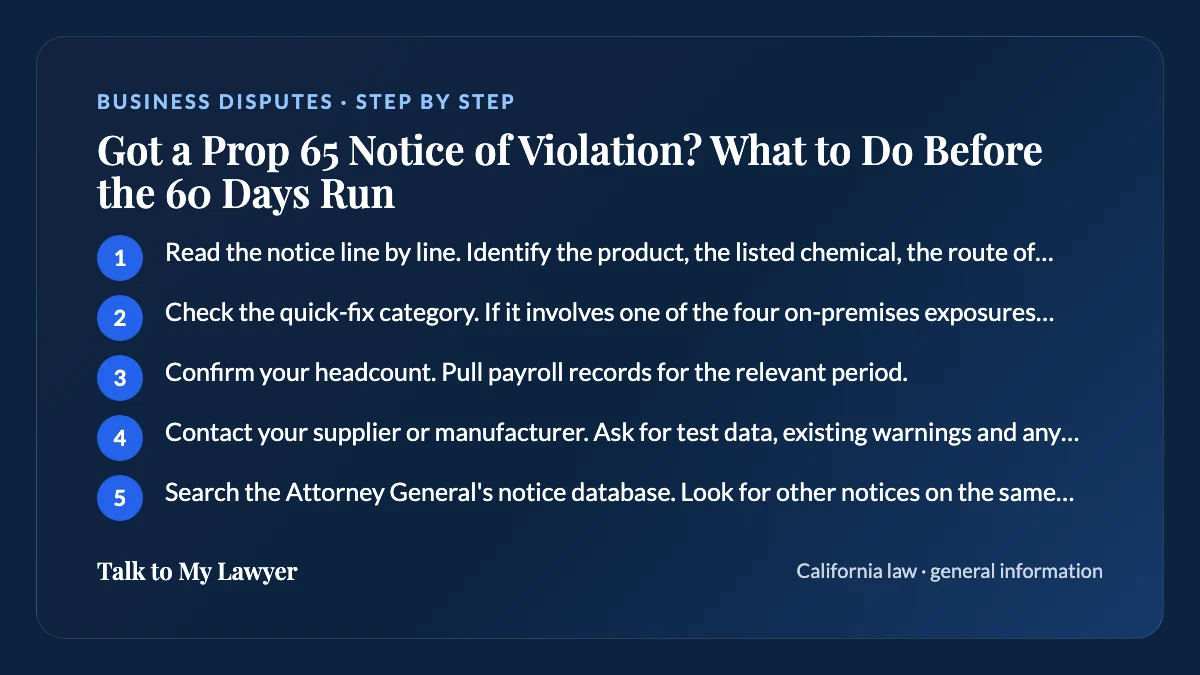
- Read the notice line by line. Identify the product, the listed chemical, the route of exposure, and the date and method of service.
- Check the quick-fix category. If it involves one of the four on-premises exposures, the 14-day deadline is the first one to calendar.
- Confirm your headcount. Pull payroll records for the relevant period.
- Contact your supplier or manufacturer. Ask for test data, existing warnings and any indemnity under your purchase terms. Send the request in writing.
- Search the Attorney General's notice database. Look for other notices on the same product, which can show whether your supplier or manufacturer received one too.
- Decide on warnings going forward. Adding a compliant warning now can matter under the good-faith penalty factor, separate from whether the notice has merit.
- Respond in writing before day 60. State your position on each point and preserve every record you relied on.
Example (hypothetical): an online kitchenware shop with 14 employees receives a notice about lead in a ceramic mug it buys from a distributor. The shop confirms the mug was sold in California, asks the distributor for lab results and its warning practices, and learns the distributor received the same notice. The shop's written reply identifies the distributor, describes the warning it added to the product page, and asks the sender to direct product questions to the manufacturer.
What should a written response to a Prop 65 notice say?
Keep it factual and specific. A reply that simply denies everything gives the sender nothing to weigh, while one that concedes exposure levels you have not tested can be used later.
We received your 60-day notice dated April 2 concerning the 12-ounce stoneware mug, SKU 4471. We are not the manufacturer; the product is made by [company], whose contact information is enclosed. We have requested testing records from the manufacturer and, as of April 18, added a warning to the product page. Please direct any questions about the product's composition to the manufacturer. We reserve all rights and defenses.
Settlement communications have their own protections, covered in answering a demand letter calmly. The guide to ADA demand letters for California businesses explains a different statute with its own notice rules.
Answering a 60-day notice with a lawyer's letter
Prop 65 turns on facts that live in other people's files: lab results, supplier warnings, listing dates and payroll. A formal response can be worth having when the notice names several products, when responsibility sits with a manufacturer or distributor, when your headcount is close to 10, or when you want the 14-day cure documented without mistakes.
Through Talk to My Lawyer, a licensed California attorney writes your response from the notice, your supplier records and your warning history, and sends it on your behalf. Once a case is filed or settlement terms are on the table, talk to a lawyer who handles Prop 65 matters.
Frequently asked questions
Do small businesses have to comply with Prop 65?
Businesses with fewer than 10 employees are outside the law's warning and discharge rules. Health and Safety Code section 25249.11(b) excludes any person employing fewer than 10 employees from the definition of 'person in the course of doing business'. Government agencies and public water systems are also excluded. A business near the line should keep payroll records that show its headcount for the period the notice covers.
Can I see the evidence behind a Prop 65 certificate of merit?
Not at the notice stage. The factual information supporting the certificate is served on the Attorney General, who must keep it confidential, with limited sharing with prosecutors and agencies. It becomes discoverable in litigation only to the extent it is relevant and not privileged. If a case ends and the court finds there was no exposure, it can review the basis privately and deem the action frivolous if no credible factual basis existed.
What happens if I ignore a Prop 65 notice?
After 60 days, the sender may file suit if no public prosecutor is diligently pursuing the same violation. A filed case can seek an injunction and civil penalties of up to $2,500 per day for each violation, with the court weighing factors including good-faith efforts to comply and when they were taken. Silence also wastes the window to gather supplier records and add warnings.
Does a retailer have to put Prop 65 warnings on products it did not make?
The statute tells regulators, where practicable, to place the duty to provide warning materials such as labels on the producer or packager rather than the retail seller. The exception is a retailer that itself introduces the listed chemical into the product. Detailed allocation rules sit in state regulations, so a retailer receiving a notice should pull its supplier agreements and ask the manufacturer what warnings it provided.
Sources
Checked against these official sources on October 18, 2026.
- California Health and Safety Code section 25249.7 (California Legislative Information)
- California Health and Safety Code section 25249.11 (California Legislative Information)
- California Health and Safety Code section 25249.10 (California Legislative Information)
- California Health and Safety Code section 25249.6 (California Legislative Information)
- Proposition 65 (California Attorney General)
This guide explains California law in general terms as of October 2026. It is general information, not legal advice for your situation, and local rules can add to it.
Join the email list and get a lawyer letter started
With Talk to My Lawyer, a licensed California attorney writes your letter from your facts and documents and sends it on your behalf. Join the Talk to My Lawyer email list for letter checklists, document prompts, and reminders before you start your letter.