Quick answer
A statute of limitations calculator for California adds the legal time limit for your claim to the date it arose: 4 years for a written contract (CCP 337), 2 years for an oral contract or personal injury, 3 years for property damage or fraud, and 1 year for libel or slander. A last day on a Saturday, Sunday or court holiday moves to the next court day (CCP 12a).
At a glance
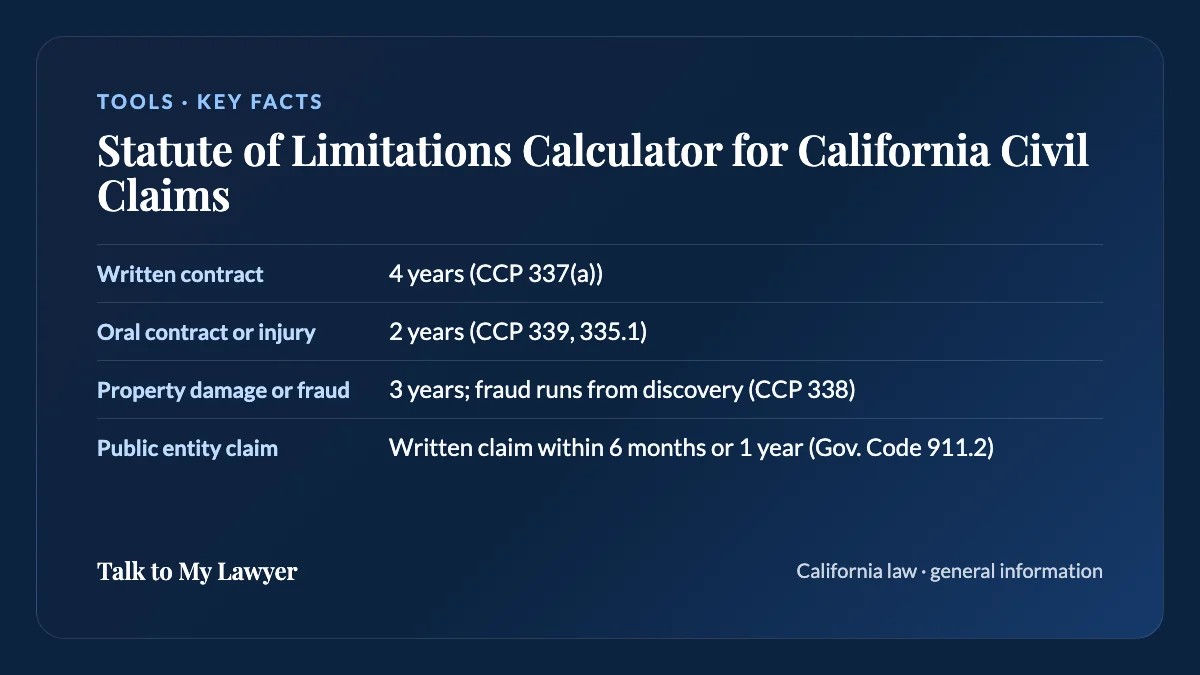
- Written contract
- 4 years (CCP 337(a))
- Oral contract or injury
- 2 years (CCP 339, 335.1)
- Property damage or fraud
- 3 years; fraud runs from discovery (CCP 338)
- Public entity claim
- Written claim within 6 months or 1 year (Gov. Code 911.2)
- Weekend or holiday
- Moves to the next court day (CCP 12a, 135)
- Demand letter
- Does not pause the deadline
How do you use the statute of limitations calculator?
Choose the claim type that matches your dispute and enter the date it arose. The calculator adds the matching period and gives an estimated last day to file, noting that a weekend or court holiday generally moves the deadline to the next court day.
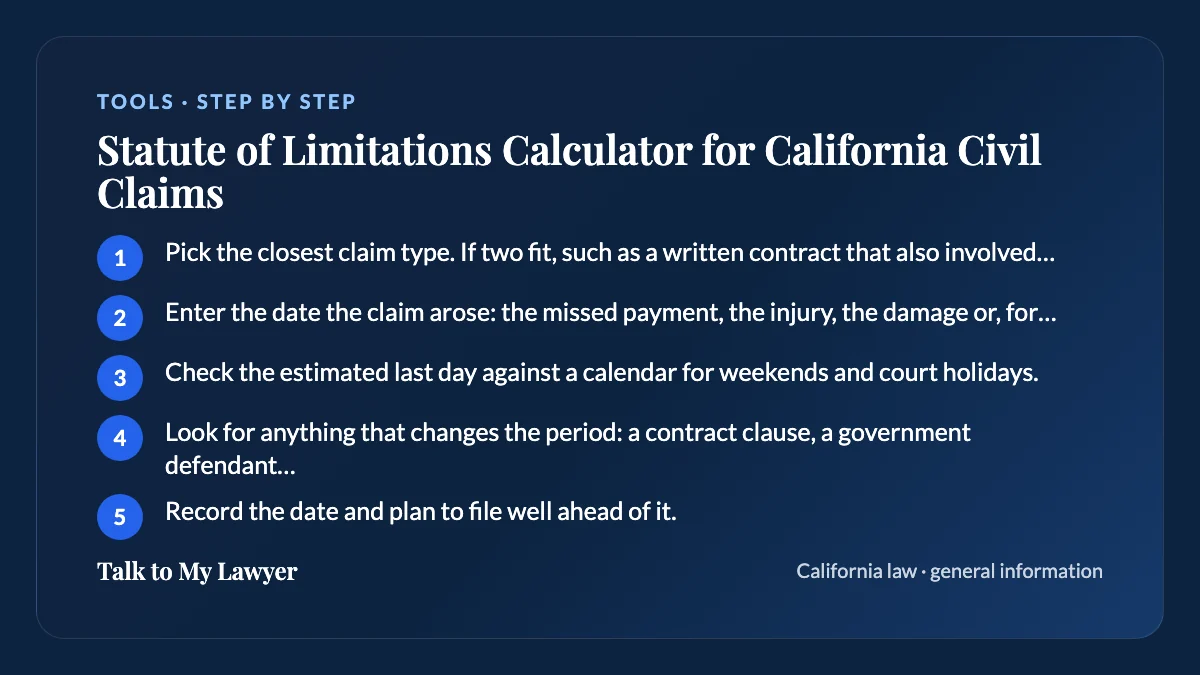
- Pick the closest claim type. If two fit, such as a written contract that also involved fraud, run both and keep the earlier date.
- Enter the date the claim arose: the missed payment, the injury, the damage or, for fraud, the day you discovered the facts.
- Check the estimated last day against a calendar for weekends and court holidays.
- Look for anything that changes the period: a contract clause, a government defendant, a minor, or a special statute.
- Record the date and plan to file well ahead of it.
For more claim types and periods, see the California statute of limitations deadline table.
Which start date should you enter?
Enter the date your claim accrued (the law's word for the day the clock starts), usually the day the harm happened or the other side broke the deal. A wrong start date throws off every date that follows.
| Claim | Date to enter | Watch for |
|---|---|---|
| Unpaid loan or invoice | The day payment was due and not made | The due date in the agreement |
| Defective goods | The day the seller tendered delivery | The clock runs from delivery even if you did not know of the defect, unless the warranty covers future performance (Commercial Code 2725(2)) |
| Injury in a crash or fall | The day of the injury | A claim against a public agency needs a written claim within six months |
| Damage to your home or land | The day of the damage | Ongoing damage raises timing questions |
| Fraud | The day you discovered the facts | Proof of when and how you found out |
What if you only found out about the problem later?
For fraud and mistake, the claim does not accrue until you discover the facts, so the three years run from discovery (CCP 338(d)). Courts apply a similar discovery rule to some other claims, though not all. Goods are a clear exception: a breach of a sales contract occurs when it happens, whether or not you knew (Commercial Code 2725(2)).
If your start date turns on when you learned something, save the record that shows that date.
What can pause or extend the deadline?
Some rules stop the clock for a time (the deadline is tolled), and others let the parties change it:
- Minors and people lacking capacity. If the person with the claim was a minor or lacked legal capacity when the claim arose, that time is not counted (CCP 352(a)). The pause does not apply to claims that must first be presented to a public entity (CCP 352(b)).
- A signed written waiver. The other side can agree in writing not to raise the time limit. It must be signed by the person obligated, and each waiver lasts no more than four years, though it can be renewed (CCP 360.5).
- Contract terms for goods. A sales contract can shorten the four years to as little as one year, but cannot lengthen it (Commercial Code 2725(1)).
The calculator ignores all three, so your real deadline may fall earlier or later than its estimate.
What happens when the last day falls on a weekend or holiday?
The deadline extends to the next day that is not a holiday. California excludes the first day and includes the last (CCP 12), and when the last day is a holiday the period runs to the next non-holiday (CCP 12a). Saturdays, Sundays and the judicial holidays in CCP 135 all count.
Court holidays are not the same as state holidays. CCP 135, as amended by AB 268 effective January 1, 2026, makes every Saturday and the day after Thanksgiving court holidays, but leaves out several state holidays: Lunar New Year, Genocide Remembrance Day (April 24), Diwali, Admission Day (September 9) and Columbus Day. Courts are open on those days, so a deadline that lands on one does not move.
Does sending a demand letter stop the statute of limitations?
No. A demand letter does not pause or reset the deadline. The clock keeps running through replies, negotiation and mediation unless the other side signs a written waiver.
Claims against government bodies need extra care. A written claim to the agency comes first: within six months for death, injury to a person, or damage to personal property or growing crops, and within one year for other claims (Government Code 911.2). The calculator's two agency options ("for injury, death, personal property or crops" and "Other written claim to a public agency") estimate the deadline to present that claim, not the deadline to sue. After a written rejection, a lawsuit generally must follow within six months (Government Code 945.6). See the guide to a claim against a California city.
If you plan to write first, count backward from your deadline and leave room for the reply window and a follow-up, as covered in the final demand letter before a lawsuit guide.
When an attorney-written letter fits your timeline
When the deadline is months away, a letter gives the other side a documented chance to resolve the dispute before anyone files. With Talk to My Lawyer, a licensed California attorney writes your letter from your facts and documents and sends it on your behalf, with a response date inside your filing window.
If the deadline is close, or you are unsure which period applies, talk to a lawyer about your facts first.
Frequently asked questions
Is the calculator's date my legal deadline?
No. It is an estimate based on the claim type and the date you enter. The real deadline can differ if the claim accrued on another date, a tolling rule applies, a contract shortened the period, or a special statute governs your claim. Confirm yours with a lawyer before relying on it.
How long do I have to sue for breach of contract in California?
Four years for a written contract (CCP 337(a)) and two years for an oral one (CCP 339), generally counted from the breach. Sales of goods follow Commercial Code 2725: four years from the breach, which the original agreement can shorten to no less than one year.
Do small claims cases have different deadlines?
No. A small claims case is a civil action, so the same limitation periods apply. The dollar limit and the procedure differ, but filing in small claims before the deadline protects the claim.
What if I am suing a city, county or state agency?
You generally must present a written claim to the agency first: within six months for death or injury to a person, personal property or growing crops, and within one year for other claims (Government Code 911.2). After a written rejection, the lawsuit deadline is generally six months from the notice (Government Code 945.6).
Sources
Checked against these official sources on October 18, 2026.
- California Code of Civil Procedure section 337 (California Legislative Information)
- California Code of Civil Procedure section 338 (California Legislative Information)
- California Government Code section 911.2 (California Legislative Information)
- California Code of Civil Procedure section 12a (California Legislative Information)
- California Code of Civil Procedure section 352 (California Legislative Information)
- California Code of Civil Procedure section 360.5 (California Legislative Information)
This guide explains California law in general terms as of October 2026. It is general information, not legal advice for your situation, and local rules can add to it.
Join the email list and get a lawyer letter started
With Talk to My Lawyer, a licensed California attorney writes your letter from your facts and documents and sends it on your behalf. Join the Talk to My Lawyer email list for letter checklists, document prompts, and reminders before you start your letter.