Quick answer
To make a company delete your data in California, send a verifiable deletion request under the California Consumer Privacy Act (Civil Code section 1798.105) through one of the methods in its privacy policy. The business must respond within 45 days, extendable once by 45 days with notice. For registered data brokers, the state's DROP platform sends one deletion request to all of them.
At a glance
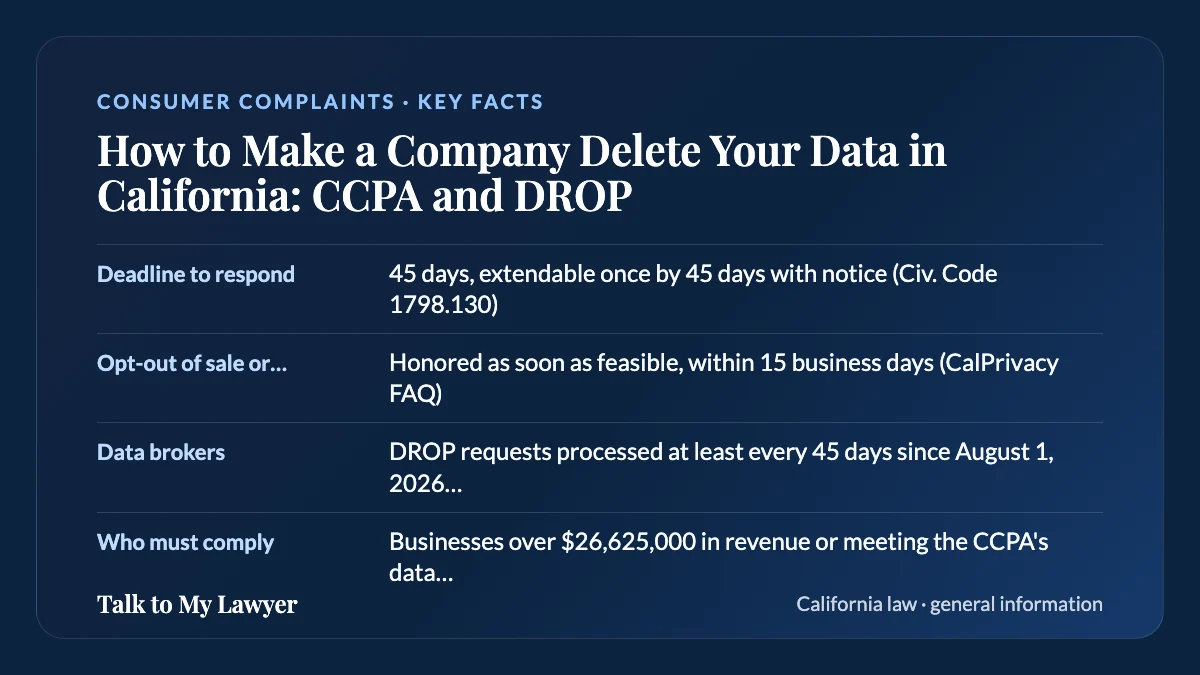
- Deadline to respond
- 45 days, extendable once by 45 days with notice (Civ. Code 1798.130)
- Opt-out of sale or sharing
- Honored as soon as feasible, within 15 business days (CalPrivacy FAQ)
- Data brokers
- DROP requests processed at least every 45 days since August 1, 2026 (1798.99.86)
- Who must comply
- Businesses over $26,625,000 in revenue or meeting the CCPA's data tests (2025 adjustment)
- Where to complain
- California Privacy Protection Agency (CalPrivacy) or the Attorney General
What data rights do Californians have under the CCPA?
The California Consumer Privacy Act, as amended by the California Privacy Rights Act, gives you several separate requests. Each one does something different, so name the one you want.
| Request | What it does | Civil Code |
|---|---|---|
| Delete | The business deletes personal information it collected from you and tells its service providers and the third parties it sold or shared with to delete it | 1798.105 |
| Correct | The business fixes inaccurate personal information | 1798.106 |
| Know (access) | The business discloses what it collected about you, in a portable format | 1798.110 and 1798.115 |
| Opt out of sale or sharing | The business stops selling or sharing your personal information | 1798.120 |
Not every company is covered. The best-known test is annual gross revenue above $26,625,000, the figure in effect since 2025; other tests turn on how much personal information a business buys, sells or shares. A small local shop may fall outside the law.
How do you send a CCPA deletion request?
Use one of the methods the business lists in its privacy policy. Businesses must offer two or more ways to submit deletion, correction and access requests, including a toll-free phone number. A business that operates only online and has a direct relationship with you may offer just an email address. Businesses with websites must accept requests through the site.
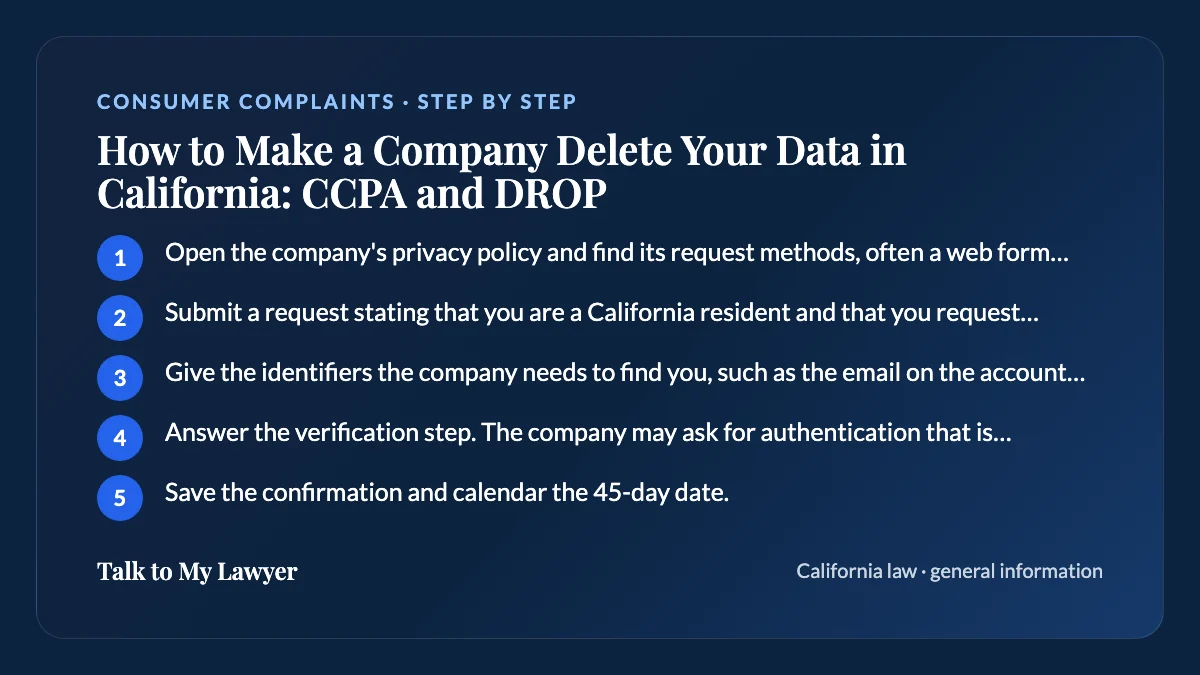
- Open the company's privacy policy and find its request methods, often a web form, email address or toll-free number.
- Submit a request stating that you are a California resident and that you request deletion under Civil Code section 1798.105. Add an opt-out of sale and sharing in the same message if you want both.
- Give the identifiers the company needs to find you, such as the email on the account, and nothing more.
- Answer the verification step. The company may ask for authentication that is reasonable for the data involved, but it may not make you create an account to submit a request (if you already have one, it may ask you to use it).
- Save the confirmation and calendar the 45-day date.
- If the company announces an extension, note the new date. It may extend once, by 45 days, and must tell you within the first 45.
I am a California resident. Under California Civil Code section 1798.105, I request that you delete all personal information you have collected from me, including data associated with the email address below, and that you notify your service providers, contractors and any third parties to whom you sold or shared it. Under section 1798.120, I also opt out of the sale and sharing of my personal information. Please confirm completion in writing within the 45 days provided by section 1798.130.
Opt-out requests move faster. The agency's guidance says businesses must comply as soon as feasibly possible, up to a maximum of 15 business days, and must honor qualifying opt-out preference signals such as Global Privacy Control.
Can a company refuse to delete your data?
Yes, in defined situations. Section 1798.105(d) lets a business keep information when it is reasonably necessary to:
- Complete the transaction, honor a warranty or recall, provide a service you asked for, or otherwise perform a contract with you.
- Help ensure security and integrity, or debug errors.
- Exercise free speech or another legal right.
- Comply with the California Electronic Communications Privacy Act.
- Carry out certain research you consented to.
- Support internal uses reasonably aligned with your expectations given your relationship with the business.
- Comply with a legal obligation.
If the business refuses, ask it in writing which exception it relies on. A vague answer, or silence after 45 days, is a reason for a follow-up letter. The business may also keep a confidential record of your deletion request so that it does not sell your information again.
How do you remove your data from data brokers in California?
Use DROP, the Delete Request and Opt-out Platform run by the California Privacy Protection Agency, which now calls itself CalPrivacy. The Delete Act required the agency to launch it by January 1, 2026, and it may not charge consumers to use it (Civil Code section 1798.99.86).
- One verified request reaches every registered data broker, and you can exclude specific brokers.
- As of October 2026: since August 1, 2026, each registered broker must check DROP at least once every 45 days and process new requests within 45 days.
- If a broker cannot verify you, it must treat the request as an opt-out of sale and sharing.
- Brokers must also direct their service providers and contractors to act on the request. After deleting your data, a broker must repeat the deletion at least every 45 days and may not sell or share new personal information about you, with limited exceptions.
- You can check the status of your request, and change it after 45 days.
DROP covers registered data brokers. For a company you dealt with directly, such as a retailer or app, send that company its own request.
What can you do if a company ignores your request?
File a complaint with CalPrivacy online or on its paper form, or with the California Attorney General. Include the date of your request, how you sent it, and any reply. CalPrivacy says it does not represent individual consumers, but complaints inform its enforcement work.
The CCPA's private lawsuit right covers data breaches caused by unreasonable security, not ignored deletion requests. If your information was exposed in a breach, the steps and the 30-day notice are in responding to a California data breach notice. Robocalls and marketing texts are governed by different laws; see stopping unwanted texts and calls.
When an attorney-written privacy request letter makes sense
You can submit a CCPA request yourself through the company's form. A lawyer's letter becomes useful when a business has ignored repeated requests, demanded identity documents out of proportion to the data, claimed an exception that does not seem to fit, or kept using your information in a way that harmed you, or when the data issue sits inside a larger dispute. For the overall format, see what a demand letter is.
When a business stalls like that, Talk to My Lawyer is one route: a licensed California attorney writes your letter from your request history and the company's replies, cites the CCPA sections that apply, and sends it on your behalf. If you are weighing a legal claim, get advice specific to your situation.
Frequently asked questions
How long does a company have to delete my data in California?
A business must respond to a verifiable deletion request within 45 days of receiving it (Civil Code section 1798.130). It may extend that once by another 45 days when reasonably necessary, but it has to tell you about the extension within the first 45 days. The clock starts on receipt, not when the business finishes verifying your identity.
Do I have to explain why I want my data deleted?
No. The CCPA gives you the right to request deletion without stating a reason. The business can ask for information reasonably needed to verify that the request comes from you, and it can deny deletion if a listed exception applies, such as completing a transaction or complying with a legal obligation. Information you give to verify your identity may be used only for verification (section 1798.130(a)(7)).
What is DROP in California?
DROP, the Delete Request and Opt-out Platform, is a state website run by the California Privacy Protection Agency. It lets a California resident send one deletion request to every registered data broker. Since August 1, 2026, brokers must check it at least every 45 days and process requests within 45 days. The agency may not charge consumers for using it.
Can I sue a company for not deleting my data?
Generally not under the CCPA itself. The act's private right of action covers data breaches caused by a business's failure to maintain reasonable security. Other violations, including ignored deletion requests, are enforced by the California Privacy Protection Agency and the Attorney General. You can file a complaint with either. Other laws may apply to your situation, so talk to a lawyer about your facts.
Does deleting my account delete my data?
Not necessarily. Closing an account and submitting a CCPA deletion request are different steps. The deletion duty in section 1798.105 is triggered by a verifiable consumer request, and even then the business may keep information that fits an exception in subdivision (d). Submit a specific deletion request and ask for written confirmation.
Sources
Checked against these official sources on October 18, 2026.
- Civil Code section 1798.105 (California Legislative Information)
- Civil Code section 1798.130 (California Legislative Information)
- Civil Code section 1798.99.86 (California Legislative Information)
- Frequently Asked Questions (California Privacy Protection Agency)
- Updated Monetary Thresholds in CCPA (California Privacy Protection Agency)
- CCPA Complaints (California Privacy Protection Agency)
This guide explains California law in general terms as of October 2026. It is general information, not legal advice for your situation, and local rules can add to it.
Join the email list and get a lawyer letter started
With Talk to My Lawyer, a licensed California attorney writes your letter from your facts and documents and sends it on your behalf. Join the Talk to My Lawyer email list for letter checklists, document prompts, and reminders before you start your letter.