Quick answer
A cease and desist letter for trespassing in California tells a named person they may not enter your property and asks them to stay off. It is not a court order, but it documents that permission was refused. Under Penal Code section 602(o), refusing to leave private property not open to the public after the owner asks is a misdemeanor, and repeated entry can support civil claims.
At a glance
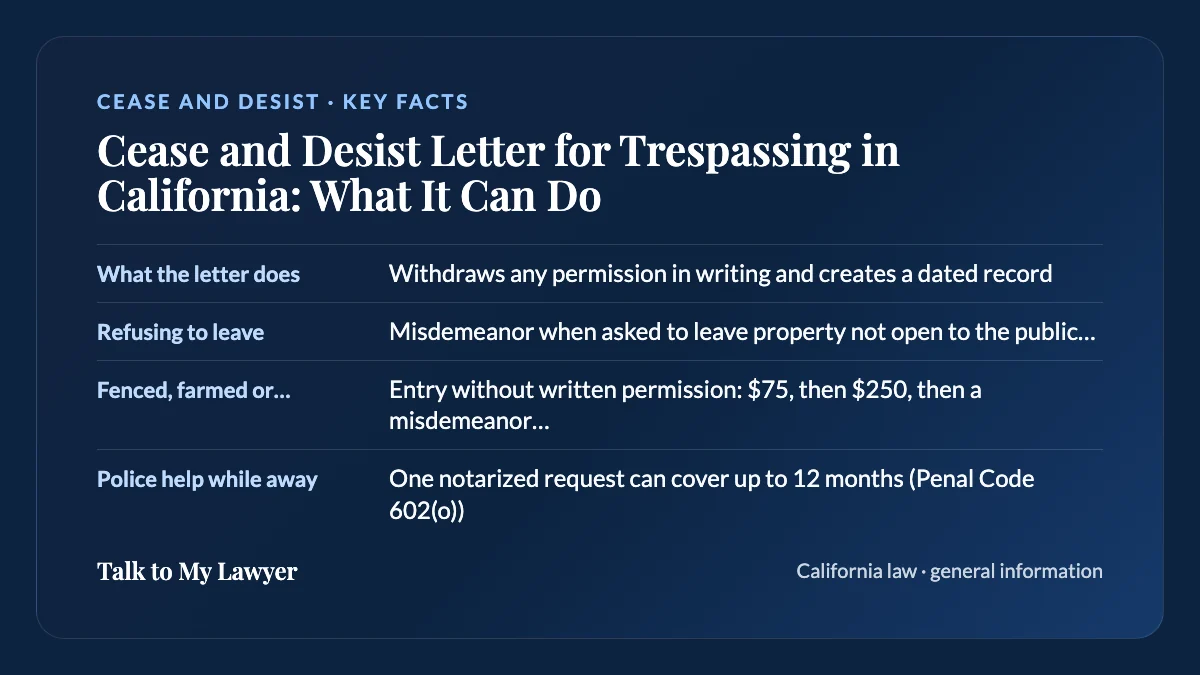
- What the letter does
- Withdraws any permission in writing and creates a dated record
- Refusing to leave
- Misdemeanor when asked to leave property not open to the public (Penal Code 602(o))
- Fenced, farmed or posted land
- Entry without written permission: $75, then $250, then a misdemeanor (Penal Code 602.8)
- Police help while away
- One notarized request can cover up to 12 months (Penal Code 602(o))
- Drones
- Recording private activity from your airspace: up to triple damages and a $5,000 to $50,000 civil fine (Civil Code 1708.8)
What does a cease and desist letter for trespassing do?
A trespass cease and desist letter states in writing that a named person does not have permission to enter your property, and asks them to stay off it. It cannot be enforced like a court order. Its value is clarity: it puts on paper, with a date, that this person is not welcome.
- It withdraws any earlier permission, express or implied, such as a former tenant's friend or a neighbor who used to cut through with your blessing.
- It identifies the property and the areas covered, including driveways, side yards and outbuildings.
- It gives you a dated record to show police, a court or an insurer.
- It can address related conduct, such as parking, dumping or flying a drone over your yard.
If the conduct includes threats or a pattern of intimidation, a letter may not be enough. Our guide to a harassment cease and desist letter deals with that, and the court option appears further down.
When is trespassing a crime in California?
Trespassing is a crime in California when it fits one of the acts listed in Penal Code section 602 or section 602.8. Stepping onto a lawn is not automatically a crime; the statutes generally require something more, such as refusing to leave, entering fenced, cultivated or posted land, or entering to cause damage.
| Situation | Penal Code provision | Key condition |
|---|---|---|
| Refuses to leave after being asked | 602(o) | Property not open to the general public; request by the owner, agent, occupant, or an officer acting at their request |
| Enters to damage property or interfere with a business | 602(k) | Entry for the purpose of injuring property or obstructing a lawful business |
| Enters and occupies property or a structure | 602(m) | No consent from the owner, agent or person in lawful possession |
| Drives a vehicle onto private property | 602(n) | Property known not to be open to the general public |
| Enters land that is fenced, cultivated or posted | 602.8 | No written permission; unfenced land must be posted at least three signs per mile and at every road and trail entering it |
Penalties under section 602.8 rise with repeat entries onto the same land: a $75 infraction for a first offense, a $250 infraction for a second, and a misdemeanor for a third or later offense. Several of these provisions turn on whether the person was told to leave or lacked written permission, which is where a letter fits.
Can police enforce trespass while you are away?
Yes, if you file a written request. Penal Code section 602(o) normally requires a separate request to the police on each occasion. A single notarized request, made on a form the law enforcement agency provides, can instead cover a period identified by specific dates of up to 12 months, or a shorter limit set by local ordinance, when there is a fire hazard or the owner is away. A separate notarized request of up to 12 months is available when the property is closed to the public and posted as closed.
- As of October 2026, the statute (last amended by SB 602, effective January 1, 2024) allows these requests to be submitted electronically where the local government accepts electronic submissions.
- A request expires when ownership of the property changes or when the person in lawful possession changes.
- You must tell the agency in writing if you no longer want its help before the period ends.
Ask your local police department or sheriff for its form. Some agencies call it a letter of agency or a trespass authorization.
What can you recover for civil trespass?
Trespass is also a civil wrong, separate from any crime. A civil claim can seek money for harm the entry caused and, in a superior court case, an order to stop it.
- Damage to property. Repair costs for broken gates, fences, sprinklers or plants.
- Trees. Cutting or injuring trees on your land can bring double or triple damages under Civil Code section 3346; our neighbor tree dispute guide explains how.
- Occupation. Where someone took over part of your land, Civil Code section 3334 measures damages to include the reasonable value of that use, looking back up to five years, and the cost of restoring the land.
- Ongoing interference. A continuing intrusion that interferes with your use of the property may be a nuisance under Civil Code section 3479.
The usual filing deadline for trespass on land is three years, set by Code of Civil Procedure section 338(b). Small claims court can award an individual up to $12,500, but an order to stop someone from entering generally requires superior court or a restraining order.
Does a hiker or angler on your land change your liability?
California's recreational use statute, Civil Code section 846, says an owner owes no duty to keep the premises safe for people entering for a recreational purpose, such as hiking, fishing, riding or sightseeing, and need not warn them of hazards. Giving permission for recreational entry does not by itself make the owner responsible for those visitors' injuries.
The protection has limits. It does not cover a willful or malicious failure to guard or warn against a dangerous condition, entry granted in exchange for payment or other consideration, or people the owner expressly invited rather than merely permitted.
A trespass letter and section 846 do different jobs. The letter withdraws permission; section 846 concerns your duty of care toward recreational users. If you charge for hunting, riding or other access, talk to a lawyer about both.
Is flying a drone over your yard trespassing?
It can create liability when the drone is used to record you. Civil Code section 1708.8(a) makes a person liable for physical invasion of privacy when they knowingly enter the land, or the airspace above the land, of another person without permission to capture images or recordings of someone engaged in a private, personal or familial activity, in a manner offensive to a reasonable person.
The remedies are serious: up to three times the general and special damages caused, possible punitive damages, and a civil fine of $5,000 to $50,000 (section 1708.8(d)). Your letter can list the flight dates and the areas of your property involved, and ask that the flights stop.
Drone flight is also regulated by federal aviation rules, so a drone passing high over a neighborhood is a different situation from one hovering outside a bedroom window.
Steps for stopping a repeat trespasser
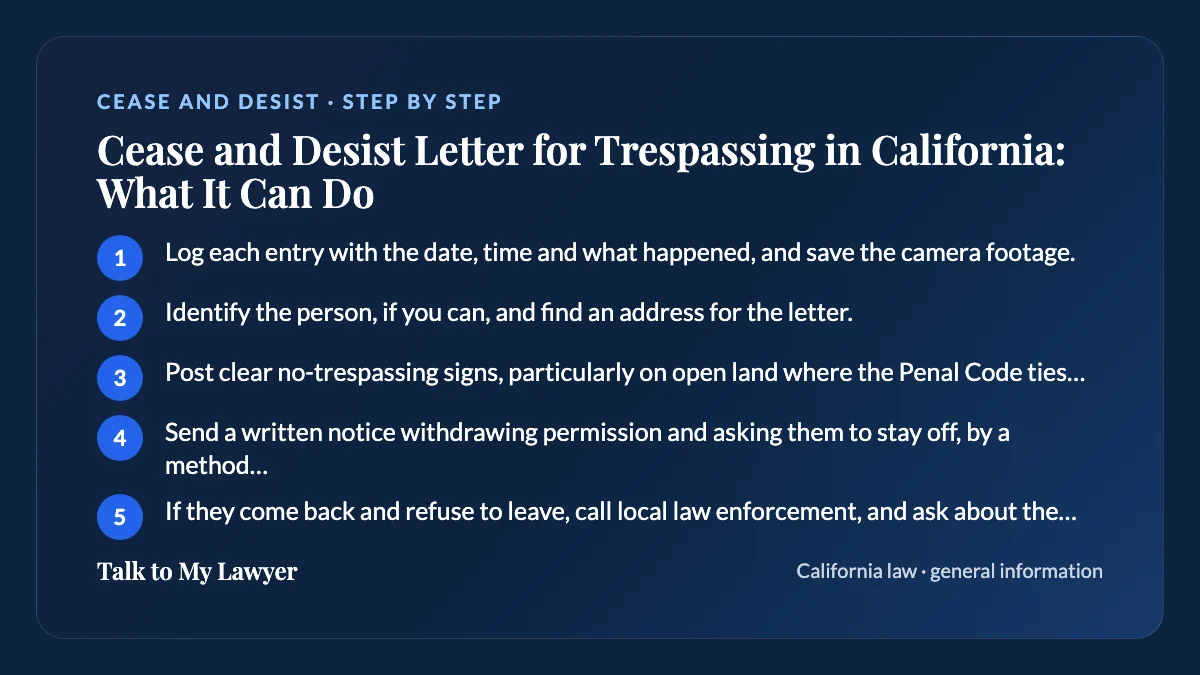
- Log each entry with the date, time and what happened, and save the camera footage.
- Identify the person, if you can, and find an address for the letter.
- Post clear no-trespassing signs, particularly on open land where the Penal Code ties offenses to posting.
- Send a written notice withdrawing permission and asking them to stay off, by a method you can prove.
- If they come back and refuse to leave, call local law enforcement, and ask about the agency's written request form if you travel or are away for long periods.
- If the conduct involves threats or harassment, consider a civil harassment restraining order.
You do not have permission to enter my property at 1180 Orchard Lane, including the driveway, side yard and back garden. My camera recorded you walking through the side yard on September 3, 9 and 16. Any permission you may have had in the past is withdrawn as of the date of this letter. Please stay off the property. If you enter again, I will ask law enforcement to remove you and will consider a civil claim for any damage.
The California Courts self-help site explains that a civil harassment restraining order is available against people such as a neighbor and can last up to five years. The request is made on form CH-100.
When a no-trespassing letter should come from a lawyer
A trespass notice can become the first page of a longer record, so it should read as calmly in front of a judge as it does on a doorstep. Consider having an attorney write it when the person claims a right to be there, such as an easement or an old agreement, when the entries cause damage, when a business or contractor is involved, or when drones or cameras raise privacy concerns.
Through Talk to My Lawyer, a licensed California attorney writes your cease and desist letter from your footage, dates and property details, and sends it on your behalf. If someone claims a legal right to cross your land, talk with a property lawyer about the details.
Frequently asked questions
Is a cease and desist letter for trespassing legally binding?
No. A cease and desist letter is not a court order and does not create new legal duties by itself. It formally withdraws permission and gives notice that a person is not welcome. That record can matter under Penal Code section 602(o), which applies when someone refuses to leave after the owner asks, and in any later civil claim or restraining order request.
Do I need no trespassing signs in California?
It depends on the land. Penal Code section 602.8 treats entry onto uncultivated, unenclosed land as an offense only where signs are displayed at least three per mile along the boundaries and at all roads and trails entering. Fenced or cultivated land is covered without signs. For a home, signs and a written notice together help show permission was refused.
Can I sue a neighbor for trespassing?
Yes. Trespass is a civil wrong, and you can seek money for damage the entry caused, including through small claims court, where an individual's claim can be as high as $12,500, once you have asked the neighbor to pay. An order to stop repeated trespass generally requires a superior court case or a restraining order. Claims for trespass on land generally must be filed within three years (CCP 338(b)).
Can I get a restraining order against a trespasser?
If the trespass is part of harassment, threats or stalking, you may be able to request a civil harassment restraining order on form CH-100. The California Courts self-help site says this type of order covers people such as neighbors and can last up to five years. A judge decides whether to grant it based on the facts you describe.
Is it illegal for someone to fly a drone over my house in California?
Flying over a house is not automatically unlawful, but Civil Code section 1708.8 makes a person liable if they knowingly enter the airspace above your land without permission to capture images or recordings of private, personal or family activity in an offensive way. Remedies include up to triple damages, possible punitive damages and a civil fine of $5,000 to $50,000.
Sources
Checked against these official sources on October 18, 2026.
- California Penal Code section 602 (California Legislative Information)
- California Penal Code section 602.8 (California Legislative Information)
- California Civil Code section 846 (California Legislative Information)
- California Civil Code section 1708.8 (California Legislative Information)
- California Code of Civil Procedure section 338 (California Legislative Information)
- Civil Harassment Restraining Orders in California (California Courts Self-Help Guide)
This guide explains California law in general terms as of October 2026. It is general information, not legal advice for your situation, and local rules can add to it.
Join the email list and get a lawyer letter started
With Talk to My Lawyer, a licensed California attorney writes your letter from your facts and documents and sends it on your behalf. Join the Talk to My Lawyer email list for letter checklists, document prompts, and reminders before you start your letter.