Quick answer
If a neighbor is encroaching on your property in California, start with a licensed survey, then ask in writing for removal or a written agreement. A neighbor can gain title by adverse possession only after five continuous years and only if they timely paid all taxes assessed on that land (Code of Civil Procedure section 325). Five years of adverse use can also create a prescriptive easement.
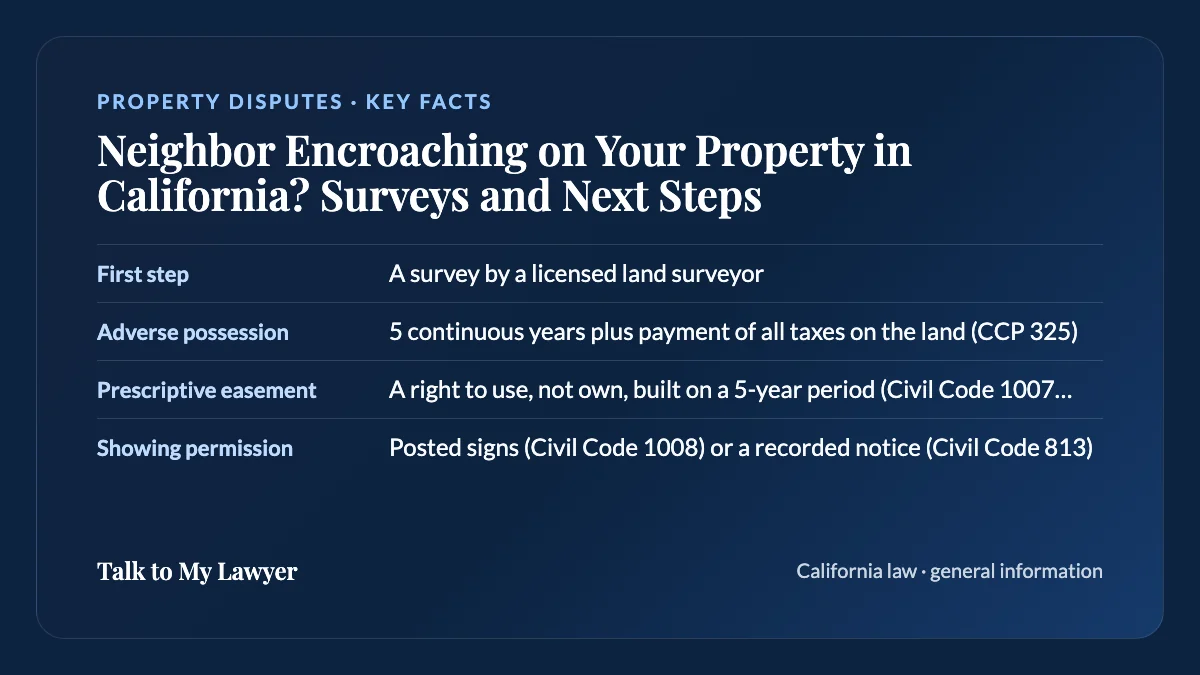
At a glance
- First step
- A survey by a licensed land surveyor
- Adverse possession
- 5 continuous years plus payment of all taxes on the land (CCP 325)
- Prescriptive easement
- A right to use, not own, built on a 5-year period (Civil Code 1007; CCP 321)
- Showing permission
- Posted signs (Civil Code 1008) or a recorded notice (Civil Code 813)
- Damages for occupation
- Value of use for up to 5 years, plus restoration costs (Civil Code 3334)
What counts as an encroachment in California?
An encroachment is anything a neighbor builds, places or keeps on your land without a right to do so. Civil Code section 829 gives a landowner the right to the surface and to everything permanently situated beneath or above it, so an encroachment can be at ground level, underground or overhead.
- Fences, block walls and retaining walls built over the line.
- Patios, driveways, sheds, decks and pool equipment.
- Roof eaves, gutters and upper-story overhangs.
- Planters, irrigation lines and buried utility runs.
- Regular use, such as a neighbor driving across a corner of your lot to reach their garage.
Branches and roots follow their own rules; see our guide to neighbor tree disputes for those.
Why does a survey come before the letter?
A survey tells you where the line actually runs. An old fence, a hedge, or the neighbor's memory of where a prior owner put stakes is not the boundary.
Hire a licensed land surveyor, ask for a written survey or marked corners, and photograph the stakes with the encroachment in frame. If the neighbor produces their own survey showing a different line, the disagreement between the two surveys becomes the real issue, and your letter should say so.
Can a neighbor take your land by adverse possession in California?
Only under strict conditions. Adverse possession lets someone gain title by occupying land openly and against the owner's rights for a set period. Code of Civil Procedure section 325 requires that the land have been occupied and claimed for five years continuously, and that the claimant and their predecessors timely paid all state, county or municipal taxes levied and assessed on the land during those five years.
When the claim is not based on a deed or other written instrument, the land counts as possessed only if it was protected by a substantial enclosure, or was usually cultivated or improved. Tax payment must be shown by certified records of the county tax collector.
That tax rule matters in a backyard dispute. A strip along your side of the line is normally assessed to you as part of your parcel, so a neighbor who has used it for years may argue for a prescriptive easement instead, which is a narrower right with different requirements.
What is a prescriptive easement, and how do you prevent one?
A prescriptive easement is a right to keep using another person's land in a specific way, such as a path or a shared driveway, earned through long use rather than granted by deed. Civil Code section 1007 recognizes title by prescription after occupancy for the period that bars recovery under the Code of Civil Procedure, and section 321 of that code uses a five-year period for real property.
| Adverse possession | Prescriptive easement | |
|---|---|---|
| What the neighbor gains | Ownership of the land | A right to use it in a specific way |
| Time period | 5 continuous years | 5 years of adverse use |
| Key statutes | CCP 325 and 321 | Civil Code 1007; CCP 321 |
| Typical example | A fenced-in strip treated as the neighbor's yard | A neighbor's regular shortcut across your driveway |
Permission defeats both claims, because permissive use is not adverse. California gives owners two formal tools:
- Signs. Under Civil Code section 1008, no use ripens into a prescriptive easement if the owner posts, at each entrance or at intervals of no more than 200 feet along the boundary, a sign reading substantially: "Right to pass by permission, and subject to control, of owner: Section 1008, Civil Code."
- A recorded notice. Civil Code section 813 lets the record owner record a notice that use of the land is by permission. For use by anyone other than the general public, the notice must also be served on the user by registered mail to be effective, and recording does not affect rights that already vested.
A letter giving written, revocable permission for one specific use can serve a similar purpose between neighbors. Have a lawyer word it, since a loosely drafted permission letter can read like a grant of rights.
What can you ask an encroaching neighbor to do?
You can ask the neighbor to remove the encroachment, to sign a written agreement that recognizes your ownership, to buy the strip, or to compensate you.
- Remove it. Move the fence, cut back the eave or relocate the shed by a set date.
- An encroachment agreement or license. The structure stays for now, but the neighbor acknowledges your title and that it remains by your permission.
- Sell or adjust the line. A sale of the strip, or a lot line adjustment through your city or county, typically with a new survey and recorded documents.
- Compensation. Civil Code section 3334 counts the value of the use of the land for up to five years before suit, the reasonable cost of restoring it, and the costs of recovering possession. When the occupation came from a mistake of fact, the value of use is the reasonable rental value.
A neighbor who built in good faith, believing the land was theirs, may ask a court for relief as a good faith improver under Code of Civil Procedure section 871.1 and the sections that follow. That possibility is one reason to consider a negotiated solution when the mistake looks honest.
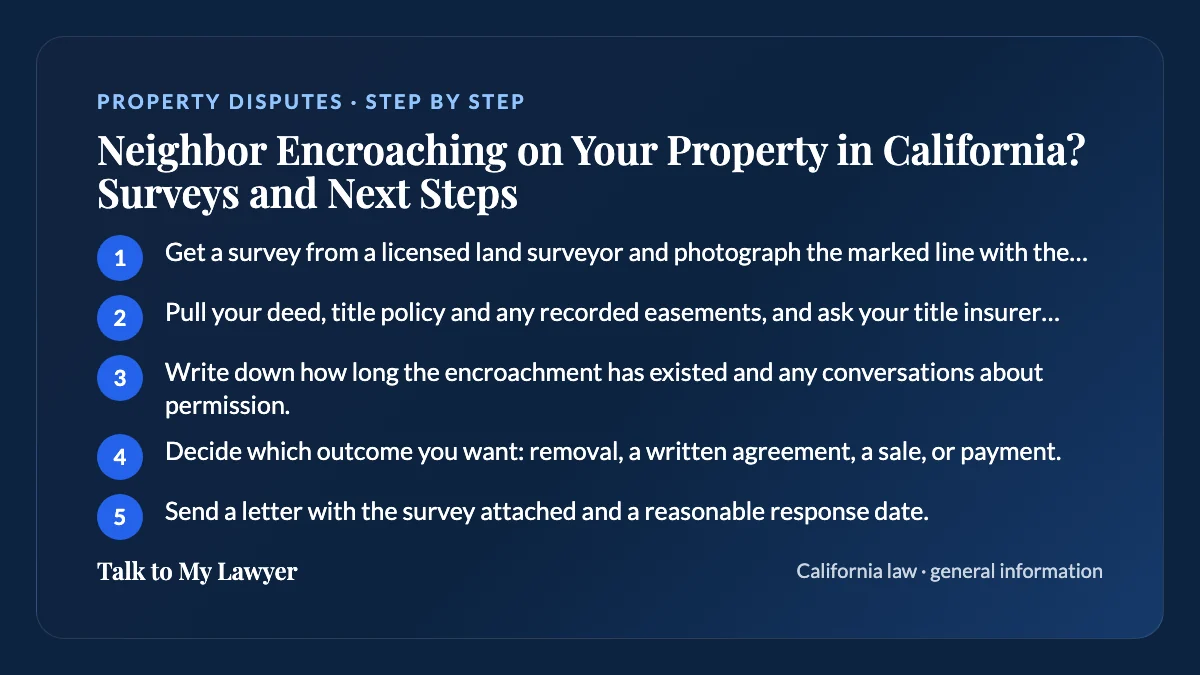
Steps when a neighbor's structure crosses the line
- Get a survey from a licensed land surveyor and photograph the marked line with the encroachment.
- Pull your deed, title policy and any recorded easements, and ask your title insurer whether your policy covers boundary issues.
- Write down how long the encroachment has existed and any conversations about permission.
- Decide which outcome you want: removal, a written agreement, a sale, or payment.
- Send a letter with the survey attached and a reasonable response date.
- If the neighbor uses part of your land, document permission in writing or use the section 1008 sign or section 813 notice.
- If no agreement is possible, talk to a real estate lawyer about a quiet title or trespass case.
A survey by Coastline Land Surveying dated March 3, copy enclosed, shows that the block wall and concrete patio completed at your home last fall extend about two feet onto my lot at 27 Harbor View Drive. I am not willing to give up that strip. Please contact me by April 15 to agree on one of two paths: removing the wall and patio from my property by June 30, or signing a written encroachment agreement confirming my ownership and that the wall remains only with my permission.
What if the neighbor refuses to move the encroachment?
If the neighbor refuses, the dispute generally moves to superior court. Code of Civil Procedure section 760.020 allows an action to quiet title, which asks the court to establish title against adverse claims to real property. Trespass and ejectment claims can ask for removal and damages.
Small claims court decides money claims up to $12,500 for individuals and can grant an injunction only where a statute expressly allows it, so ownership and removal disputes generally belong in superior court.
Timing matters. A lawsuit for trespass upon or injury to real property generally carries a three-year deadline (Code of Civil Procedure section 338(b)), and adverse possession and prescription both run on five-year periods. A dated letter is one clear record of when you objected. If the neighbor's use also involves people crossing your land, our guide to a cease and desist letter for trespassing covers that side.
Why boundary letters benefit from a lawyer's drafting
Boundary letters can later be read by title companies, surveyors, lenders and future buyers as well as the neighbor, so the wording about permission and ownership matters. Having a lawyer draft it makes sense when the encroachment is a permanent structure, when the neighbor says the land is theirs, when an easement or old agreement appears in the record, or when you want to allow a use without giving up rights.
Through Talk to My Lawyer, a licensed California attorney writes your letter from your survey, deed and photos, and sends it on your behalf. For advice on quiet title or a recorded agreement, talk to a real estate lawyer about your facts.
Frequently asked questions
How long does a neighbor have to use my land before claiming it in California?
Five years. Adverse possession under Code of Civil Procedure section 325 needs five years of continuous occupation and claim, plus timely payment of all taxes assessed on the land for those years, shown by certified county tax records. A prescriptive easement, which is a right of use rather than ownership, also relies on a five-year period. Your permission defeats both.
Can I remove my neighbor's fence if it is on my property?
Removing a structure yourself can lead to claims for property damage and escalate the dispute, especially when the line is contested or the neighbor has their own survey. A survey, a written demand and a court order if one becomes necessary are the more orderly path. Talk to a lawyer before taking down anything a neighbor built, even if you believe it sits on your land.
What is a quiet title action in California?
A quiet title action is a lawsuit asking a court to establish who holds title to real property against someone else's adverse claim. It is authorized by Code of Civil Procedure section 760.020 and filed in superior court. In a boundary dispute it can settle where the line runs and whether a neighbor has any ownership or easement rights in the disputed strip.
Does title insurance cover a neighbor's encroachment?
It depends on the policy. Some owner's policies cover certain boundary and survey matters, while others exclude problems an accurate survey would have revealed. Read the exclusions and schedules in your policy, and send the insurer a written notice of claim with the survey attached. Its answer may affect who pays to resolve the encroachment.
Can I let my neighbor use my land without losing it?
Yes. Permissive use is not adverse, so it does not ripen into title or a prescriptive easement. California offers formal tools: permission signs under Civil Code section 1008, and a recorded notice under section 813 that must also be served by registered mail on a specific user. A written, revocable license between neighbors, drafted by a lawyer, is another option.
Sources
Checked against these official sources on October 18, 2026.
- California Code of Civil Procedure section 325 (California Legislative Information)
- California Code of Civil Procedure section 321 (California Legislative Information)
- California Civil Code section 1008 (California Legislative Information)
- California Civil Code section 813 (California Legislative Information)
- California Civil Code section 3334 (California Legislative Information)
- California Code of Civil Procedure section 760.020 (California Legislative Information)
This guide explains California law in general terms as of October 2026. It is general information, not legal advice for your situation, and local rules can add to it.
Join the email list and get a lawyer letter started
With Talk to My Lawyer, a licensed California attorney writes your letter from your facts and documents and sends it on your behalf. Join the Talk to My Lawyer email list for letter checklists, document prompts, and reminders before you start your letter.