Quick answer
California's Good Neighbor Fence Act (Civil Code section 841) presumes adjoining landowners benefit equally from a dividing fence and share equally in the reasonable costs of building, maintaining or replacing it, unless they agreed otherwise in writing. Before incurring costs, you must give each neighbor 30 days' written notice describing the problem, the proposed solution, estimated costs, the cost split and a timeline.
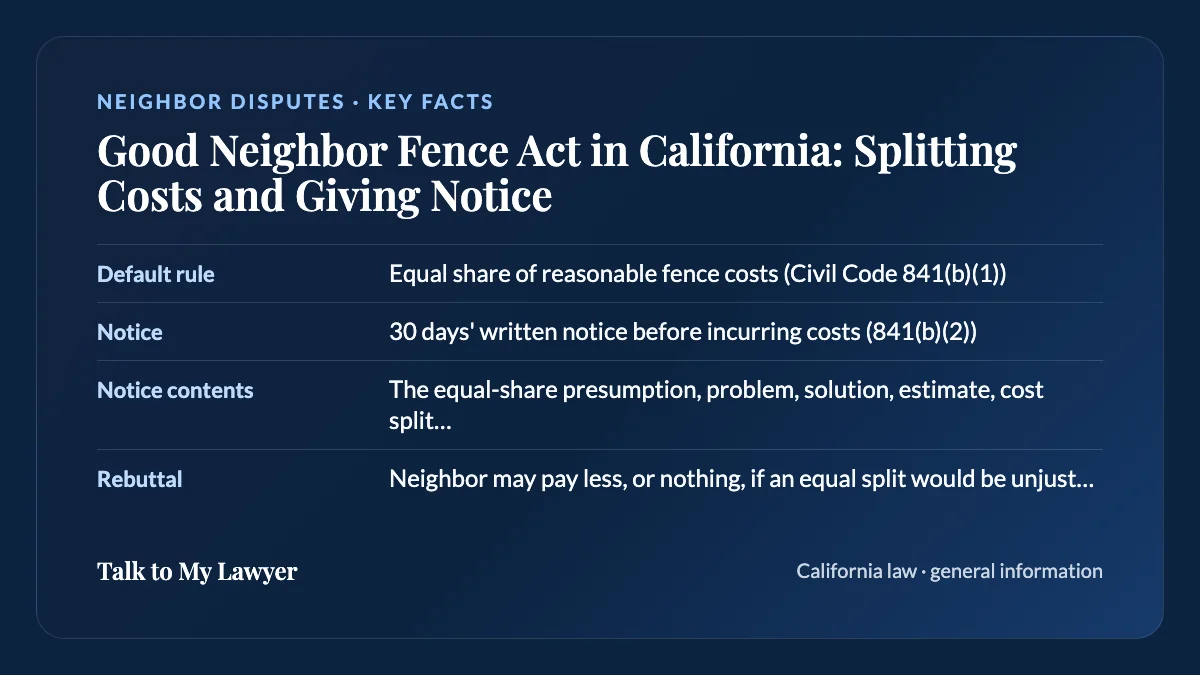
At a glance
- Default rule
- Equal share of reasonable fence costs (Civil Code 841(b)(1))
- Notice
- 30 days' written notice before incurring costs (841(b)(2))
- Notice contents
- The equal-share presumption, problem, solution, estimate, cost split and timeline
- Rebuttal
- Neighbor may pay less, or nothing, if an equal split would be unjust (841(b)(3), (4))
- Spite fence
- Over 10 feet, unnecessary and malicious, is a private nuisance (841.4)
What does the Good Neighbor Fence Act require?
The Good Neighbor Fence Act requires adjoining landowners to share equally in maintaining the boundaries and monuments between them, and presumes they share equally in the reasonable cost of a dividing fence. The rule sits in Civil Code section 841, rewritten by AB 1404 and in effect since January 1, 2014.
- Who it covers. A "landowner" is a private person or entity that lawfully holds any possessory interest in real property. Cities, counties, districts and other public agencies are excluded.
- Who counts as adjoining. Properties that are contiguous to or in contact with each other.
- What it covers. The reasonable costs of construction, maintenance or necessary replacement of a fence dividing the two properties.
- Written agreements control. If you and your neighbor signed a written agreement splitting costs another way, the presumption gives way to it.
The presumption is a starting point, not an invoice. It gives you a legal basis to ask for half of a reasonable cost, and it gives your neighbor a defined way to argue for less.
What must a 30-day fence notice include?
A 30-day fence notice must be in writing and go to each affected neighbor at least 30 days before you incur costs. Section 841(b)(2) lists its required contents:
- Notice of the presumption that adjoining owners are equally responsible for reasonable fence costs.
- A description of the problem facing the shared fence.
- The proposed solution.
- The estimated construction or maintenance cost.
- The proposed cost-sharing approach.
- The proposed timeline.
In practice the notice is your first letter. A missing item hands your neighbor an easy objection, so attach the contractor's quote and a photo of the problem.
Under California Civil Code section 841, adjoining landowners are presumed to share equally in the reasonable costs of maintaining or replacing a fence that divides their properties. The 62-foot wood fence between our lots at 410 and 412 Alder Lane has three broken posts and is leaning into your side yard (photos enclosed). I propose replacing it with a 6-foot redwood fence on the same line. The enclosed quote from Pine Valley Fence is $6,820. I propose that we each pay half, $3,410, with work to begin no earlier than June 20, which is more than 30 days after this notice. Please tell me by June 10 whether you agree or would like to discuss another option.
When can a neighbor pay less than half of a fence?
A neighbor can pay less than half, or nothing, by showing that an equal split would be unjust. The standard is a preponderance of the evidence, and section 841(b)(3) lists what the court must consider:
| Factor in section 841(b)(3) | How it might look in a dispute |
|---|---|
| Burden substantially disproportionate to the benefit | The fence mainly encloses your dog run, while the neighbor's side is an unused slope |
| Cost exceeds the difference in property value | A custom masonry wall that costs more than it adds to the property |
| Undue financial hardship, shown by reasonable proof | A neighbor on a fixed income who documents their finances |
| Unnecessary or excessive costs | A quote far above comparable bids, or work beyond what the problem requires |
| Personal aesthetic, architectural or other preferences | Upgrading from wood to wrought iron because you prefer the look |
| Other equitable factors | Anything else that makes an equal split unfair on the facts |
If the neighbor rebuts the presumption, the court in its discretion may order a contribution of less than half, or no contribution, consistent with that neighbor's circumstances (section 841(b)(4)).
Example: how a replacement fence might be split
Example (hypothetical): two neighbors share a failing 70-foot wood fence. One of them gathers quotes: $7,000 for a like-for-like wood fence, and $11,200 for a stucco-and-wood design she prefers.
- A 30-day notice built on the $7,000 option supports a request for $3,500, matching the presumption.
- A notice built on the $11,200 option invites the argument that $4,200 of the cost reflects personal aesthetic preference.
- A middle path is to ask for half of the like-for-like cost and pay for the upgrade yourself: $3,500 from the neighbor and $7,700 from you.
The figures are illustrative. What counts as reasonable depends on local prices and the condition of the existing fence.
What is a spite fence in California?
A spite fence is a fence, or a structure in the nature of a fence, that unnecessarily exceeds 10 feet in height and is maliciously built or kept to annoy the neighbor. Civil Code section 841.4 declares it a private nuisance, and a neighbor whose comfort or enjoyment of their property is harmed may use the Civil Code's nuisance remedies against its continuance.
Each element matters: taller than 10 feet, unnecessary, and malicious. A tall screen built for privacy or noise may not qualify, and a structure 10 feet or shorter falls outside this section, though a city ordinance may still regulate it.
Do HOA and city rules change the fence rules?
They can add requirements. Cities set their own fence height limits and permit rules, and those vary from one city to the next. In a common interest development, the HOA may also require approval before you change a fence.
Where governing documents require approval, Civil Code section 4765 requires the association to use a fair, reasonable and expeditious procedure with prompt deadlines and to decide in good faith, not unreasonably, arbitrarily or capriciously. The decision must be in writing, and a denial must explain why and describe how to ask the board to reconsider at an open meeting. For a dispute with the association itself, see our guide to an HOA dispute demand letter.
Steps for a shared fence dispute
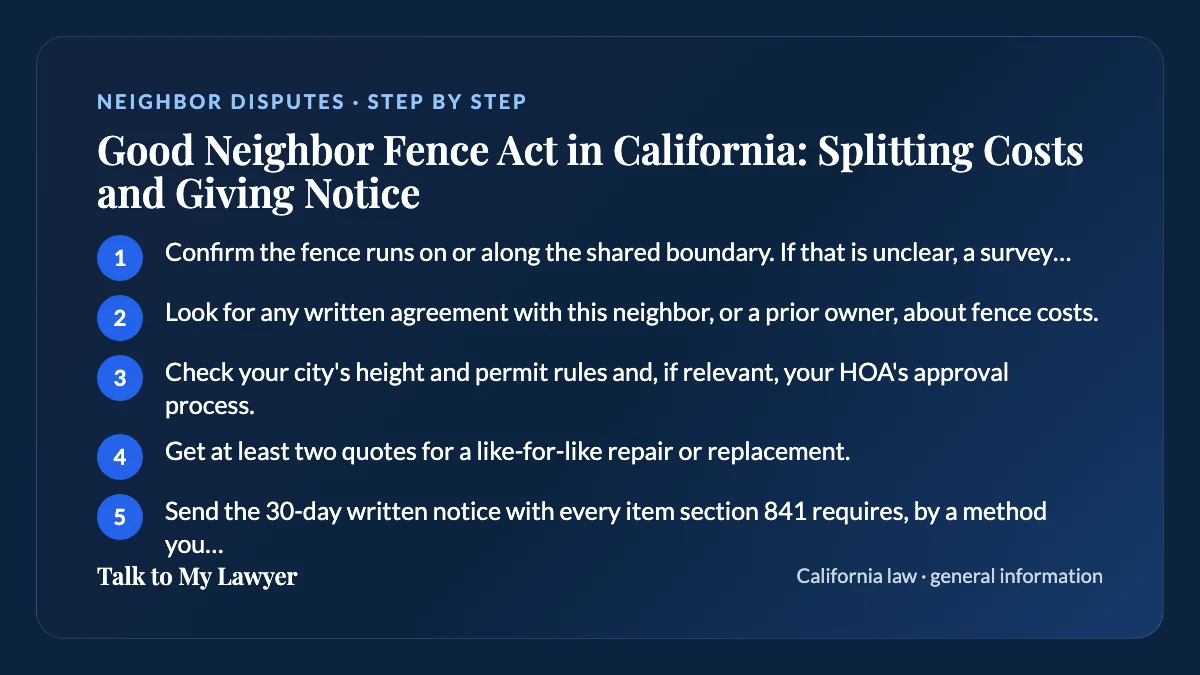
- Confirm the fence runs on or along the shared boundary. If that is unclear, a survey settles where the line is.
- Look for any written agreement with this neighbor, or a prior owner, about fence costs.
- Check your city's height and permit rules and, if relevant, your HOA's approval process.
- Get at least two quotes for a like-for-like repair or replacement.
- Send the 30-day written notice with every item section 841(b)(2) requires, by a method you can prove.
- Wait the full 30 days and keep a record of any response.
- After the work, send an invoice for the agreed or presumed share with the paid receipt attached.
- If the neighbor still will not pay, consider mediation or small claims court, where individuals can claim up to $12,500.
Before a small claims filing, the court expects you to have asked the other side to pay, and the notice and invoice show that you did. Our guide to writing a demand letter before small claims walks through the filing.
Putting an attorney's name on a fence notice
A fence notice is a statutory document as much as a letter, and it has to cover every item in section 841(b)(2) to do its job. Having an attorney write it can make sense when the fence is expensive, when the boundary itself is in doubt, when an HOA or city approval is tangled up with the project, or when the neighbor has already said they will not contribute.
Through Talk to My Lawyer, a licensed California attorney writes your notice or demand letter from your quotes, photos and any survey, and sends it on your behalf. For questions about rebutting the presumption or bringing a spite fence claim, talk to a lawyer about your facts.
Frequently asked questions
Does my neighbor have to pay half of a fence in California?
Under Civil Code section 841, adjoining landowners are presumed to share equally in the reasonable costs of building, maintaining or replacing a dividing fence, unless a written agreement says otherwise. Your neighbor can rebut that presumption by showing an equal split would be unjust, for example because the cost is excessive, reflects your aesthetic preferences, or would cause them undue financial hardship.
What happens if I replace a shared fence without giving 30 days' notice?
Section 841(b)(2) says a landowner who intends to incur fence costs shall give 30 days' prior written notice with specific contents. Skipping that step gives your neighbor a ready argument against contributing, and a court may weigh it when deciding what, if anything, they owe. If the work is already finished, talk to a lawyer about whether and how to ask for a share.
Can my neighbor build a 10-foot fence in California?
City zoning codes set fence height limits, and they vary by city, so start there. Separately, Civil Code section 841.4 makes a fence that unnecessarily exceeds 10 feet and is built or kept maliciously to annoy a neighbor a private nuisance. Check your city code and any HOA rules for the limits that apply to your lot before raising the issue.
Does the Good Neighbor Fence Act apply to renters?
The statute defines landowner as a private person or entity that lawfully holds any possessory interest in real property, which is broader than the owner on title. How that applies to a tenant, and whether a lease shifts fence costs to the landlord or the tenant, depends on the facts and the lease. A renter asked to share a fence cost should check with their landlord and a lawyer first.
Who owns the fence between two properties in California?
Section 841 speaks to shared responsibility for a fence dividing two properties rather than to who owns it. A fence on the boundary is presumed to benefit both owners equally. If a fence sits wholly on one lot, or the boundary itself is disputed, a survey and your deeds will matter, and the question may become an encroachment issue rather than a cost-sharing one.
Sources
Checked against these official sources on October 18, 2026.
- California Civil Code section 841 (California Legislative Information)
- California Civil Code section 841.4 (California Legislative Information)
- California Civil Code section 4765 (California Legislative Information)
- California Code of Civil Procedure section 116.221 (California Legislative Information)
- Ask for the money (California Courts Self-Help Guide)
This guide explains California law in general terms as of October 2026. It is general information, not legal advice for your situation, and local rules can add to it.
Join the email list and get a lawyer letter started
With Talk to My Lawyer, a licensed California attorney writes your letter from your facts and documents and sends it on your behalf. Join the Talk to My Lawyer email list for letter checklists, document prompts, and reminders before you start your letter.