Quick answer
In a California neighbor tree dispute, ownership follows the trunk. A tree whose trunk stands wholly on one lot belongs to that owner even if roots or branches cross the line (Civil Code section 833), and a trunk straddling the line is owned in common (section 834). Wrongfully cutting or injuring another person's tree can bring triple damages, or double damages if the trespass was casual or involuntary (section 3346).
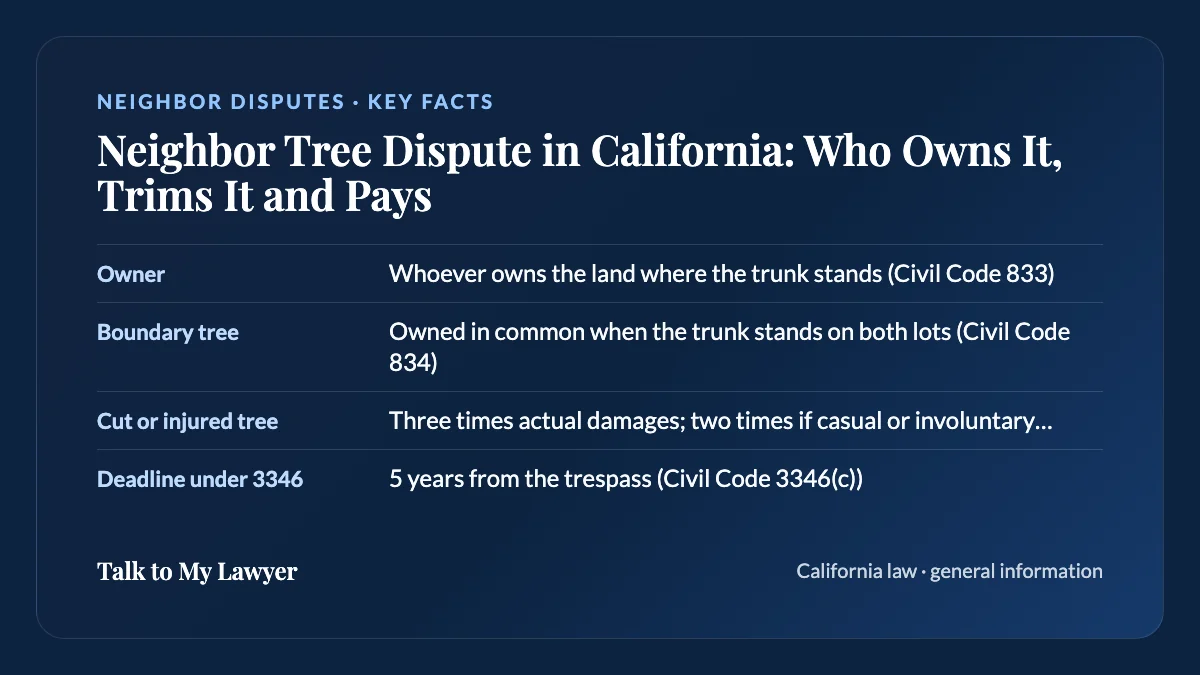
At a glance
- Owner
- Whoever owns the land where the trunk stands (Civil Code 833)
- Boundary tree
- Owned in common when the trunk stands on both lots (Civil Code 834)
- Cut or injured tree
- Three times actual damages; two times if casual or involuntary (Civil Code 3346(a))
- Deadline under 3346
- 5 years from the trespass (Civil Code 3346(c))
- Small claims
- Up to $12,500 for individuals; excess can be waived (CCP 116.220(d), 116.221)
Who owns a tree on or near the property line?
The owner of the ground under the trunk owns the tree. Civil Code section 833 says trees whose trunks stand wholly on one owner's land belong exclusively to that owner, "although their roots grow into the land of another." When the trunk stands partly on two lots, section 834 makes the neighbors owners in common.
| Where the trunk stands | Who owns the tree | Practical effect |
|---|---|---|
| Wholly on your neighbor's lot | Your neighbor | Branches and roots that reach your yard are still part of the neighbor's tree |
| Wholly on your lot | You | You are responsible for its care, including the parts hanging over the fence |
| Straddling the line | Both of you, in common | Neither owner should remove or heavily cut it without the other's agreement |
If you are unsure where the line runs, a survey answers that. Our guide to property line encroachment explains how surveys fit into boundary disputes.
Can you trim a neighbor's tree branches or roots in California?
Generally, yes, back to the property line, provided you do not kill or seriously damage the tree. California case law recognizes a landowner's right to cut back branches and roots that cross onto their land, consistent with Civil Code section 829, which gives a landowner rights in the surface of their land and in what lies permanently above and below it.
The right has limits:
- Stay on your side. Trimming from your own yard is one thing. Entering the neighbor's yard, or climbing the tree from their side, without permission is a trespass.
- Do not kill the tree. California courts have held neighbors liable when cutting roots or branches harmed a tree's health or stability, even though the cutting took place on the cutter's own land.
- Boundary trees are shared. A tree owned in common under section 834 is not yours alone to take down.
- Check local rules. Some cities protect oaks, heritage trees or other designated trees and require a permit before significant cutting or removal.
A certified arborist's written plan before major root or limb work can help either way, because it records that the work was planned to keep the tree healthy.
What if your neighbor cut down or damaged your tree?
Civil Code section 3346 sets a penalty measure for wrongful injury to or removal of trees on another person's land: three times the amount that would compensate for the actual loss. The multiplier drops to two when the trespass was casual or involuntary, or when the person had probable cause to believe the land was their own.
Code of Civil Procedure section 733 separately makes a person who cuts down or injures a tree on another's land without lawful authority liable for treble damages. Willfully cutting or injuring timber growing on another person's land can also be a misdemeanor under Penal Code section 602(a).
- Survey defense. Under section 3346(b), damages are limited to the actual loss when the cutting relied on a licensed land surveyor's survey that misplaced the boundary, and the person (or their principal, lessor or immediate predecessor in title) had the survey made.
- Deadline. A claim for damages under section 3346 must be filed within five years of the trespass. Related claims can run on shorter clocks, such as three years for injury to real property under Code of Civil Procedure section 338(b), so the five-year figure is not a reason to wait.
Example (hypothetical): a neighbor's landscaper removes a mature pine that stood entirely on your lot. An arborist values the loss, including stump removal and a replacement tree, at $5,500.
| Measure under section 3346 | Amount | When it applies |
|---|---|---|
| Actual detriment | $5,500 | Starting figure, and the cap if the survey defense applies |
| Double damages | $11,000 | Trespass was casual or involuntary, or the neighbor reasonably believed the land was theirs |
| Triple damages | $16,500 | Other wrongful cutting or injury |
A triple-damages figure of $16,500 is above the $12,500 cap that applies to individuals in small claims. You can waive the excess and stay in small claims (Code of Civil Procedure section 116.220(d)) or file in superior court. Which multiplier applies is for the court to decide on the facts.
Who pays when a neighbor's tree damages your property?
The neighbor may be responsible if they failed to use ordinary care in managing the tree. Civil Code section 1714 makes everyone responsible for injury caused by a want of ordinary care or skill in the management of their property.
- Falling limbs and trees. A dead or visibly decaying tree is a different case from a healthy tree that came down in an extreme storm. Written warnings you sent before the failure can show the owner knew of the risk.
- Roots. Roots that crack a foundation, wall or sewer line can support a negligence claim, and sometimes a nuisance claim. Civil Code section 3479 defines a nuisance to include an obstruction to the free use of property that interferes with its comfortable enjoyment.
- Insurance. Your homeowner's policy may pay for some tree damage and then pursue the neighbor. Report the loss to your insurer before you settle anything directly.
Can a neighbor's tree block your view?
Only if a local rule or private agreement says so. State law does not give California homeowners a general right to a view or to sunlight across a neighbor's land, so view disputes turn on city ordinances, homeowners association covenants and recorded agreements.
Some California cities have adopted view or tree ordinances that set out a process for asking a neighbor to trim, sometimes with mediation as a first step. If you live in a planned development, the CC&Rs may cap tree heights or require trimming. Pull both before you write, and quote the exact provision.
Steps to take before you write to your neighbor
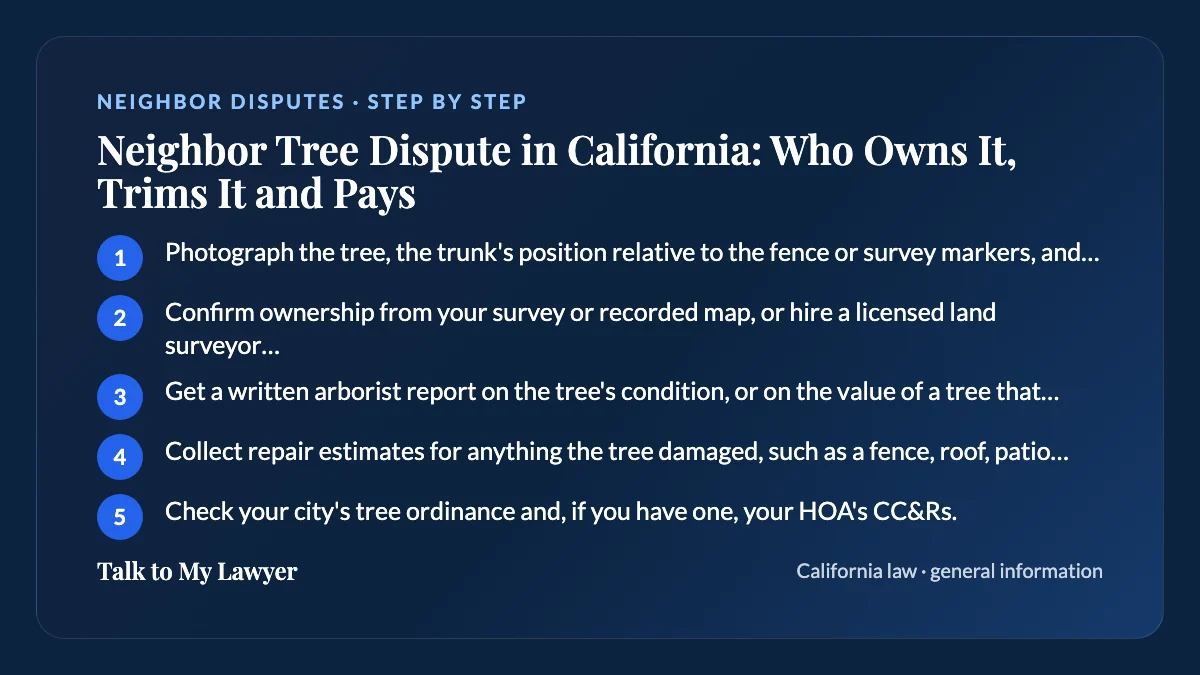
- Photograph the tree, the trunk's position relative to the fence or survey markers, and any damage, with dates.
- Confirm ownership from your survey or recorded map, or hire a licensed land surveyor if the trunk is close to the line.
- Get a written arborist report on the tree's condition, or on the value of a tree that was cut.
- Collect repair estimates for anything the tree damaged, such as a fence, roof, patio or sewer line.
- Check your city's tree ordinance and, if you have one, your HOA's CC&Rs.
- Notify your insurer if there is property damage.
- Write the letter, ask for one specific thing, and give a reasonable response date.
Sample wording for a neighbor tree letter
A tree letter reads most clearly when it asks for one concrete thing: trim a limb, remove a dead tree, pay for a crushed fence, or compensate for a tree that was cut. Two short examples follow.
The large eucalyptus whose trunk stands on your lot at 18 Ridge Road has a dead limb, roughly 30 feet long, hanging over my garage roof. The enclosed arborist report dated May 6 rates that limb at high risk of failure. Please arrange for a licensed tree service to remove it by June 15. Your crew is welcome to use my side gate for access.
On April 12, a crew working for you cut down the Monterey pine that stood entirely on my property, as shown on the enclosed survey. The enclosed arborist report values the loss at $5,500. Under California Civil Code section 3346, damages for wrongful removal of a tree on another person's land can be two or three times the actual loss. I am asking for $5,500 by May 20 to resolve this without a court claim.
If the neighbor ignores the letter, small claims court is available for claims up to $12,500. Our guide to preparing a demand before a small claims filing covers the filing steps.
When a tree claim is worth an attorney's letter
Tree cases can carry double or triple damages, which raises the stakes on both sides of the fence and can bring insurers and tree services into the conversation. A lawyer-written letter can help when a valuable tree was removed, when a contractor or tree company shares responsibility, when the trunk sits near an uncertain boundary, or when you will live next to this neighbor for years and want the facts set down once, carefully.
Through Talk to My Lawyer, a licensed California attorney writes your letter from your survey, arborist report, photos and estimates, and sends it on your behalf to your neighbor and any tree service involved. For advice on which damages measure fits your facts, talk to a lawyer about your situation.
Frequently asked questions
Can I cut my neighbor's tree branches that hang over my yard in California?
Generally you may trim branches and roots back to the property line from your own side, at your own cost, as long as the cutting does not kill or seriously damage the tree. You may not enter your neighbor's land to do it without permission, and a tree whose trunk straddles the line is jointly owned. Check for a local protected tree ordinance before you start.
Who pays to trim a tree that hangs over the property line?
The tree's owner is responsible for its care, and you may trim growth that crosses onto your land at your own expense. Sharing the cost of trimming one neighbor wants and the other does not is a matter for agreement, a local ordinance or CC&Rs. The picture changes when the tree is dead or dangerous, since the owner's duty of ordinary care may make them responsible for damage it causes.
What is the penalty for cutting down a neighbor's tree in California?
Civil Code section 3346 sets damages at three times the actual loss for wrongful injury to or removal of trees on another's land, or two times when the trespass was casual or involuntary or the person reasonably believed the land was theirs. Reliance on a faulty licensed survey can limit damages to the actual loss. Code of Civil Procedure section 733 also provides treble damages, and willful cutting can be a misdemeanor.
Is my neighbor responsible if their tree falls on my house?
It depends on whether the owner failed to use ordinary care. A healthy tree that falls in an unusual storm is treated differently from a dead or leaning tree the owner had been warned about. Your homeowner's insurer may pay first and pursue the neighbor afterward. Keep photos, an arborist's opinion on the tree's condition, and copies of any earlier warnings you sent.
Do I have a right to a view in California?
Not as a general rule of state law. View rights in California come from local view or tree ordinances, homeowners association covenants, or recorded agreements such as view easements. If one of those applies, it will set out what can be required, who pays, and any mediation step. Without one, a neighbor's tree that blocks a view is generally not something you can force them to trim.
Sources
Checked against these official sources on October 18, 2026.
- California Civil Code section 833 (California Legislative Information)
- California Civil Code section 834 (California Legislative Information)
- California Civil Code section 3346 (California Legislative Information)
- California Code of Civil Procedure section 733 (California Legislative Information)
- California Civil Code section 1714 (California Legislative Information)
- California Code of Civil Procedure section 116.220 (California Legislative Information)
This guide explains California law in general terms as of October 2026. It is general information, not legal advice for your situation, and local rules can add to it.
Join the email list and get a lawyer letter started
With Talk to My Lawyer, a licensed California attorney writes your letter from your facts and documents and sends it on your behalf. Join the Talk to My Lawyer email list for letter checklists, document prompts, and reminders before you start your letter.