Quick answer
For neighbor water runoff damage in California, courts apply the reasonableness rule from the 1966 Supreme Court case Keys v. Romley: an uphill owner who fails to take reasonable care with surface water can be liable to the downhill neighbor, who must also take reasonable precautions. Leaks are judged under ordinary negligence (Civil Code section 1714), and repeated flows can be a nuisance.
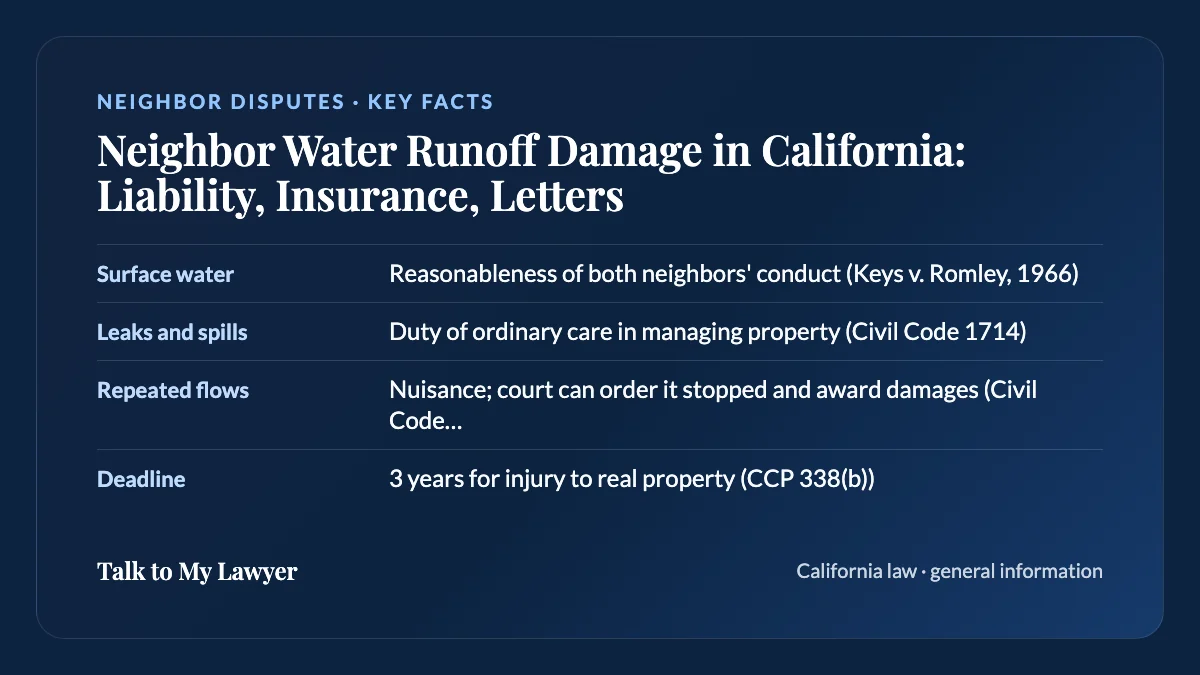
At a glance
- Surface water
- Reasonableness of both neighbors' conduct (Keys v. Romley, 1966)
- Leaks and spills
- Duty of ordinary care in managing property (Civil Code 1714)
- Repeated flows
- Nuisance; court can order it stopped and award damages (Civil Code 3479; CCP 731)
- Deadline
- 3 years for injury to real property (CCP 338(b))
- Insurance
- Homeowners policies cover some water damage but not flood (Department of Insurance)
Is a neighbor liable for water runoff in California?
A neighbor can be liable for water runoff in California if they failed to take reasonable care in handling surface water and that failure damaged your property. In Keys v. Romley (1966), the California Supreme Court replaced older, rigid surface water rules with a test of reasonableness that applies to both neighbors.
Reasonableness is decided on the facts of each case. The practical questions include:
- The amount of harm the water caused.
- Whether that harm was foreseeable.
- The purpose or motive behind the neighbor's use of their land.
- Whether the usefulness of the neighbor's use outweighs the seriousness of the harm to yours.
The rule runs in both directions: the neighbor on the receiving end is also expected to take reasonable precautions. If your own grading, a blocked drain or a missing gutter contributed, expect that to come up.
Runoff, leaks or nuisance: which rule fits your damage?
| What happened | Main legal theory | Key question |
|---|---|---|
| Neighbor regraded, paved or added downspouts, and storm runoff now reaches you | Surface water reasonableness rule | Was the change, and how it drains, reasonable? |
| Neighbor's pipe, irrigation line, pool or water heater leaked | Negligence (Civil Code 1714) | Did they fail to use ordinary care in managing their property? |
| Water arrives every time it rains or the sprinklers run | Nuisance (Civil Code 3479) | Does it obstruct the free use of your property and interfere with its enjoyment? |
| Water came through a shared wall, floor or common pipe in a condo | Governing documents plus negligence | Who maintains that component under the CC&Rs? |
One event can fit more than one row. A cracked irrigation line that soaks a slope every night is a leak and, while it continues, may also be a nuisance.
Should you go through insurance first?
If the damage is substantial, report it to your insurer early. The California Department of Insurance explains that homeowners policies do not cover flood damage but do cover other kinds of water damage, and that the deductible is the portion of the loss you pay before the insurer begins to pay.
- Protect the property. The Department says insurers reimburse reasonable costs to protect your property, and suggests saving receipts and holding off on extensive permanent repairs until the adjuster has inspected.
- Subrogation. If your insurer pays, it may pursue the neighbor or the neighbor's insurer to recover what it paid, a process called subrogation. Ask how your deductible is handled, since that may be the part you still need to recover yourself.
- Their policy. Your letter can ask the neighbor to forward it to their homeowner's insurer and share the claim number.
For a dispute with an insurer over the claim itself, see our guide to a property damage insurance demand letter.
Evidence that shows where the water came from
Water claims turn on causation: showing the water came from the neighbor's land, and why. Useful evidence includes:
- Video of water flowing from their lot onto yours during a storm, with the date visible.
- Before-and-after photos of the neighbor's grading, paving, retaining wall or downspouts.
- Building permit records for the neighbor's project from your city or county.
- A drainage engineer's or contractor's written opinion on the cause.
- A plumber's leak detection report when a pipe or line is suspected.
- Moisture readings or photos that show when the problem started.
- Repair estimates and invoices, plus receipts for pumps, sandbags or drying.
The evidence checklist for demand letters shows how to label and attach these so the reader can follow them.
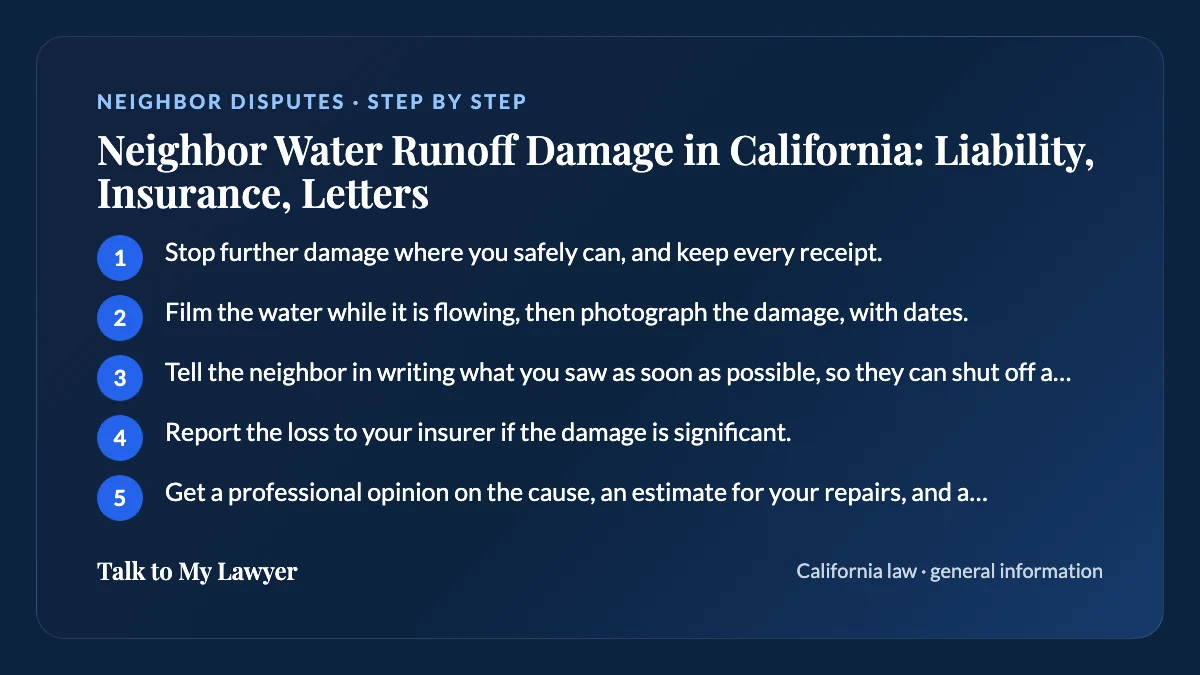
Steps to take after water damage from a neighbor's property
- Stop further damage where you safely can, and keep every receipt.
- Film the water while it is flowing, then photograph the damage, with dates.
- Tell the neighbor in writing what you saw as soon as possible, so they can shut off a leak or clear a drain.
- Report the loss to your insurer if the damage is significant.
- Get a professional opinion on the cause, an estimate for your repairs, and a description of the fix needed on the neighbor's side.
- Send a demand letter asking for repair costs and a permanent fix by set dates.
- If the problem continues, keep a dated log of each event.
What should a water damage letter ask your neighbor to do?
A water damage letter can ask for two things: payment for the harm already done, and a change that stops the water at its source. Code of Civil Procedure section 731 lets a person whose property is harmed by a nuisance sue to have it enjoined or abated and to recover damages, which is why asking for both is reasonable.
Since your backyard was regraded and paved in August, storm runoff from your lot has flowed through the side yard into my garage on October 4, November 12 and November 30 (video enclosed). The enclosed report from Valley Drainage Services identifies the new slope and the downspout outlet at the property line as the source. Repairs to my garage floor and drywall are estimated at $4,860. Please pay that amount by January 10, and confirm in writing by the same date how and when you will redirect the runoff, for example by installing a drain line to the street.
If your insurer is handling part of the loss, tell the insurer before you send any letter that offers to settle.
How long do you have to sue for neighbor water damage?
Generally three years. Code of Civil Procedure section 338(b) gives three years to sue for trespass upon or injury to real property. When the water keeps coming, how the deadline runs can depend on whether a court treats the problem as continuing or permanent, a question to put to a lawyer early.
Which court depends on what you want:
- Money only, $12,500 or less. Small claims court is open to individuals for claims up to that amount (Code of Civil Procedure section 116.221), after you ask for payment.
- An order to stop the water. Small claims can grant an injunction only when a statute expressly authorizes it (section 116.220(a)(5)), so an order to regrade or install drainage generally belongs in superior court.
- Larger losses. Superior court, sometimes alongside or after an insurance claim.
When runoff damage calls for an attorney's letter
A drainage problem can come back with every storm, and the letter you send now may later be read by insurers, engineers and a judge. An attorney can be useful here when the damage is large, when the neighbor's contractor or insurer is involved, when you need the neighbor to change their land rather than simply pay, or when both lots may share some of the blame.
Through Talk to My Lawyer, a licensed California attorney writes your letter from your photos, video, repair estimates and any engineer's report, and sends it on your behalf. For advice about insurance coverage or a lawsuit for an injunction, talk to a lawyer about your facts.
Frequently asked questions
Can I sue my neighbor for water runoff damage in California?
Yes, if the runoff came from their property and they failed to act reasonably in handling it, or a leak resulted from their lack of ordinary care. Money claims up to $12,500 can go to small claims court. A court order requiring drainage changes generally needs a superior court case. The deadline for injury to real property is three years under Code of Civil Procedure section 338(b).
Is my neighbor allowed to drain water onto my property?
California does not forbid all runoff between lots, since water naturally flows downhill. Under the reasonableness rule from Keys v. Romley, the question is whether the neighbor acted reasonably, weighing the harm, its foreseeability and the purpose of their land use. Concentrating water onto your lot through a downspout or new grading can be unreasonable on the right facts.
Does homeowners insurance cover water damage from a neighbor?
It may. The California Department of Insurance says homeowners policies cover some kinds of water damage but not flood, which needs separate coverage. Read your policy's water damage terms and exclusions. If your insurer pays, it may seek reimbursement from the neighbor or their insurer, and you may still need to pursue your deductible yourself.
What if the water came from my upstairs neighbor's condo?
Start with your HOA's governing documents, which say who maintains pipes, walls and common areas. A leak from a unit owner's appliance or fixture may be that owner's responsibility under ordinary negligence rules, while a failed common pipe may fall to the association. Report the leak to the association and your insurer, and keep photos and plumber reports.
What should I do first when a neighbor's water is flooding my yard?
Protect your property safely, then film the water while it is flowing so the source is clear. Tell the neighbor in writing right away, since a running leak may be shut off quickly. Save receipts for sandbags, pumps or drying, and report significant damage to your insurer before making permanent repairs.
Sources
Checked against these official sources on October 18, 2026.
- California Civil Code section 3479 (California Legislative Information)
- California Code of Civil Procedure section 731 (California Legislative Information)
- California Civil Code section 1714 (California Legislative Information)
- California Code of Civil Procedure section 338 (California Legislative Information)
- Residential Property Claims Guide (California Department of Insurance)
- California Code of Civil Procedure section 116.220 (California Legislative Information)
This guide explains California law in general terms as of October 2026. It is general information, not legal advice for your situation, and local rules can add to it.
Join the email list and get a lawyer letter started
With Talk to My Lawyer, a licensed California attorney writes your letter from your facts and documents and sends it on your behalf. Join the Talk to My Lawyer email list for letter checklists, document prompts, and reminders before you start your letter.