Quick answer
A counterfeit products cease and desist letter tells a seller to stop selling goods bearing a fake copy of your registered trademark. Federal law defines a counterfeit as a spurious mark identical with or substantially indistinguishable from a registered mark (15 U.S.C. 1127). In a lawsuit, statutory damages run $1,000 to $200,000 per mark per type of goods, up to $2,000,000 if willful.
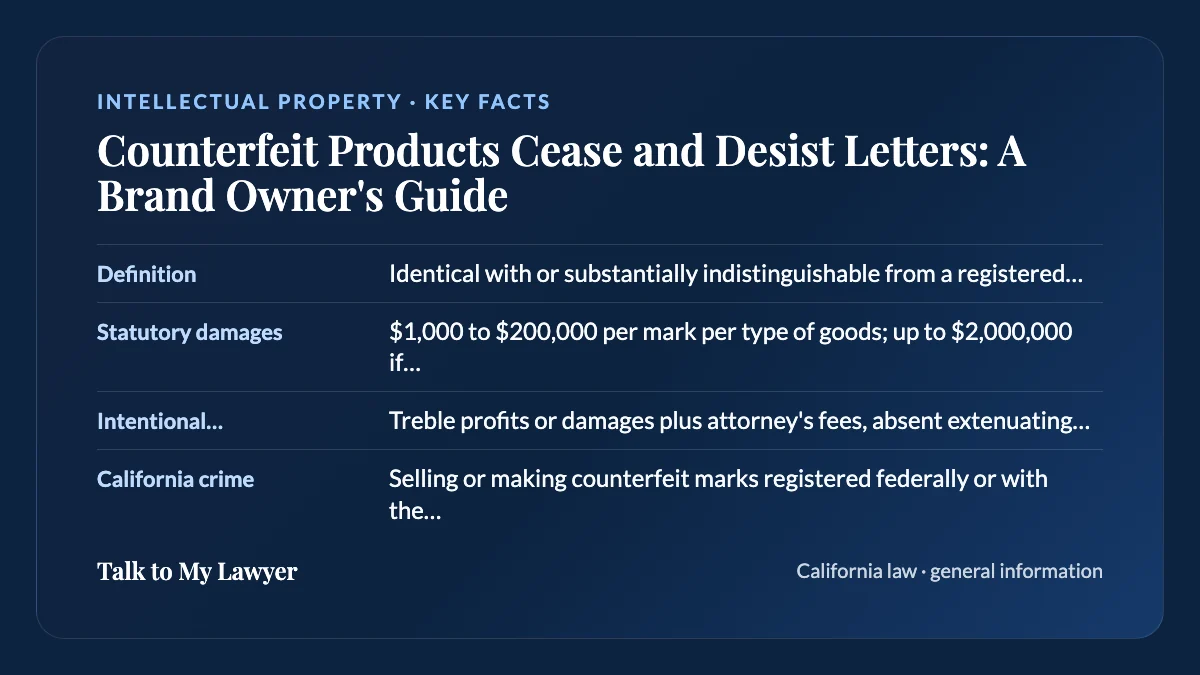
At a glance
- Definition
- Identical with or substantially indistinguishable from a registered mark (15 U.S.C. 1127)
- Statutory damages
- $1,000 to $200,000 per mark per type of goods; up to $2,000,000 if willful (1117(c))
- Intentional counterfeiting
- Treble profits or damages plus attorney's fees, absent extenuating circumstances (1117(b))
- California crime
- Selling or making counterfeit marks registered federally or with the Secretary of State (Penal Code 350)
- Border protection
- Record your registered mark with CBP: $190 per class (cbp.gov)
When is a product legally counterfeit?
A product is counterfeit when it carries a spurious mark that is identical with, or substantially indistinguishable from, a registered mark (15 U.S.C. section 1127). For seizure and enhanced remedies, the copied mark must be registered on the USPTO's Principal Register and in use, and goods made by a producer who was authorized to use the mark for those goods are excluded (15 U.S.C. section 1116(d)(1)(B)).
That makes counterfeiting narrower than ordinary trademark infringement. Sorting the problem correctly shapes the letter:
| Situation | Likely category | Letter focus |
|---|---|---|
| Fake goods with your exact logo and brand name | Counterfeit | Stop sales, surrender stock, identify the supplier |
| A similar but different name or logo on competing goods | Possible infringement, not counterfeiting | Likelihood of confusion; see our trademark cease and desist guide |
| Genuine goods resold below your price | Often lawful resale; altered or materially different goods raise other questions | Often no letter, or a narrower one |
| Your product photos or copy used on a listing | Possible copyright infringement | Takedown of the images and text |
What can a brand owner recover for counterfeiting?
The Lanham Act gives trademark owners stronger tools against counterfeits than against other infringement:
- Profits, damages and costs under 15 U.S.C. section 1117(a).
- Treble damages and attorney's fees for intentional counterfeiting: the court must enter judgment for three times the profits or damages, whichever is greater, unless it finds extenuating circumstances (section 1117(b)).
- Statutory damages in place of actual damages: $1,000 to $200,000 per counterfeit mark per type of goods or services, and up to $2,000,000 per mark per type of goods for willful use (section 1117(c)).
- Injunctions, with a rebuttable presumption of irreparable harm once a violation or likely success is shown (section 1116(a)).
- Ex parte seizure of counterfeit goods, marks and records by court order in a civil case (section 1116(d)).
Those numbers are what a court may award after a lawsuit, not amounts a letter can collect. Cite them accurately and in proportion to the seller in front of you.
How does California law treat counterfeit goods?
California makes it a crime to willfully manufacture, intentionally sell, or knowingly possess for sale any counterfeit of a mark registered with the California Secretary of State or on the USPTO's Principal Register (Penal Code section 350).
For offenses involving fewer than 1,000 items and less than the grand theft value, an individual faces up to one year in county jail, a fine of up to $10,000, or both, and a business entity faces a fine of up to $200,000. Larger offenses carry fines of up to $500,000 for individuals and $1,000,000 for businesses, and a conviction generally requires forfeiture and destruction of the goods.
Prosecutors bring those cases, not brand owners. A private letter should not threaten criminal charges to win a civil demand. Reporting to law enforcement is a separate decision, best made with a lawyer.
Finding the seller: marketplaces, INFORM and customs
Online sellers can be hard to name. Federal law now helps. Under the INFORM Consumers Act, in effect since June 27, 2023, online marketplaces must collect and verify bank, tax and contact information from high-volume third-party sellers, defined as those with 200 or more sales and $5,000 or more in gross revenue on the platform in a continuous 12-month period.
- For high-volume sellers with $20,000 or more in annual gross revenue, the marketplace must disclose the seller's name, physical address and contact information on product listing pages or in order confirmations, with a narrow exception for sellers working from home.
- Each listing page for a high-volume seller must show a phone number and an electronic way to report suspicious activity to the marketplace.
- Marketplaces also run their own brand protection and infringement report programs, which may ask for your registration number.
For imports, recording your trademark with U.S. Customs and Border Protection lets the agency detain, seize and destroy goods bearing an infringing version of it at the border. Recordation requires a registration on the USPTO's Principal Register and costs $190 per class of goods, according to CBP's intellectual property rights page.
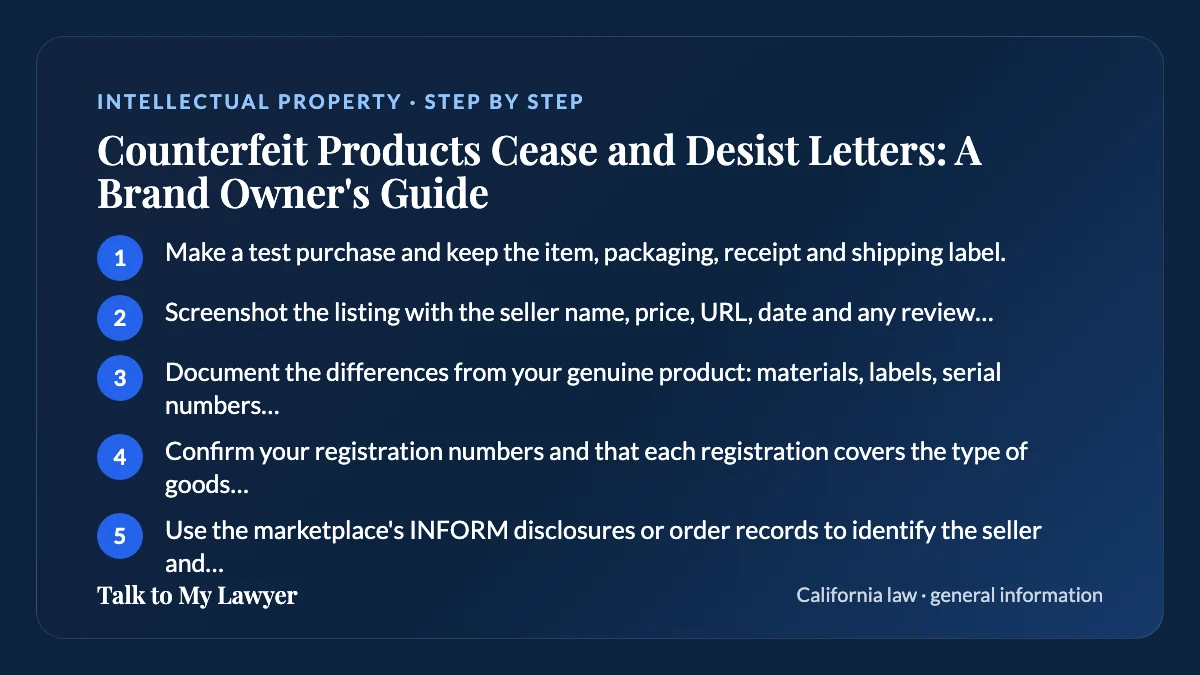
Steps to take before sending a counterfeit cease and desist
- Make a test purchase and keep the item, packaging, receipt and shipping label.
- Screenshot the listing with the seller name, price, URL, date and any review mentioning quality problems.
- Document the differences from your genuine product: materials, labels, serial numbers, packaging.
- Confirm your registration numbers and that each registration covers the type of goods sold.
- Use the marketplace's INFORM disclosures or order records to identify the seller and address.
- File the platform's infringement report, keeping its reference number.
- Decide what you want: stop sales, inventory and supplier details, surrender of stock, a payment, or all of these.
If the same seller also runs a site on a domain using your brand, our guide to domain name cybersquatting covers recovering it.
What a counterfeit cease and desist letter should ask for
The letter should identify your marks by registration number, describe the counterfeit goods and where they were sold, and list specific steps with a deadline. Typical requests:
- Stop manufacturing, importing, advertising and selling the goods.
- Take down every listing, on every platform.
- Disclose the supplier, quantities bought and sold, and the dates.
- Deliver remaining stock for destruction, or certify that it was destroyed.
- Preserve all records, messages and payment data related to the goods.
- Sign a written undertaking not to sell goods bearing your marks again.
We own U.S. Trademark Registration No. [number] for the mark FENWAY OAK, covering leather wallets. On May 6, we bought a wallet from your store listing titled "FENWAY OAK bifold wallet." It is not a genuine product: it lacks our serial number, uses a different leather and bears a copy of our mark. Selling goods with a counterfeit of a registered mark violates the federal Lanham Act. Please remove all listings within seven days, identify your supplier and the number of units sold, and confirm in writing how you will dispose of remaining stock.
A seller may answer that it bought the goods believing them genuine. That can bear on remedies, such as whether the use was willful, but it does not make further sales lawful. If the seller replies through a lawyer, the guide for businesses that have received a cease and desist letter previews the arguments they may raise.
What happens if the counterfeit seller ignores you?
If listings stay up past your deadline, the next steps can run in parallel: a second platform report attaching your letter and test purchase, CBP recordation if imports are involved, and a federal lawsuit seeking an injunction, damages and, where justified, an ex parte seizure order. Each choice carries costs and timing issues worth discussing with a lawyer.
Where an attorney-written counterfeit letter fits
Counterfeit enforcement mixes a takedown, an information request and the groundwork for possible litigation, and a letter that overreaches can draw a dispute about your own conduct. Having an attorney write it fits when a seller is moving volume, when a supplier or importer is behind several storefronts, when the seller has denied the goods are fake, or when you want the letter to support a later lawsuit or seizure request.
Through Talk to My Lawyer, a licensed California attorney writes your letter from your registrations, test purchase and listing screenshots, and sends it on your behalf, addressed to the seller at the location the marketplace discloses. A lawsuit or seizure request calls for advice from a lawyer on your specific situation. Our overview of intellectual property infringement letters covers related claims.
Frequently asked questions
What is the difference between counterfeit and trademark infringement?
Counterfeiting is a narrower and more serious category of infringement. It involves a mark identical with, or substantially indistinguishable from, a registered mark, usually on the same kind of goods. Ordinary infringement covers marks that are similar enough to confuse buyers. Counterfeiting opens up treble damages, statutory damages of up to $200,000 per mark per type of goods, and ex parte seizure.
Can I send a cease and desist to an Amazon or eBay seller?
Yes. You can send a letter to the seller directly and also file the marketplace's infringement report. Under the INFORM Consumers Act, marketplaces must disclose the name, address and contact details of high-volume sellers with $20,000 or more in annual gross revenue, which helps you address the letter to the person or company behind the storefront.
Do I need a registered trademark to stop counterfeits?
For the strongest remedies, yes. The federal counterfeit definition used for seizure orders requires a mark on the USPTO's Principal Register that is in use, and recording a mark with CBP for border enforcement also requires a Principal Register registration. California Penal Code section 350 covers marks registered with the Secretary of State or the USPTO. Unregistered marks may still support infringement claims.
How much can I recover from a counterfeiter?
In a lawsuit, a court may award the counterfeiter's profits, your damages and costs, tripled for intentional counterfeiting with attorney's fees. You can elect statutory damages instead: $1,000 to $200,000 per counterfeit mark per type of goods, or up to $2,000,000 if the use was willful (15 U.S.C. section 1117). What any case recovers depends on the facts and the defendant's assets.
Can I report counterfeit sellers to the police in California?
Yes. Penal Code section 350 makes it a crime to willfully manufacture, intentionally sell or knowingly possess for sale goods with counterfeit marks registered with the state or the USPTO. Prosecutors decide whether to charge. A civil cease and desist letter should not threaten a criminal report to pressure a payment.
Sources
Checked against these official sources on October 18, 2026.
- 15 U.S. Code section 1127 (Legal Information Institute, Cornell Law School)
- 15 U.S. Code section 1116 (Legal Information Institute, Cornell Law School)
- 15 U.S. Code section 1117 (Legal Information Institute, Cornell Law School)
- California Penal Code section 350 (California Legislative Information)
- Informing Businesses about the INFORM Consumers Act (Federal Trade Commission)
- IPR Protection: e-Recordation (U.S. Customs and Border Protection)
This guide explains California law in general terms as of October 2026. It is general information, not legal advice for your situation, and local rules can add to it.
Join the email list and get a lawyer letter started
With Talk to My Lawyer, a licensed California attorney writes your letter from your facts and documents and sends it on your behalf. Join the Talk to My Lawyer email list for letter checklists, document prompts, and reminders before you start your letter.