Quick answer
If someone registered your business domain name in bad faith, you may be able to recover it. The UDRP, an ICANN policy written into domain registration agreements, lets a trademark owner seek transfer or cancellation without going to court. The federal Anticybersquatting Consumer Protection Act (15 U.S.C. 1125(d)) allows a lawsuit with statutory damages of $1,000 to $100,000 per domain. A demand letter asking for transfer can come first.
At a glance
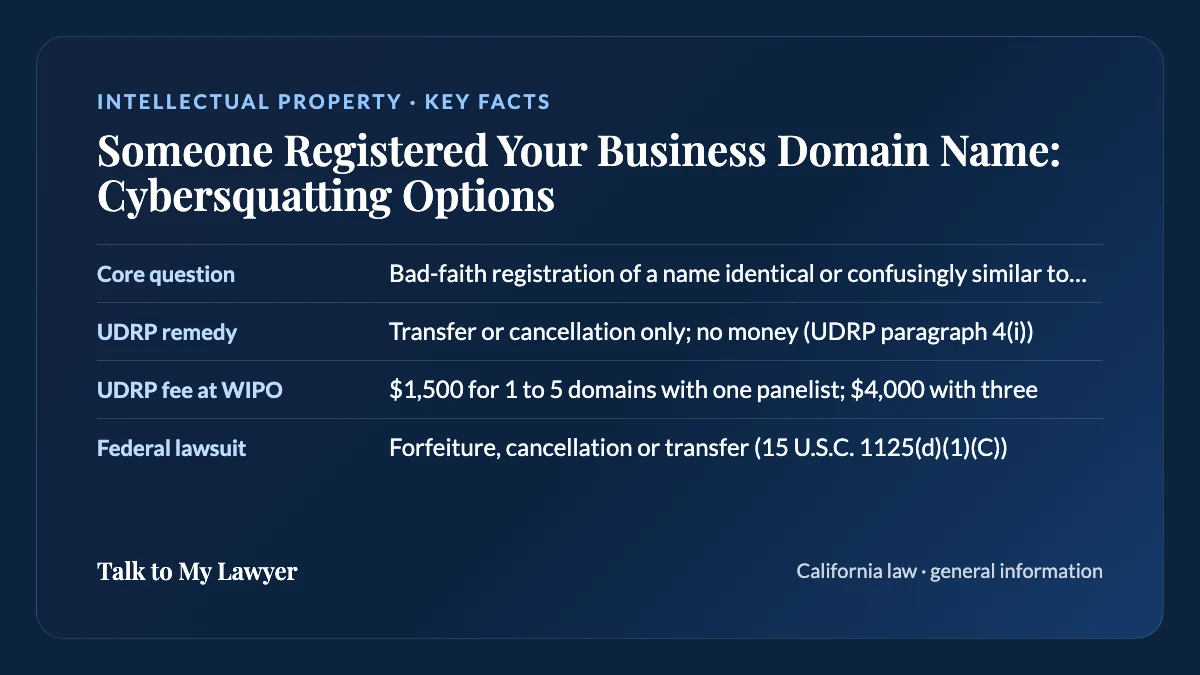
- Core question
- Bad-faith registration of a name identical or confusingly similar to your mark
- UDRP remedy
- Transfer or cancellation only; no money (UDRP paragraph 4(i))
- UDRP fee at WIPO
- $1,500 for 1 to 5 domains with one panelist; $4,000 with three
- Federal lawsuit
- Forfeiture, cancellation or transfer (15 U.S.C. 1125(d)(1)(C))
- Statutory damages
- $1,000 to $100,000 per domain name (15 U.S.C. 1117(d))
What can you do if someone registered your business domain name?
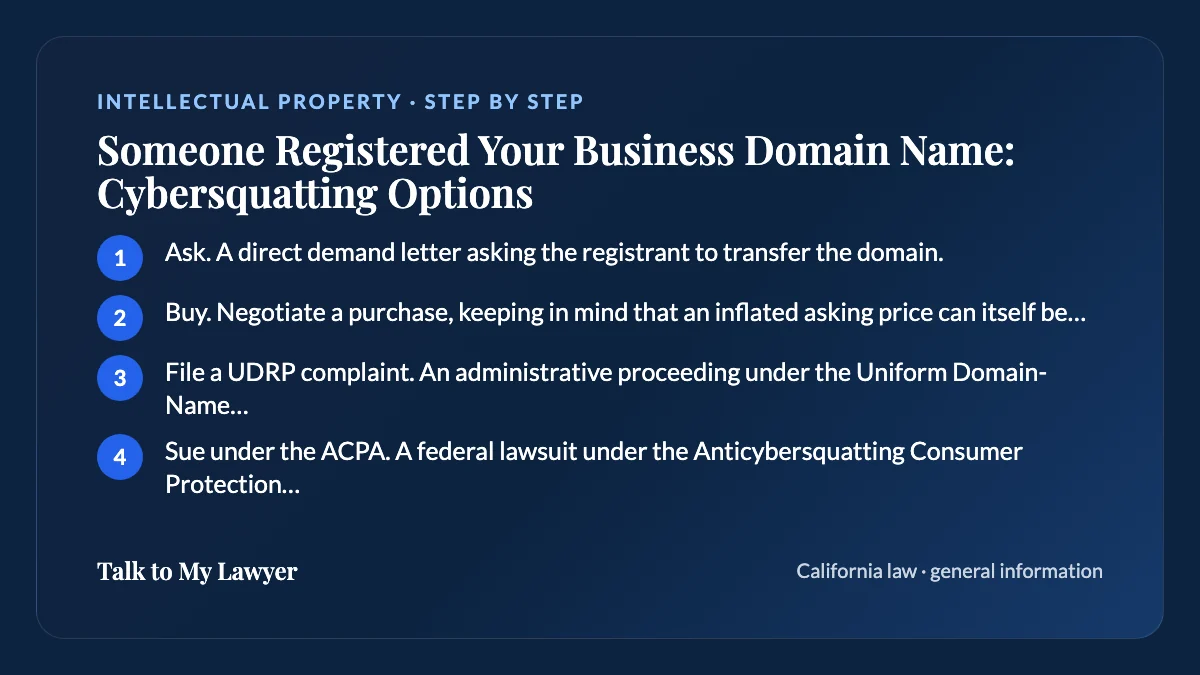
Your options depend on two things: whether you have trademark rights in the name, and whether the registrant acted in bad faith. If both are true, you have four routes, which you can use in sequence.
- Ask. A direct demand letter asking the registrant to transfer the domain.
- Buy. Negotiate a purchase, keeping in mind that an inflated asking price can itself be evidence of bad faith.
- File a UDRP complaint. An administrative proceeding under the Uniform Domain-Name Dispute-Resolution Policy, decided by a panel, that can order transfer.
- Sue under the ACPA. A federal lawsuit under the Anticybersquatting Consumer Protection Act, which can order transfer and award money.
If the registrant simply got there first with a legitimate business of their own, none of these may work. Being first to register a generic word or a common surname is not cybersquatting.
How do you know it is cybersquatting and not a coincidence?
Look for bad faith. Under paragraph 4(a) of the UDRP, a complainant must show three things: the domain is identical or confusingly similar to a trademark or service mark in which the complainant has rights, the registrant has no rights or legitimate interests in it, and it was registered and is being used in bad faith.
The UDRP (paragraph 4(b)) and the ACPA (15 U.S.C. section 1125(d)(1)(B)) both list signs of bad faith. They overlap:
- An offer to sell the domain to you or a competitor for more than the registrant's out-of-pocket costs.
- A pattern of registering domains that match other companies' marks.
- A site that uses your name to divert customers for profit, such as ads for competitors.
- Registration mainly to disrupt a competitor's business.
- False or missing contact information in the registration record.
The registrant's side counts too. UDRP paragraph 4(c) recognizes legitimate interests where the registrant used the name for a real business before the dispute, is commonly known by it, or makes a noncommercial or fair use without intent to mislead. The ACPA also requires your mark to have been distinctive when the domain was registered, so dates matter: a domain registered before your brand existed is a harder case.
UDRP complaint or federal lawsuit: how they compare
| UDRP proceeding | ACPA lawsuit (15 U.S.C. 1125(d)) | |
|---|---|---|
| Where | An approved dispute provider, such as the WIPO Arbitration and Mediation Center | Federal district court |
| What you must show | Confusing similarity, no legitimate interest, and bad-faith registration and use | Bad-faith intent to profit, and a domain identical or confusingly similar to a mark distinctive when registered |
| Remedies | Transfer or cancellation only | Forfeiture, cancellation or transfer, plus actual damages or statutory damages of $1,000 to $100,000 per domain |
| Cost | WIPO fee of $1,500 for 1 to 5 domains with a single panelist, $4,000 with three, plus any legal fees | Court filing fees and litigation costs |
A UDRP win is not always final. Under paragraph 4(k), the registrar waits 10 business days after a transfer decision and holds off if the registrant shows it has filed a court case in that time. If the registrant cannot be found at all, the ACPA allows an in rem case against the domain itself, after due diligence to locate the owner (15 U.S.C. 1125(d)(2)).
Does California law help with a business domain name?
Only in narrow cases. California's cyberpiracy statute, Business and Professions Code section 17525, bars bad-faith registration or use of a domain or subdomain that is identical or confusingly similar to the personal name of a living person or deceased personality, or to the name of a sports team, league, amusement park, venue or event used to sell goods such as tickets.
If your business operates under your own name, the statute may apply. Registering such a name without consent is presumed to be in bad faith, and a person who lost money or property may recover actual, consequential and punitive damages where warranted, plus attorney's fees if the case is resolved in their favor (section 17525(d) and (f)). For a company name that is not a personal name, the federal tools above are the main options, and if your business name also appears on a confusing website or product, our guide to trademark cease and desist letters covers that side.
What to gather before you contact the registrant
- Screenshots of the site, dated, including any for-sale banner, ads or links to competitors.
- The WHOIS or RDAP registration record, showing the registration date and registrar, even if the owner is privacy-protected.
- Your trademark registration certificate, or proof of when you started using the name in commerce if it is unregistered.
- Any messages from the registrant, especially offers to sell.
- Customer emails or calls showing people landed on the wrong site.
Write the letter through the registrant's listed email, or the registrar's privacy relay if the record is masked. Keep the tone factual. A measured letter that cites the law gives the registrant a clear choice, and whatever they reply becomes part of your record. If the registrant turns out to be a company, looking up its legal name and registered agent tells you where formal notice should go.
Sample wording for a domain transfer demand
We own the federally registered trademark QUILLFERN CYCLES, U.S. Registration No. [number], used since 2016. The domain quillferncycles.com was registered on March 9, 2025, and now displays advertisements for competing bicycle shops and an offer to sell the domain for $9,800. We believe this registration is in bad faith under 15 U.S.C. section 1125(d) and paragraph 4(b) of the UDRP. Please initiate a transfer of the domain to us through your registrar within 14 days. We will reimburse documented registration costs.
Offering documented out-of-pocket costs is a choice, not a requirement. It can make transfer easy for a registrant who acted carelessly.
Who should send the domain demand, and when
Domain disputes reward a clean record, since UDRP panels and federal courts both look at what each side said and when. A demand from an attorney fits when the domain is diverting customers, when the registrant has asked for a large payment, when several domains are involved, or when you expect to file a UDRP complaint or a lawsuit and want the demand to support it.
Through Talk to My Lawyer, a licensed California attorney writes your letter from your trademark records, screenshots and the registration data, and sends it on your behalf to the registrant or the registrar's relay address. Choosing between a UDRP complaint and a federal case is worth discussing with an intellectual property lawyer. Related reading: our guide to counterfeit goods cease and desist letters and the overview of intellectual property infringement letters.
Frequently asked questions
Is it illegal to register a domain with someone else's business name?
Not automatically. It becomes cybersquatting when the registrant acts with bad-faith intent to profit from a trademark, for example by offering to sell the domain to the owner or using it to divert customers. Someone with a legitimate business of the same name, a fair use, or an earlier registration may have every right to keep it.
How much does a UDRP complaint cost?
At the WIPO Arbitration and Mediation Center, the fee for one to five domain names is $1,500 with a single panelist and $4,000 with a three-member panel, according to WIPO's published fee schedule. Legal fees for preparing the complaint are separate. Other approved providers set their own fees. A UDRP case cannot award money, only transfer or cancellation.
Can I get money damages from a cybersquatter?
Not through the UDRP. Under the federal Anticybersquatting Consumer Protection Act, a trademark owner who sues can elect statutory damages of $1,000 to $100,000 per domain name instead of proving actual damages and profits (15 U.S.C. section 1117(d)). California's section 17525 also allows damages, but only for domains based on personal names and certain team, venue or event names.
What if I cannot find out who owns the domain?
Registration records may be privacy-shielded, and registrars may offer a way to relay messages to the owner. If the owner still cannot be found, the ACPA allows an in rem lawsuit against the domain itself in the district where the registrar or registry is located, after due diligence that includes sending notice to the registrant's postal and email addresses. Remedies in that case are limited to transfer, forfeiture or cancellation.
Do I need a registered trademark to recover a domain?
Registration helps, but the UDRP asks whether you have rights in a trademark or service mark, and the ACPA protects distinctive marks. Proof of long, continuous use of your business name in commerce may support rights in an unregistered mark. The date your rights began, compared with the domain's registration date, matters in both proceedings.
Sources
Checked against these official sources on October 18, 2026.
- 15 U.S. Code section 1125 (Legal Information Institute, Cornell Law School)
- 15 U.S. Code section 1117 (Legal Information Institute, Cornell Law School)
- Uniform Domain Name Dispute Resolution Policy (ICANN)
- Schedule of Fees under the UDRP (WIPO Arbitration and Mediation Center)
- California Business and Professions Code section 17525 (California Legislative Information)
This guide explains California law in general terms as of October 2026. It is general information, not legal advice for your situation, and local rules can add to it.
Join the email list and get a lawyer letter started
With Talk to My Lawyer, a licensed California attorney writes your letter from your facts and documents and sends it on your behalf. Join the Talk to My Lawyer email list for letter checklists, document prompts, and reminders before you start your letter.