Quick answer
A credit card billing dispute letter is a written billing error notice under the Fair Credit Billing Act. It must reach the card issuer at its billing-error address within 60 days after it sent the first statement showing the error (12 CFR 1026.13). The issuer must acknowledge it within 30 days and resolve it within two billing cycles, and never more than 90 days.
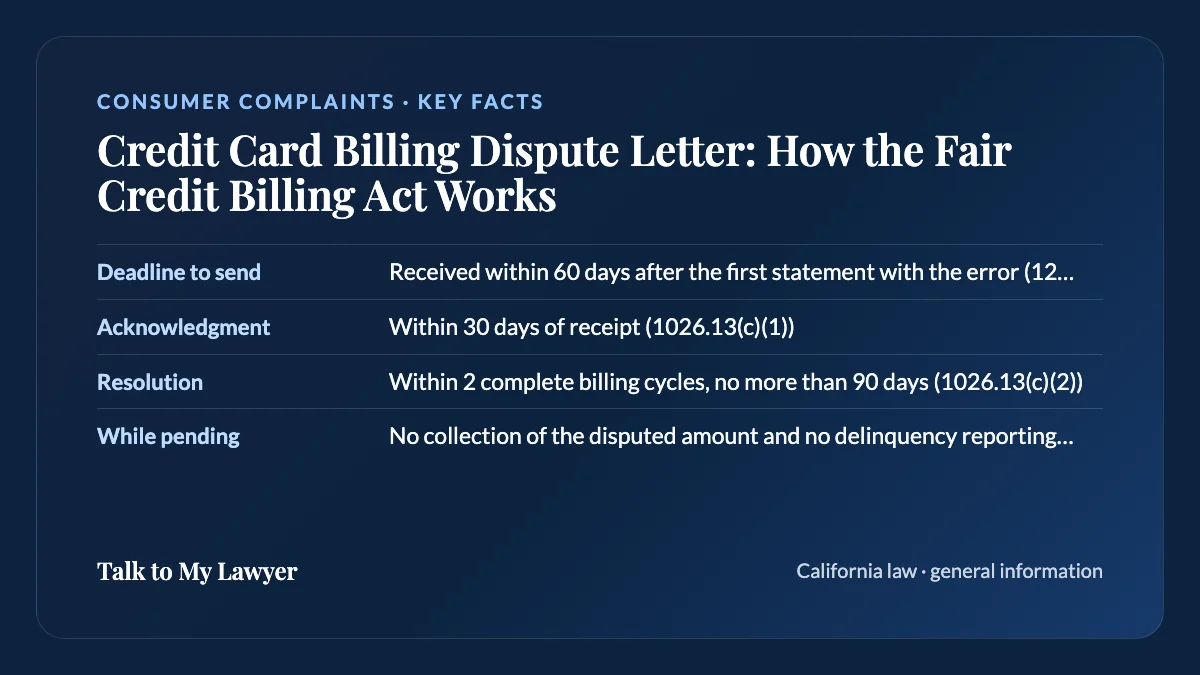
At a glance
- Deadline to send
- Received within 60 days after the first statement with the error (12 CFR 1026.13(b))
- Acknowledgment
- Within 30 days of receipt (1026.13(c)(1))
- Resolution
- Within 2 complete billing cycles, no more than 90 days (1026.13(c)(2))
- While pending
- No collection of the disputed amount and no delinquency reporting (1026.13(d))
- Quality disputes
- Separate rule: over $50 and in-state or within 100 miles (15 U.S.C. 1666i)
- California rule
- Issuer's own errors fixed within 2 cycles or 90 days; treble damages if willful (Civil Code 1747.50)
What counts as a billing error under federal law?
Regulation Z, the federal rule that carries out the Fair Credit Billing Act, lists seven kinds of billing error in 12 CFR 1026.13(a). In plain terms, a statement shows a billing error when it includes:
- A charge you did not make and did not authorize anyone to make.
- A charge that is not identified properly on the statement.
- A charge for goods or services you did not accept or that were not delivered as agreed.
- A payment or credit that was not applied correctly.
- A math or accounting error by the issuer.
- A charge you want explained, including with supporting documents.
- A statement that was never sent to an address you gave in writing at least 20 days before the billing cycle closed.
For unauthorized charges, a separate federal rule caps what you can owe at $50, and you owe nothing for use after you have notified the issuer (15 U.S.C. 1643). A dispute about the quality of something you did receive is handled differently, as explained further down.
How long do you have to send a credit card billing dispute letter?
Your notice must be received no later than 60 days after the issuer transmitted the first periodic statement that shows the error (12 CFR 1026.13(b)(1)). The count starts when the issuer sent that first statement, not on the purchase date, and the deadline is about arrival, so allow for mailing time.
Send it to the address the issuer lists for billing errors, which can differ from the payment address. The statement must disclose that address. A notice qualifies when it:
- Lets the issuer identify your name and account number.
- Says, to the extent you can, that you believe there is a billing error and why.
- Gives the type, date and amount of the error.
The Consumer Financial Protection Bureau suggests calling the issuer right away too, but stresses that you must also send the written notice to protect your rights. Keep a copy and proof of the delivery date.
What must the card issuer do after it receives your letter?
| Stage | What the issuer must or may do | Rule |
|---|---|---|
| Within 30 days | Send written acknowledgment, unless it has already resolved the dispute | 1026.13(c)(1) |
| Within 2 billing cycles (90 days at most) | Correct the error and send a correction notice, or explain in writing why it found no error | 1026.13(c)(2), (e), (f) |
| While pending | May not try to collect the disputed amount or related charges, or report them as delinquent | 1026.13(d)(1), (2) |
| While pending | May not close or restrict the account solely because you disputed in good faith | 1026.13(d)(3) |
| While pending | May collect the undisputed balance and count the disputed amount against your credit limit | 1026.13(d)(4) |
| Autopay | May not deduct the disputed amount if your notice arrives at least 3 business days before the payment date | 1026.13(d)(1) |
If the issuer finds no error, it must explain why and, if you ask, send copies of documentary evidence that you owe the charge (1026.13(f)). It then tells you in writing what you owe and when, and must allow your grace period or 10 days, whichever is longer, before reporting the amount as delinquent.
An issuer that does not follow these rules forfeits the right to collect the disputed amount and related finance charges, up to $50 (15 U.S.C. 1666(e)).
Does California add its own billing-error rule?
Yes, for errors the issuer itself makes. Under the Song-Beverly Credit Card Act, Civil Code section 1747.50 requires every card issuer to correct any billing error made by the card issuer within two complete billing cycles, and no later than 90 days, after receiving an inquiry.
- An issuer that misses that window is not entitled to the overcharged amount or to any interest, finance charges or other charges tied to it.
- A cardholder injured by a willful violation can sue for damages, and judgment may be entered for three times actual damages.
- A cardholder who brings that action is entitled to reasonable attorney fees and costs.
Because the California section speaks of errors made by the card issuer, whether it reaches a particular charge, such as one a merchant posted without your authority, and how it fits with the federal rule are questions for a lawyer.
Billing error or quality dispute: which rule applies?
If the item never arrived, that is a billing error. If it arrived but was defective or not as described, the main tool is 15 U.S.C. 1666i, which lets you raise claims and defenses from the purchase against the card issuer.
| Point | Billing error notice | Claims and defenses (1666i) |
|---|---|---|
| Typical problem | Unauthorized charge, wrong amount, item not delivered, payment not credited | Goods or services received but defective or not as promised |
| Deadline | Notice received within 60 days of the first statement | No 60-day limit in the statute; limited to credit still outstanding when you first notify |
| Conditions | Written notice to the billing-error address | Good-faith attempt to resolve it with the merchant, purchase over $50, made in your state or within 100 miles of your mailing address |
| Exceptions to conditions | Not applicable | The $50 and distance limits do not apply if the seller is the issuer, is controlled by or under common control with it, is its franchised dealer, or took the order through a mail solicitation the issuer made or joined |
The amount you can assert under section 1666i cannot exceed the credit outstanding for that purchase when you first notify the issuer or the merchant. For a broader comparison of a card dispute and a letter to the business, see chargeback vs. demand letter.
How to write the dispute letter, step by step
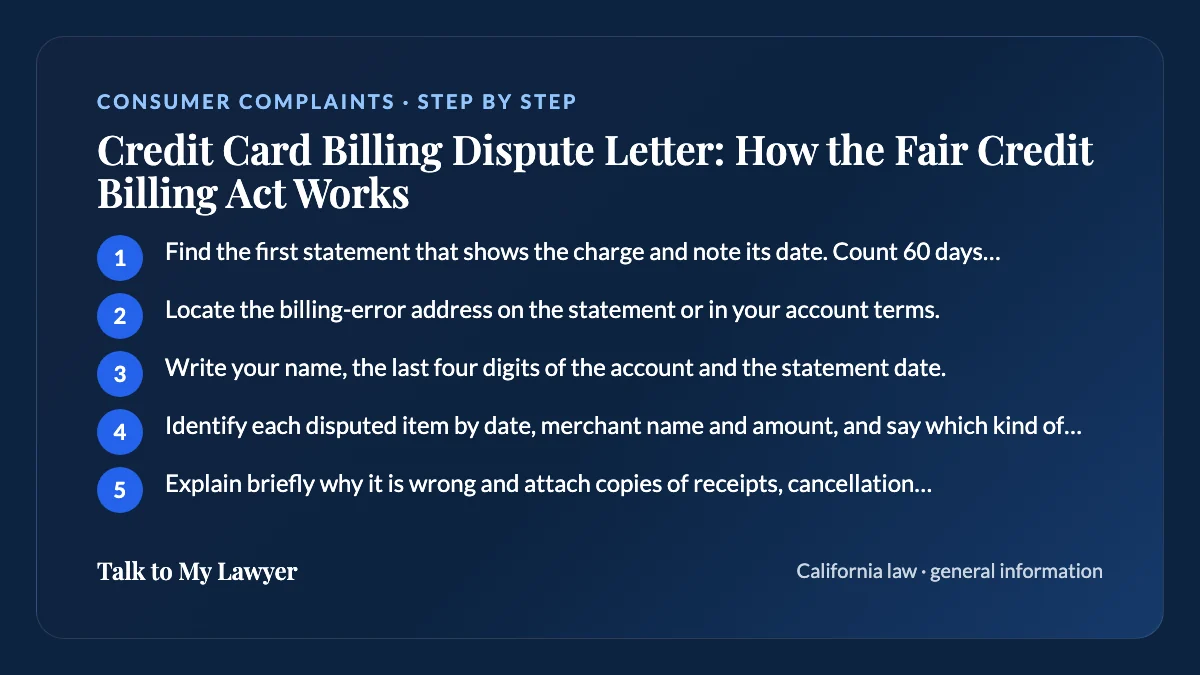
- Find the first statement that shows the charge and note its date. Count 60 days forward and plan for the letter to arrive well before then.
- Locate the billing-error address on the statement or in your account terms.
- Write your name, the last four digits of the account and the statement date.
- Identify each disputed item by date, merchant name and amount, and say which kind of error it is.
- Explain briefly why it is wrong and attach copies (never originals) of receipts, cancellation confirmations or tracking records.
- Ask for a correction and, if the issuer disagrees, for copies of its documentary evidence.
- Send it by a method that proves the delivery date, such as certified mail with a return receipt, and keep a copy.
I am writing to dispute a billing error on my statement dated August 28, 2026, for the account ending 2093. The statement shows a charge of $640.00 on August 9, 2026, from [merchant name], a hotel I have never visited. I did not make or authorize this charge, and I was at home in Fresno that week, as the enclosed work schedule shows. Please correct the error under 12 CFR 1026.13 and remove any related finance charges. If you conclude the charge is valid, please send copies of the documents you relied on.
What if the issuer rejects your dispute?
Read the explanation and ask for the evidence if it did not come with it. If you still disagree, write again within the time the issuer gives you to pay. Under 12 CFR 1026.13(g)(4), if you send that further written notice, the issuer may not report the amount as delinquent unless it also reports that the amount is in dispute, tells you in writing who received the report, and reports the eventual outcome to them.
Once an issuer has fully complied with the rule, it has no further duty if you simply resend the same dispute (1026.13(h)). You can also file a complaint with the Consumer Financial Protection Bureau. If the problem was a debit card or bank transfer rather than a credit card, a different law applies; see our guide to disputing an unauthorized bank transfer.
When an attorney should write your card dispute
A billing dispute can start with your own short notice to the issuer, sent in your own words. A letter from an attorney is worth considering when the amount is large, the issuer has missed its 30- or 90-day deadlines, a disputed charge has been reported as late, or you want to raise both the federal rules and California's treble-damages statute.
Through Talk to My Lawyer, a licensed California attorney writes your letter from your statements, receipts and the issuer's replies, and sends it on your behalf. For advice on a lawsuit over a billing error, talk to a lawyer about your facts.
Frequently asked questions
How long do I have to dispute a credit card charge?
Under the Fair Credit Billing Act and Regulation Z, your written billing error notice must be received by the issuer no later than 60 days after it sent the first statement showing the error. The clock runs from the statement, not the purchase date. Disputes about the quality of goods under 15 U.S.C. 1666i follow different conditions and are not tied to that 60-day window.
Do I have to pay the disputed amount while the card company investigates?
No. While a billing error notice is pending, you need not pay the disputed amount or related charges, and the issuer may not try to collect them or report them as delinquent (12 CFR 1026.13(d)). You still need to pay the undisputed part of your bill on time, and the issuer may count the disputed amount against your credit limit.
Can I dispute a credit card charge by phone instead of writing?
You can call, and the Consumer Financial Protection Bureau suggests doing so promptly. But the federal billing error protections attach to a written notice received at the issuer's billing-error address within 60 days. A phone call alone may not trigger the 30-day acknowledgment duty, the 90-day resolution deadline or the ban on reporting the amount as delinquent.
What is the difference between a billing error and a chargeback?
A billing error notice is your legal right under the Fair Credit Billing Act, with fixed deadlines for you and the issuer. Chargeback is the informal name for the card-network process that reverses a charge, and its rules come from the networks and your card agreement rather than from the statute. Quality complaints about goods you received fall under a separate statute, 15 U.S.C. 1666i, with its own $50 and 100-mile conditions.
What happens if the card issuer misses the 90-day deadline?
Federally, an issuer that fails to follow the billing error rules forfeits the right to collect the disputed amount and related finance charges, capped at $50 (15 U.S.C. 1666(e)). In California, Civil Code section 1747.50 says an issuer that does not correct its own billing error within two billing cycles or 90 days is not entitled to the overcharge, and willful violations can bring treble damages.
Sources
Checked against these official sources on October 18, 2026.
- 12 CFR 1026.13 Billing error resolution (eCFR (Consumer Financial Protection Bureau rule))
- 15 U.S. Code section 1666 Correction of billing errors (Legal Information Institute, Cornell Law School)
- 15 U.S. Code section 1666i Claims and defenses (Legal Information Institute, Cornell Law School)
- 15 U.S. Code section 1643 Liability of holder of credit card (Legal Information Institute, Cornell Law School)
- California Civil Code section 1747.50 (California Legislative Information)
- How do I dispute a charge on my credit card bill? (Consumer Financial Protection Bureau)
This guide explains California law in general terms as of October 2026. It is general information, not legal advice for your situation, and local rules can add to it.
Join the email list and get a lawyer letter started
With Talk to My Lawyer, a licensed California attorney writes your letter from your facts and documents and sends it on your behalf. Join the Talk to My Lawyer email list for letter checklists, document prompts, and reminders before you start your letter.