Quick answer
If your disability insurance claim was denied in California, first identify the coverage. Private employer group plans are generally governed by ERISA, which gives you at least 180 days to file a written appeal (29 CFR 2560.503-1). Individual policies fall under California insurance law. State Disability Insurance (SDI) denials go to EDD, with 30 days to appeal from the notice date.
At a glance
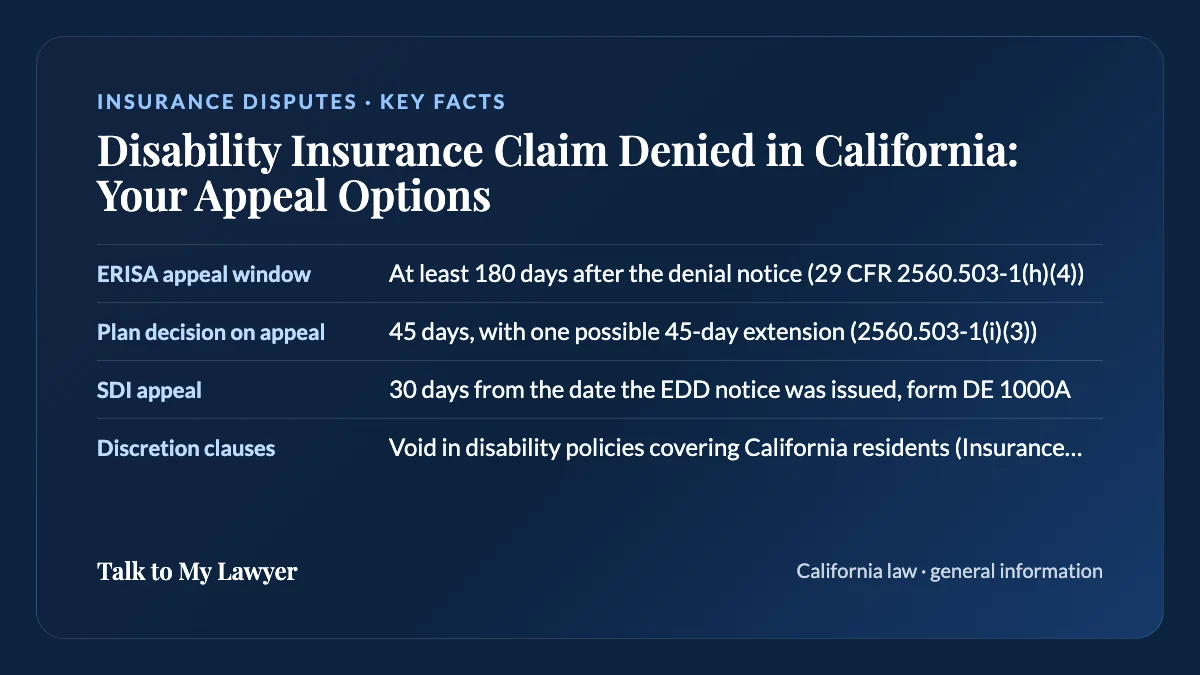
- ERISA appeal window
- At least 180 days after the denial notice (29 CFR 2560.503-1(h)(4))
- Plan decision on appeal
- 45 days, with one possible 45-day extension (2560.503-1(i)(3))
- SDI appeal
- 30 days from the date the EDD notice was issued, form DE 1000A
- Discretion clauses
- Void in disability policies covering California residents (Insurance Code 10110.6)
- Late benefit payments
- 10% yearly interest after 30 days on disability income policies (Insurance Code 10111.2)
Which kind of disability coverage denied your claim?
Start with the source of the coverage, because it decides the rules, the deadlines and the forum. Look at your enrollment papers, pay stubs and the denial letter's letterhead.
| Coverage | Main rules | First step after a denial |
|---|---|---|
| Short- or long-term disability through a private employer | ERISA and the federal claims regulation, plus California insurance law for insured plans | Written internal appeal to the plan, filed within the window stated in the denial (at least 180 days) |
| Individual policy you bought yourself | California Insurance Code and the policy terms | Written request for reconsideration or a demand letter to the insurer; complaint to the Department of Insurance if needed |
| California State Disability Insurance (SDI) | Unemployment Insurance Code and EDD procedures | Appeal to EDD within 30 days of the notice date |
| Government or church employer plan | Excluded from ERISA Title I (29 U.S.C. 1003(b)) | Follow the plan's own appeal rules and ask a lawyer which law governs |
Some people hold more than one of these at once. A worker can have SDI, an employer long-term disability plan and a private policy, each with its own denial and its own clock.
How long do you have to appeal an ERISA disability denial?
Under the federal claims regulation, a disability plan must give you at least 180 days after you receive the denial notice to file an appeal (29 CFR 2560.503-1(h)(3)(i) and (h)(4)). Your plan can allow more time, never less. Mark the exact date from your letter.
The same regulation sets the plan's own timing. An initial disability decision is due within 45 days of the claim, with up to two 30-day extensions. A decision on appeal is due within 45 days, with one extension of up to 45 more days for special circumstances.
The appeal is the stage where your evidence goes into the file. If the case later reaches court under ERISA, a judge may look mainly at the record the plan had, so a thin appeal can limit what can be argued later.
What a disability denial letter has to explain
A disability denial must do more than say no. The regulation requires a discussion of the decision, including why the plan disagreed with or did not follow your treating providers' views, and with a Social Security disability decision you gave the plan (2560.503-1(g)(1)(vii)).
- The specific reasons for the denial and the plan provisions relied on.
- Any internal rules, guidelines or protocols used, or a statement that none exist.
- What additional information would help, and why.
- A description of the appeal steps and your right to sue after the appeal.
When a denial skips these points, say so in your appeal. If a plan fails to follow the claims procedures, the regulation can treat you as having exhausted the internal process, which affects when you may go to court (2560.503-1(l)(2)). The regulation also counts a rescission of disability coverage as an adverse decision you can appeal.
What California law adds for disability policies
California voids any clause in a life or disability policy covering a California resident that gives the insurer discretionary authority to decide eligibility or interpret the policy (Insurance Code section 10110.6). The rule applies to group and individual products, wherever the policy was issued, once it is offered, issued or renewed.
Why it matters: discretion clauses can lead a court to defer to the insurer's decision. Without one, review is generally less deferential. How that affects an ERISA case depends on the plan and the court, so get legal advice on it.
For disability income policies, Insurance Code section 10111.2 requires payment within 30 calendar days after the insurer has all the information it needs. If the insurer is missing information, it must send you a written list within 30 days of the claim. If the insurer accepts the claim but pays late, the delayed payment carries interest at 10 percent a year from the 31st day after it had that information. If it neither pays nor sends the list within 30 days, interest starts on the 31st day after the claim.
For an insured policy, the California Department of Insurance takes consumer complaints through an online form and its hotline, 1-800-927-4357.
How do you appeal a denied SDI claim?
A State Disability Insurance denial is appealed to EDD, electronically or in writing, within 30 days of the date the notice was issued. The notice includes the appeal form, DE 1000A. If you lost it, EDD accepts a detailed letter with your printed name, DI claim ID or EDD Customer Account Number, Social Security number, address, phone number, the reason for appeal and your signature.
If EDD cannot confirm eligibility, the appeal goes to a local Office of Appeals of the California Unemployment Insurance Appeals Board, where an administrative law judge holds a hearing. A late appeal may still proceed if the judge finds good cause, so explain any delay in writing.
SDI is a state program, separate from any private policy. Winning or losing one does not decide the other, though medical records from one file can support the other.
Steps to build a disability appeal letter
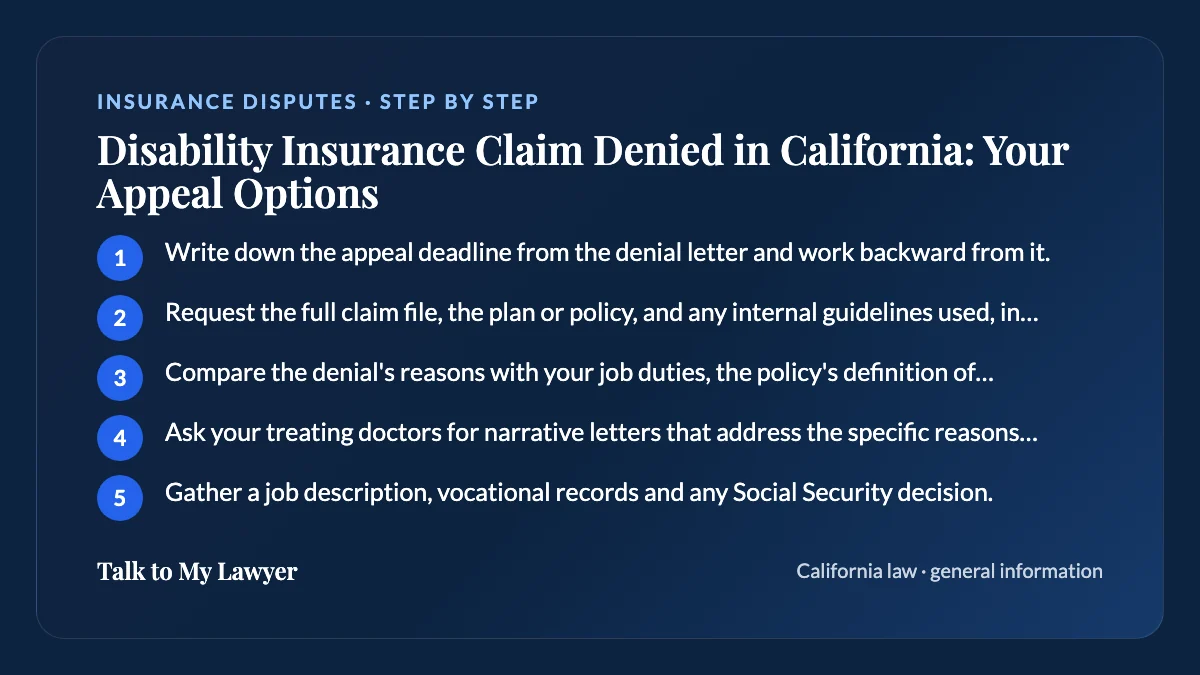
- Write down the appeal deadline from the denial letter and work backward from it.
- Request the full claim file, the plan or policy, and any internal guidelines used, in writing.
- Compare the denial's reasons with your job duties, the policy's definition of disability and the medical evidence.
- Ask your treating doctors for narrative letters that address the specific reasons given, including restrictions and how long they will last.
- Gather a job description, vocational records and any Social Security decision.
- Write the appeal: answer each reason for denial, attach evidence, list every enclosure and ask for a decision within the regulatory timeline.
- Send it by a trackable method and keep a full copy of everything you submitted.
I appeal the denial dated March 4 of my long-term disability claim. The denial states that I can perform my own occupation. My occupation, as described in the attached job description, requires standing for most of a shift and lifting up to 40 pounds. Dr. Lee's enclosed letter limits me to 15 minutes of standing and no lifting over 10 pounds through at least September. Please reverse the denial and pay benefits from the end of the elimination period.
Our demand letter evidence checklist can help you organize records before you write. For the general approach to insurer denials, see insurance claim denial demand letters.
Example: one injury, two denials, two clocks
Example (hypothetical): a warehouse supervisor hurts her back and stops working on January 10. EDD denies her SDI claim in a notice issued February 1. Her employer's insured long-term disability plan denies her claim on June 15.
- SDI: her appeal is due within 30 days of February 1, so by early March.
- Long-term disability: she has at least 180 days after receiving the June 15 notice, into mid-December, unless the plan gives more.
- The plan then has 45 days to decide, plus one 45-day extension if it explains the special circumstances in writing.
Because the plan is insured and covers a California resident, any clause giving the insurer discretion to interpret the policy is void under section 10110.6.
Paper reviews and long claim files: an attorney-written appeal
A denial that rests on a missing doctor's note is a different problem from one built on a file reviewer's opinion, a surveillance clip or a conflict with your Social Security award. The first can be answered in your own words. The others, along with an individual policy that stops paying after years of benefits, are where an attorney-written appeal or demand letter can help. For health coverage denials, the process differs and has its own guide.
With Talk to My Lawyer, a licensed California attorney writes your letter from your facts and documents (the denial notice, medical records and policy) and sends it on your behalf. Whether an ERISA lawsuit or a bad-faith claim fits your case depends on details only a lawyer reading your claim file can weigh.
Frequently asked questions
Can I sue right away if my long-term disability claim is denied?
For an ERISA plan, generally not. You are generally expected to finish the plan's internal appeal first, and the appeal is where you add medical records and other evidence to the file. If the plan fails to follow the federal claims procedures, the regulation can treat the internal process as exhausted. A lawyer can tell you whether that applies to your claim.
What is the difference between own occupation and any occupation?
These are policy definitions of disability. An own-occupation test asks whether you can do the main duties of your own job. An any-occupation test asks whether you can do any job you are reasonably fitted for by training and experience. Some long-term policies switch from the first to the second after a set period, so read your policy's exact wording and dates.
Do I have to give the insurer my medical records again on appeal?
The appeal is where records the insurer never saw can enter the file. The plan must consider all information you submit on appeal, even if it was not available for the first decision. Ask for your claim file first so you can see what the insurer already has and what it said was missing.
How long does EDD give me to appeal an SDI denial?
EDD says you can appeal within 30 days of the date your notice was issued, electronically or in writing, using form DE 1000A or a detailed letter. If you miss the deadline, you can still file, but you must explain why. An administrative law judge decides whether there was good cause for the delay.
Does a Social Security disability approval force my insurer to pay?
No, the standards differ, and an insurer can reach a different conclusion. Under the federal claims regulation, though, a denial of an ERISA disability claim must explain why the plan disagreed with a Social Security disability decision you submitted. If a denial ignores your award, your appeal can point that out.
Sources
Checked against these official sources on October 18, 2026.
- 29 CFR 2560.503-1 Claims procedure (Legal Information Institute (Cornell Law School))
- 29 U.S.C. 1003 Coverage (Legal Information Institute (Cornell Law School))
- California Insurance Code section 10110.6 (California Legislative Information)
- California Insurance Code section 10111.2 (California Legislative Information)
- Disability Insurance appeals (California Employment Development Department)
- Consumer help (California Department of Insurance)
This guide explains California law in general terms as of October 2026. It is general information, not legal advice for your situation, and local rules can add to it.
Join the email list and get a lawyer letter started
With Talk to My Lawyer, a licensed California attorney writes your letter from your facts and documents and sends it on your behalf. Join the Talk to My Lawyer email list for letter checklists, document prompts, and reminders before you start your letter.