Quick answer
In a California earnest money dispute, the purchase agreement decides who keeps the deposit. A buyer who cancels under a valid contingency generally gets it back. On owner-occupied homes of up to four units, a seller keeping over 3% must prove that amount reasonable (Civil Code 1675). Ignoring a written demand to sign escrow releases for 30 days, absent a good faith dispute, risks treble damages (Civil Code 1057.3).
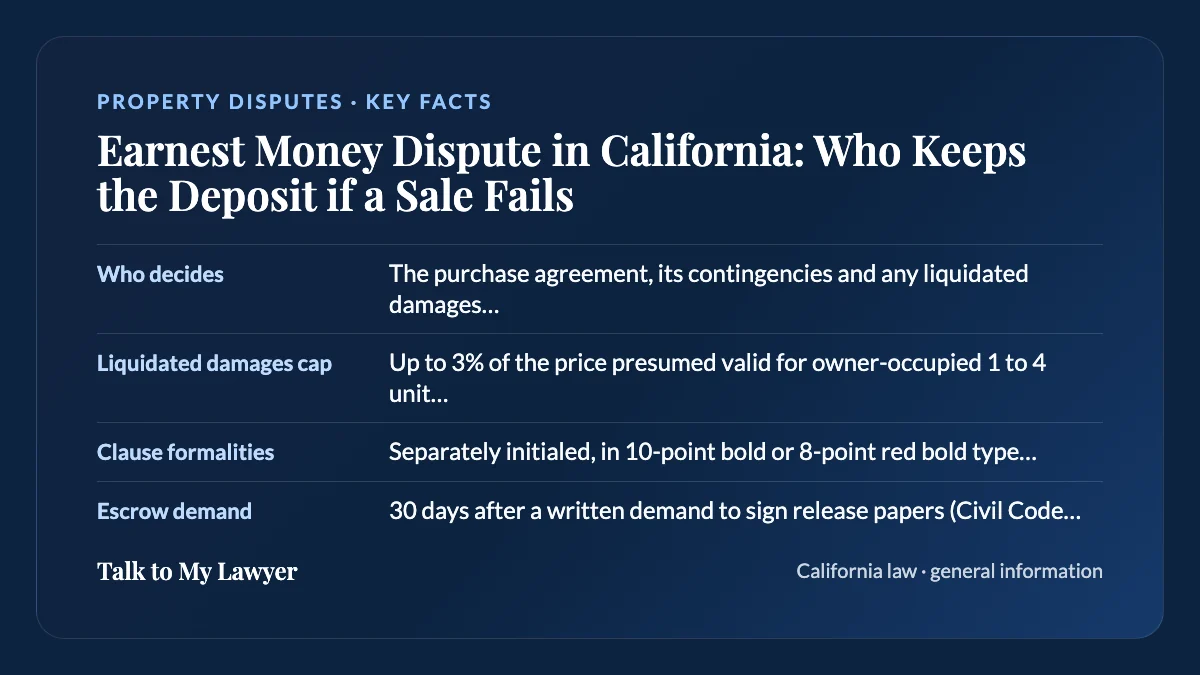
At a glance
- Who decides
- The purchase agreement, its contingencies and any liquidated damages clause
- Liquidated damages cap
- Up to 3% of the price presumed valid for owner-occupied 1 to 4 unit homes (Civil Code 1675)
- Clause formalities
- Separately initialed, in 10-point bold or 8-point red bold type (Civil Code 1677)
- Escrow demand
- 30 days after a written demand to sign release papers (Civil Code 1057.3(b))
- Bad-faith refusal
- The funds, plus treble damages of $100 to $1,000, plus attorney's fees
Who gets the earnest money when a California home sale falls through?
The contract decides. Your purchase agreement says when the buyer may cancel and get the deposit back, when the seller may keep it, and what happens if neither side agrees. California statutes then limit how much a seller can keep and penalize a party who blocks the release of money without a real reason.
Three questions frame a deposit fight:
- Was a contingency still open? Loan, appraisal, inspection and sale-of-home contingencies let a buyer cancel within set periods. A buyer who cancels in time and in the way the contract requires is generally entitled to the deposit back.
- Who failed to perform? A liquidated damages clause compensates the seller when the buyer fails to complete the purchase. If the seller could not deliver clear title or refused to close, that clause does not hand the seller the deposit.
- Did both sides initial a liquidated damages clause? Without one, a seller who claims the buyer defaulted has to prove actual losses instead of simply keeping the deposit.
Reread the cancellation notice that was actually sent, not the one you remember. Its date, the form used and who signed it can decide the dispute.
How does the 3 percent liquidated damages rule work?
For a home of one to four units that the buyer intends to live in, a liquidated damages clause is presumed valid only up to 3% of the purchase price (Civil Code section 1675). Liquidated damages means an amount agreed in advance as the seller's compensation if the buyer defaults.
| Amount kept by the seller | What section 1675 says | Who carries the burden |
|---|---|---|
| 3% of the price or less | Valid to the extent actually paid, unless shown to be unreasonable | The buyer must prove it is unreasonable |
| More than 3% of the price | Invalid unless shown to be reasonable | The seller must prove it is reasonable |
Reasonableness looks at the circumstances when the contract was signed and at the price and terms of any resale, or contract to resell, made within six months of the buyer's default (section 1675(e)). A quick resale at a higher price is the kind of fact that can weigh against the seller.
The clause also has to meet strict formalities. Each party must separately sign or initial it, and in a printed contract it must appear in at least 10-point bold type or in contrasting red print in at least 8-point bold type (Civil Code section 1677). A later deposit counts as liquidated damages only if a separate clause covering that payment is also initialed (Civil Code section 1678). If your deposit was increased partway through escrow, check for that second set of initials.
Why won't escrow just release the deposit?
Escrow is a neutral holder that acts on instructions from both sides, so after a sale collapses it wants both signatures before money moves. If one side refuses to sign, the deposit stays put, and the escrow holder can also file an interpleader action asking a court to decide (Civil Code section 1057.3(g)).
California puts the duty on the buyer and seller, not the escrow officer. Section 1057.3(a) says both parties must make sure deposited funds go back to the person who deposited them, or to whoever the contract entitles, if the purchase does not close on the contract date or a signed extension.
Signing escrow release papers does not by itself cancel the contract or waive a breach claim unless the document says so (section 1057.3(e)). That matters if you want the deposit back and still plan to claim other losses.
The 30-day written demand under Civil Code 1057.3
If the other party fails to sign the documents escrow needs to release the funds within 30 days after your written demand, section 1057.3(b) makes them liable for the funds not held for a good faith dispute, treble damages of not less than $100 and not more than $1,000, and reasonable attorney's fees in an action to enforce the section.
Three limits apply. The liability runs to the person who made the deposit, usually the buyer. The penalty does not apply when the money is withheld to resolve a good faith dispute, meaning the withholding party reasonably believed it was legally entitled to the funds, and the person seeking the money must prove there was no such dispute. The section also covers only property with one to four residential units where the buyer intends to occupy one of them.
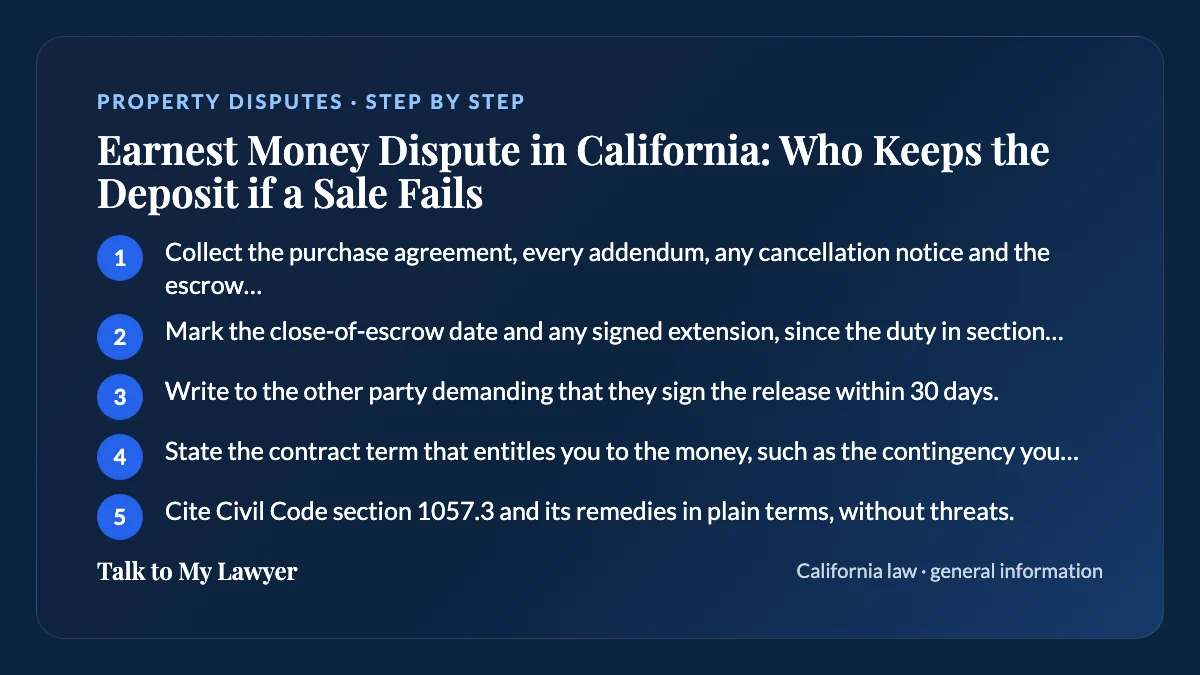
Put the demand in writing and keep it specific:
- Collect the purchase agreement, every addendum, any cancellation notice and the escrow cancellation instructions.
- Mark the close-of-escrow date and any signed extension, since the duty in section 1057.3(a) runs from the missed closing date.
- Write to the other party (and their agent, with a copy to escrow) demanding that they sign the release within 30 days.
- State the contract term that entitles you to the money, such as the contingency you cancelled under and the date you did it.
- Cite Civil Code section 1057.3 and its remedies in plain terms, without threats.
- Keep proof of delivery (certified mail with a return receipt, plus an email copy) and mark day 30 on your calendar.
Example: two deposits, two different answers
Example (hypothetical): two buyers each agree to buy an $800,000 house they plan to live in, and each sale falls apart.
| Buyer A | Buyer B | |
|---|---|---|
| Deposit | $24,000 (3%) | $32,000 (4%) |
| What happened | Cancelled in writing two days before the loan contingency expired after the loan was denied | Removed all contingencies, then backed out three weeks before closing |
| Liquidated damages clause | Initialed by both sides | Initialed by both sides |
| Likely starting point | A timely contingency cancellation points toward a refund | The seller can claim the deposit, but above 3% must prove $32,000 is reasonable |
| If the seller sits on the release | Section 1057.3 demand and possible treble damages if there is no good faith dispute | A good faith dispute may well exist, which would rule out the section 1057.3 penalty and leave the argument over the amount |
These are starting points. Contract wording, notice dates and the resale price can change either result.
What an earnest money demand letter says
Keep the letter short and anchored in documents. It may be forwarded to people who never saw the file, so lead with facts a stranger can check.
On March 3, I delivered a written notice cancelling our purchase agreement for 18 Linden Court under the loan contingency in paragraph 3, two days before that contingency expired. Escrow sent cancellation instructions on March 6, and I signed them that day. I ask that you sign the instructions releasing my $24,000 deposit within 30 days of this letter. Under Civil Code section 1057.3, a party who does not sign within 30 days of a written demand, without a good faith dispute, may be liable for the deposit, treble damages and attorney's fees.
A seller writing to a buyer who walked away can use the same structure: identify the default, the initialed clause and the amount, and ask the buyer to sign the release. Leave out the section 1057.3 penalty, though, because that liability runs only to the person who made the deposit. For more on structure, see the guide to writing a breach of contract demand letter.
What happens if the other side still won't sign?
If day 30 passes, the next step depends on the amount and your contract. Check whether the purchase agreement requires mediation or arbitration first, since some agreements tie attorney's fees to trying mediation before suing. Our guide to mediation before a lawsuit in California explains how that works.
- Small claims: an individual can sue for up to $12,500 (Code of Civil Procedure section 116.221), which may fit a smaller deposit. See sending a demand letter before small claims.
- Civil court: larger deposits go to superior court. Once a section 1057.3 action is filed, escrow deposits the disputed sum, less cancellation charges, with the court and is discharged (section 1057.3(d)).
If the sale failed because the seller hid a problem the inspection uncovered, the deposit may be only part of the claim. Our guide to seller nondisclosure claims covers disclosure duties.
Having an attorney write the escrow release demand
A frozen escrow deposit is a contract question with a statutory clock attached, and the 30-day demand is clearest when it names the exact contingency, notice date and clause. Having an attorney write that demand is worth considering when the deposit is large, when the other side has its own lawyer, when the liquidated damages clause or its initials are in doubt, or when you expect to argue there was no good faith dispute.
Through Talk to My Lawyer, a licensed California attorney writes your letter from your purchase agreement, cancellation notice and escrow papers, and sends it on your behalf. Whether to sue for the deposit or other losses is worth talking through with a lawyer who has read your contract.
Frequently asked questions
Can a California seller keep earnest money if the buyer backs out?
Only if the contract allows it. A buyer who cancels within an open contingency period, following the contract's notice rules, is generally entitled to the deposit back. If the buyer defaults after removing contingencies, a seller can keep the deposit as liquidated damages only if both parties separately initialed a valid clause. For an owner-occupied home of up to four units, more than 3% of the price is presumed invalid.
How long can a seller hold up my earnest money in escrow?
There is no fixed release date, because escrow needs both signatures. What California adds is a penalty: if a party fails to sign the release documents within 30 days after a written demand, and there is no good faith dispute over the money, they can owe the person who made the deposit the funds, treble damages between $100 and $1,000, and attorney's fees under Civil Code section 1057.3.
Is the 3% cap a hard limit on liquidated damages?
No. It sets who carries the burden. If the seller keeps 3% or less, the clause is valid unless the buyer proves the amount unreasonable. Above 3%, the clause is invalid unless the seller proves the amount reasonable. The rule in Civil Code section 1675 applies to homes of one to four units the buyer intended to occupy, with a separate process for certain new condominium sales.
Does signing escrow cancellation instructions give up my other claims?
Not automatically. Civil Code section 1057.3(e) says that signing documents to release escrow funds, or accepting released funds, does not cancel the underlying purchase contract unless the document specifically says so. Read any release language before you sign, since the parties can write a cancellation or mutual release into it.
Can I sue for my earnest money in small claims court?
Yes, if the amount fits. Small claims court hears cases brought by individuals for up to $12,500. Larger deposits go to superior court. Check your purchase agreement first, since it may require mediation or arbitration and may affect whether attorney's fees are recoverable. Bring a copy of your written demand to the hearing.
Sources
Checked against these official sources on October 18, 2026.
- California Civil Code section 1675 (California Legislative Information)
- California Civil Code section 1677 (California Legislative Information)
- California Civil Code section 1678 (California Legislative Information)
- California Civil Code section 1057.3 (California Legislative Information)
- California Code of Civil Procedure section 116.221 (California Legislative Information)
This guide explains California law in general terms as of October 2026. It is general information, not legal advice for your situation, and local rules can add to it.
Join the email list and get a lawyer letter started
With Talk to My Lawyer, a licensed California attorney writes your letter from your facts and documents and sends it on your behalf. Join the Talk to My Lawyer email list for letter checklists, document prompts, and reminders before you start your letter.