Quick answer
If a seller did not disclose defects in California, start with the Real Estate Transfer Disclosure Statement required by Civil Code section 1102.6. Sellers must make disclosures in good faith, cannot waive them in an "as is" sale, and are liable for actual damages if they willfully or negligently fail to disclose (Civil Code 1102.13). Fraud claims generally have a three-year deadline that runs from discovery.
At a glance
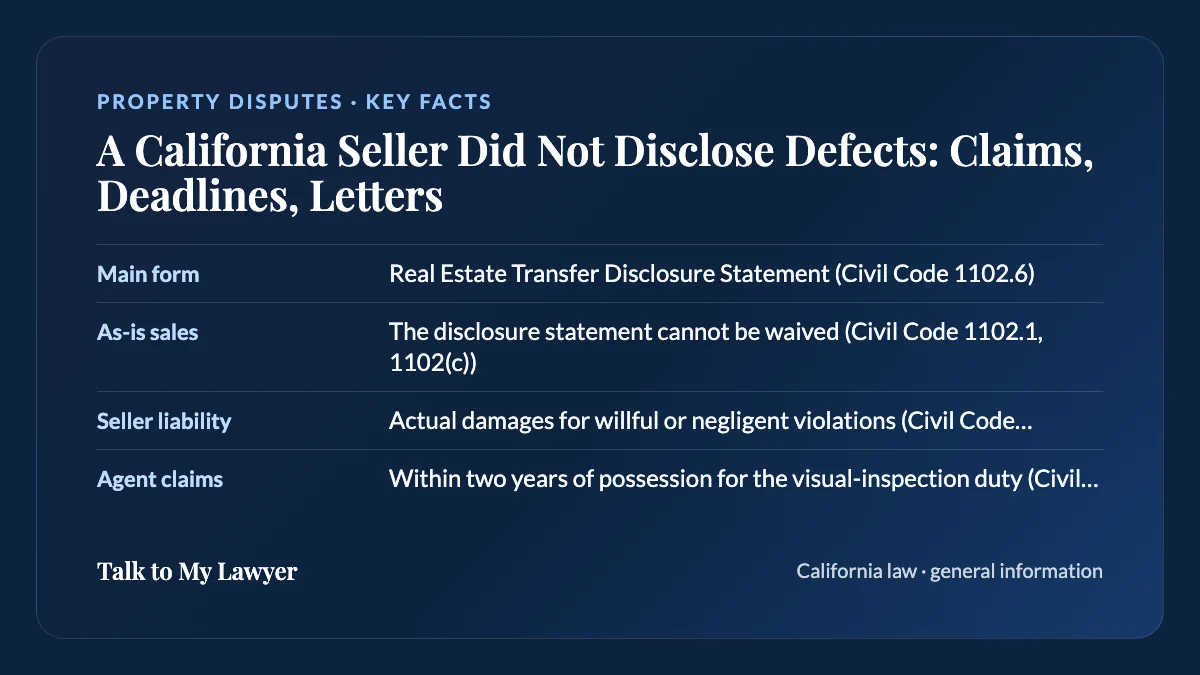
- Main form
- Real Estate Transfer Disclosure Statement (Civil Code 1102.6)
- As-is sales
- The disclosure statement cannot be waived (Civil Code 1102.1, 1102(c))
- Seller liability
- Actual damages for willful or negligent violations (Civil Code 1102.13)
- Agent claims
- Within two years of possession for the visual-inspection duty (Civil Code 2079.4)
- Fraud deadline
- Three years from discovery of the facts (Code of Civil Procedure 338(d))
What does a California home seller have to disclose?
A California seller of single-family residential property must give the buyer a completed Real Estate Transfer Disclosure Statement, often called the TDS, as soon as practicable before title transfers (Civil Code sections 1102.3 and 1102.6). The statutory form in section 1102.6 walks the seller through the home's features and condition and asks about defects and other problems the seller knows of.
Every disclosure must be made in good faith, which the statute defines as honesty in fact (section 1102.7). The listed items are a starting point: section 1102.8 says the article does not limit any other disclosure duty needed to avoid fraud, misrepresentation or deceit.
Some transfers are exempt under section 1102.2, including court-ordered and probate sales, foreclosure sales, transfers between co-owners, transfers to a spouse or blood relative, and sales by fiduciaries administering a trust, guardianship, conservatorship or estate. That last exemption does not cover an individual trustee of a revocable trust who is a former owner of the home or lived there within the preceding year.
If a disclosure or a material amendment arrives after you made your offer, you have three days after personal delivery, or five days after delivery by mail or electronically, to terminate the offer in writing (section 1102.3). That window has passed by the time defects surface after closing, but the delivery dates still matter as evidence.
Does an as-is sale let the seller stay quiet about defects?
No. California's Legislature stated that delivery of the transfer disclosure statement may not be waived in an "as is" sale (Civil Code section 1102.1(a)), and any waiver of the disclosure article is void as against public policy (section 1102(c)).
An as-is clause usually means the seller will not make repairs and the buyer accepts the property's condition. It does not turn a known leak into a secret the seller may keep. What the seller knew, and when, sits at the center of a nondisclosure claim.
The statute also protects sellers who acted honestly. Under section 1102.4, a seller or agent is not liable for an error or omission that was not within their personal knowledge, came from a public agency or a licensed expert's report, and was passed on with ordinary care.
Which disclosure rules changed in 2024 to 2026?
The disclosure article keeps growing. As of October 2026, these recent additions are worth checking against your paperwork. Under section 1102.5(b), the rules in effect on the date all parties entered the contract are the ones that apply, so the date you signed matters.
| Rule | What the seller must disclose | Applies to |
|---|---|---|
| Recent flips (section 1102.6h) | Additions, structural changes and repairs done by contractors since the seller took title, contractor names, and permits | Offers accepted within 18 months of the seller taking title, on or after July 1, 2024 |
| Fire hazard zones (section 1102.6f) | A list of low-cost wildfire retrofits and which ones the seller completed | Homes built before 2010 in high or very high fire hazard zones, from July 1, 2025 |
| Electrical systems (section 1102.6i) | A statement advising an inspection of panels and wiring | From January 1, 2026, except buildings within three years of their certificate of occupancy |
| Gas appliances (section 1102.6j) | Known state or local rules on replacing gas appliances that come with the home | From January 1, 2026 |
| Smoking residue (section 1102.6k, AB 455) | Actual knowledge of tobacco or nicotine residue, or a history of occupants smoking or vaping | Effective January 1, 2026 |
Can you hold the real estate agent responsible?
Sometimes. For homes of one to four units, a licensed agent who has a written contract with the seller to find a buyer, or who cooperates with that agent, must conduct a reasonably competent and diligent visual inspection and disclose to the buyer all facts materially affecting value or desirability that an investigation would reveal (Civil Code section 2079).
That duty has a short deadline. A lawsuit for breach of it must be filed within two years from the date of possession, meaning recordation, close of escrow or occupancy, whichever came first (section 2079.4). Claims that an agent knowingly concealed a defect may rest on other law with different deadlines.
How long do you have to bring a nondisclosure claim?
It depends on the legal theory, which is why the dates in your file deserve as much attention as the defect:
- Fraud or concealment: three years, but the clock does not start until you discover the facts constituting the fraud (Code of Civil Procedure section 338(d)).
- Agent's inspection duty: no more than two years from possession (Civil Code section 2079.4).
- Breach of the purchase contract: the contract claim deadline, which our guide to the California statute of limitations explains.
Section 1102.13 says a sale is not undone just because a disclosure rule was broken, but a person who willfully or negligently fails to perform a disclosure duty is liable for the buyer's actual damages. Write down the date you first noticed the problem and what you saw. If the home is newly built, the builder rules are different; see our guide to construction defect claims.
How to put a nondisclosure demand letter together
A nondisclosure letter stands on proof of what the seller knew. Gather documents first, then write. Our demand letter evidence checklist covers general record-keeping; these items are specific to home sales:
- The signed TDS, the Seller Property Questionnaire if one was used, and any amendments.
- Your inspection reports and the seller's pre-listing reports.
- Repair estimates and invoices, with photos dated from when you found the defect.
- Proof the seller knew: prior repair invoices, permit records, insurance claims, HOA notices, or neighbors' accounts.
- The listing and marketing materials, which sometimes describe work that the TDS left out.
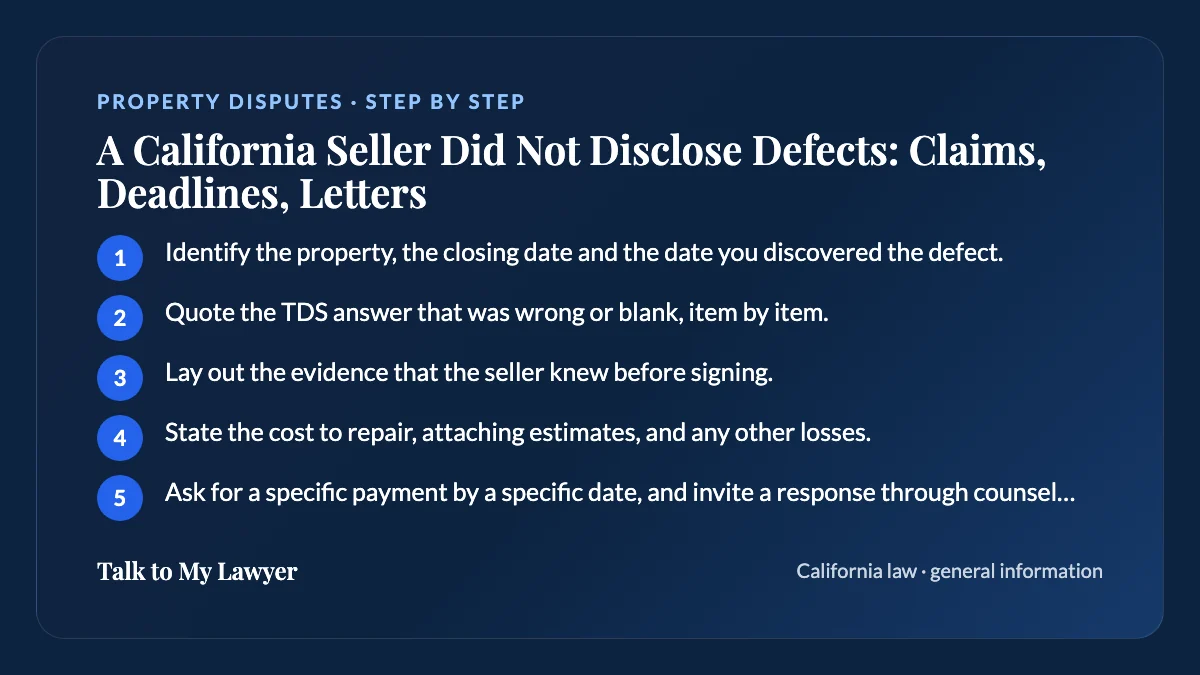
- Identify the property, the closing date and the date you discovered the defect.
- Quote the TDS answer that was wrong or blank, item by item.
- Lay out the evidence that the seller knew before signing.
- State the cost to repair, attaching estimates, and any other losses.
- Ask for a specific payment by a specific date, and invite a response through counsel if the seller has one.
- Copy both agents if you believe they also knew, and keep proof of delivery.
Sample wording for a letter to the seller
Your Transfer Disclosure Statement dated May 2 disclosed no roof leaks or water intrusion. After the first rain in November, water entered the northwest bedroom. The roofer we hired found a patch dated 2023 and an invoice addressed to you for the same area. Repairing the roof and the ceiling is estimated at $14,600. Civil Code section 1102.7 requires disclosures to be made in good faith. Please confirm by December 15 whether you will pay this amount.
Facts, documents and a number. Leave out guesses about motive, and do not overstate what the evidence shows.
Bringing an attorney in on a hidden-defect claim
A hidden-defect claim turns on what the seller knew and when, and the two-year agent deadline runs from possession, not discovery. Having an attorney write the demand is a reasonable step when the repair costs are significant, when both a seller and agents may share responsibility, when your purchase agreement has a mediation or attorney's fee clause, or when the seller has already denied knowing.
Through Talk to My Lawyer, a licensed California attorney writes your letter from your disclosure documents, inspection reports and repair estimates, and sends it on your behalf, with copies to anyone else involved in the sale. Whether to file suit, and which deadlines apply to your purchase, are questions for a lawyer who has seen your file.
Frequently asked questions
Can I sue a seller for not disclosing defects in California?
You can bring a claim if the seller knew of a material defect and failed to disclose it, or disclosed it falsely. Civil Code section 1102.13 makes a seller who willfully or negligently fails to perform a disclosure duty liable for your actual damages, and fraud or contract claims may also apply. The sale itself stays valid, so the claim is usually for money, such as repair costs.
What if the seller says they did not know about the problem?
Under Civil Code section 1102.4, a seller is not liable under the disclosure article for an error or omission that was not within their personal knowledge, was based on information from a public agency or a licensed expert's report, and was passed on with ordinary care. That is why evidence of knowledge matters: earlier repair invoices, permits, insurance claims or notices the seller received can show they knew.
Do I have a claim if I bought the house as is?
Possibly. California does not allow the transfer disclosure statement to be waived in an as-is sale, and a waiver of the disclosure rules is void. An as-is clause usually means the seller will not repair, not that the seller may hide known defects. Your inspection contingency and what your own inspector found may still affect the claim.
How long do I have to sue my real estate agent for failing to disclose?
For the statutory duty to visually inspect and disclose, Civil Code section 2079.4 sets a limit of two years from the date of possession, which means recordation, close of escrow or occupancy, whichever occurred first. Claims of intentional concealment may follow different deadlines. Because the two-year period runs from possession, not discovery, it can expire before a defect even appears.
Does the seller have to disclose that someone smoked in the house?
For single-family homes, yes, if the seller actually knows. Civil Code section 1102.6k, added by AB 455 and effective January 1, 2026, requires a seller with actual knowledge of tobacco or nicotine residue, or of a history of occupants smoking tobacco or nicotine products on the property, to disclose it in writing. Using an e-cigarette or vape device counts as smoking under the section.
Sources
Checked against these official sources on October 18, 2026.
- Civil Code Article 1.5, Disclosures Upon Transfer of Residential Property (sections 1102 to 1102.19) (California Legislative Information)
- California Civil Code section 2079 (California Legislative Information)
- California Civil Code section 2079.4 (California Legislative Information)
- California Code of Civil Procedure section 338 (California Legislative Information)
- File a Complaint (California Department of Real Estate)
This guide explains California law in general terms as of October 2026. It is general information, not legal advice for your situation, and local rules can add to it.
Join the email list and get a lawyer letter started
With Talk to My Lawyer, a licensed California attorney writes your letter from your facts and documents and sends it on your behalf. Join the Talk to My Lawyer email list for letter checklists, document prompts, and reminders before you start your letter.