Quick answer
A construction defect claim on a new California home usually runs through the Right to Repair Act (SB 800, Civil Code 895 to 945.5). Before suing, you send the builder written notice by certified mail, overnight mail or personal delivery. The builder must acknowledge within 14 days, may inspect, and may offer a repair within 30 days of inspecting. The general outer limit is 10 years after substantial completion.
At a glance
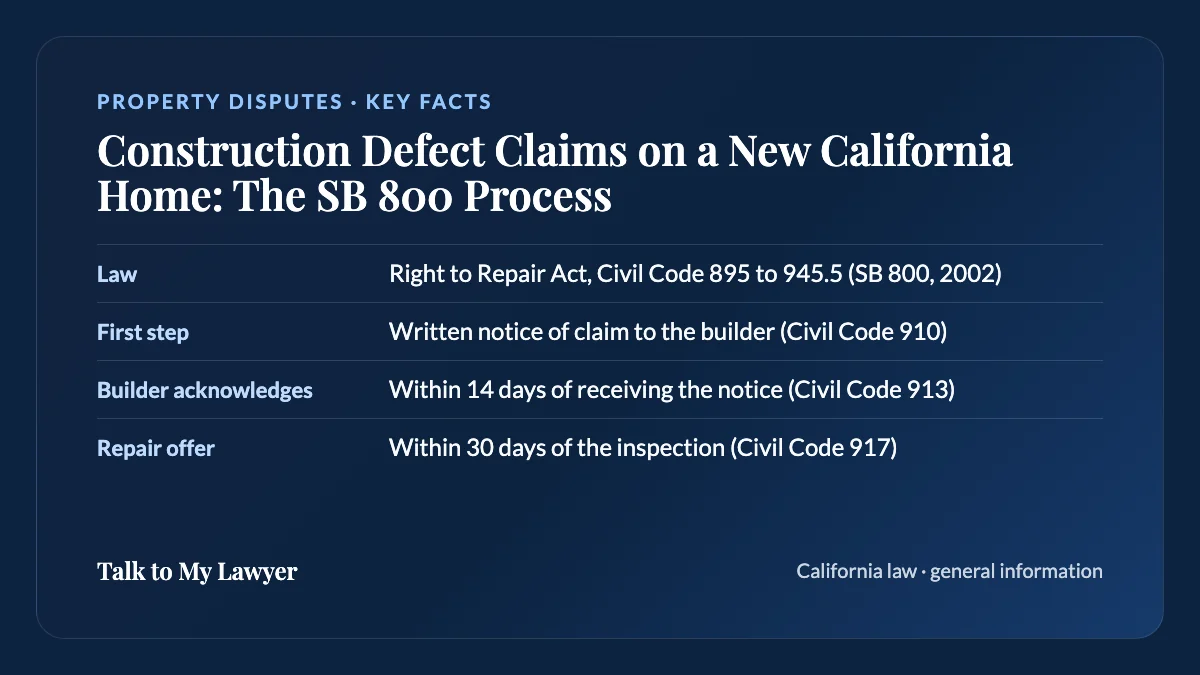
- Law
- Right to Repair Act, Civil Code 895 to 945.5 (SB 800, 2002)
- First step
- Written notice of claim to the builder (Civil Code 910)
- Builder acknowledges
- Within 14 days of receiving the notice (Civil Code 913)
- Repair offer
- Within 30 days of the inspection (Civil Code 917)
- Outer limit
- 10 years after substantial completion, shorter for some items (Civil Code 896, 941)
Does California's Right to Repair Act cover your home?
It covers original construction intended to be sold as an individual dwelling unit, which takes in new single-family homes, townhomes and condominiums sold by a builder (Civil Code section 896). For condominium conversions, it does not displace other statutory or common law.
A "builder" is the developer, contractor or original seller that was in the business of selling or building homes for the public at that project (section 911). A general contractor with no affiliation to the builder is generally not a "builder" under that definition. The act binds original buyers and their successors, so a second owner who bought the home a few years in can use it too (section 945).
The act sets performance standards instead of asking you to prove exactly what went wrong. Under section 942, you need only show the home does not meet the applicable standard; no further proof of causation or damages is needed for the violation itself, as long as it relates to the original construction.
Remodels and work by a contractor you hired yourself fall outside the act. For those, see our guide to a contractor refund demand letter. If you bought a resale home and the seller hid a problem, our guide to seller nondisclosure claims is the better fit.
What counts as a defect, and how long do you have?
Section 896 lists standards for water intrusion, structural integrity, soils, fire protection, plumbing, electrical systems and many finish items. The general limit is 10 years after substantial completion (section 941), but several standards carry their own shorter limits counted from close of escrow.
| Standard (section 896) | Time limit to bring an action |
|---|---|
| Water through doors, windows, roofs, decks, foundations | Generally 10 years after substantial completion |
| Plumbing and sewer systems; electrical systems | 4 years from close of escrow |
| Hardscape, driveways and patios with excessive cracks; untreated steel fences | 4 years from close of escrow |
| Paint and stains | 5 years from close of escrow |
| Untreated wood posts in soil; landscaping; dryer ducts | 2 years from close of escrow |
| Irrigation and drainage | 1 year from close of escrow |
| Noise between attached units | 1 year from original occupancy of the adjacent unit |
Cabinets, mirrors, flooring, countertops, walls, paint finishes and trim are handled differently. The builder must give at least a one-year written warranty on their fit and finish, and those items are outside the act's claim process (section 900).
How do you give a builder notice of a construction defect?
You send a written notice of claim by certified mail, overnight mail or personal delivery to the builder (Civil Code section 910). The notice must include your name, address and preferred contact method, state that you allege a violation under this part, and describe the problem in enough detail to show its nature and location, as far as you know it.
Send it to the agent for notice the builder keeps on file with the California Secretary of State, or to the third party named in your sales documents (section 912(e)). Your closing package should also include a copy of the act and a notice recorded on title (section 912(f) and (g)).
You can also ask in writing for the plans, specifications, soils reports, maintenance recommendations and warranties for your home. The builder must provide them within 30 days, at your copying expense (section 912(a) to (d)).
The builder's deadlines after your notice
Chapter 4 of the act runs on fixed days, and section 930 says those time periods are strictly construed unless you knowingly agree in writing to extend them.
| Step | Deadline | Section |
|---|---|---|
| Builder acknowledges your notice in writing | 14 days after receipt | 913 |
| Initial inspection and testing | 14 days after acknowledgment | 916(a) |
| Second inspection, if the builder gives written reasons within 3 days of the first | Within 40 days of the first | 916(c) |
| Written offer to repair | 30 days after the last inspection | 917 |
| Your decision: accept, or ask for up to 3 other contractors | 30 days after the offer | 918 |
| Repair begins | 14 days after you accept (other triggers apply) | 921(a) |
If the builder misses a step, such as failing to acknowledge, declining the process, skipping the inspection or not making an offer, you are released from the prelitigation procedure and may file suit, with the act's standards still applying (sections 915, 916(d) and 920).
Repair offer or cash offer: what each one means
A repair offer must come with a detailed, step-by-step statement of what will be fixed, where and by when, plus the names and license numbers of the contractors (section 917). It must also offer mediation of up to four hours with a mediator the builder pays for (section 919). If the builder will repair only some items, it must explain in writing why it is leaving the others (section 924).
- Repair: the builder cannot demand a release in exchange, and you can still sue afterward over the original violation or an inadequate repair (section 926). Every effort must be made to finish within 120 days (section 921(b)).
- Cash only: the builder may offer money instead of a repair, and may ask for a reasonable release in return (section 929). You can accept or reject it and file suit.
- Recording: you may photograph or video the inspections and the repair work (sections 916(a) and 922).
Damages under section 944 cover the reasonable cost of repair, damage caused by the defect or by the repair, relocation and storage expenses, certain lost business income and reasonable investigative costs.
Does the notice process pause the statute of limitations?
Partly. If a limitation period would otherwise run out during the process, section 927 extends the time to file until 100 days after the repair is completed. If the builder fails to acknowledge, opts out or does not request an inspection on time, the extension runs to 45 days after its response time expired. Repairs themselves do not otherwise restart the 10-year period (section 941(e)).
Keep your own timeline alongside the builder's. Our guide to the California statute of limitations covers deadlines for claims outside the act, such as fraud.
Writing your notice of claim, step by step
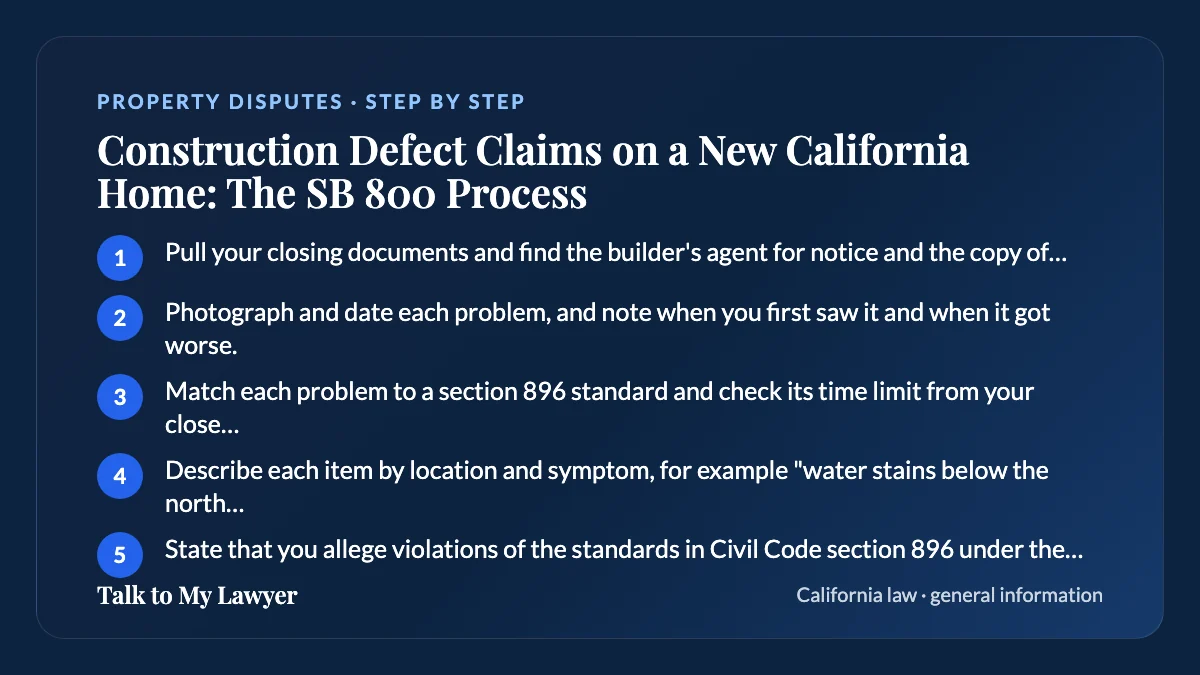
- Pull your closing documents and find the builder's agent for notice and the copy of the act you initialed.
- Photograph and date each problem, and note when you first saw it and when it got worse.
- Match each problem to a section 896 standard and check its time limit from your close of escrow date.
- Describe each item by location and symptom, for example "water stains below the north living room window after rain."
- State that you allege violations of the standards in Civil Code section 896 under the Right to Repair Act.
- Request plans, soils reports and maintenance documents under section 912 in the same letter or separately.
- Send by certified or overnight mail, keep the receipt, and calendar day 14.
This is a notice of claim under Civil Code section 910. We own 2207 Larkspur Way, which closed escrow on June 14, 2024. We allege that the residence violates the standards in Civil Code section 896(a), because water passes around the second-floor north bedroom window during rain, and section 896(g), because the rear patio has cracks with significant vertical displacement. Please contact us by email at the address below. We also request the documents described in section 912(a) to (d).
If your home is in a community with a homeowners association, common-area defects may be the association's claim. Our guide to HOA disputes covers working with the board.
When the SB 800 notice comes from an attorney
An SB 800 notice starts a clock that section 930 says must be strictly construed, so a notice that is incomplete or sent the wrong way can cost weeks. Section 913 also requires a builder to include your attorney in all later substantive communications once your lawyer serves the notice or sends a representation letter. Attorney involvement is worth weighing when defects affect structure or water intrusion, several items have different time limits, or the builder has already pointed you back to its warranty desk.
Through Talk to My Lawyer, a licensed California attorney writes your notice of claim from your closing documents, photos and inspection notes, cites the section 896 standards that fit, and sends it on your behalf by a delivery method the act allows. Questions about accepting a repair offer, signing a release or filing suit belong with a lawyer who has seen your documents.
Frequently asked questions
Do I have to give the builder a chance to fix defects before suing in California?
For claims under the Right to Repair Act, yes. Civil Code section 910 requires written notice to the builder before filing, and the builder may then inspect and offer to repair. If you sue without following the process, the builder can ask the court to stay the case. If the builder misses its own deadlines, you are released and may file.
How long does a builder have to respond to an SB 800 notice?
The builder must acknowledge your notice in writing within 14 days of receiving it, complete any initial inspection within 14 days after acknowledging, and make any written repair offer within 30 days of the last inspection. The builder may hold a second inspection if it gives written reasons within three days of the first, and must finish it within 40 days of the first. The statute says these time periods are strictly construed.
What is the statute of limitations for construction defects on a new home in California?
Under the Right to Repair Act, the general limit is 10 years after substantial completion (Civil Code section 941). Some standards have shorter limits from close of escrow: one year for irrigation and drainage, two years for landscaping and dryer ducts, four years for plumbing and electrical, and five years for paint. Fraud and contract claims follow other deadlines.
Can I choose my own contractor for the repair?
Not entirely. After a repair offer, you may ask the builder to name up to three alternative contractors who are not owned or controlled by the builder and who work in your county. The builder has 35 days to present them, and you then have 20 days to authorize the builder or one of those contractors to do the work (Civil Code section 918).
Does the Right to Repair Act apply if I am not the original buyer?
Yes. Civil Code section 945 says the act's standards, rights and obligations bind original purchasers and their successors in interest. A later owner can send a notice of claim, subject to the same time limits counted from the original close of escrow or substantial completion, so a home bought several years after construction may have little time left on shorter standards.
Sources
Checked against these official sources on October 18, 2026.
- Civil Code Title 7, Chapter 2: Actionable Defects (section 896) (California Legislative Information)
- California Civil Code section 900 (California Legislative Information)
- Civil Code Title 7, Chapter 4: Prelitigation Procedure (sections 910 to 938) (California Legislative Information)
- Civil Code Title 7, Chapter 5: Procedure (sections 941 to 945.5) (California Legislative Information)
This guide explains California law in general terms as of October 2026. It is general information, not legal advice for your situation, and local rules can add to it.
Join the email list and get a lawyer letter started
With Talk to My Lawyer, a licensed California attorney writes your letter from your facts and documents and sends it on your behalf. Join the Talk to My Lawyer email list for letter checklists, document prompts, and reminders before you start your letter.