Quick answer
Free mediation for a California dispute is available through county programs funded under California's dispute resolution programs law (Business and Professions Code 465 and following), which must offer services on a sliding scale and at no cost to people who are indigent. Some small claims courts also offer free or low-cost mediation before or on the hearing day. What is said in mediation is generally confidential under Evidence Code 1119.
At a glance
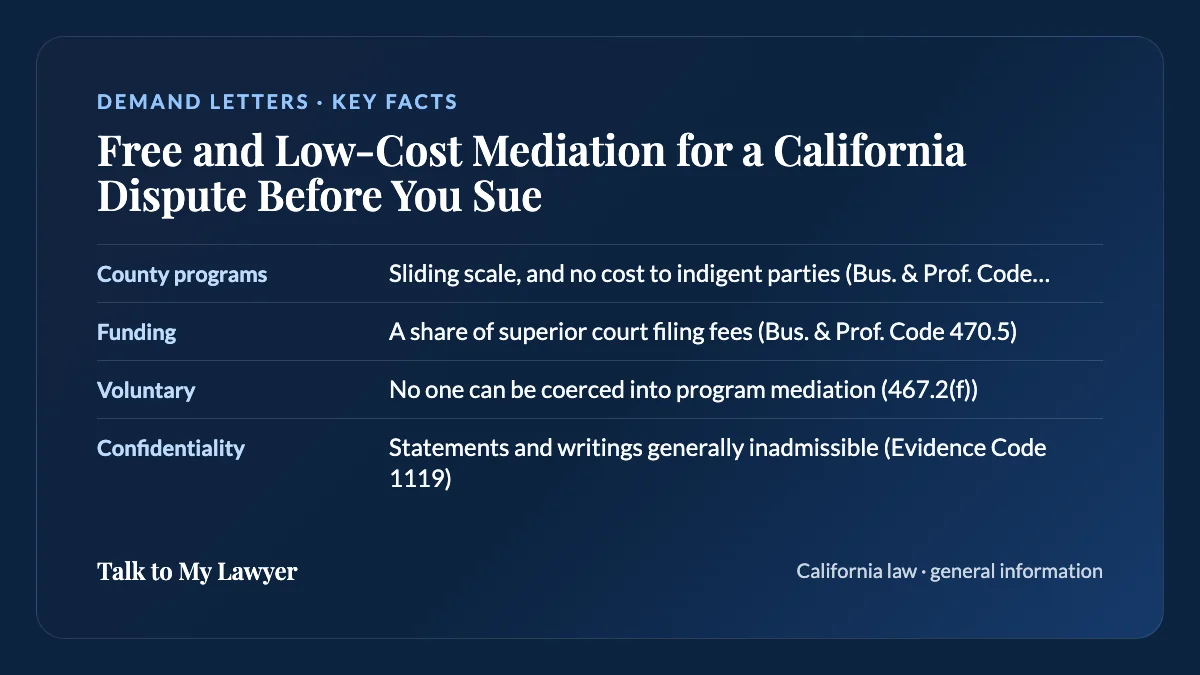
- County programs
- Sliding scale, and no cost to indigent parties (Bus. & Prof. Code 467.2)
- Funding
- A share of superior court filing fees (Bus. & Prof. Code 470.5)
- Voluntary
- No one can be coerced into program mediation (467.2(f))
- Confidentiality
- Statements and writings generally inadmissible (Evidence Code 1119)
- Agreements
- Signed written settlement admissible if it says it is binding (Evidence Code 1123)
Is there free mediation for disputes in California?
Yes, in counties that run programs under state law. California's dispute resolution programs law, passed in 1986 (Business and Professions Code sections 465 to 471.5), lets counties fund local mediation programs with a share of superior court filing fees (Business and Professions Code 470.5). To qualify for that money, a program must provide dispute resolution on a sliding scale and without cost to indigents (section 467.2(c)).
Courts add a second route. The California Courts Self-Help Guide says many small claims courts offer free or low-cost mediation before the hearing or on the hearing day, and county programs can help before or after a case is filed. Availability, eligibility and fees vary by county, so check before you count on it.
- Your county superior court's ADR or small claims page.
- Your county's small claims advisor or court clerk.
- The Department of Consumer Affairs list of local dispute resolution programs.
- Your local bar association's lawyer referral service, for private mediators.
How does mediation work?
A neutral person, the mediator, helps you and the other side talk and look for an agreement you both accept. Evidence Code section 1115 defines mediation that way. The mediator does not decide who is right or impose a result.
In a program funded under the Act, the rules add protections:
- Participation is voluntary, and no one may be coerced into it (467.2(f)).
- Before the session, the program gives you a written statement of the process and your rights, including the right to bring a lawyer as the program's rules permit (467.3).
- Unless you agreed to a binding award, you can withdraw and go to court (467.7).
- Mediators must be trained in conflict resolution under the program rules (467.2(b)).
Is what you say in mediation confidential in California?
Generally, yes. Under Evidence Code section 1119, anything said and any writing prepared for or during a mediation is not admissible or subject to discovery in a later civil case, arbitration or other noncriminal proceeding, and the communications remain confidential. Section 467.5 of the Business and Professions Code extends these rules to everything a funded program conducts, including conciliation.
| Rule | What it means for you |
|---|---|
| Evidence Code 1119 | Your offers and admissions in mediation generally cannot be used against you in court |
| Evidence Code 1120 | A document that was admissible before mediation does not become protected just because you showed it there |
| Evidence Code 1121 | The mediator cannot report to the court on who was reasonable, beyond whether an agreement was reached |
| Evidence Code 1126 | Confidentiality continues after the mediation ends |
| Evidence Code 1129 | A lawyer representing you must give you a printed disclosure of these rules and get your signed acknowledgment |
Is a mediated agreement legally binding?
It can be, if you write it the right way. Evidence Code section 1123 says a signed written settlement prepared in mediation is not shielded by confidentiality if, among other options, it states that it is enforceable or binding, or words to that effect.
Program agreements carry an extra rule. Under Business and Professions Code 467.4(a), an agreement reached with a funded program is not enforceable in court or admissible as evidence unless the parties consent or the agreement clearly says they intend it to be. Our guide to a settlement agreement and release covers what the written terms should include.
When should you propose mediation in a demand letter?
Mediation fits disputes where the facts are messy, the relationship continues, or both sides have a point: neighbors, landlords and tenants, business partners, family members and contractors mid-project. It also fits when the amount is modest compared with the cost of litigation.
Propose it after you state your demand, not instead of it. That way the reader knows your position and the alternative.
If you dispute any part of this amount, I am willing to meet with a neutral mediator through the county dispute resolution program within the next 30 days. Please let me know by November 14 whether you will pay the amount above or agree to mediate, and I will send the program's contact details.
Watch your filing deadline. Mediation does not stop the statute of limitations on its own, but under section 467.4(b) the parties can sign an agreement suspending it for as long as the program's process lasts. See our California statute of limitations table for common deadlines.
How to set up mediation before a lawsuit, step by step
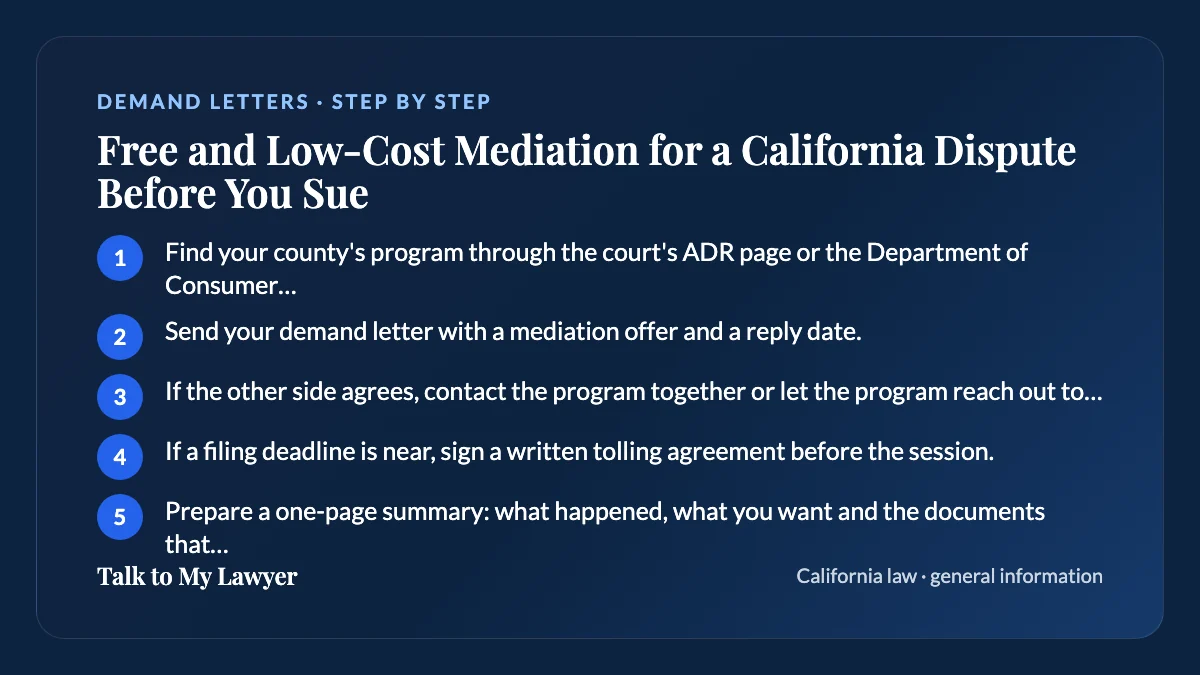
- Find your county's program through the court's ADR page or the Department of Consumer Affairs list, and ask about fees and eligibility.
- Send your demand letter with a mediation offer and a reply date.
- If the other side agrees, contact the program together or let the program reach out to them.
- If a filing deadline is near, sign a written tolling agreement before the session.
- Prepare a one-page summary: what happened, what you want and the documents that support it.
- Decide in advance the lowest terms you would accept and what matters besides money.
- If you reach agreement, put it in writing, sign it, and state that it is binding and enforceable.
Mediation, small claims or arbitration?
| Mediation | Small claims | Arbitration | |
|---|---|---|---|
| Who decides | You and the other side | A judge | An arbitrator |
| Lawyers | Allowed, subject to program rules | Not at the hearing | Allowed |
| Confidential | Generally yes (Evidence Code 1119) | Public hearing | Depends on the rules and agreement |
| Result | Only what both sides sign | Judgment | Award, binding or nonbinding |
| Can include non-money terms | Yes | Limited | Depends on the agreement |
Mediation and small claims can work together. If mediation fails, you can still file, and the demand letter before small claims you already sent satisfies the court's ask-first step.
A demand that leaves the door open to mediation
A good mediation offer starts with a clear demand: the facts, the amount, the deadline and a calm invitation to sit down with a neutral. An attorney-written letter can pair that offer with a tolling proposal when the filing deadline is close.
Through Talk to My Lawyer, a licensed California attorney writes your letter from your facts and documents, can include a mediation proposal, and sends it on your behalf. Whether mediation suits your dispute is worth a short conversation with a lawyer about your facts.
Frequently asked questions
Is mediation legally binding in California?
Mediation itself is not binding; the mediator does not decide anything. An agreement you reach can be. A signed written settlement that states it is enforceable or binding can be used in court despite mediation confidentiality (Evidence Code 1123). For agreements made through a county program, Business and Professions Code 467.4 requires that intention to be clearly stated.
Can someone be forced to mediate in California?
Not in a county program funded under the state's dispute resolution programs law, which must be voluntary and may not coerce anyone (Bus. & Prof. Code 467.2(f)). A contract can contain a mediation clause, and courts can order or refer some filed civil cases to mediation under court rules and local programs. Check your contract and your court's ADR page.
How much does a mediator cost in California?
It varies. County programs funded under the Act must offer services on a sliding scale and at no cost to indigent parties. Some small claims courts offer free or low-cost mediation. Private mediators set their own fees, which differ widely, so ask before booking. Your court's small claims advisor or ADR office can point you to local options.
Can what I say in mediation be used against me in court?
Generally no. Evidence Code 1119 makes statements, admissions and writings prepared for a mediation inadmissible and not subject to discovery in later civil proceedings. But evidence that was admissible before the mediation stays admissible (Evidence Code 1120), so showing a contract or photo in mediation does not shield it. Confidentiality survives after the mediation ends.
Does mediation stop the statute of limitations?
Not automatically. The deadline keeps running unless the parties agree otherwise. Business and Professions Code 467.4(b) lets the parties agree in writing to toll the statute of limitations while a county program's process is pending, and CCP 360.5 allows signed written waivers. If your deadline is near, get the tolling agreement signed before the session.
Sources
Checked against these official sources on October 18, 2026.
- California Business and Professions Code, Chapter 8: Dispute Resolution Programs (sections 465 to 471.5) (California Legislative Information)
- California Evidence Code, Chapter 2: Mediation (sections 1115 to 1129) (California Legislative Information)
- Why mediate in small claims (California Courts Self-Help Guide)
- Local Dispute Resolution Programs (California Department of Consumer Affairs)
This guide explains California law in general terms as of October 2026. It is general information, not legal advice for your situation, and local rules can add to it.
Join the email list and get a lawyer letter started
With Talk to My Lawyer, a licensed California attorney writes your letter from your facts and documents and sends it on your behalf. Join the Talk to My Lawyer email list for letter checklists, document prompts, and reminders before you start your letter.