Quick answer
A settlement agreement after a demand letter should name the parties, state the amount and payment dates, describe exactly which claims are released, and say what happens if payment is missed. In California, a general release does not cover unknown claims unless you waive Civil Code section 1542. Some confidentiality terms are void, including clauses hiding facts of sexual harassment or workplace discrimination claims.
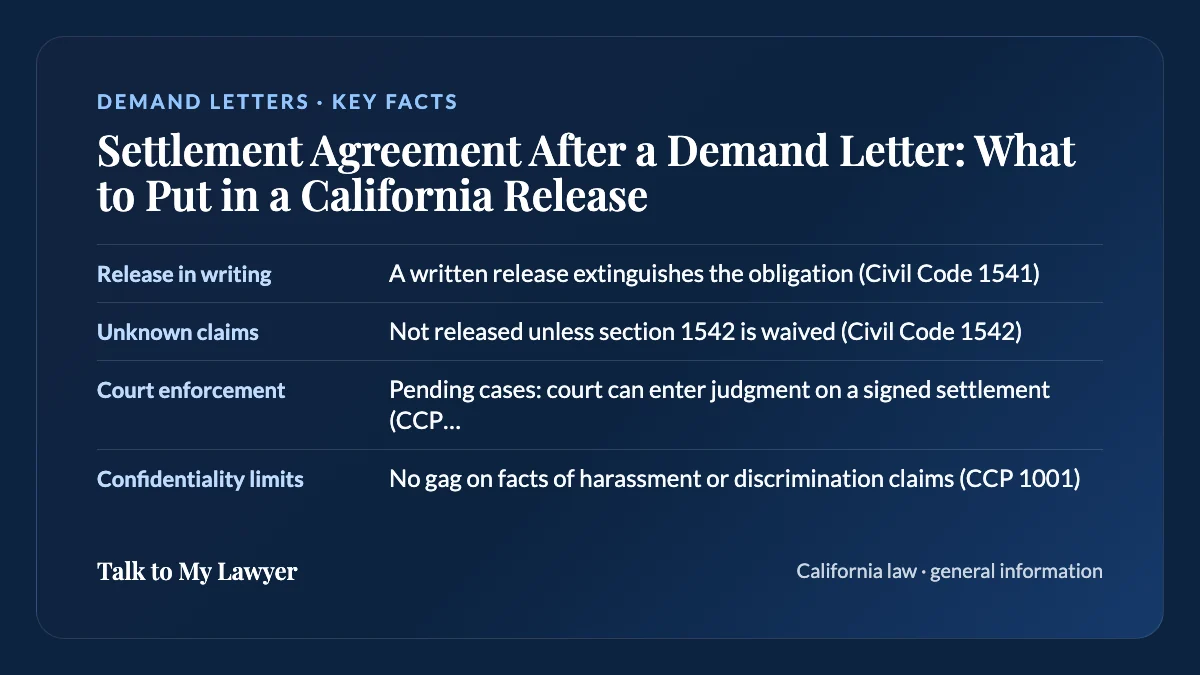
At a glance
- Release in writing
- A written release extinguishes the obligation (Civil Code 1541)
- Unknown claims
- Not released unless section 1542 is waived (Civil Code 1542)
- Court enforcement
- Pending cases: court can enter judgment on a signed settlement (CCP 664.6)
- Confidentiality limits
- No gag on facts of harassment or discrimination claims (CCP 1001)
- Taxes
- Settlements are generally taxable unless an exclusion applies (IRS)
What should a settlement agreement include?
A settlement agreement should answer five questions in plain words: who is settling, what is paid or done, by when, what claims go away, and what happens if someone breaks the deal. Use this checklist when you draft or read one.
- Parties: full legal names, including the business entity rather than a trade name alone.
- Background: one or two sentences describing the dispute and your demand letter date.
- Payment: the amount, method, account or payee, and exact due dates.
- Other promises: returning property, removing content, repairs, or a reference letter.
- Release: which claims are released, by whom, and any carve-outs.
- Section 1542 waiver, if the release is meant to cover unknown claims.
- Confidentiality and non-disparagement, checked against California's limits.
- Default terms: notice, a short cure period and what follows a missed payment.
- No admission: a statement that settling is not an admission of liability.
- Signatures and date, plus a line saying whether electronic signatures and signed copies count.
How broad should the release be?
As broad as the deal you intend, and no broader. Under Civil Code section 1541, a release given in writing extinguishes the obligation it covers, so the words describing the released claims are the heart of the document.
| Release type | What it covers | When it fits |
|---|---|---|
| Specific release | Only the dispute described, such as the invoice or the repair job | You still do business together or have other open matters |
| General release | All claims arising before signing, known claims at minimum | You want a clean break |
| Mutual release | Both sides release each other | Each side had complaints |
| One-way release | Only the person receiving payment releases | Common when the other side simply pays |
Carve-outs keep the settlement itself enforceable. Say plainly that the release does not cover the obligations created by the agreement, such as the payment schedule.
What does a Civil Code section 1542 waiver do?
Section 1542 protects you from accidentally releasing claims you did not know about. Unless you waive it, a general release reaches only the claims you knew or suspected when you signed. Here is the statute's full text:
A general release does not extend to claims that the creditor or releasing party does not know or suspect to exist in his or her favor at the time of executing the release and that, if known by him or her, would have materially affected his or her settlement with the debtor or released party.
A waiver clause quotes this text and states that the releasing party gives up its protection. Before agreeing, ask whether any hidden problem could surface later, such as a latent construction defect or an injury that has not fully shown itself. If so, a specific release or a carve-out may fit better.
How do you protect yourself if they stop paying?
Build the answer into the agreement. Spell out the dates, require written notice of a missed payment and a short cure period, and state that the unpaid balance becomes due at once if the cure period passes.
Respondent will pay Claimant $6,000 in three payments of $2,000, due on or before November 15, December 15 and January 15, by bank transfer to the account Claimant designates in writing. If any payment is more than 10 days late after written notice, the full unpaid balance becomes due immediately.
Be careful with a penalty-style default amount. Civil Code section 1671 limits liquidated damages, and in consumer deals a fixed penalty figure is generally void unless real damages would be very hard to measure.
If a lawsuit is already pending, Code of Civil Procedure section 664.6 lets the court enter judgment on the settlement terms when the parties sign the writing or agree orally before the court, and the court can keep jurisdiction to enforce it. Signatures by a party's attorney count, except in civil harassment, family, probate, juvenile and dependency matters. If no case was filed, a missed payment is generally enforced as a breach of contract. As of October 2026, section 664.6 also reaches some settlements of tort claims against a local public entity made before any lawsuit is pending, when the claim is eligible for the entity's victims' compensation fund and the signed agreement says it is enforceable under section 664.6 (AB 1908, effective September 30, 2026).
Can a California settlement be confidential?
Often, yes, but California voids some secrecy terms. The amount paid can generally be kept confidential. Facts about certain kinds of misconduct cannot.
| Law | What it limits | What is still allowed |
|---|---|---|
| CCP 1001 | Clauses that restrict disclosure of factual information about sexual assault, sexual harassment, workplace harassment, discrimination or retaliation, or housing harassment or discrimination, when a claim was filed in a civil or administrative action | Keeping the amount confidential; shielding the claimant's identity at the claimant's request |
| CCP 1002 | Clauses preventing disclosure of facts in cases involving felony sex offenses, childhood sexual assault and related acts | Protecting the victim's medical and identifying information |
| Gov. Code 12964.5 | Separation agreements that stop a departing employee from speaking about unlawful workplace conduct; requires set language in non-disparagement clauses and at least five business days to consult a lawyer | General releases; keeping the severance amount confidential; protecting trade secrets |
These rules are why an employment or harassment settlement deserves a lawyer's read before signing.
Are settlement payments taxable?
Often. The IRS says settlement amounts are generally taxable unless a specific exclusion applies, and the tax treatment depends on what the payment replaces. Compensatory damages received on account of personal physical injuries or physical sickness can be excluded under Internal Revenue Code section 104(a)(2). Emotional distress damages without a physical injury, and punitive damages, are generally taxable.
The IRS also gives weight to how the agreement characterizes the payment, and payers generally issue a Form 1099. Ask a tax professional before you agree on allocation language.
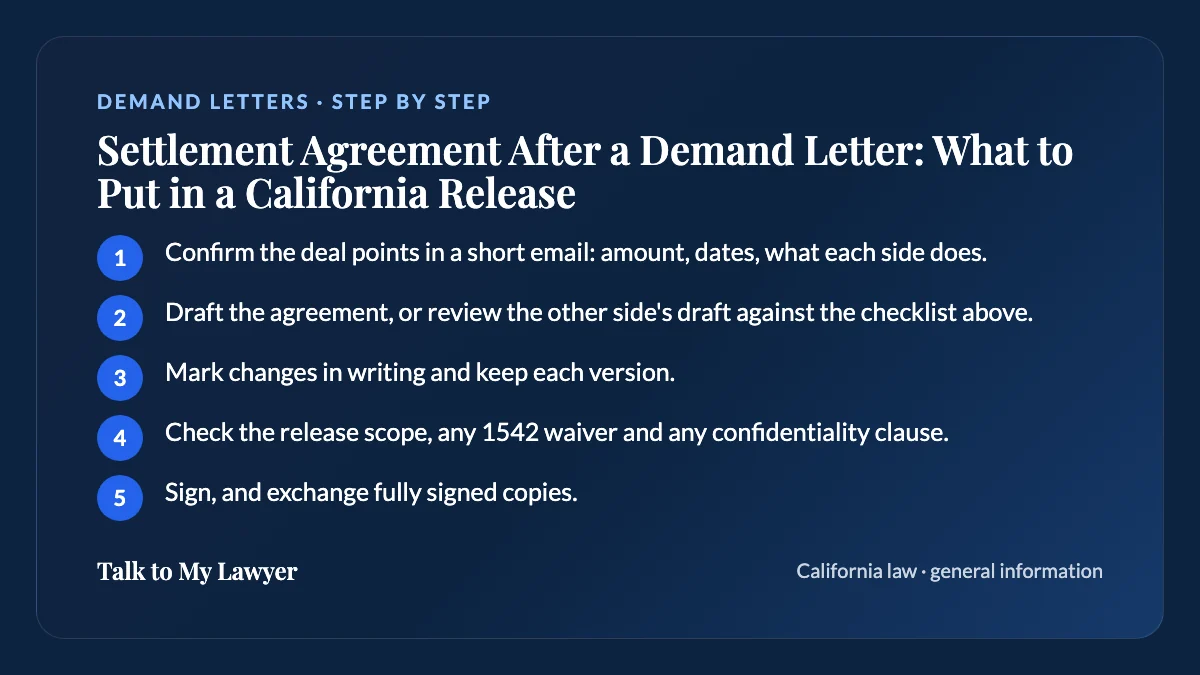
From a deal in principle to a signed agreement, step by step
- Confirm the deal points in a short email: amount, dates, what each side does.
- Draft the agreement, or review the other side's draft against the checklist above.
- Mark changes in writing and keep each version.
- Check the release scope, any 1542 waiver and any confidentiality clause.
- Sign, and exchange fully signed copies.
- Track each payment as it arrives. If a case is pending, file the dismissal the agreement requires.
- Keep the signed agreement, payment records and correspondence in one file.
Offers made while you negotiate are generally inadmissible to prove liability (Evidence Code 1152). For how a settlement offer fits into the demand stage, see our guide to the pre-litigation settlement demand letter, and if you are the one who received the demand, how to respond to a demand letter.
Putting the settlement offer in writing first
Many settlements start on paper before anyone drafts a release: a letter that proposes the amount, the payment plan and the scope of the release. Putting those terms in writing early gives both sides the same starting point when the agreement is drafted.
Through Talk to My Lawyer, a licensed California attorney writes your letter from your facts and documents, whether it is a demand or a settlement offer, sets out proposed terms, and sends it on your behalf. Before signing any release, it is worth having a lawyer read it against your facts.
Frequently asked questions
Is a settlement agreement binding without a lawyer in California?
It can be. A settlement agreement is a contract, and a written release extinguishes the obligations it covers under Civil Code 1541. Whether a particular agreement is enforceable depends on its terms, the signatures and the circumstances. Because the release can end claims permanently, consider having a lawyer read it before signing, even if you negotiated it yourself.
What is a 1542 waiver in a California settlement?
Civil Code 1542 says a general release does not cover claims you did not know or suspect when you signed, if knowing them would have materially affected the settlement. A 1542 waiver gives up that protection, so the release reaches unknown claims too. A waiver clause quotes the statute and states the waiver expressly. Think about hidden problems before agreeing to one.
Can a settlement agreement be confidential in California?
Partly. The settlement amount can generally be kept confidential. But CCP 1001 voids clauses that restrict disclosure of factual information about sexual harassment, sexual assault, workplace harassment, discrimination or retaliation, and housing discrimination, where a claim was filed. Employment separation agreements must also allow disclosure of unlawful workplace acts under Government Code 12964.5.
What happens if the other side does not pay the settlement?
Check the default terms first: notice, cure period and acceleration of the balance. If a lawsuit was pending and the agreement meets CCP 664.6, you can ask the court to enter judgment on the settlement terms. If no case was filed, the usual remedy is a claim for breach of the settlement agreement, which may fit small claims if the amount is within the limit.
Do I have to pay taxes on a settlement?
Possibly. The IRS treats settlement amounts as generally taxable unless an exclusion applies. Compensatory damages for personal physical injuries or physical sickness can be excluded under IRC 104(a)(2), but punitive damages and emotional distress damages without physical injury are generally taxable. How the agreement describes the payment matters, so ask a tax professional before signing.
Sources
Checked against these official sources on October 18, 2026.
- California Civil Code section 1542 (California Legislative Information)
- California Code of Civil Procedure section 664.6 (California Legislative Information)
- AB 1908 Settlement agreements: victims' compensation funding (Chapter 907, Statutes of 2026) (California Legislative Information)
- California Code of Civil Procedure section 1001 (California Legislative Information)
- California Government Code section 12964.5 (California Legislative Information)
- Tax implications of settlements and judgments (Internal Revenue Service)
This guide explains California law in general terms as of October 2026. It is general information, not legal advice for your situation, and local rules can add to it.
Join the email list and get a lawyer letter started
With Talk to My Lawyer, a licensed California attorney writes your letter from your facts and documents and sends it on your behalf. Join the Talk to My Lawyer email list for letter checklists, document prompts, and reminders before you start your letter.