Quick answer
Elder financial abuse in California occurs when a person or business takes, hides or keeps the property of someone 65 or older (or a dependent adult) for a wrongful use, with intent to defraud, or through undue influence (Welfare and Institutions Code section 15610.30). Report it to Adult Protective Services or police. In a lawsuit, a proven claim brings attorney's fees, and bad-faith takings can cost twice the property's value.
At a glance
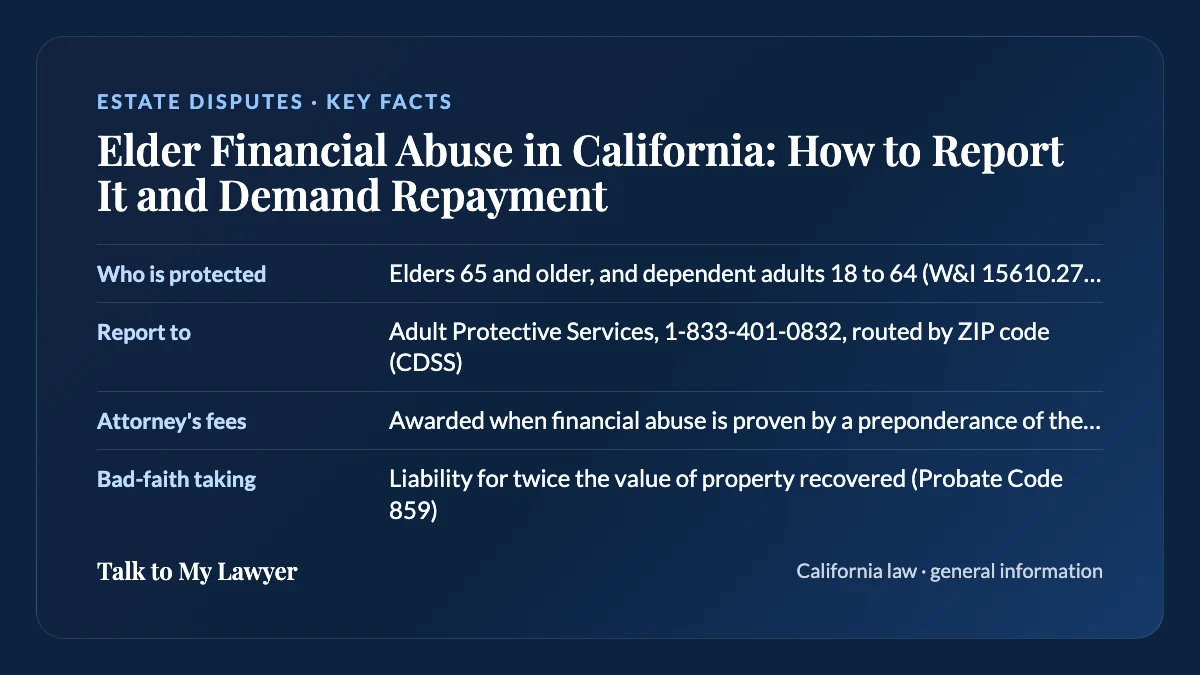
- Who is protected
- Elders 65 and older, and dependent adults 18 to 64 (W&I 15610.27, 15610.23)
- Report to
- Adult Protective Services, 1-833-401-0832, routed by ZIP code (CDSS)
- Attorney's fees
- Awarded when financial abuse is proven by a preponderance of the evidence (W&I 15657.5)
- Bad-faith taking
- Liability for twice the value of property recovered (Probate Code 859)
- Deadline to sue
- 4 years after the abuse is discovered or should have been (W&I 15657.7)
What counts as elder financial abuse in California?
Under Welfare and Institutions Code section 15610.30, financial abuse happens when a person or entity takes, secretes, appropriates, obtains or retains real or personal property of an elder or dependent adult for a wrongful use or with intent to defraud, or does so by undue influence. Helping someone else do it counts too.
- Elder means a California resident 65 or older (section 15610.27).
- Dependent adult means a resident 18 to 64 whose physical or mental limitations restrict their ability to carry out normal activities or protect their rights (section 15610.23).
- Wrongful use includes taking property when the person knew or should have known the conduct was likely to be harmful to the elder.
- Property is taken when the elder is deprived of any property right, including through an agreement, a gift or a bequest in a will.
That last point matters. A signed document does not end the question. A deed, loan or gift obtained by undue influence can still be financial abuse.
What are the warning signs of financial abuse of an older adult?
No single sign proves anything, but patterns are worth writing down with dates:
- Large or repeated withdrawals, transfers or checks the older adult cannot explain.
- A new friend, caregiver or relative who controls the mail, phone or bank access.
- Recently signed powers of attorney, deeds, loans or changes to a will or trust.
- Unpaid bills or utility shutoffs despite adequate income.
- Missing valuables, or purchases the older adult does not remember making.
- Isolation: family calls go unanswered or visits are discouraged.
How do you report elder financial abuse in California?
Call Adult Protective Services (APS). The California Department of Social Services lists a statewide number, 1-833-401-0832, that connects you to your county APS agency after you enter a ZIP code, 24 hours a day, 7 days a week. You can also contact the county APS office directly or report to local law enforcement. Call 911 if someone is in immediate danger.
According to the Department, APS serves adults 60 and older and dependent adults 18 to 59 with disabilities. That is a slightly different age line than the civil lawsuit statute uses, which defines an elder as 65 or older. The Department also publishes written report forms: SOC 342, the financial abuse report for financial institution employees, and SOC 341 for everyone else.
What does a person with power of attorney owe the older adult?
An agent under a power of attorney (the law calls this person the attorney-in-fact) is a fiduciary. Probate Code section 4232 requires the agent to act solely in the principal's interest and avoid conflicts of interest.
- Records. The agent must keep records of every transaction made for the principal (section 4236(a)).
- Accounting on request. The agent must account when the principal asks, when a conservator of the estate asks, or after death when the personal representative or successor in interest asks (section 4236(b)). The power of attorney cannot waive this.
- Court petition. If the agent fails to account within 60 days after a written request from the person who then files a petition, the court can compel an accounting (section 4541(c)). A relative, spouse, conservator or any interested person or friend of the principal may petition (section 4540). A power of attorney signed with a lawyer's certificate can remove that right for some of these people, but never for the principal or a conservator (section 4503).
- Liability. An agent who breaches a duty is chargeable with losses and profits from the breach (section 4231.5(a)). Taking property in bad faith or through elder financial abuse brings liability for twice the value of the property recovered (section 4231.5(c)).
The 60-day clock in section 4541 starts with a written request, which is one reason to make the first request a letter rather than a phone call.
What can a court award for elder financial abuse?
| Remedy | When it applies | Statute |
|---|---|---|
| Compensatory damages plus attorney's fees and costs | Financial abuse proven by a preponderance of the evidence | W&I 15657.5(a) |
| Removal of certain limits on damages recoverable after the elder's death | Also proven by clear and convincing evidence that the defendant acted with recklessness, oppression, fraud or malice | W&I 15657.5(b) |
| Twice the value of property recovered | Property taken in bad faith, by undue influence in bad faith, or through elder financial abuse | Probate Code 859; 4231.5(c) for agents |
| Time limit to sue | 4 years after the plaintiff discovers, or reasonably should have discovered, the facts | W&I 15657.7 |
Who can bring the claim depends on the facts, including whether the older adult is living and able to act, so ask a lawyer about standing. If the abuser is the executor or trustee, our guide on an executor delaying distribution explains the probate court tools.
How to demand an accounting and the return of an elder's money
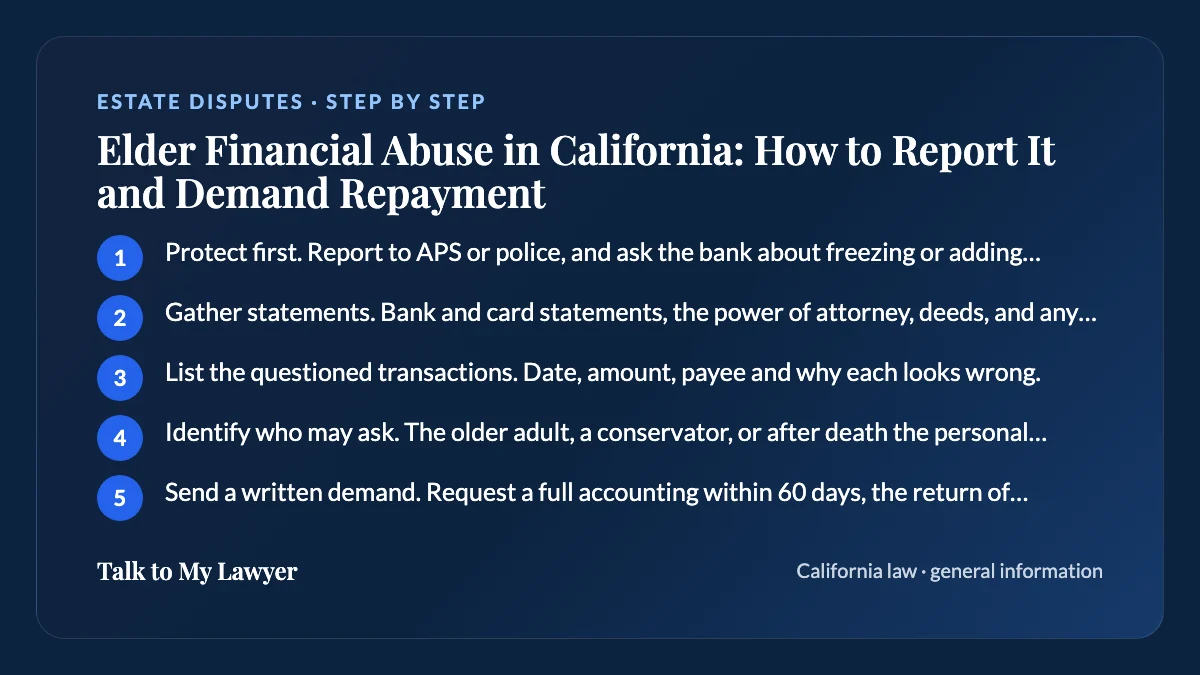
- Protect first. Report to APS or police, and ask the bank about freezing or adding alerts to accounts if the older adult agrees or someone has authority.
- Gather statements. Bank and card statements, the power of attorney, deeds, and any loan or gift paperwork.
- List the questioned transactions. Date, amount, payee and why each looks wrong.
- Identify who may ask. The older adult, a conservator, or after death the personal representative can demand an account under section 4236.
- Send a written demand. Request a full accounting within 60 days, the return of specific funds or property, and preservation of records.
- Calendar day 60. If no accounting arrives, a petition under Probate Code section 4541(c) becomes available to the person who made the request.
As conservator of the estate of Robert Chen, I request a complete accounting of all transactions you made as his attorney-in-fact from January 1, 2025, to the present, as required by Probate Code section 4236. The account statements show 14 withdrawals totaling $38,600 that I cannot connect to Mr. Chen's expenses (list enclosed). Please provide the accounting, with supporting records, within 60 days, and return the $38,600 or explain each withdrawal in writing. Please preserve all related records.
Example (hypothetical): if a court later finds the $38,600 was taken in bad faith, Probate Code section 859 and section 4231.5(c) provide for liability of twice the value of the property recovered, and Welfare and Institutions Code section 15657.5 adds attorney's fees and costs once financial abuse is proven. A court decides those questions on the evidence.
For the next step if the demand is ignored, see our guide to a final demand letter before a lawsuit.
Demanding repayment for an older relative through an attorney
The person who took the money may be a sibling, a new partner or a trusted caregiver, which makes the first move hard. An attorney's letter puts the statutes, the transaction list and the 60-day accounting request in one place, which matters if you later petition the court or file suit. It can also help when you are unsure who has authority to make the demand.
Through Talk to My Lawyer, a licensed California attorney writes your demand for an accounting and repayment from the bank records, the power of attorney and your list of transactions, and sends it on your behalf. If someone is in danger, call 911 or APS first, and talk to an elder law attorney about your facts.
Frequently asked questions
What age is considered elder abuse in California?
For the civil Elder Abuse and Dependent Adult Civil Protection Act, an elder is a California resident 65 or older (Welfare and Institutions Code section 15610.27). Dependent adults aged 18 to 64 with limiting physical or mental conditions are also protected. Adult Protective Services, according to the Department of Social Services, serves adults 60 and older and dependent adults 18 to 59, so you can report concerns about a 62-year-old to APS.
Can a family member be sued for elder financial abuse?
Yes. The definition in Welfare and Institutions Code section 15610.30 covers any person or entity that wrongfully takes or keeps an elder's property, including relatives and agents under a power of attorney. A family relationship does not excuse a taking for a wrongful use or by undue influence. Proven claims bring attorney's fees under section 15657.5, and bad-faith takings can bring liability for twice the value recovered.
How do I make a power of attorney agent give an accounting?
Make the request in writing. An agent must account when asked by the principal, a conservator of the estate, or after death the personal representative or successor in interest (Probate Code section 4236). If the agent does not provide an accounting or report within 60 days after a written request, the person who asked can petition the court to compel it under section 4541(c).
What is the deadline to sue for elder financial abuse in California?
Welfare and Institutions Code section 15657.7 gives a four-year window for a damages action for financial abuse under sections 15657.5 and 15657.6. The window opens when the plaintiff discovers the facts of the abuse, or would have discovered them with reasonable diligence. Other claims arising from the same facts may have different deadlines, so talk to a lawyer promptly about which apply.
Do I have to report to APS before sending a demand letter?
Reporting and demanding are separate steps with different purposes: a report asks APS or police to investigate and protect the older adult, while a demand asks the person who took the money for records and repayment. If you believe abuse is ongoing, reporting first can help stop further losses.
Sources
Checked against these official sources on October 18, 2026.
- California Welfare and Institutions Code section 15610.30 (California Legislative Information)
- California Welfare and Institutions Code section 15657.5 (California Legislative Information)
- California Probate Code section 4541 (California Legislative Information)
- California Probate Code section 4231.5 (California Legislative Information)
- California Welfare and Institutions Code section 15657.7 (California Legislative Information)
- Adult Protective Services (California Department of Social Services)
This guide explains California law in general terms as of October 2026. It is general information, not legal advice for your situation, and local rules can add to it.
Join the email list and get a lawyer letter started
With Talk to My Lawyer, a licensed California attorney writes your letter from your facts and documents and sends it on your behalf. Join the Talk to My Lawyer email list for letter checklists, document prompts, and reminders before you start your letter.