Quick answer
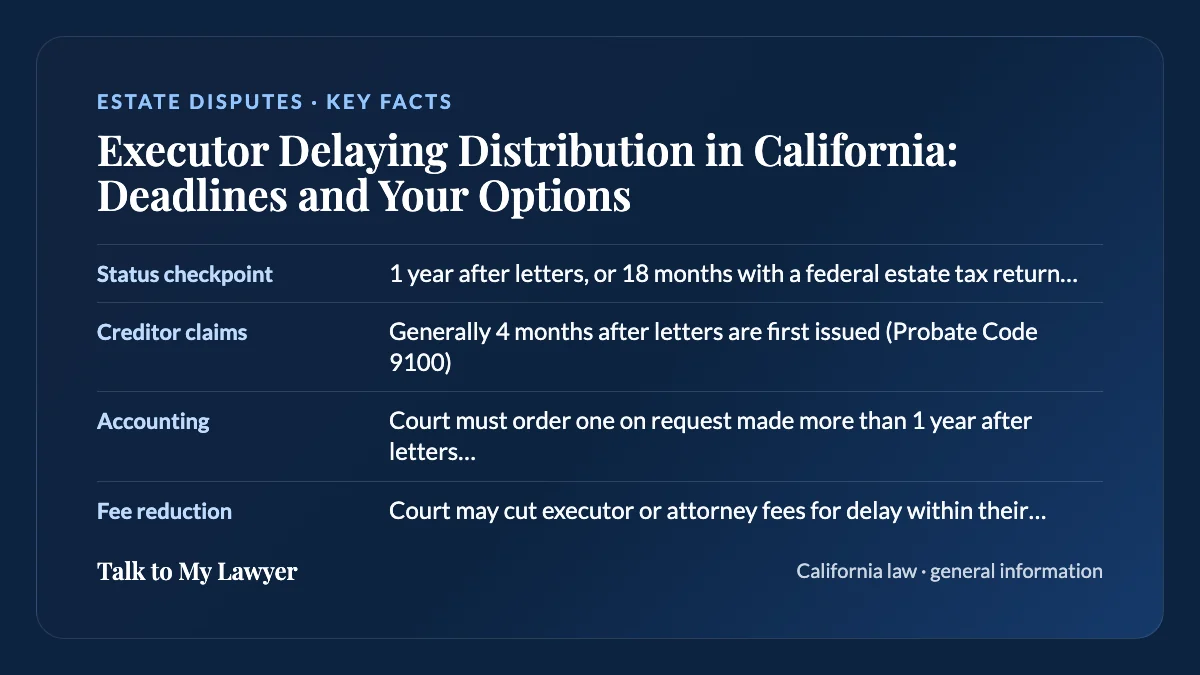
If an executor is delaying distribution in California, check the probate timeline. Within a year after letters issue, or 18 months if a federal estate tax return is required, the executor must petition for final distribution or file a status report explaining the delay (Probate Code section 12200). After a year, a beneficiary can petition for a court-ordered accounting (section 10950), and the court can cut fees for unjustified delay.
At a glance
- Status checkpoint
- 1 year after letters, or 18 months with a federal estate tax return (Probate Code 12200)
- Creditor claims
- Generally 4 months after letters are first issued (Probate Code 9100)
- Accounting
- Court must order one on request made more than 1 year after letters (Probate Code 10950(b))
- Fee reduction
- Court may cut executor or attorney fees for delay within their control (Probate Code 12205)
- Removal
- Grounds include waste, mismanagement and long neglect (Probate Code 8502)
How long does an executor have to distribute an estate in California?
California sets a checkpoint rather than a hard deadline. Under Probate Code section 12200, the personal representative (the executor named in a will, or an administrator appointed by the court) must either petition for final distribution or file a report of status of administration within one year after letters are issued. The deadline is 18 months if the estate must file a federal estate tax return.
'Letters' are the court document that gives the executor authority, so the clock starts on that date, not the date of death. You can find it in the probate court file.
A status report must explain the condition of the estate, why it cannot be closed, and how much more time is needed. It must be filed with the court, and the notice of hearing must tell interested persons, in bold or capital letters, that they have the right to petition for an account under Probate Code section 10950 (section 12201).
Which delays are normal in probate?
Some waiting is built into the process. Knowing the built-in steps makes it easier to see when a delay goes beyond them.
| Stage | Timing | Rule |
|---|---|---|
| Earliest petition for preliminary distribution | At least 2 months after letters | Probate Code 11620 |
| Creditor claim period | Later of 4 months after letters or 60 days after notice is mailed to a creditor | Probate Code 9100 |
| Petition for final distribution or status report | 1 year after letters (18 months with federal estate tax return) | Probate Code 12200 |
| Mandatory accounting on request | Request made more than 1 year after letters or the last account | Probate Code 10950(b) |
Selling a house, resolving a will contest, waiting on tax filings, or locating assets can each add time legitimately. What the law expects is an explanation. An executor who cannot or will not explain the holdup is the situation the tools below were built for.
What can a beneficiary do about a slow executor?
Probate is supervised by a court, and interested persons (heirs and beneficiaries, among others) can ask the judge to act. These are the main levers, from mildest to strongest.
- Ask for an accounting. The court may order an account at any time and must order one on petition of an interested person made more than one year after letters or after the last account (Probate Code section 10950).
- Ask the court to cite the executor. For good cause, the court can order the personal representative to appear and explain the condition of the estate and why it cannot be distributed and closed (section 12202).
- Petition for distribution yourself. Any interested person, as well as the executor, may petition for preliminary or final distribution (section 11600).
- Ask for reduced fees. If administration took longer than allowed, the delay was within the executor's or attorney's control and not in the estate's interest, the court may reduce their compensation (section 12205).
- Seek removal. Grounds include wasting or mismanaging the estate, wrongful neglect, long neglect of duties, or removal being necessary to protect the estate (section 8502).
For the records side of the same problem, see our guide on requesting probate and estate records.
What if the inheritance is in a trust, not probate?
Then the rules come from trust law, and no court is involved unless someone files a petition. A trustee has distinct duties to keep beneficiaries informed:
- On a beneficiary's reasonable request, the trustee must provide information about the trust's administration relevant to that beneficiary's interest (Probate Code section 16061).
- The trustee must account at least once a year, when the trust ends, and when trustees change, to beneficiaries entitled to current distributions, subject to listed exceptions (section 16062).
A written request is the starting point in both systems. It fixes the date you asked, which matters if you later ask a court to step in.
Steps to take when an executor is delaying distribution
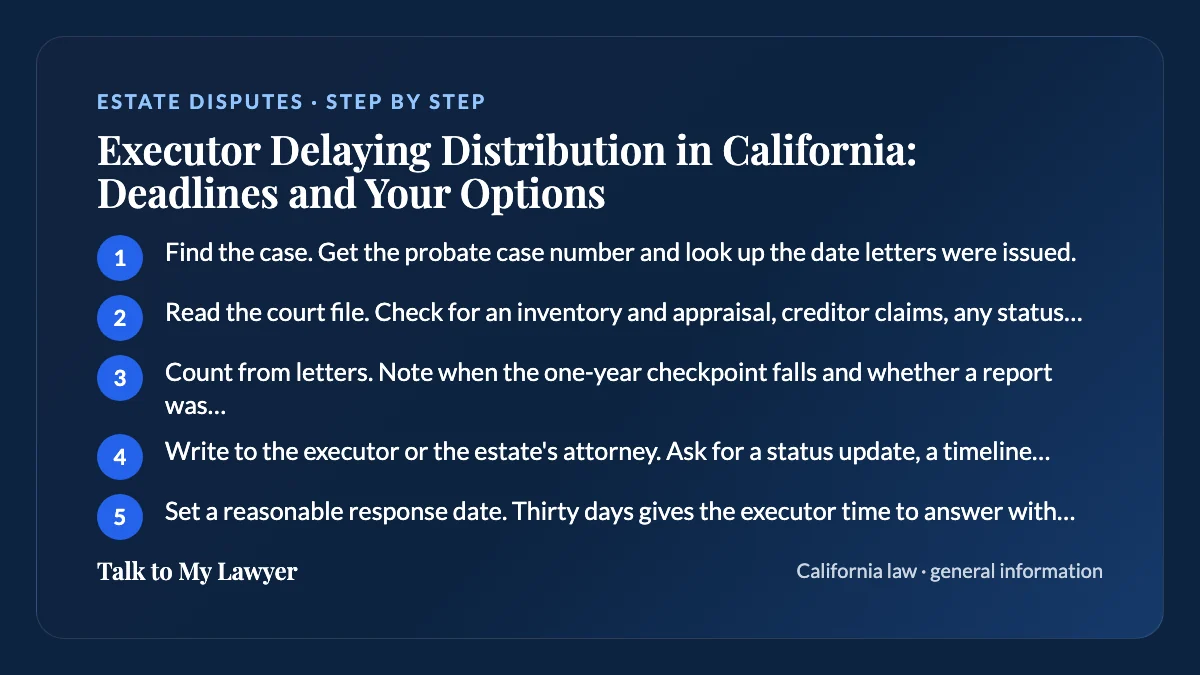
- Find the case. Get the probate case number and look up the date letters were issued.
- Read the court file. Check for an inventory and appraisal, creditor claims, any status report, and pending petitions.
- Count from letters. Note when the one-year (or 18-month) checkpoint falls and whether a report was filed.
- Write to the executor or the estate's attorney. Ask for a status update, a timeline, and an informal accounting.
- Set a reasonable response date. Thirty days gives the executor time to answer with documents.
- Keep copies. Both your letter and whatever comes back belong in your file for any later petition.
Letters testamentary in the Estate of Maria Lopez (Case No. [number]) were issued on March 10, 2025. More than one year has passed, and I have not received notice of a petition for final distribution or a status report under Probate Code section 12200. As a beneficiary, I request a written update on the condition of the estate, the reasons it has not been distributed, an estimated closing date, and an informal accounting of receipts and expenses. Please respond by June 30.
Example (hypothetical): letters issued March 10, 2025, and no federal estate tax return is required. The section 12200 checkpoint was March 10, 2026. If nothing was filed by then, a beneficiary writing in May 2026 can point to the missed checkpoint, and because more than a year has passed since letters with no account filed, a petition for an accounting under section 10950(b) is one the court must grant.
What happens after you send the letter?
The executor may answer with a real explanation and a timeline, in which case you have a record of what was promised. If the reply is vague or never comes, your letter can be attached as an exhibit to a petition for an accounting, a citation under section 12202, or a petition for distribution. Our guide to what a demand letter is explains why a dated written request carries weight.
When a beneficiary's letter should come from an attorney
Family history can drown out a beneficiary's own letter. A letter from an attorney that cites sections 12200, 10950 and 12205 puts the court checkpoints on the record in plain terms. That can be useful when the estate has missed its one-year mark, when assets such as a house appear to be sitting unused, when the executor is also a beneficiary, or when several heirs want one clear voice.
Through Talk to My Lawyer, a licensed California attorney writes your letter from the probate case details, the court file and your correspondence with the executor, and sends it on your behalf. To file a petition, talk to a probate lawyer about your facts.
Frequently asked questions
Can an executor take as long as they want in California?
No. Within one year after letters are issued, or 18 months if a federal estate tax return is required, the personal representative must petition for final distribution or file a status report explaining the delay (Probate Code section 12200). Interested persons can ask the court to cite the executor to explain, and the court may reduce compensation when delay within the executor's control was not in the estate's interest.
How do I force an executor to give an accounting in California?
Ask in writing first, then petition the probate court. Under Probate Code section 10950, the court may order an accounting at any time, and must order one when an interested person petitions more than one year after letters were issued or after the last account was filed. The order sets the deadline for the executor to file it.
Can I get part of my inheritance before probate closes?
Sometimes. California allows a petition for preliminary distribution of all or part of a beneficiary's share, but not until at least two months after letters are first issued to a general personal representative (Probate Code section 11620). The petition can come from any interested person, as well as from the executor (section 11600).
What are the grounds to remove an executor in California?
Probate Code section 8502 allows removal when the personal representative has wasted, embezzled, mismanaged or committed fraud on the estate, or is about to; is incapable of properly doing the job; has wrongfully neglected the estate or long neglected to act; when removal is necessary to protect the estate or interested persons; or for any other cause a statute provides. Removal requires a court order.
Does a trustee have the same one-year deadline as a probate executor?
No. Section 12200 applies to probate estates supervised by a court. Trustees follow trust law instead: they must respond to reasonable requests for information about the trust's administration (Probate Code section 16061) and, for beneficiaries entitled to current distributions, account at least annually and at key events (section 16062), subject to exceptions. A beneficiary can petition the court if a trustee does not comply.
Sources
Checked against these official sources on October 18, 2026.
- California Probate Code section 12200 (California Legislative Information)
- California Probate Code section 12201 (California Legislative Information)
- California Probate Code section 10950 (California Legislative Information)
- California Probate Code section 12205 (California Legislative Information)
- California Probate Code section 8502 (California Legislative Information)
- California Probate Code section 16061 (California Legislative Information)
This guide explains California law in general terms as of October 2026. It is general information, not legal advice for your situation, and local rules can add to it.
Join the email list and get a lawyer letter started
With Talk to My Lawyer, a licensed California attorney writes your letter from your facts and documents and sends it on your behalf. Join the Talk to My Lawyer email list for letter checklists, document prompts, and reminders before you start your letter.