Quick answer
California employers must reimburse employees for necessary expenses incurred because of their job, including work mileage in a personal car and work use of a personal cell phone (Labor Code section 2802). The IRS mileage rate is a common measure: 72.5 cents a mile for the first half of 2026 and 76 cents from July 1, 2026, but the law requires full reimbursement, not a specific formula.
At a glance
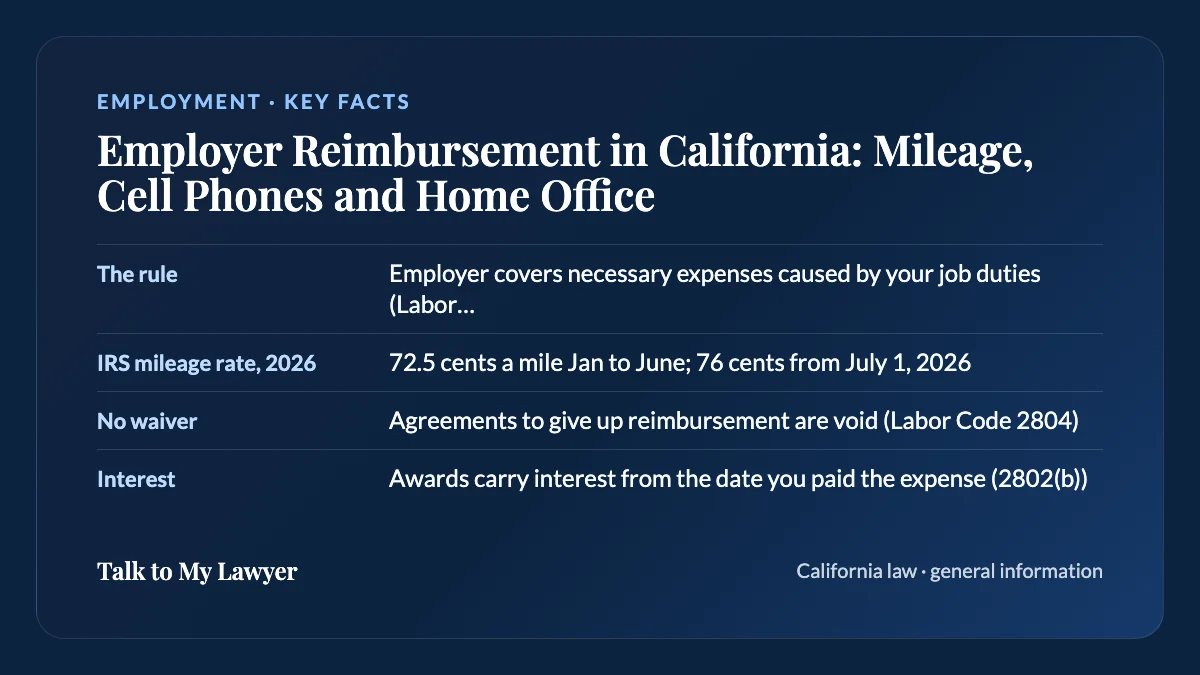
- The rule
- Employer covers necessary expenses caused by your job duties (Labor Code 2802(a))
- IRS mileage rate, 2026
- 72.5 cents a mile Jan to June; 76 cents from July 1, 2026
- No waiver
- Agreements to give up reimbursement are void (Labor Code 2804)
- Interest
- Awards carry interest from the date you paid the expense (2802(b))
- Deadline
- 3 years for reimbursement claims, per the Labor Commissioner
What does California Labor Code 2802 make an employer pay for?
Section 2802 requires an employer to indemnify you for all necessary expenditures or losses you incur in direct consequence of doing your job, or of following the employer's directions. Two ideas do the work: the cost must be caused by the job, and it must be necessary and reasonable.
- Driving. Miles driven in your own car between job sites, to clients or on errands for the employer.
- Phones and data. Work calls, texts and apps on a personal phone the job requires you to use.
- Tools and equipment. Items the employer requires that you buy for the job.
- Uniforms. If the employer requires a uniform, the Labor Commissioner says the employer must pay for it, and uniform includes clothing and accessories of distinctive design and color.
- Travel. Required business travel costs, subject to reasonable limits.
The protection cannot be signed away. Section 2804 makes any agreement to waive these rights null and void, so a handbook clause saying employees cover their own phone bills does not end the question.
How much mileage reimbursement does California require in 2026?
California law requires full reimbursement of the actual, reasonable cost of driving for work, not a particular per-mile figure. The IRS standard business mileage rate is a common yardstick, but no statute makes it the required measure.
| Period | IRS business rate |
|---|---|
| January 1 to June 30, 2026 | 72.5 cents per mile |
| July 1 to December 31, 2026 | 76 cents per mile |
As of October 2026, the IRS has raised its rate mid-year, effective July 1, so a claim covering all of 2026 uses two rates. An employer may use another method, such as tracking actual costs or paying a car allowance, as long as the amount fully covers the expense. If an allowance falls short, the difference is still owed.
Example (hypothetical): a home health aide drove 600 work miles a month in her own car from April through September 2026 and received nothing. At the IRS rates, that is 1,800 miles at 72.5 cents ($1,305) plus 1,800 miles at 76 cents ($1,368), a total of $2,673 before interest.
Does a California employer have to pay for your personal cell phone?
If your job requires you to use a personal cell phone for work, section 2802 requires the employer to reimburse a reasonable share of the cost. A 2014 California Court of Appeal decision, Cochran v. Schwan's Home Service, held that this applies even if you have an unlimited plan and your bill did not go up.
The court did not set a percentage. What counts as reasonable depends on how much of your phone use is for work. Common approaches are a monthly stipend or a share of the bill matched to work use, and either one can be measured against your actual records.
Are work-from-home costs reimbursable in California?
They can be. No separate statute lists home-office costs, so the same section 2802 test applies: was the expense necessary and caused by the job? Internet service, a share of a phone plan, a monitor or a printer can qualify when the employer requires you to work from home and the cost is reasonable.
The facts carry the weight. A worker who chose remote work when an office was available may stand on different footing from one whose office closed. A list of what you bought, why the job needed it and what the employer told you about remote work is the starting point.
Checklist: records that support a reimbursement claim
- A mileage log with dates, start and end points, purpose and miles, or route records from a mapping app.
- Phone bills with work use marked, and any instruction to use your own phone.
- Receipts for tools, uniforms, equipment and travel.
- The employer's reimbursement policy and any expense reports you submitted.
- Emails or texts approving, denying or ignoring your requests.
- Pay stubs showing what, if anything, was reimbursed.
Deductions are a related issue. The Labor Commissioner says an employer generally cannot take money from your pay for breakage or loss caused by a simple mistake or accident. If deductions were made, include them; the guide to unpaid wages demand letters covers that side.
How to ask your employer for reimbursement in writing
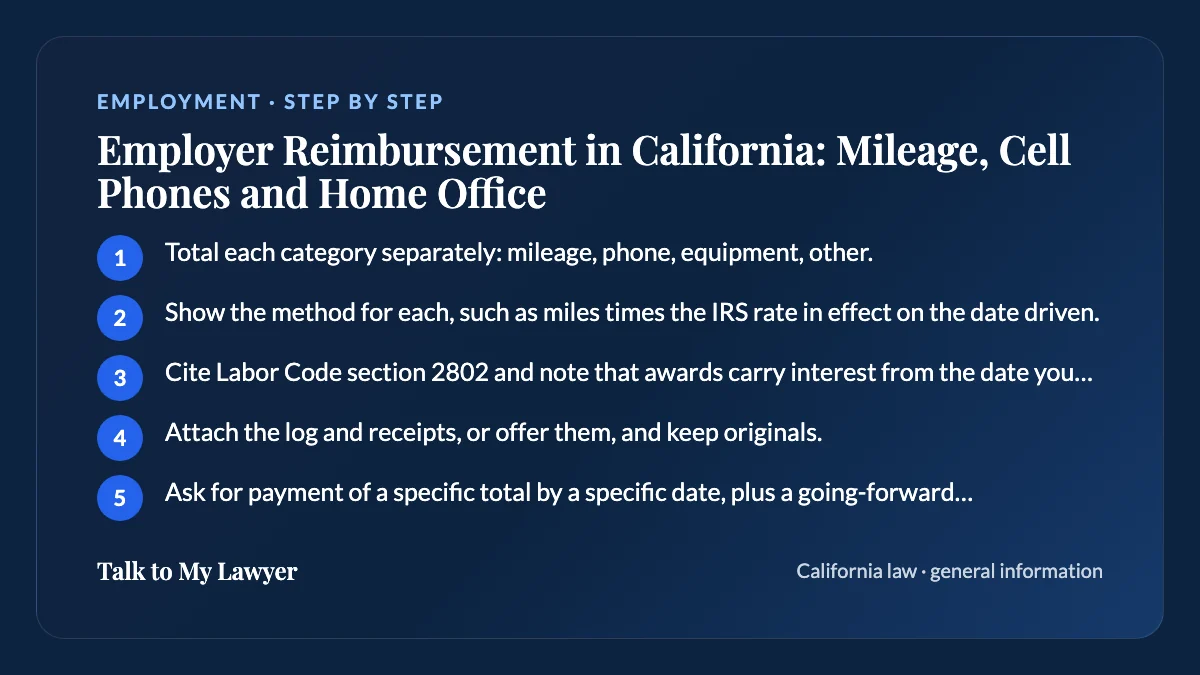
- Total each category separately: mileage, phone, equipment, other.
- Show the method for each, such as miles times the IRS rate in effect on the date driven.
- Cite Labor Code section 2802 and note that awards carry interest from the date you paid each expense.
- Attach the log and receipts, or offer them, and keep originals.
- Ask for payment of a specific total by a specific date, plus a going-forward reimbursement arrangement.
- Send it to payroll or human resources in a way you can prove.
From April 1 through September 30, 2026, I drove 3,600 miles in my personal vehicle for client visits assigned by the agency, and I have not been reimbursed. Labor Code section 2802 requires reimbursement of necessary expenses incurred in my job duties. Using the IRS business rates in effect when I drove, the amount owed is $2,673. My mileage log is attached. Please pay this amount by October 31 and confirm how future mileage will be reimbursed.
What happens if the employer ignores a reimbursement demand?
The next step can be a wage claim filed with the Labor Commissioner, whose office allows three years for unpaid reimbursement claims. The Labor Commissioner may also issue a citation for the amount owed, and amounts recovered that way go to the employee (section 2802(d)).
In court, necessary expenditures include reasonable costs and attorney's fees incurred enforcing section 2802, and awards carry interest at the judgment rate from the date you paid the expense. Smaller claims can go to small claims court, up to $12,500 for individuals; the filing steps are in the small claims demand letter guide.
Retaliating against a worker for asserting Labor Code rights is unlawful in California. If your hours or assignments change after you ask, the guide to workplace retaliation letters explains your options.
When an attorney-written reimbursement letter makes sense
Expense claims grow quietly, a few dollars of mileage and phone use at a time. A single month of driving with a clean log may need no more than a short note. The harder cases are costs that span years, a car allowance the employer insists is enough, contested home-office costs, or a group of coworkers carrying the same expenses. Each category then needs its own legal footing in the letter.
Send your mileage logs, phone bills and receipts to Talk to My Lawyer, and a licensed California attorney writes your letter from those documents and your facts and sends it on your behalf. Whether each expense was truly required by the job is a question a lawyer can answer from those same records.
Frequently asked questions
Does California require employers to pay the IRS mileage rate?
No. Labor Code section 2802 requires reimbursement of the full, reasonable cost of driving for work, and the IRS rate is a common way to measure it, not a legal requirement. An employer can use actual costs or an allowance instead. If its method pays less than your real costs, you can show the difference with records of fuel, insurance, maintenance and the miles you drove.
Can my employer make me use my own phone for work in California?
An employer can require it, but then it must reimburse a reasonable share of the cost under section 2802. The Court of Appeal's 2014 Cochran decision held this applies even when an employee has an unlimited plan and the bill does not increase. The amount is not fixed by law, so records showing how much of your use was for work are the best support.
Can I be asked to sign away expense reimbursement?
No. Labor Code section 2804 makes any express or implied agreement to waive the reimbursement rights in that article null and void. A policy saying employees cover their own phones or mileage does not cancel the employer's obligation. An employer can set reasonable rules for how to submit expenses, such as deadlines and forms, but not a rule that the cost is yours.
Is interest owed on unreimbursed expenses?
Yes, when the expenses are awarded by a court or the Labor Commissioner. Section 2802(b) says these awards carry interest at the same rate as civil judgments, starting from the date you incurred each expense. That is a reason to keep receipts and logs that show when each expense was paid, since older items earn more interest.
Sources
Checked against these official sources on October 18, 2026.
- California Labor Code section 2802 (California Legislative Information)
- California Labor Code section 2804 (California Legislative Information)
- Standard mileage rates (Internal Revenue Service)
- Deductions from wages (California Labor Commissioner's Office)
- How to file a wage claim (California Labor Commissioner's Office)
- Cochran v. Schwan's Home Service, Inc. (2014), B247160 (California Court of Appeal (California Courts))
This guide explains California law in general terms as of October 2026. It is general information, not legal advice for your situation, and local rules can add to it.
Join the email list and get a lawyer letter started
With Talk to My Lawyer, a licensed California attorney writes your letter from your facts and documents and sends it on your behalf. Join the Talk to My Lawyer email list for letter checklists, document prompts, and reminders before you start your letter.