Quick answer
An HOA records request in California is made in writing under Civil Code sections 5200 to 5240. The association must produce current fiscal year records within 10 business days and records from the two prior fiscal years within 30 calendar days, and may charge only actual copying and mailing costs. If a court finds access was unreasonably withheld, it must award costs and attorney's fees and may add up to $500 per denied written request.
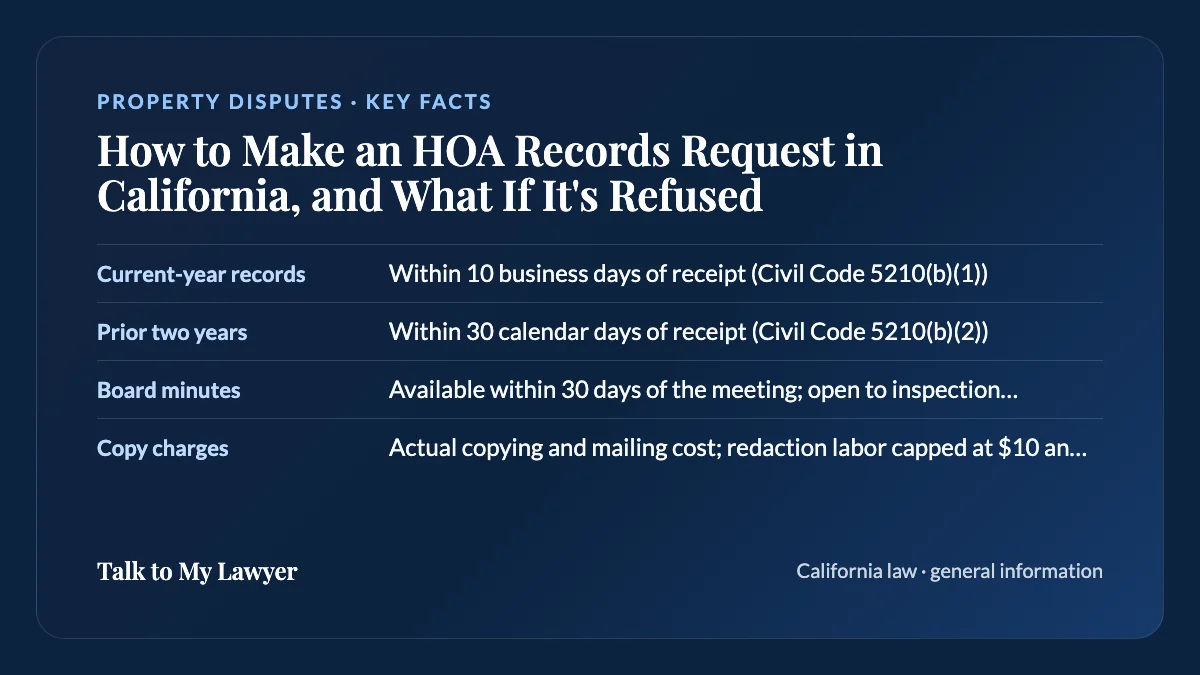
At a glance
- Current-year records
- Within 10 business days of receipt (Civil Code 5210(b)(1))
- Prior two years
- Within 30 calendar days of receipt (Civil Code 5210(b)(2))
- Board minutes
- Available within 30 days of the meeting; open to inspection permanently (4950, 5210)
- Copy charges
- Actual copying and mailing cost; redaction labor capped at $10 an hour and $200 per request (5205)
- If wrongly refused
- Fees and costs, plus up to $500 per denied written request; small claims allowed (5235)
Which HOA records can a California homeowner inspect?
Any member of a California common interest development can inspect and copy the "association records" defined in Civil Code section 5200. The list is long and specific, which helps: you can name the exact category you want.
- Financial statements: balance sheets, income and expense statements, budget comparisons and general ledgers.
- Executed contracts that are not privileged, and written board approval of vendor proposals or invoices.
- State and federal tax returns, check registers, and reserve account balances with records of reserve payments.
- Agendas and minutes of member, board and board-appointed committee meetings (but not executive session minutes).
- The governing documents: the CC&Rs, bylaws, articles and operating rules.
- The membership list, including names, property and mailing addresses and, where collected, email addresses, except for owners who opted out.
- "Enhanced" records: invoices, receipts, canceled checks, purchase orders, bank and association credit card statements, and reimbursement requests.
- Election materials, such as returned ballots, the voter list and the candidate registration list. Signed voter envelopes can be inspected but not copied.
If your complaint is about fines, hearings or assessments rather than paperwork, our HOA dispute letter guide covers those rules. This guide stays with records.
How long does an HOA have to answer a records request in California?
The deadline depends on the age of the record, and the clock starts on the day your request is received (Civil Code section 5210(b)).
| Record | How far back you can ask | Deadline to produce |
|---|---|---|
| Records prepared this fiscal year | Current year | 10 business days |
| Records from the previous two fiscal years | Two prior years | 30 calendar days |
| Board and member meeting minutes | Permanently | Within 30 days of the meeting, as final, draft or summary minutes (section 4950) |
| Minutes of committees with decision-making power | Permanently, for meetings since January 1, 2007 | 15 calendar days after approval |
| Membership list | Current list | On the Corporations Code section 8330 timeline |
Ordinary records older than the current fiscal year and the two before it fall outside the inspection right. Minutes are different, and so are the balcony inspection reports, which stay open for two inspection cycles (sections 5210(a)(3) and 5551(i)).
What can the association black out or hold back?
Section 5215 lets the association withhold or redact information in narrow cases: when release is reasonably likely to lead to identity theft or fraud, when the material is privileged (for example, attorney-client advice or confidential settlements), or when it would compromise an individual member's privacy.
Other owners' disciplinary records, collection files and payment plans can be withheld, as can personnel records, executive session minutes and interior plans of individual homes. Bank account numbers, Social Security numbers and similar identifiers may be blacked out.
Two limits matter in practice. First, the association may not hide what it pays employees, vendors or contractors, although individual staff pay is shown by job title, not by name. Second, if you ask, an association that denies or redacts records must give you a written explanation of the legal basis for doing so (section 5215(d)). Asking for that explanation in your first letter costs nothing and creates a clear record.
The membership list carries one extra condition: you must state a purpose reasonably related to your interest as a member, such as contacting neighbors about a recall or an upcoming election (section 5225).
What can an HOA charge for copies of records?
The association may bill only the direct and actual cost of copying and mailing, and it must tell you the amount and get your agreement before it copies anything (section 5205(f)).
- Redacting enhanced records (invoices, bank statements and similar items) can add up to $10 per hour of redaction time, with a $200 ceiling for each written request, again only after you agree to the estimate.
- You may ask for electronic copies in a format that cannot be altered. The charge is then limited to the direct cost of producing the electronic copy.
- Inspection happens at the association's business office inside the development, or at an agreed place if there is none. When you ask in writing for copies of specific records, the association can mail or deliver them instead.
A flat "records retrieval fee" or a management company's administrative surcharge does not appear anywhere in section 5205. If you are quoted one, ask in writing how it reflects actual copying and mailing cost.
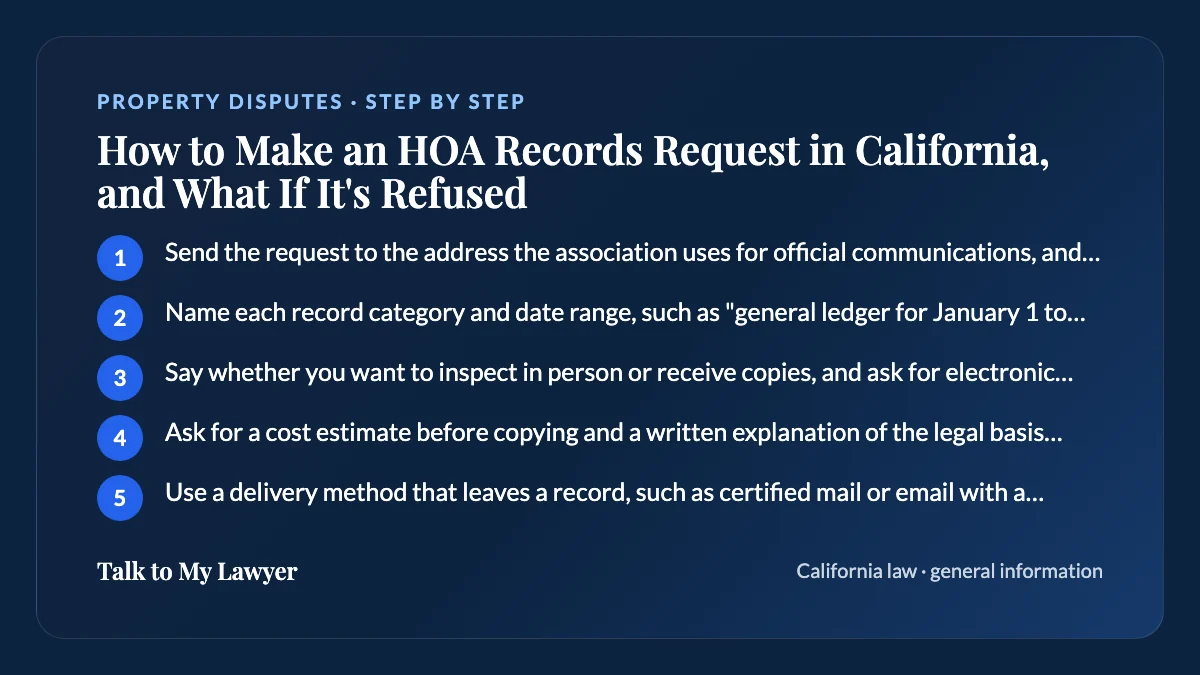
Steps for a written HOA records request
- Send the request to the address the association uses for official communications (often its management company), and keep a copy.
- Name each record category and date range, such as "general ledger for January 1 to June 30, 2026" or "all executed landscaping contracts for fiscal years 2024 and 2025."
- Say whether you want to inspect in person or receive copies, and ask for electronic copies if you prefer them.
- Ask for a cost estimate before copying and a written explanation of the legal basis for any redaction or denial.
- Use a delivery method that leaves a record, such as certified mail or email with a read receipt, and calendar 10 business days and 30 calendar days from receipt.
- Once a deadline is missed, follow up in writing: cite section 5210, attach the original request and give a final response date.
As a member of the Oak Hollow Owners Association (Lot 42), I request copies under Civil Code sections 5200 to 5210 of the following: (1) the general ledger for the current fiscal year to date; (2) all executed contracts for roofing and paving work approved in fiscal years 2024 and 2025; and (3) the invoices paid under those contracts. Electronic copies sent to the email address below are fine; please tell me the copying cost before you prepare them. If any record is withheld or redacted, please explain the legal basis in writing, as section 5215(d) provides.
What happens if the HOA refuses or ignores the request?
You can sue to enforce the right to inspect and copy. If a court finds the association unreasonably withheld access, it must award you reasonable costs and attorney's fees and may impose a civil penalty of as much as $500 per denied written request (Civil Code section 5235(a)).
Section 5235(b) expressly allows these cases in small claims court when the demand is within that court's limit, which is $12,500 for a claim brought by an individual (Code of Civil Procedure section 116.221). The Davis-Stirling rule that the parties first try alternative dispute resolution, such as mediation, before certain superior court enforcement cases does not apply to small claims (Civil Code section 5930(c)).
The protection runs both ways. If a court finds an owner's records case frivolous, unreasonable or without foundation, the association can recover its costs (section 5235(c)). A clear, specific written request helps show that yours was reasonable. For the court steps, see how to file in small claims court in California.
Example: counting the clock on two requests
Example (hypothetical): an owner's request for this year's general ledger and last year's reserve payment records reaches the association on Monday, March 2, 2026. There are no holidays in the period.
- The current-year ledger is due within 10 business days, so by Monday, March 16.
- The prior-year reserve records are due within 30 calendar days, so by Wednesday, April 1.
- On March 20 the manager replies that the board "does not release financials." The owner sends a second written request citing section 5210. That request is also ignored.
- If a court later finds both denials unreasonable, the penalty exposure is up to $500 for each of the two written requests, so up to $1,000, plus the owner's reasonable costs.
Whether a denial was unreasonable is the court's decision. The penalty is discretionary; the fee award is mandatory once that finding is made.
When a records demand written by an attorney makes sense
When the 10-day or 30-day deadline passes with no ledger in hand, the next letter has to do more than ask again. A request in your own words fits a simple ask, such as one year's ledger or a set of minutes. An attorney's letter fits better once the board has already said no, when the management company keeps asking for fees the statute does not mention, when you need records quickly for an election or a recall, or when several owners want to make the same demand.
Through Talk to My Lawyer, a licensed California attorney writes your letter from the records you asked for, your dates and the board's answers, cites the sections of the Davis-Stirling Act that apply, and sends it on your behalf. A lawsuit is a separate decision, and one worth discussing with counsel first.
Frequently asked questions
Can my HOA refuse to show me its bank statements?
Generally no. Bank statements for accounts where assessments are deposited or withdrawn are "enhanced association records" under Civil Code section 5200(b), so members can inspect them. The association can redact account numbers and personal identifying details, and it may charge up to $10 an hour, no more than $200 per request, for redaction time, but only after you agree to the estimate.
Do I have to say why I want HOA records?
For most records, no. The statute does not require a reason for inspecting financial records, contracts or minutes. The exception is the membership list: you must state a purpose reasonably related to your interest as a member, and the association can deny access if it reasonably believes the list will be used for something else. Records you obtain may not be sold or used commercially.
Can someone else request HOA records for me?
Yes. A member may designate another person, such as a relative, an accountant or a lawyer, to inspect and copy records on the member's behalf. The designation must be in writing (Civil Code section 5205(b)). Include the signed designation with the request so the association cannot delay over who is asking.
Can I see the minutes of the board's executive session?
No. Minutes and other information from executive sessions are excluded from the records members can inspect, under sections 5200 and 5215. One exception: executed contracts are still available even if the board discussed them in executive session, unless they are privileged, and contracts for maintenance, management or legal services do not count as privileged for this purpose.
How far back can I request HOA records in California?
For most records, the current fiscal year and the two previous fiscal years (Civil Code section 5210(a)). Minutes of member and board meetings are open permanently, and minutes of committees with decision-making authority are open for meetings since January 1, 2007. Balcony and other exterior elevated element inspection reports stay open for two inspection cycles (sections 5210(a)(3) and 5551(i)).
Sources
Checked against these official sources on October 18, 2026.
- California Civil Code sections 5200 to 5240 (Record Inspection) (California Legislative Information)
- California Civil Code section 4950 (California Legislative Information)
- California Civil Code section 5930 (California Legislative Information)
- California Civil Code section 5551 (California Legislative Information)
- California Code of Civil Procedure section 116.221 (California Legislative Information)
- SB 410 (2025), Common interest developments: association records: exterior elevated elements inspection (California Legislative Information)
This guide explains California law in general terms as of October 2026. It is general information, not legal advice for your situation, and local rules can add to it.
Join the email list and get a lawyer letter started
With Talk to My Lawyer, a licensed California attorney writes your letter from your facts and documents and sends it on your behalf. Join the Talk to My Lawyer email list for letter checklists, document prompts, and reminders before you start your letter.