Quick answer
To write a demand letter, first fix the exact amount or action you want and a calendar-date deadline. Then list the key facts as dated sentences, add the contract term or law that supports you, and attach copies of your proof. Write the opening sentence last. Keep the tone calm and factual. In California, a compromise offer cannot be used to prove liability (Evidence Code section 1152).
At a glance
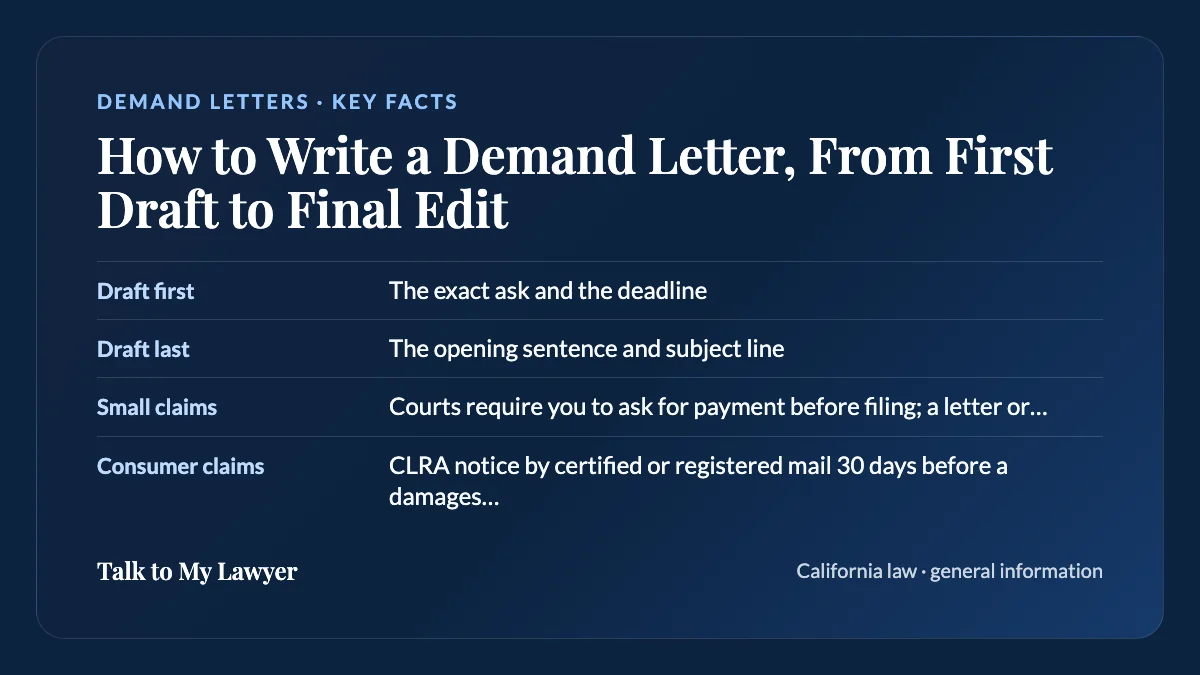
- Draft first
- The exact ask and the deadline
- Draft last
- The opening sentence and subject line
- Small claims
- Courts require you to ask for payment before filing; a letter or email works
- Consumer claims
- CLRA notice by certified or registered mail 30 days before a damages suit (Civil Code 1782)
- Settlement talk
- Offers generally inadmissible to prove liability (Evidence Code 1152)
What order should you write a demand letter in?
Write it backwards. Decide the ask first, then the facts that justify it, then the rule, and only then the opening. The reader sees the letter top to bottom, but you build it from the bottom up, so every paragraph serves the request.
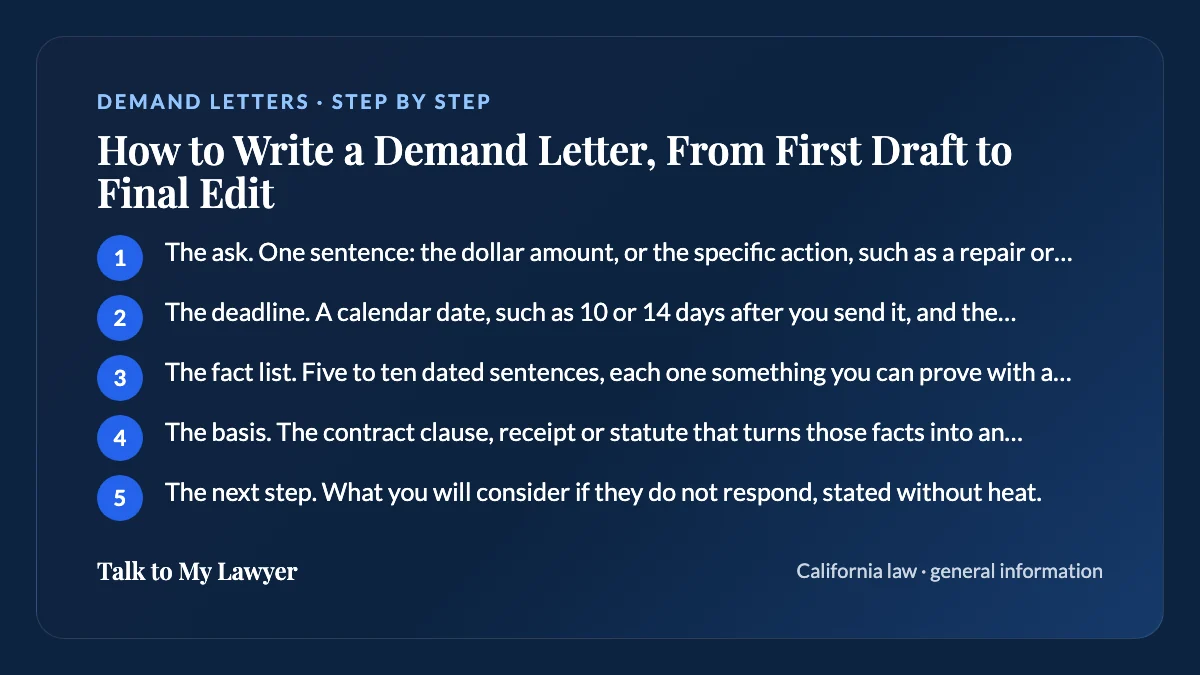
- The ask. One sentence: the dollar amount, or the specific action, such as a repair or a refund. If you cannot write it in one sentence, you are not ready to draft.
- The deadline. A calendar date, such as 10 or 14 days after you send it, and the payment method.
- The fact list. Five to ten dated sentences, each one something you can prove with a document or a message.
- The basis. The contract clause, receipt or statute that turns those facts into an obligation.
- The next step. What you will consider if they do not respond, stated without heat.
- The opening. Now write the first sentence: who you are, what this is about and what you want.
If you would rather start from a fill-in structure, our demand letter template lays out the parts with sample wording. This guide is about the writing itself.
What tone should a demand letter have?
Calm, specific and businesslike. Write as if a judge will read it later, because one might. The courts' small claims guide asks plaintiffs to request payment before filing, and your letter can become the exhibit that shows you did.
| Sounds weak | Sounds firm |
|---|---|
| I was hoping you might be able to pay at some point soon, if that works. | Please pay $1,250 by November 3. |
| You are a liar and a thief, and everyone will know it. | You received the $1,250 deposit on August 2 and did not deliver the cabinets. |
| I will take every legal action possible and you will regret this. | If payment has not arrived by November 3, my next step is a small claims filing. |
| I think the contract might say something about refunds. | Section 4 of our contract provides a full refund if work does not start by September 1. |
The firm versions share three traits: a number, a date and a source. Adjectives drop out.
How do you write the facts and organize the proof?
Put one fact in each sentence, in date order, and tie each to a document. The reader should be able to check every sentence against an enclosure.
- Use dates, not "recently." "On June 4" can be checked. "A while ago" cannot.
- Name documents as exhibits. "Invoice 1189 (Exhibit A)" lets the reader find it in seconds.
- Quote short phrases. If the other side wrote "I'll pay you Friday," quote those words and the date of the text.
- Leave out feelings and history that do not affect what is owed.
- Send copies only. Keep originals, and keep a full set of what you sent.
For a full list of what to collect by dispute type, see our demand letter evidence checklist.
How much law should a demand letter include?
Enough to show why the money is owed, and no more. One accurate citation beats five you have not read. In a simple contract dispute, the clause or the receipt can be the whole legal basis.
Some California claims do carry rules that change how you write and send the letter:
- Consumer claims under the CLRA. Before suing for damages, the consumer must give written notice of the specific violations, demand a correction, repair or replacement, and mail it certified or registered with a return receipt, no later than 30 days before filing (Civil Code section 1782).
- Bounced checks. A certified-mail demand naming section 1719, the check's amount and the service charge opens a 30-day window, after which treble damages of $100 to $1,500 can apply (Civil Code section 1719).
- Contracts without an interest rate. Interest runs at 10 percent per year after a breach (Civil Code section 3289(b)).
Cite a statute only after reading its current text on the Legislature's website, leginfo.legislature.ca.gov.
Demand letter editing checklist
Put the draft away for a few hours, then edit with these questions:
- Can someone who knows nothing about the dispute tell, from the first two sentences, what you want?
- Does the amount appear the same way every time it is mentioned?
- Is every fact dated and backed by an enclosure?
- Have you removed insults, guesses about motives and anything you would not want a judge to read?
- Is the deadline a calendar date with a payment method attached?
- Does the next step describe a lawful civil option, such as small claims, and nothing else?
- Is the recipient's legal name correct?
- Does it fit on one or two pages?
Example: one paragraph, before and after editing
Example (hypothetical): a homeowner in Long Beach paid a flooring installer a $2,600 deposit for a job that never started. Here is a first draft and the edited version.
I can't believe how unprofessional you have been. I gave you a lot of money months ago and you keep ignoring me. I want all of it back right away or I'm going to sue you and post reviews everywhere so nobody hires you again.
On May 12, 2026, I paid you a $2,600 deposit for installation of oak flooring at 88 Linden Avenue, to begin June 9 (receipt and text confirmation enclosed). No work has started, and my messages of June 10, June 24 and July 15 have not been answered. Please return the $2,600 deposit by August 15, by Zelle to (555) 010-0177 or by a check mailed to me here. Without a refund by that date, I intend to file in small claims court.
The edit added four dates, an address, the amount twice and a payment method. It removed the review threat, the anger and the vague "a lot of money." If the installer was a contractor who required a state license, our guide to contractor refund demand letters covers rules specific to that trade.
Finishing touches before it goes out
Sign and date the letter, then mail it by a method that leaves a receipt. A bounced-check demand must go by certified mail, and a CLRA notice by certified or registered mail with a return receipt; for other letters, certified mail is a sensible default. An email copy gives the reader a fast way to answer.
If the reply opens a negotiation, Evidence Code section 1152 lets both sides talk about a compromise without the offer itself becoming proof that someone owed money.
When the draft keeps stalling
If you have rewritten the letter several times and still are not sure which facts matter, which rule applies or how to state the next step, that uncertainty is itself useful information. A lawyer can help when the claim involves a statute with notice rules, a large amount, a business with counsel, or a filing deadline that is getting close.
Through Talk to My Lawyer, a licensed California attorney writes your demand letter from your facts and documents, starting with the receipts and messages you already have, and sends it on your behalf. For advice on bringing a case, talk to a lawyer about your facts.
Frequently asked questions
What should the first sentence of a demand letter say?
It should say who you are, what the letter is about and what you want, in one sentence. For example: "I am writing to request a refund of the $2,600 deposit I paid you on May 12 for flooring installation." Write it last, after you have settled the amount, the facts and the deadline, so it matches the rest of the letter.
What response deadline should my demand letter set?
No general California rule sets a deadline for a private demand letter, so you choose it. For a simple payment request, 10 to 14 days after sending gives the reader time to act. Some claims have statutory waiting periods, such as the 30 days in a CLRA notice or a bounced-check demand. Always use a calendar date rather than "two weeks."
Should I write a demand letter myself or hire a lawyer?
You can write one yourself for a straightforward, documented claim. Consider legal help when the amount is large, a statute with notice rules applies, the other side has a lawyer, or the filing deadline is near. A lawyer can also tell you whether your claim has legal problems a letter would not fix, such as the wrong defendant.
Can a demand letter be used against me in court?
It can be shown in court, which is why accuracy and tone matter. A letter with a wrong date or an overstated amount may be pointed out by the other side. Evidence Code section 1152 generally keeps compromise offers and negotiation statements out as proof of liability, though the facts you assert can still come up.
Do I need to cite laws in a demand letter?
Not always. For a simple unpaid bill, the contract, invoice or receipt can be enough. Cite a statute when it gives you a specific right or remedy, such as interest at 10 percent a year on a contract with no stated rate, or when it sets notice rules you must follow, as the CLRA and California's bounced-check statute do.
Sources
Checked against these official sources on October 18, 2026.
- California Civil Code section 1782 (California Legislative Information)
- California Civil Code section 1719 (California Legislative Information)
- California Evidence Code section 1152 (California Legislative Information)
- California Civil Code section 3289 (California Legislative Information)
- California Penal Code section 519 (California Legislative Information)
- Ask for the money (California Courts Self-Help Guide)
This guide explains California law in general terms as of October 2026. It is general information, not legal advice for your situation, and local rules can add to it.
Join the email list and get a lawyer letter started
With Talk to My Lawyer, a licensed California attorney writes your letter from your facts and documents and sends it on your behalf. Join the Talk to My Lawyer email list for letter checklists, document prompts, and reminders before you start your letter.