Quick answer
A demand letter template has nine parts: your contact block and date, the recipient's legal name, a subject line, a one-sentence purpose, a dated facts summary, the legal basis, the exact amount with its math, a response deadline with payment instructions, and the next step if unpaid. In California, some claims need extra wording, such as the certified-mail notice for a bounced check under Civil Code section 1719.
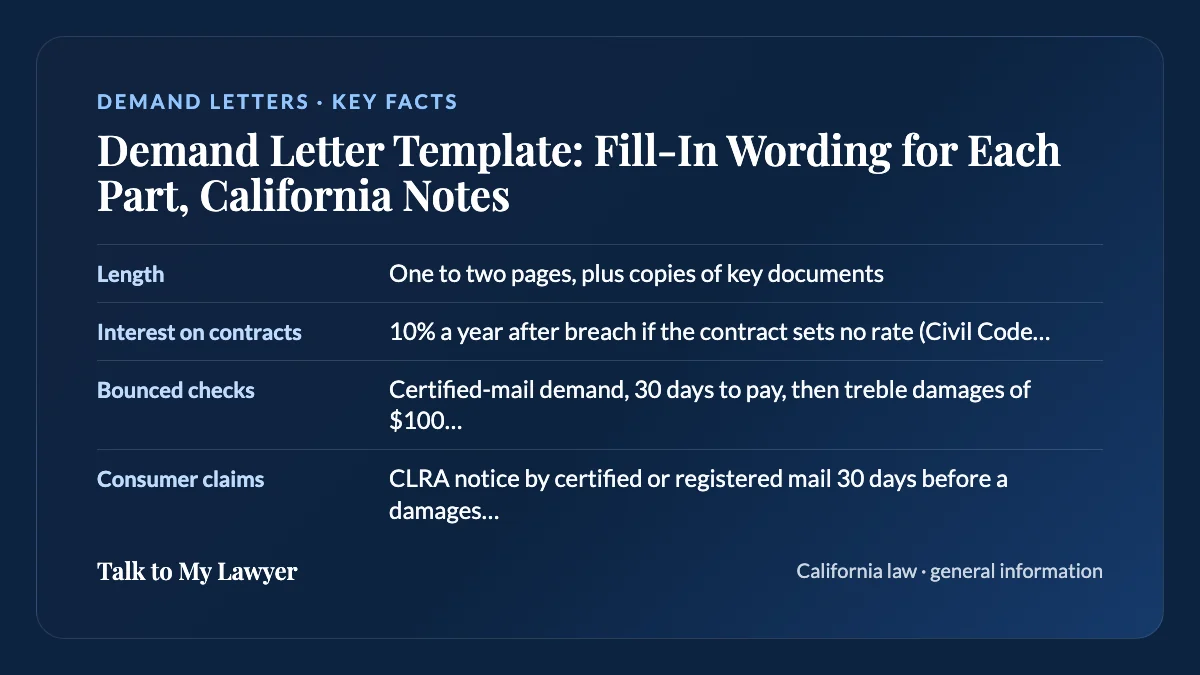
At a glance
- Length
- One to two pages, plus copies of key documents
- Interest on contracts
- 10% a year after breach if the contract sets no rate (Civil Code 3289(b))
- Bounced checks
- Certified-mail demand, 30 days to pay, then treble damages of $100 to $1,500 (Civil Code 1719)
- Consumer claims
- CLRA notice by certified or registered mail 30 days before a damages suit (Civil Code 1782)
- Small claims limit
- $12,500 for individuals, $6,250 for businesses (CCP 116.221, 116.220)
What goes in a demand letter template?
A demand letter template has nine parts, in this order. Each one answers a question the reader will have, and together they fit on one or two pages.
| Part | What it does | Sample wording to adapt |
|---|---|---|
| 1. Your block and date | Shows who is writing and when | [Your name], [mailing address], [email], [phone]. [Date]. |
| 2. Recipient | Names the person or legal entity that owes you | [Full legal name of business, including LLC or Inc.], Attn: [owner or manager], [address] |
| 3. Subject line | Lets anyone sorting mail see the issue | Re: Demand for payment of $[amount], [invoice, loan or order number] |
| 4. Purpose | States the ask in one sentence | I am writing to request payment of $[amount] owed under [agreement] dated [date]. |
| 5. Facts | A short, dated account | On [date], we agreed that [what was promised]. On [date], I [what you did]. [Their failure] occurred on [date]. |
| 6. Basis | Why the money is owed | Under our written agreement, payment was due within [number] days of delivery. [Cite any statute that applies.] |
| 7. Amount and math | Shows how you reached the number | Principal $[x], less payments of $[y], plus [interest or documented costs] of $[z], for a total of $[total]. |
| 8. Deadline and payment | Makes paying easy | Please pay $[total] by [date, 10 to 14 days out] by [check to address, or transfer to account details]. |
| 9. Next step and close | Says what you will consider, calmly | If I do not receive payment by [date], I will consider filing a claim in small claims court. I would prefer to resolve this directly. Sincerely, [name]. |
Below the signature, list each enclosure, such as "Enclosures: invoice 1047, email of March 3 approving the work." Send copies, never originals.
How to fill in the template, step by step
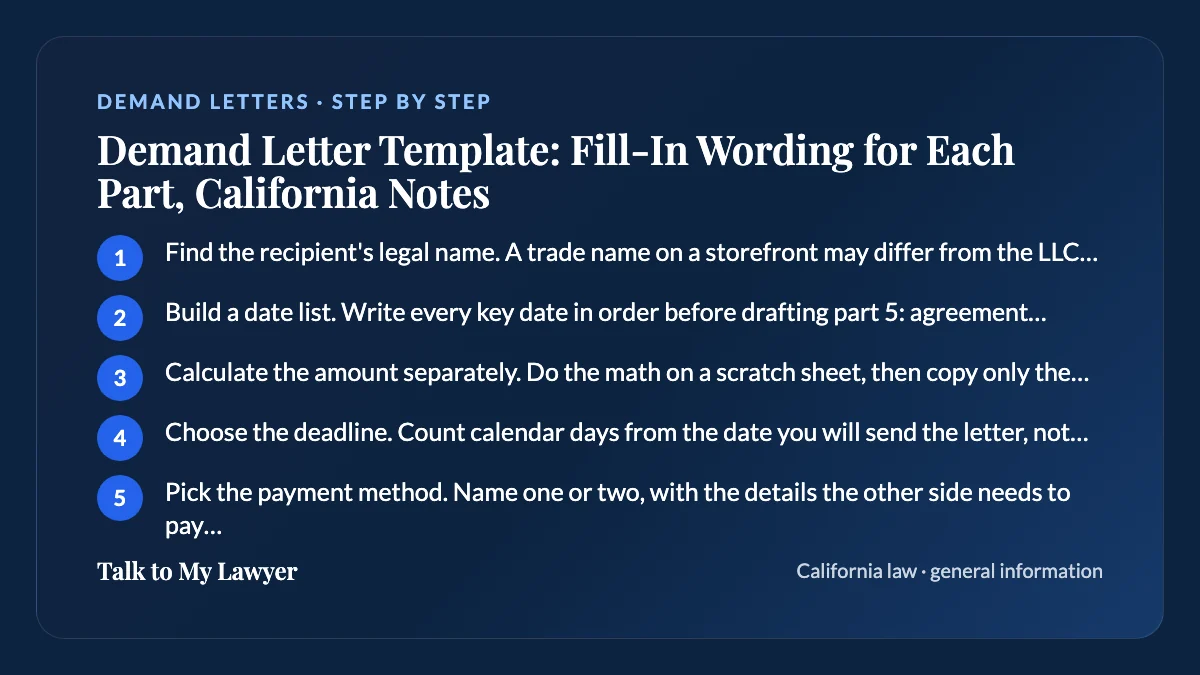
- Find the recipient's legal name. A trade name on a storefront may differ from the LLC that signed your contract. State records can confirm it; this guide to looking up a business's legal name lists the places to check.
- Build a date list. Write every key date in order before drafting part 5: agreement, delivery, due date, each reminder, any partial payment.
- Calculate the amount separately. Do the math on a scratch sheet, then copy only the result and the short breakdown into part 7.
- Choose the deadline. Count calendar days from the date you will send the letter, not from the date you wrote it.
- Pick the payment method. Name one or two, with the details the other side needs to pay you that day.
- Attach the proof. Contract, invoice, receipts, the key texts or emails. Label them so the letter can refer to them.
- Read it aloud. Cut any sentence that argues, insults or guesses at motives.
How should the template change for common California claims?
The nine parts stay the same. What changes is part 6, the legal basis, and sometimes how you must send the letter.
| Claim type | What to add | Rule |
|---|---|---|
| Unpaid invoice or contract | The contract's interest rate, or 10% a year from the date of breach if none is stated | Civil Code 3289 |
| Bounced check | Send by certified mail and state the statute, the check amount and the service charge; the writer then has 30 days to pay | Civil Code 1719 |
| Faulty goods or services bought for personal use | Identify the specific practices and demand a correction, repair, replacement or other remedy; the notice goes by certified or registered mail (return receipt requested) 30 or more days before any suit for damages | Civil Code 1782 (CLRA) |
| Final wages after you quit or were fired | An employer that willfully pays final wages late keeps owing a day's wages as a penalty, capped at 30 days | Labor Code 203 |
| Personal loan to a friend or relative | Describe how the loan was made and repayment terms; note whether anything was in writing | CCP 337 (written) or 339 (oral) for time limits |
For a bounced check, our dedicated guide to a California bounced check demand letter walks through the treble-damages calculation.
Example: the template filled in
Example (hypothetical): a freelance photographer in San Diego shot a product catalog for a skincare company for $3,800 under a signed quote that set no interest rate. Payment was due April 15, 2026. The company paid nothing, and the photographer writes on October 1.
Re: Demand for payment of $3,800, invoice 2026-031. I am writing to request payment of $3,800 owed under the signed quote dated March 2, 2026. I delivered 64 edited catalog images on March 31, and your marketing manager confirmed receipt by email that day. Payment was due April 15. I sent reminders on May 1 and June 12 and have received no payment. Please pay $3,800 by October 15 by check to the address above or by bank transfer using the enclosed details. Because our agreement sets no interest rate, California Civil Code section 3289 provides interest of 10 percent per year after the breach. I will waive that interest if the full $3,800 arrives by October 15. If I do not receive payment, I will consider filing in small claims court.
Notice what is missing: adjectives about the client, threats, and a guess at why they did not pay. The dates and the documents carry the letter.
What does a demand letter template miss?
A template cannot check your facts against the law. Four gaps matter in California:
- Time limits. The filing window is four years for a claim on a written contract (CCP 337) and two years for an oral one (CCP 339). Mailing a letter does not pause either clock.
- The right defendant. Owners, parent companies and franchisees are different legal persons. A letter to the wrong one can waste weeks.
- Special notice rules. Some claims require a particular mailing method, wording or waiting period before suit, as the table above shows. A generic template will not flag them.
- What not to say. Threatening to report someone to the police or to expose a secret unless they pay can cross into extortion under California Penal Code section 519. Keep the next step to lawful civil options.
If small claims court is your planned next step, our small claims demand letter template focuses on the court's pre-filing requirement and form SC-100.
A last check before you send
- The total in the subject line, part 7 and part 8 is the same number.
- Every date matches your documents.
- The deadline is a real calendar date, not "within two weeks."
- The recipient's name matches the legal entity on the contract or state records.
- You kept a signed copy, with proof of mailing or a sent email.
- You would be comfortable with a judge reading every sentence.
The California courts' self-help guide says to request payment before starting a small claims case, in person, by letter or by email. A completed template meets that step and leaves you a dated copy.
When a filled-in template is not enough
A template handles a clean, documented debt well. Some letters need judgment the blanks cannot supply: a claim close to its filing deadline, a dispute where the other side says you breached first, a business with several related companies, or a claim with statutory notice rules such as the CLRA.
Through Talk to My Lawyer, a licensed California attorney writes your letter from your facts and documents (the agreement, the invoices, the reminders you already sent) and sends it on your behalf. For advice on where to file, talk to a lawyer about your facts.
Frequently asked questions
Is there an official California demand letter form?
No. California does not have one required demand letter form for general money claims. The state courts' small claims pages accept a request made face to face, on paper or by email before filing, and they post sample letters for a few situations. Certain claims, such as bounced checks and consumer claims under the CLRA, have their own statutory notice requirements.
How long should a demand letter be?
For a straightforward debt, one to two pages is enough. The reader should be able to find the amount, the reason and the deadline within a minute. Put detail in the enclosures rather than the letter itself: the contract, the invoice, receipts and the key messages. A long letter tends to bury the request.
Can I use a demand letter template for an insurance claim?
You can use the same basic structure, but insurance claims have their own rules about claim numbers, policy language and the insurer's duties to respond. Some formal time-limited settlement demands to insurers are governed by specific statutes. For those, a template built for unpaid invoices or loans is a starting point, not a finished letter.
Should a demand letter template include interest?
Leave a line for it. Where the contract names a rate, use that rate. Where it is silent, the 10 percent annual rate in Civil Code section 3289(b) applies after breach for contracts made after 1985. Write the date interest started and the figure it produces, or offer to drop interest if the principal arrives by your deadline.
Do I have to sign a demand letter?
No rule requires a signature on a private demand letter, but signing it and keeping a signed copy makes the record clearer. Include your printed name, contact details and the date. If you send by email, attach a signed PDF and keep the sent message, which shows when it went out.
Sources
Checked against these official sources on October 18, 2026.
- California Civil Code section 3289 (California Legislative Information)
- California Civil Code section 1719 (California Legislative Information)
- California Civil Code section 1782 (California Legislative Information)
- California Code of Civil Procedure section 337 (California Legislative Information)
- California Penal Code section 519 (California Legislative Information)
- Ask for the money (California Courts Self-Help Guide)
This guide explains California law in general terms as of October 2026. It is general information, not legal advice for your situation, and local rules can add to it.
Join the email list and get a lawyer letter started
With Talk to My Lawyer, a licensed California attorney writes your letter from your facts and documents and sends it on your behalf. Join the Talk to My Lawyer email list for letter checklists, document prompts, and reminders before you start your letter.