Quick answer
A California landlord may not shut off your utilities to force you out. Civil Code section 789.3 bans that, along with changing the locks, removing doors or windows, and taking your belongings. A court can award actual damages plus up to $100 for each day or part of a day the violation lasts (at least $250 per cause of action), and attorney's fees to the prevailing party.
At a glance
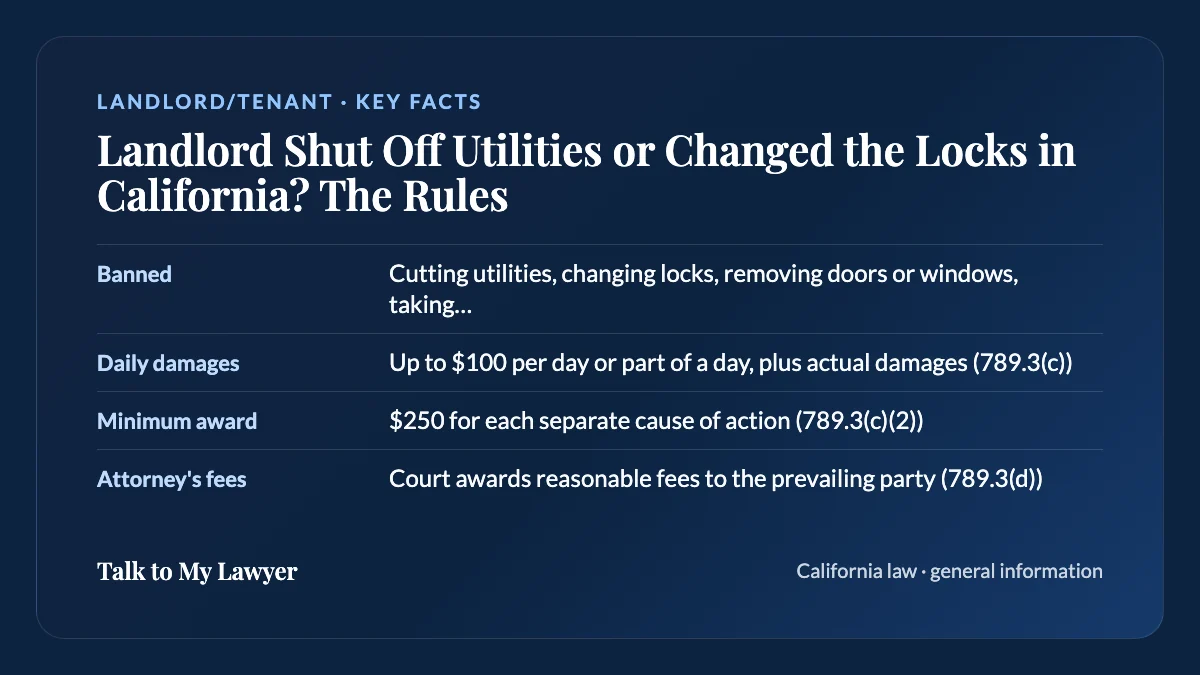
- Banned
- Cutting utilities, changing locks, removing doors or windows, taking belongings (Civ. Code 789.3)
- Daily damages
- Up to $100 per day or part of a day, plus actual damages (789.3(c))
- Minimum award
- $250 for each separate cause of action (789.3(c)(2))
- Attorney's fees
- Court awards reasonable fees to the prevailing party (789.3(d))
- Lawful removal
- Only after a court judgment, carried out by the sheriff
Can a California landlord shut off utilities or lock you out?
No. Civil Code section 789.3 makes it unlawful for a landlord, acting with intent to end your occupancy, to willfully cause the interruption or termination of any utility service furnished to you. The statute names water, heat, light, electricity, gas, telephone, elevator and refrigeration, and says the list is not exhaustive.
Two details make the rule wider than it first looks. It covers shutoffs the landlord causes directly or indirectly, and it applies whether or not the utility service is under the landlord's control. A landlord who calls the gas company to close an account in the landlord's name, or who simply stops paying a bill on purpose to push you out, can fall within it.
The same section bars a landlord, with the same intent, from willfully doing any of these:
- Keeping you out by changing the locks, using a bootlock, or any similar method or device.
- Removing outside doors or windows.
- Removing your personal property, furnishings or other items without your prior written consent, unless the landlord follows the abandoned-property procedure that starts at Civil Code section 1980.
Why a lockout is not an eviction
California gives landlords one route to remove a tenant: a court case called an unlawful detainer. Section 789.3 says plainly that it does not prevent a lawful eviction by appropriate legal authorities. What it forbids is the shortcut.
| Court eviction | Self-help eviction |
|---|---|
| Starts with a written notice to the tenant | Starts with a dead outlet, a dry tap or a new lock |
| Landlord files an unlawful detainer case and the tenant can respond | No case, no hearing, no chance to answer |
| Judge decides who gets possession | Landlord decides alone |
| Landlord gets a Writ of Execution (form EJ-130) and takes it to the sheriff | No writ, no sheriff |
| Sheriff serves a Notice to Vacate giving 5 days, then removes the tenant if needed | Tenant is shut out at once |
The California Courts self-help guide describes the end of a lawful eviction this way: after the landlord wins, the sheriff gives the tenant 5 days to move, and only then comes back to remove them and lock them out. A landlord who jumps straight to that last step, with no judgment and no sheriff, is doing exactly what section 789.3 forbids.
How much can you recover when a landlord shuts off utilities?
A landlord who violates section 789.3 is liable in a civil action for your actual damages plus a statutory amount of up to $100 for each day or part of a day the violation continues. The court decides the daily figure, but it may not award less than $250 for each separate cause of action.
- Actual damages can include a motel bill, spoiled food, a lost work shift or replacement of property that was taken.
- Repeat violations that happen later, not at the same time as the first one, count as separate causes of action with their own award.
- Attorney's fees go to the prevailing party, which means either side. A tenant who sues and loses can be ordered to pay the landlord's fees.
- Injunctive relief: while the case is pending, you may ask the court for an order to stop the violation from continuing.
- Other remedies stay open. The statute says its remedy is not exclusive.
Example (hypothetical): a landlord cuts the water to a rented duplex unit on a Friday and restores it the following Wednesday morning. Friday through Wednesday is six days or parts of days, so for that one shutoff the court could award up to $600 in statutory damages, and no less than $250, plus the tenant's documented costs, such as $340 for two nights in a motel and $90 in spoiled groceries.
Some of the same conduct can also fall under Civil Code section 1940.2. It bars a landlord, for the purpose of pushing a tenant out, from using or threatening force, willful threats or menacing conduct that interferes with quiet enjoyment, among other acts, and a tenant who wins is entitled to a civil penalty of up to $2,000 for each violation. Our guide to landlord harassment and how to answer it in writing covers that statute in detail.
What if the power is cut because the landlord stopped paying the bill?
Public Utilities Code section 777 gives tenants a separate safety net. It applies when an electrical, gas, heat or water corporation supplies individually metered service to a house, apartment building or mobilehome park and the landlord is the customer of record. If that account falls behind, the utility must make every good-faith effort to tell the residents in writing, at least 10 days before termination, that service will be cut.
The notice must also tell residents they have the right to become customers themselves without paying the landlord's overdue balance. For a detached single-family home, the utility may give 7 days' notice instead and may ask you to show that the delinquent customer was the landlord, using a lease, rent receipts or similar records.
If you take over the account for a service your rent already covers, and the rent does not state the utility charges separately, section 777 lets you deduct from each rent payment the reasonable charges you paid the utility for that service during the previous payment period. Keep every bill and receipt. Section 777 is written for utility corporations; if a city or district runs your water or power, ask it which notice rules apply.
What to do in the first hours of a lockout or shutoff
Evidence fades quickly in these cases, because service may come back and the landlord later says it never went off. These practical steps build a record:
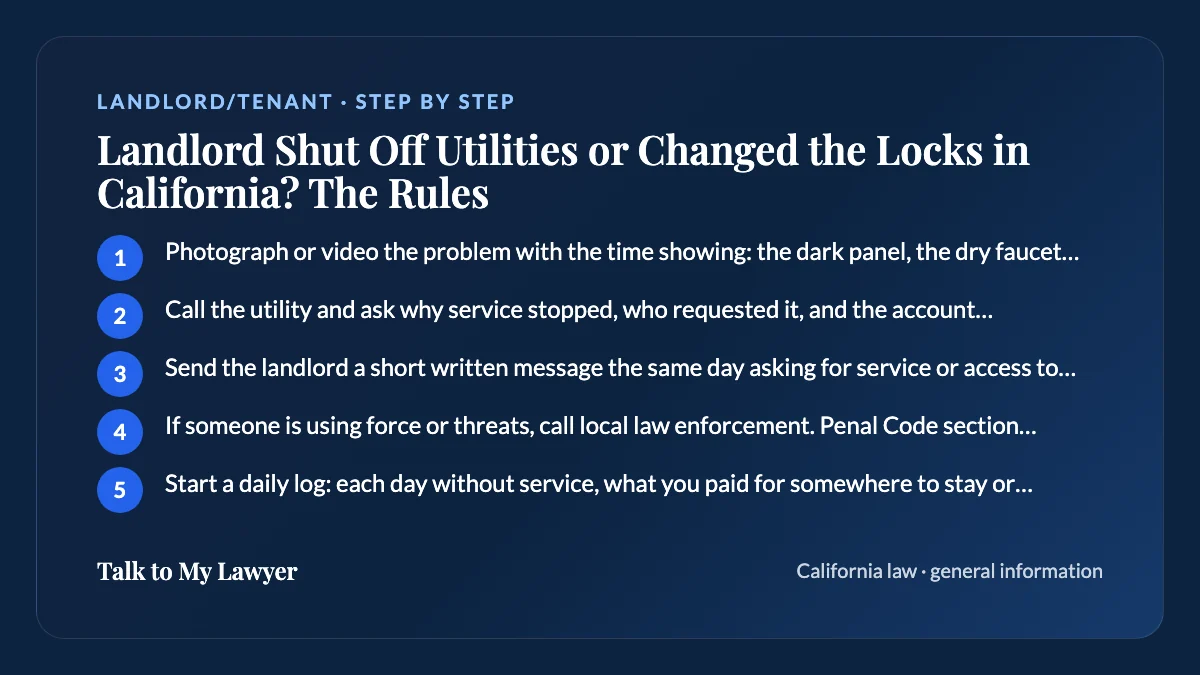
- Photograph or video the problem with the time showing: the dark panel, the dry faucet, the new lock, the missing door, the empty room.
- Call the utility and ask why service stopped, who requested it, and the account holder's name. Write down the time and the representative's name.
- Send the landlord a short written message the same day asking for service or access to be restored, and keep the reply or the silence.
- If someone is using force or threats, call local law enforcement. Penal Code section 418 makes it a misdemeanor to use force or violence to enter or hold another person's lands or possessions except as the law allows.
- Start a daily log: each day without service, what you paid for somewhere to stay or eat, and work you missed.
- Keep receipts for every cost, and talk to a lawyer or legal aid office about asking a court for an emergency order if the problem continues.
When section 789.3 may not apply
The statute turns on intent to end your occupancy. A planned shutoff for a repair, announced in advance and restored when the work is done, is a different situation, though it may raise other habitability questions.
- The lockout provisions do not apply to the occupancies described in Civil Code section 1940(b), which covers certain transient hotel and motel stays.
- A landlord may remove property left behind by following the abandoned-property procedure in Civil Code sections 1980 and following.
- Nothing in the section stops a sheriff from carrying out a court-ordered eviction.
Some cities add their own anti-harassment rules, so check local law where you live. If the landlord has also been letting themselves in, our guide to entry without notice and a written boundary letter explains Civil Code section 1954.
What a demand letter to restore utilities or access should say
Short and dated works best here. The letter has one urgent job (getting service or access back) and one record-keeping job (fixing the dates for any later claim).
- The unit address and the date and time the service stopped or the lock changed.
- What you have done so far: calls to the utility, messages to the landlord.
- A citation to Civil Code section 789.3 and a request to restore service or access immediately.
- A request to return any property taken, listed item by item.
- A note that daily statutory damages continue while the violation lasts, and that you are keeping receipts.
At about 7:30 a.m. on March 4, the water to 22 Ridge Court, Unit B, was shut off at the valve on the side of the building. The water company confirmed my account is current. Under California Civil Code section 789.3, cutting off a tenant's utilities to end a tenancy is unlawful. Please restore water service today. I am keeping a record of each day without water and of the costs it causes me.
When an attorney's letter about a lockout makes sense
A water shutoff fixed the same afternoon, with an apology, may need nothing more than your own dated message. A landlord who changes the locks again, keeps your belongings, or ignores a written request while the daily damages add up is a different matter, and so is any case where you plan to ask a court for an order.
Through Talk to My Lawyer, a licensed California attorney writes your letter from your photos, log and receipts, cites section 789.3 and any other statute that fits your facts, and sends it on your behalf. If you are locked out tonight, talk to a lawyer or legal aid office about emergency options for your situation.
Frequently asked questions
Can a landlord turn off the water for unpaid rent in California?
No. Unpaid rent does not give a landlord the right to cut utilities. A willful interruption of water or any other utility, done with intent to end the tenancy, is exactly what Civil Code section 789.3 forbids. A landlord who wants possession for unpaid rent must serve the proper notice and win an unlawful detainer case in court, and only the sheriff can carry out the removal.
Is a landlord lockout a crime in California?
Section 789.3 itself is a civil statute that gives tenants a right to sue. Separately, Penal Code section 418 makes it a misdemeanor to use force or violence to enter or keep possession of another person's lands or possessions except as the law allows. Whether a particular lockout is a crime depends on the facts, so ask law enforcement or a lawyer.
Can my landlord remove my belongings after changing the locks?
Not without your prior written consent, unless the landlord follows the abandoned-property procedure in Civil Code sections 1980 and following. Section 789.3 lists removing a tenant's personal property, furnishings or other items as one of the banned ways to force a tenant out. Write down every item taken and its value, and ask for its return in writing.
Can I sue for an illegal utility shutoff in small claims court?
A money claim for actual damages and the statutory daily amount can be brought in small claims court if the total is within the limit, which is $12,500 for an individual under Code of Civil Procedure section 116.221. If you need an order to get service turned back on quickly, ask a lawyer which court and procedure fit your situation.
Does the $100 a day apply to each utility separately?
The statute sets an amount of up to $100 for each day the landlord remains in violation, with at least $250 for each separate cause of action. Later violations that are not committed at the same time as the first are treated as separate causes of action. How a court counts several utilities cut at once is a question to ask a lawyer about your facts.
Sources
Checked against these official sources on October 18, 2026.
- California Civil Code section 789.3 (California Legislative Information)
- California Civil Code section 1940.2 (California Legislative Information)
- California Penal Code section 418 (California Legislative Information)
- California Public Utilities Code section 777 (California Legislative Information)
- After the eviction trial decision (California Courts Self-Help Guide)
- California Civil Code section 1940 (California Legislative Information)
This guide explains California law in general terms as of October 2026. It is general information, not legal advice for your situation, and local rules can add to it.
Join the email list and get a lawyer letter started
With Talk to My Lawyer, a licensed California attorney writes your letter from your facts and documents and sends it on your behalf. Join the Talk to My Lawyer email list for letter checklists, document prompts, and reminders before you start your letter.