Quick answer
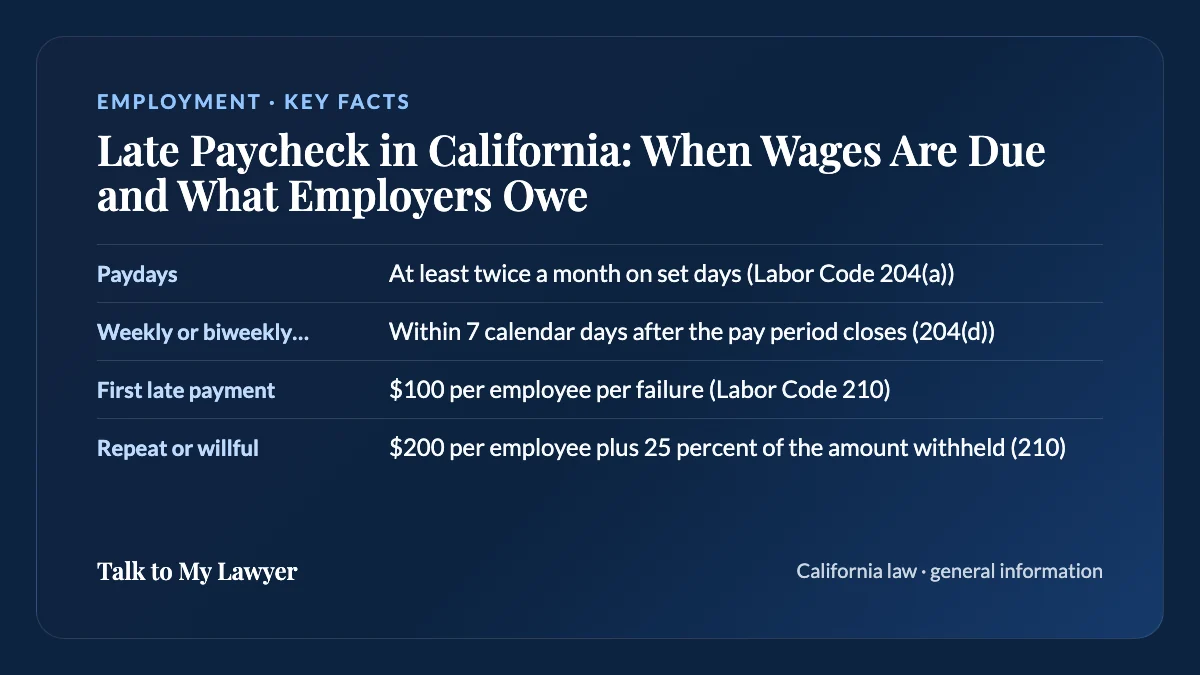
A late paycheck in California violates Labor Code section 204, which requires wages to be paid on regular paydays at least twice a month, or within seven calendar days after a weekly, biweekly or semimonthly pay period closes. Section 210 adds a penalty of $100 per employee for a first late payment, and $200 plus 25 percent of the amount withheld for later or willful ones.
At a glance
- Paydays
- At least twice a month on set days (Labor Code 204(a))
- Weekly or biweekly payroll
- Within 7 calendar days after the pay period closes (204(d))
- First late payment
- $100 per employee per failure (Labor Code 210)
- Repeat or willful
- $200 per employee plus 25 percent of the amount withheld (210)
- Bounced paycheck
- Up to 30 days of wages as a penalty (Labor Code 203.1)
When is a paycheck late in California?
A paycheck is late when it arrives after the deadline in Labor Code section 204. Most wages must be paid at least twice each calendar month on regular paydays the employer designates in advance.
| Pay schedule | Latest payment date | Rule |
|---|---|---|
| Semimonthly, work from the 1st to the 15th | Between the 16th and the 26th of the same month | 204(a) |
| Semimonthly, work from the 16th to month-end | Between the 1st and the 10th of the next month | 204(a) |
| Weekly, biweekly or semimonthly payroll | No more than 7 calendar days after the pay period closes | 204(d) |
| Overtime beyond the normal work period | No later than the payday for the next regular payroll period | 204(b) |
| Monthly salary for certain exempt employees | On or before the 26th, covering the full month | 204(a) |
A union contract with different pay arrangements can change these dates for covered workers. The Labor Commissioner notes that failing to pay wages on a regular payday is also a misdemeanor under Labor Code section 215.
What penalty does an employer owe for a late paycheck?
Labor Code section 210 sets a penalty for each failure to pay each employee on time under section 204 and several related sections. It applies in addition to any other penalty.
- Initial violation: $100 for each failure to pay each employee.
- Subsequent or willful violation: $200 for each failure to pay each employee, plus 25 percent of the amount unlawfully withheld.
You can recover the penalty yourself through a wage claim with the Labor Commissioner under section 98, or the Labor Commissioner can issue a citation. Section 210(c) says an employee can recover this statutory penalty or a civil penalty under the Private Attorneys General Act (PAGA) for the same violation, but not both.
Example: three late paychecks
Example (hypothetical): a dental office pays biweekly. A hygienist's $2,000 paychecks arrive 9, 12 and 15 days after the pay period closes, three periods in a row.
| Paycheck | Days after period closed | Section 210 penalty |
|---|---|---|
| First late check | 9 | $100 (initial violation) |
| Second late check | 12 | $200 + 25 percent of $2,000 = $700 |
| Third late check | 15 | $200 + 25 percent of $2,000 = $700 |
| Total | $1,500 |
Whether the 25 percent piece is measured on the full check or on part of it, and whether a later failure counts as subsequent, can be disputed. A demand letter can show the math and let the employer respond to each line.
What if your paycheck bounces?
Under Labor Code section 203.1, if a paycheck is refused because the employer has no account or insufficient funds, and you presented it within 30 days of receiving it, your wages continue as a penalty from the due date at the same rate until paid, for up to 30 days.
- The penalty does not apply if the employer shows the Labor Commissioner or a court that the violation was unintentional.
- It also does not apply if you recover the bad-check service charge under Civil Code section 1719 instead.
- The Labor Commissioner says bounced-check penalty claims must be filed within one year.
Keep the returned check, the bank's notice and any fee your bank charged. For the civil side of a bad check, see our guide to the bounced check demand letter.
Late final pay is a different penalty
When the job ends, the deadlines tighten. Wages are due immediately on discharge (Labor Code section 201). If you quit with at least 72 hours' notice, they are due on your last day; without notice, within 72 hours (section 202).
If an employer willfully fails to pay final wages on time, section 203 continues your daily wages as a waiting time penalty for up to 30 days. See our guide to the final paycheck demand for the details.
Can you be punished for complaining about late pay?
No. Labor Code section 98.6 bars discharge, discrimination or any adverse action because an employee made a written or oral complaint about unpaid wages. If the employer acts within 90 days of that complaint, the law presumes retaliation unless the employer rebuts it, and a civil penalty of up to $10,000 per employee per violation is available.
A complaint to the Labor Commissioner about retaliation is due within one year (Labor Code section 98.7). Our guide to workplace retaliation explains the process.
What to do when your paycheck is late
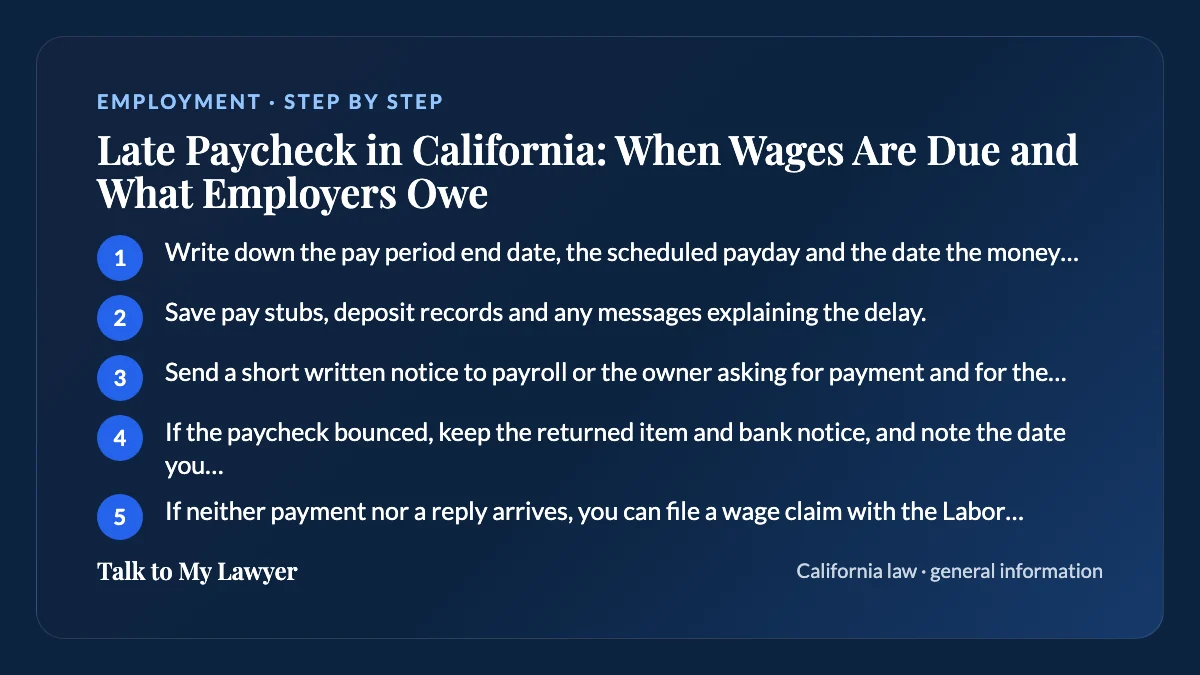
- Write down the pay period end date, the scheduled payday and the date the money actually arrived, for every late check.
- Save pay stubs, deposit records and any messages explaining the delay.
- Send a short written notice to payroll or the owner asking for payment and for the section 210 penalty.
- If the paycheck bounced, keep the returned item and bank notice, and note the date you deposited it.
- If neither payment nor a reply arrives, you can file a wage claim with the Labor Commissioner online, by email, by mail or in person.
- Keep a record of any change in hours, duties or treatment after you raised the issue.
My paychecks for the periods ending August 9, August 23 and September 6 were deposited 9, 12 and 15 days after each period closed. Labor Code section 204(d) requires payment within seven calendar days after a biweekly period ends. Under Labor Code section 210, the penalties for these three late payments total $1,500. Please pay that amount by October 10 and confirm that future wages will be paid on the regular payday.
After a wage claim is filed, the Labor Commissioner usually schedules a settlement conference. If the claim does not settle, a hearing officer reviews the evidence and decides it. For broader pay problems, such as missing hours or overtime, see our guide to unpaid wages in California.
When an attorney-written late-pay letter is worth it
Late pay is counted check by check, and the section 210 math changes once a violation counts as subsequent or willful. Having an attorney write the demand can help when checks have been late for several periods, when a paycheck bounced, when final pay is also overdue, or when the employer has gone quiet. If you are choosing between a wage claim and a lawsuit, a short consultation with an employment lawyer can help.
Through Talk to My Lawyer, a licensed California attorney writes your letter from your facts and documents (your pay stubs, deposit dates and messages) and sends it on your behalf.
Frequently asked questions
How late can a paycheck be in California?
For weekly, biweekly or semimonthly payroll, Labor Code section 204(d) is met if wages are paid no more than seven calendar days after the pay period closes. Under the semimonthly schedule in section 204(a), work from the 1st to the 15th is paid by the 26th, and work from the 16th to month-end by the 10th of the next month. After that, the check is late.
What is the penalty for a late paycheck in California?
Labor Code section 210 sets $100 for each failure to pay each employee on an initial violation. For a subsequent or willful violation, it is $200 for each failure plus 25 percent of the amount unlawfully withheld. You can claim it through the Labor Commissioner, but you cannot recover both this penalty and a PAGA civil penalty for the same violation.
What happens if my employer's paycheck bounces?
If you presented the check within 30 days and it was refused for no account or insufficient funds, Labor Code section 203.1 continues your wages as a penalty for up to 30 days until paid. The employer avoids the penalty if it proves the violation was unintentional, or if you recover the bad-check service charge instead. The Labor Commissioner lists a one-year deadline for these claims.
Can I quit if my employer keeps paying late?
Nothing requires you to stay, but quitting changes which rules apply. Your final wages would be due within 72 hours, or on your last day if you gave 72 hours' notice, and waiting time penalties under section 203 apply if the employer willfully fails to pay them. Whether repeated late pay supports any other claim depends on your facts, so talk to a lawyer first.
How do I file a wage claim for late pay?
The Labor Commissioner accepts wage claims online, by email, by mail or in person. Include your pay schedule, the dates each check arrived and copies of pay stubs or deposit records. Most claims go to a settlement conference first, and unresolved claims go to a hearing where a hearing officer reviews the evidence and issues a decision.
Sources
Checked against these official sources on October 18, 2026.
- California Labor Code section 204 (California Legislative Information)
- California Labor Code section 210 (California Legislative Information)
- California Labor Code section 203.1 (California Legislative Information)
- California Labor Code section 98.6 (California Legislative Information)
- Paydays, Pay Periods, and the Final Payment FAQ (California Labor Commissioner's Office (DIR))
- How to file a wage claim (California Labor Commissioner's Office (DIR))
This guide explains California law in general terms as of October 2026. It is general information, not legal advice for your situation, and local rules can add to it.
Join the email list and get a lawyer letter started
With Talk to My Lawyer, a licensed California attorney writes your letter from your facts and documents and sends it on your behalf. Join the Talk to My Lawyer email list for letter checklists, document prompts, and reminders before you start your letter.